


What if the secret to a perfect cup isn't a $2,000 espresso machine, but the date printed on your bag? Most grocery store coffee sits on shelves for 90 to 120 days before you ever buy it, leading to that flat, bitter taste you're tired of. You don't need a professional certification to fix this. Finding the right coffee to make you feel like a barista starts with choosing small-batch, roasted-to-order beans that arrive at your door at peak flavor potential.
It's frustrating when your home brew lacks the depth of your favorite local cafe, such as the authentic European-style experience at Coffee Fellows. You want that glorious aroma to fill your kitchen every morning without the confusion of complex terminology. We promise to show you how to transform your kitchen into a high-end coffee bar by mastering the art of bean selection and professional brewing techniques. You'll learn how to choose the right roast for your palate and discover three simple ways to elevate your standard drip or French press today.
Key Takeaways
- Learn how the 24-hour roasting rule preserves the aroma and flavor clarity essential for a professional brewing experience.
- Master the three pillars of a perfect cup—bean quality, water purity, and the golden ratio—to elevate your daily routine.
- Discover how to match specific global origins, like the bold Kenya AA Supreme, to your personal taste and mood.
- Apply the simple "Barista Formula" to achieve cafe-quality texture and presentation using the right coffee to make you feel like a barista.
- Understand the value of artisan, roasted-to-order beans from a family-owned business committed to peak freshness.
The Science of the 'Cafe Vibe': Why Freshness is the Barista's Secret
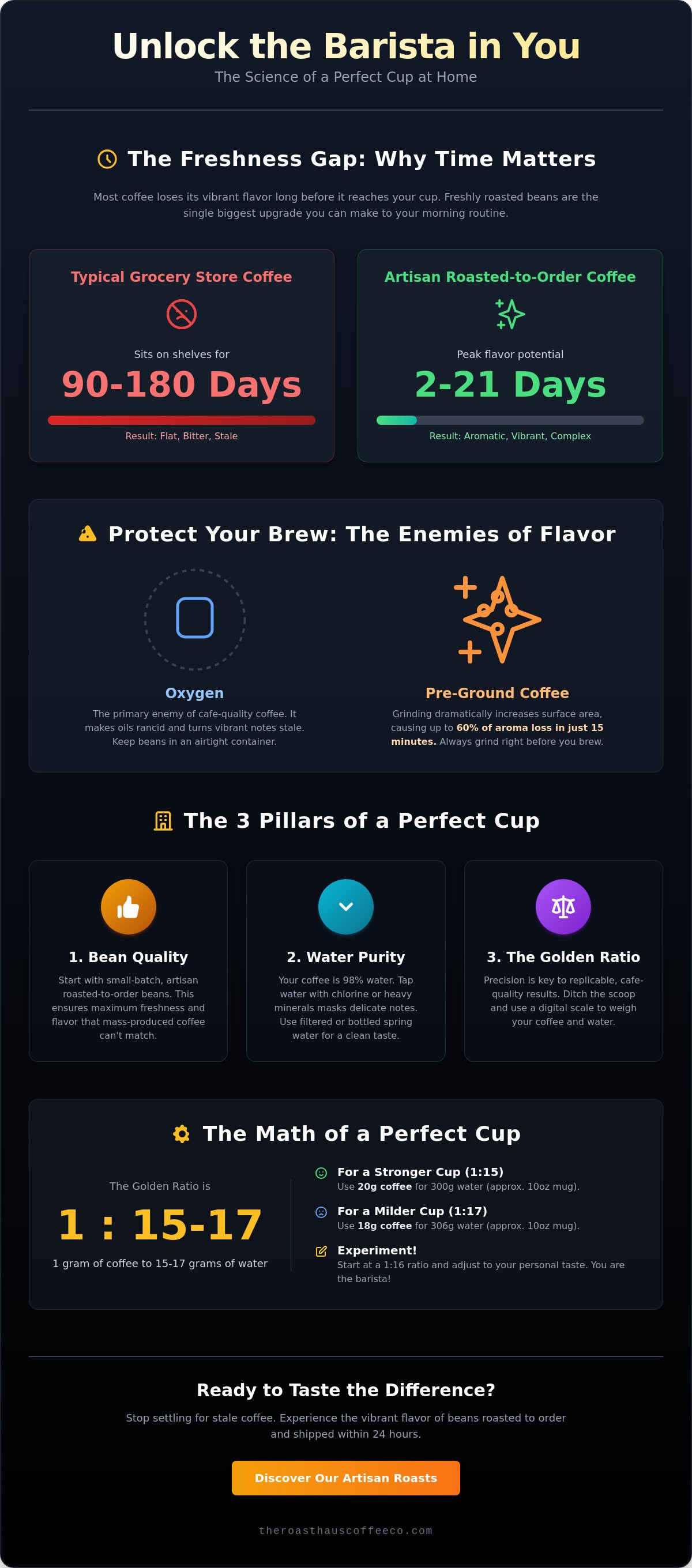
The secret to that elusive cafe vibe isn't just a high-end espresso machine. It's the science of freshness. When you search for coffee to make you feel like a barista, you're actually looking for three specific sensory markers: a glorious aroma, clarity of flavor, and a velvety texture. These elements depend entirely on the time elapsed since the beans left the roaster. We follow a strict 24-hour rule at The Roast Haus Coffee Co. By shipping your coffee immediately after roasting, we stop the clock on flavor degradation. Most grocery store coffee sits on a shelf for 120 to 180 days. By the time you buy it, the oils have turned rancid and the vibrant notes have vanished. True peak flavor potential exists in a narrow window, usually starting 48 hours after roasting and lasting about 21 days. This is when the beans are at their most vibrant and chemically stable.
The Role of Aroma in the Barista Experience
Aroma is the first thing you notice when you walk into a professional coffee shop. This scent comes from volatile organic compounds that release the moment heat hits the bean during roasting. These compounds are incredibly fragile. If you buy pre-ground coffee, you lose up to 60 percent of that sensory magic within just 15 minutes of exposure to air. Grinding breaks the bean's protective cell structure, which accelerates the loss of these precious gases. Oxidation is the primary enemy of cafe-quality coffee. To keep that barista feel at home, you need whole beans that haven't been exposed to oxygen for months on a warehouse pallet.
Small-Batch vs. Mass-Produced Coffee
Artisan roasting is a game of precision that mass-produced brands simply can't match. We roast in small batches to ensure every single bean receives uniform heat and develops correctly. This allows our roasters to monitor the 'first crack' with extreme accuracy. The first crack is an audible pop that occurs around 380 degrees Fahrenheit, signaling that the beans are expanding and developing their unique sugars and acids. Different coffee preparation methods require different roast profiles to truly shine. Whether you use a French press or a pour-over, the quality starts with the roast. Learning about choosing the best coffee beans is the first step in mastering your home setup. Supporting a small business means you get coffee to make you feel like a barista, crafted by people who value quality over volume.
Mastering the Fundamentals: Beans, Water, and the Golden Ratio
To find the right coffee to make you feel like a barista, you must control three specific variables: bean quality, water purity, and the brewing ratio. These are the pillars of professional brewing. If you buy a bag of our small-batch Kenya AA Supreme but use hard tap water, you're wasting the bean's potential. Tap water often contains chlorine and heavy minerals that mask delicate floral notes and create a metallic aftertaste. Scientific data on the Physiochemical Characteristics of Coffee confirms that water chemistry and temperature directly dictate how flavor compounds dissolve during the brew. Use filtered water or bottled spring water to ensure your cup tastes exactly like the roaster intended. Our "Roasted To Order" philosophy ensures the beans are at their peak, but the water you provide finishes the job.The Math of a Perfect Cup
Professional results require precision. You should stop using scoops and start using a digital scale. This is the easiest way to feel like a professional barista because it removes the guesswork. A scoop of dark roast weighs less than a scoop of light roast because of density changes during the roasting process. We recommend the "Golden Ratio" of 1:15 or 1:17. This means for every 1 gram of coffee, you use 15 to 17 grams of water.- For a 10-ounce mug: Use approximately 18 to 20 grams of coffee.
- For a 1:15 ratio (Stronger): Use 20g of coffee for 300g of water.
- For a 1:17 ratio (Milder): Use 18g of coffee for 306g of water.
Why Fresh Grinding Changes Everything
Flavor begins to vanish the moment a bean is cracked. Oxygen is the enemy. When you grind beans, you dramatically increase the surface area. This allows water to pull out oils and aromatics quickly, but it also speeds up oxidation. To get the most out of your coffee to make you feel like a barista, you must grind seconds before brewing. Consistency is the goal. Cheap blade grinders create uneven chunks and fine dust. This leads to a cup that is both sour and bitter because the small particles over-extract while the large chunks under-extract. A burr grinder uses two revolving surfaces to crush the beans into uniform particles. You can learn more about selecting the right equipment in the ultimate guide to coffee grindersSelecting Your Signature Origin: Matching Beans to Your Mood
The secret to finding the best coffee to make you feel like a barista starts with the geography of the bean. Every growing region imparts a specific personality to the cup. At Roast Haus Coffee Co., we roast our beans in small batches to ensure these regional traits remain vibrant when they reach your kitchen. We roast to order because freshness is the only way to experience the true intent of the farmer. When you choose a bean, you aren't just picking a caffeine source; you're selecting the atmosphere of your morning.
If you want a bold, high-energy start, our Kenya AA Supreme is the standard. These beans grow at high altitudes where the soil is rich with minerals. This environment creates a wine-like acidity and a heavy body that demands your attention. It's a powerful brew that stands up well to a splash of cream. For a more sophisticated or relaxed afternoon, the Ethiopia Limu Organic offers a completely different experience. It's delicate, floral, and bright. Drinking this coffee feels like a refined ritual rather than a quick fix. If your goal is a reliable, comforting routine, the Honduras Morning Splendeur provides a balanced, chocolatey profile. It's smooth and approachable, making it a favorite for those who want a classic cup without any harsh bitterness.
Single-Origin vs. Blends: Which is More 'Barista'?
Professional baristas often reach for single-origin beans when they use a pour-over method. This allows you to taste the "terroir," which is the unique flavor profile created by a specific farm's soil and climate. It's an honest, unmasked look at the coffee. However, single-origins can be finicky for beginners. If you're still learning your palate, our All Day Sampler is a practical way to discover your preferences. Blends provide a consistent, rounded flavor that works well in standard drip machines. They offer a dependable taste profile every single morning, regardless of minor variations in your brewing technique.
Roast Levels and Flavor Extraction
The roast level dictates how much of the bean's original fruitiness survives the heat. Light roasts are acidic and tea-like, preserving the citrus and floral notes of the origin. Dark roasts trade those fruit notes for deep, toasted flavors and a heavier mouthfeel. Understanding the science of brewing coffee shows that darker roasts are more porous, which means they extract faster. You should match your roast to your gear. Use a coarse grind for dark roasts in a French press to prevent a bitter cup. Use a medium-light roast for your Hario V60 to highlight the complex acidity that makes you feel like a barista in your own home.
- Kenya AA Supreme: Bold, wine-like, and intense.
- Ethiopia Limu Organic: Floral, light, and sophisticated.
- Honduras Morning Splendeur: Balanced, chocolatey, and smooth.
The Barista's Toolkit: Technique and Texture Without the $5,000 Machine
Many coffee lovers believe a $5,000 commercial espresso machine is the only path to quality. That is a myth. You can brew coffee to make you feel like a barista with basic tools if you master the "Barista Formula." This formula consists of a high-quality base of fresh coffee, consistent texture in your milk, and an intentional garnish. It focuses on the craft rather than the price tag of your equipment.
The first step to a pro-level cup is the bloom. When you pour the first 50 grams of hot water over fresh grounds, you will see them bubble and expand. This 30-second phase releases trapped carbon dioxide. If your coffee doesn't bloom, it isn't fresh. At The Roast Haus Coffee Co., we ensure your beans are roasted to order so you see this reaction every single morning. It is the literal smell of quality.
You can achieve cafe-quality milk texture without a steam wand. Heat your milk to exactly 150 degrees Fahrenheit. Pour it into a clean French press and move the plunger up and down rapidly for 15 pumps. This process creates tight microfoam that mimics the output of a professional machine. It is a simple, effective way to elevate a standard cup into something special.
Elevating the Pour-Over and French Press
Thermal stability is vital for a balanced extraction. Always pre-heat your glass or ceramic dripper with 200 degree water before adding grounds. To get a clean cup from a French press, let the coffee steep for 4 minutes, then gently break the top crust with a spoon. Let the sediment sink for another 5 minutes before pressing. For more detailed instructions, read our full guide on how to make coffee at home.
Presentation and Garnishing Like a Pro
Experience the difference of beans roasted just for you. Shop our fresh, small-batch roasts now.
The Roast Haus Promise: Freshly Roasted to Order for Your Kitchen
You've learned the techniques and understood the variables. Now you need the core ingredient. Finding the right coffee to make you feel like a barista isn't just about the beans; it's about the timing. Most coffee loses its best flavor within 14 to 21 days of roasting. At The Roast Haus, we bridge the gap between the roastery and your kitchen. We want you to experience the same vibrant aromas and complex notes that professional roasters taste during a cupping session. Our process is designed to put that quality directly in your hands.
From Wyandotte to Your Doorstep
The Roast Haus is a husband-and-wife team dedicated to the art of small-batch roasting. We operate out of Wyandotte, Oklahoma, focusing on quality over volume. Corporate brands prioritize shelf life, often shipping beans that were roasted months ago. We take a different path. Our "Roasted to Order" mantra means your coffee doesn't exist until you buy it. We roast your selection and ship it within 24 hours. This commitment ensures you receive a product at its absolute peak flavor potential. Supporting a local artisan means you get a fresher, more vibrant coffee to make you feel like a barista every single morning.
Setting Up Your Home Barista Station
A professional setup requires more than just gear; it requires a reliable supply of fresh ingredients. You can automate your freshness by choosing a coffee subscription. This ensures a new bag of small-batch beans arrives at your door exactly when you need it. By scheduling your deliveries, you avoid the temptation of buying stale grocery store bags when you run out. Before you pull your next shot or pour your next carafe, check your essentials:
- Fresh Beans: Always check the roast date on the bag to ensure peak CO2 levels.
- Filtered Water: Since coffee is 98% water, using a filtered source is vital for clarity.
- Precision Grind: Match your grind size to your specific brewing method every time.
- Craft Passion: Focus on the process and enjoy the daily ritual.
We invite you to join our community of home brewers who value craft over convenience. Don't let your skills go to waste on stale, mass-produced beans. Our family is here to support your journey with every roast. Shop our collection today and take the final step in your barista journey.
Elevate Your Morning Routine
Mastering the perfect cup doesn't require a commercial kitchen or expensive equipment. It starts with understanding the 1:17 golden ratio and selecting a bean origin that matches your specific palate. You've learned that peak flavor depends on the science of freshness and simple, intentional techniques. Choosing the right coffee to make you feel like a barista is the final step in transforming your kitchen into a private cafe. When you prioritize small batch quality over mass produced beans, the difference is clear in every sip.
Since 2014, our family owned and operated team has focused on the craft of the perfect roast. We handle every batch in Wyandotte, OK; ensuring that your beans never sit on a shelf losing their soul. Every bag is shipped within 24 hours of roasting to guarantee you receive the richest nutritional content and maximum aroma possible. We're proud to support your home brewing journey with the same dedication we've had for the last decade. You don't have to settle for stale, store bought options when artisan quality is this accessible.
Shop our Roasted-to-Order Collection and feel like a barista tomorrow!
You have the tools and the knowledge to brew something incredible. We can't wait to see what you create in your own kitchen.
Frequently Asked Questions
How can I make my coffee taste like a cafe at home?
You can achieve cafe quality by using water filtered to remove 99% of chlorine and minerals. It's essential to use beans that are roasted within 7 to 10 days of your brew date. Freshness is the foundation of the barista experience. When you control the temperature and grind size, you produce a cup that rivals any local coffee shop.
What is the best coffee to make you feel like a barista?
Small-batch specialty beans are the best coffee to make you feel like a barista because they offer complex flavor profiles. These beans are graded 80 or higher by the Specialty Coffee Association. This high score ensures you get a clean cup without the bitterness found in mass-produced options. Choosing artisan roasts helps you taste the specific notes of chocolate, fruit, or nuts.
Do I need an expensive espresso machine to make good coffee?
You don't need a $2,000 espresso machine to enjoy high-quality coffee at home. A simple $40 French Press or a Hario V60 dripper gives you total control over the brewing process. Professional results come from mastering your technique and using fresh ingredients rather than buying expensive gear. Most baristas actually prefer manual methods because they allow for more precision during the extraction phase.
What does 'roasted to order' actually mean for the flavor?
Roasted to order means your coffee is roasted specifically for you and shipped within 24 hours of the roast. This process stops the clock on oxidation, which typically ruins the delicate aromatic oils in coffee within 21 days. You get the full flavor potential of the bean every time you brew. It's the only way to guarantee that the coffee in your cup is truly fresh.
How much coffee should I use for one cup to get the right strength?
Use 15 to 17 grams of coffee for every 250 milliliters of water to get a standard strength. This 1:15 or 1:17 ratio is the industry standard for a balanced cup. Using a digital scale ensures you get the exact same results every morning. Small adjustments to this ratio allow you to customize the strength to your personal preference without ruining the flavor.
What is the difference between single-origin and blended coffee beans?
Single-origin beans come from one specific geographic location, such as a single farm in Colombia. Blends mix beans from 2 or more origins to create a balanced and consistent flavor profile. Single-origins highlight unique local characteristics and seasonal variations, while blends provide a reliable taste throughout the year. Both options are excellent if the beans are sourced from high-quality, sustainable family farms.
How long does coffee stay fresh after the roast date?
Coffee stays at peak freshness for 14 days after the roast date. After 30 days, the beans lose approximately 60% of their aromatic compounds due to constant exposure to oxygen. We ship our beans the same day they are roasted to ensure you receive them during this peak window. Proper storage in an airtight container can help preserve these flavors for a few extra days.
Can I use a regular drip coffee maker to make 'barista' coffee?
You can use a drip maker if it reaches the industry standard temperature of 195 to 205 degrees Fahrenheit. Many home machines fail to reach this heat, resulting in a weak and sour brew. Check your machine's manual to see if it meets the Specialty Coffee Association's Golden Cup Standard. If it does, using fresh beans will immediately improve the quality of your morning cup.

