


It’s one of the most common questions we hear from passionate coffee drinkers: does dark roast have more caffeine? You’ve likely heard convincing arguments from both sides, leaving you unsure which beans to grab when you need that perfect energy boost. One person swears by the bold, strong flavor of a dark roast for a powerful kick, while another insists lighter roasts pack the real punch. This conflicting information makes it hard to choose the right coffee for your needs.
As artisan roasters dedicated to freshness and flavor, we believe in honest answers. We’re here to cut through the noise and give you the definitive truth about caffeine and roast levels. In this guide, we'll explain the simple science behind how roasting affects a coffee bean, why this common myth exists, and how the way you measure your coffee-by scoop or by weight-is the real key to the answer. You'll leave with the confidence to choose the perfect brew for both its flavor and its function.
Key Takeaways
- The answer to "does dark roast have more caffeine" isn't a simple yes or no; it all depends on how you measure your beans.
- Discover why we often mistake a coffee's "bold" or "strong" flavor for a higher caffeine kick.
- Understand how the roasting process transforms a bean’s flavor without significantly changing its caffeine content.
- Learn how to choose the right roast for your perfect cup, based on the taste you love and the energy you need.
The Straight Answer: It's All in How You Measure
Let's get straight to the point. The idea that a dark, bold roast packs more of a punch is one of the most common myths in the coffee world. When people ask, does dark roast have more caffeine, the honest answer is a bit surprising: it completely depends on how you measure your coffee beans.
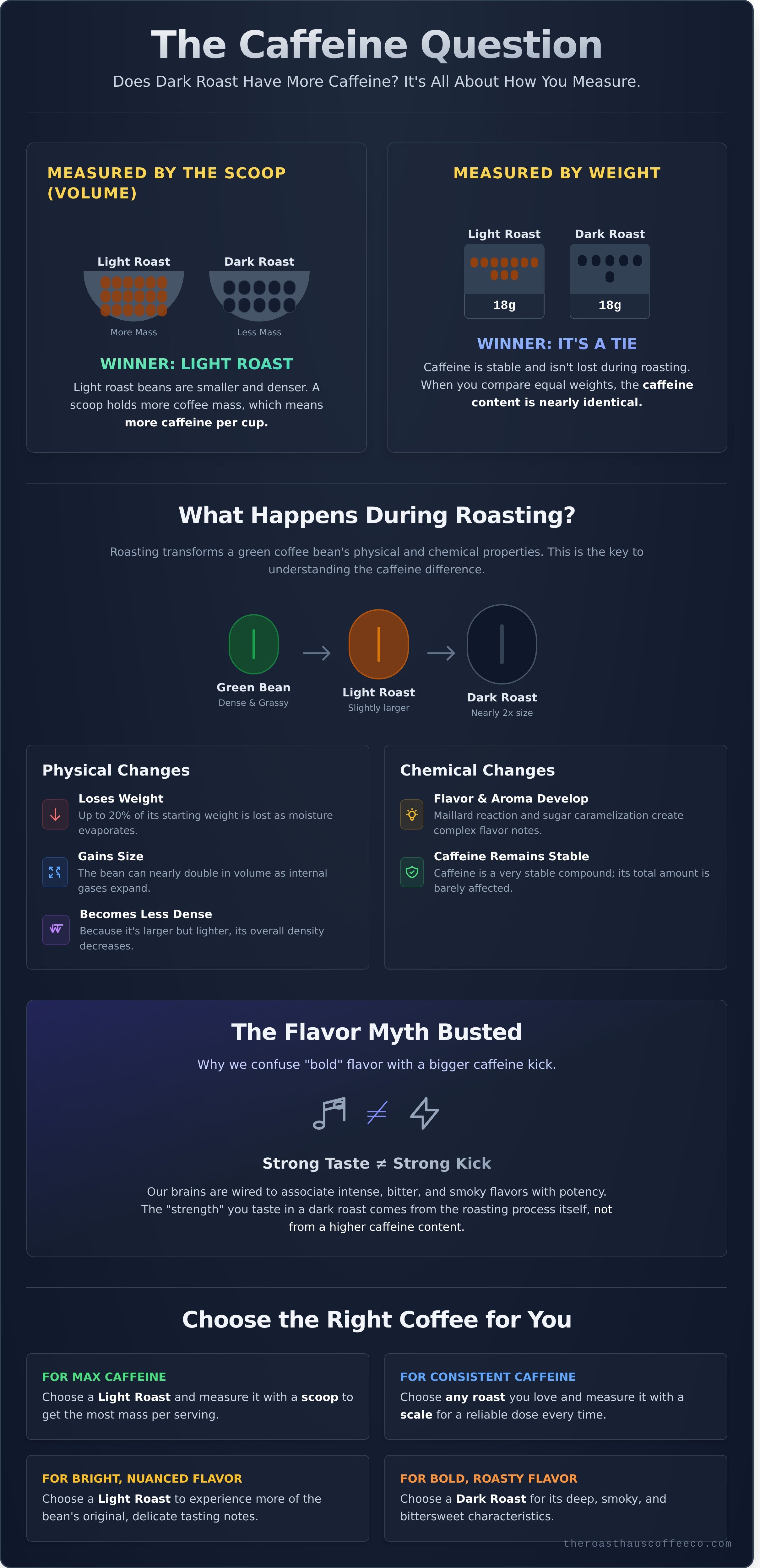
The confusion comes from the physical transformation a coffee bean undergoes in the roaster. As beans are heated longer for a dark roast, they lose moisture and expand, becoming physically larger but less dense. The caffeine itself, however, is extremely stable and isn't simply "burned off." To understand the full picture of what happens to beans during roasting, it's key to know that the total caffeine content changes very little. The real difference is in the bean's final weight and size.
Winner by the Scoop (Volume): Light Roast
If you measure your coffee with a scoop, a light roast will deliver a more caffeinated cup. It’s a matter of simple physics. Light roast beans are smaller and denser. A scoop filled with these compact beans holds more coffee mass than a scoop of larger, lighter dark roast beans.
Think of it this way: a cup of dense granola will always weigh more than a cup of light, fluffy puffed rice. More mass means more coffee, and more coffee means more caffeine.
Winner by the Bean (Weight): It's a Tie
For the most accurate comparison, you need to use a scale. If you weigh out 18 grams of light roast and 18 grams of dark roast, the caffeine content will be nearly identical. This is because you are comparing an equal mass of coffee, and as we covered, the caffeine isn't lost in the roasting process.
A single dark roast bean has almost the same amount of caffeine as a single light roast bean-it's just lighter and takes up more space. Measuring by weight is the best way to ensure a consistent cup, no matter which roast profile you love.
What Really Happens to Beans During Roasting?
To get to the heart of the caffeine question, we first need to understand what roasting actually does. Roasting isn't a process of adding anything to coffee-it’s a craft focused on unlocking the incredible flavor locked inside the raw, green beans. Before they meet the heat of our roaster, green coffee beans are dense, hard, and smell grassy. The roasting process uses carefully controlled heat to transform them into the aromatic, brittle beans you grind for your morning cup.
This transformation involves two key types of changes: physical and chemical. Understanding them is the key to busting the myth that asks, does dark roast have more caffeine?
Physical Changes: The 'Pop' and Expansion
When we heat green coffee beans, the first thing that happens is water loss. The moisture inside the bean turns to steam, trying to escape. This process makes the bean lighter and reduces its overall mass. As pressure builds, the bean dramatically expands in size and eventually cracks open with an audible "pop"-what roasters call the "first crack."
- They lose weight: A dark roast bean can lose up to 20% of its starting weight due to moisture evaporation.
- They gain size: The bean can nearly double in volume as gases expand inside it.
- They become less dense: Because they are larger but weigh less, dark roast beans are significantly less dense than light roast beans.
This change in density is the single most important factor in the caffeine debate. A scoop of large, light dark-roast beans will simply weigh less than a scoop of small, dense light-roast beans.
Chemical Changes: Creating Flavor and Aroma
While the beans are expanding, a world of chemical reactions is taking place. This is where a roaster’s skill truly shines. Heat triggers the Maillard reaction, the same process that browns toast or sears a steak. It creates hundreds of new aromatic compounds, developing the complex notes of chocolate, nuts, and fruit that we love in coffee.
At the same time, the natural sugars in the bean begin to caramelize, first creating sweetness and then, as the roast gets darker, the bittersweet and roasty notes characteristic of a dark roast. But what about the caffeine? Caffeine is an incredibly stable compound. While all this flavor development is happening, the caffeine content remains almost entirely unchanged. Scientific analysis published by the Royal Society of Chemistry shows that roasting has little impact on caffeine on a per-bean basis. The real difference comes from how you measure your coffee, which we'll explore next.
Why We Confuse 'Bold' Flavor with High Caffeine
The biggest reason the dark roast caffeine myth exists comes down to a simple mix-up: we confuse strong flavor with strong stimulant effects. Our brains are wired to associate intense, bitter tastes with potency. When you drink a coffee that’s smoky, deep, and powerful on the tongue, your mind naturally assumes it’s also packed with more of everything else, including caffeine.
But in the world of artisan coffee, flavor and function are two different things. The "strength" you taste is a result of the roasting process, not the caffeine content. This psychological connection is the true source of the confusion.
The 'Roasty' Taste of Dark Roasts
Dark roasts are pushed further in the roaster, which caramelizes the sugars and brings oils to the surface. This creates the intense, bold flavors we often call ‘strong’ or ‘robust.’ This powerful taste is exactly why so many people ask, does dark roast have more caffeine? They assume the intensity must mean a bigger kick. Common tasting notes include:
- Dark chocolate
- Smoky or charred notes
- Caramel and molasses
- Low acidity
These are descriptions of flavor, not a measurement of caffeine. The bitterness and boldness are products of the roast, telling you about the coffee's taste profile, not its stimulant level.
The Delicate Flavors of Light Roasts
In contrast, light roasts are roasted for a shorter time, preserving much more of the coffee bean's original character. Their flavor is often described as brighter, more acidic, and nuanced, with fruity or floral notes. Because these flavors aren't as overpowering, some perceive them as 'weaker.' In reality, they are often more complex. A higher, brighter acidity doesn't mean less caffeine; it simply points to a different, more delicate flavor experience that honors the bean's origin.
Understanding this difference is the key. The only way to truly know what you prefer is to experience the true character of each roast for yourself, fresh from the roaster.
How to Choose the Right Coffee for You
Now that we've settled the debate over does dark roast have more caffeine, you can make your choice based on facts, not myths. The truth is, the difference is minimal and depends entirely on how you measure your beans. Your decision should come down to what you truly want from your cup: the flavor you love and the caffeine kick you desire.
Remember, the biggest factor in caffeine content isn't the roast—it's the bean itself. Robusta beans pack nearly double the caffeine of Arabica. At The Roast Haus Coffee Co., we focus on roasting premium Arabica beans to bring out their absolute best flavor, from bright and fruity to rich and chocolatey. Let's find your perfect match.
For the Highest Caffeine Kick
If you want the most caffeine possible from an Arabica bean, choose a light roast. Because light roast beans are denser and smaller, measuring by volume (with a scoop) gives you slightly more coffee mass, and therefore more caffeine, per cup. This method maximizes your morning jolt while delivering the bright, complex flavors that make light roasts so unique. For a truly vibrant and energizing cup, try our Ethiopia Limu Organic.
For the Richest, Boldest Flavor
For those who crave that classic, comforting coffee taste, a medium or dark roast is the perfect choice. Roasting longer develops deep, rich notes of chocolate, nuts, and caramel while reducing acidity for a smooth, bold finish. While the caffeine-by-scoop is slightly less than a light roast, it's still a satisfying and robust amount to power your day. Our Honduras Morning Splendeur offers a fantastic, classic taste that never disappoints.
Our Philosophy: Freshness and Flavor First
At The Roast Haus Coffee Co., we don't roast to manipulate caffeine. We roast to order to unlock the peak potential of every single bean. Our goal is simple: to deliver the freshest, most flavorful cup of coffee possible, right to your door. We believe the conversation shouldn't just be about caffeine levels, but about the incredible spectrum of tastes coffee has to offer. Whether you choose a light, medium, or dark roast, you can be confident it was roasted with one thing in mind—taste.
Freshness is the true key to great coffee. Explore our collection at theroasthauscoffeeco.com based on the taste notes you love and discover a coffee that's perfect for you. We ship it the same day it's roasted, so you always get the best cup possible.
The Final Grind: It's All About Flavor
So, the next time someone asks, does dark roast have more caffeine, you'll have the real answer: it all comes down to how you measure. We've learned that a bold, smoky flavor doesn't automatically mean a bigger jolt of energy. The roasting process changes a bean's density and mass, meaning a scoop of light roast often has slightly more caffeine, while measuring by weight makes them nearly identical.
Ultimately, the best coffee isn't about chasing the highest caffeine content-it's about finding a flavor you truly love. At The Roast Haus Coffee Co., we believe that starts with unparalleled freshness. As a family-owned artisan roastery, we are committed to small-batch quality you can taste. That's why every single bag is Roasted To Order, ensuring it arrives at its peak.
Ready to discover a coffee that's perfect for your palate? Shop our fresh, roasted-to-order coffees by flavor profile. Stop guessing and start enjoying a truly exceptional brew. Your perfect cup is waiting.
Frequently Asked Questions
Which has more caffeine: Robusta or Arabica beans?
Robusta beans have significantly more caffeine, often nearly double the amount found in Arabica beans. This is a natural characteristic of the coffee plant. At The Roast Haus, we focus on 100% Arabica beans because we believe their smoother, more complex flavor profiles create a superior cup of coffee. While Robusta provides a bigger jolt, we prioritize the rich, nuanced taste that only high-quality, freshly roasted Arabica can deliver.
Does espresso have more caffeine than a regular cup of coffee?
This depends on how you measure it. A single one-ounce shot of espresso has less total caffeine (around 64mg) than a standard eight-ounce cup of drip coffee (95-165mg). However, espresso is much more concentrated. Ounce-for-ounce, espresso has more caffeine. So, a shot gives you a quick, potent burst, while a full cup of drip coffee delivers more caffeine overall but is spread out over a larger volume.
Is there more caffeine in cold brew coffee?
Yes, cold brew is typically higher in caffeine. The reason is the brewing method itself. Cold brew requires a much higher coffee-to-water ratio and a very long steeping time-often 12 hours or more. This extended contact between the grounds and water results in a very efficient extraction of caffeine, creating a smooth-tasting concentrate that is both flavorful and potent, even after being diluted with water or milk.
What's the difference between light, medium, and dark roast flavor?
The roast level is all about flavor development. Light roasts preserve the bean's origin characteristics, offering bright, acidic, and often floral or fruity notes. Medium roasts strike a balance, with more body and sweetness. While people often ask does dark roast have more caffeine, the real difference is its bold, smoky, and chocolatey flavor, where the "roasty" taste from the process itself becomes the main feature and acidity is low.
How much caffeine is in Swiss Water Process decaf coffee?
The Swiss Water Process is an incredibly effective, 100% chemical-free method for decaffeinating coffee. We love it because it preserves the coffee’s original flavor so well. This process uses only water, temperature, and time to gently remove caffeine, resulting in a finished product that is guaranteed to be 99.9% caffeine-free. It’s the best way to enjoy a rich, flavorful cup of coffee without the buzz. For those interested in exploring other naturally caffeine-free wellness beverages, you can learn more about Rastaman Stew.
Does the brewing method affect caffeine extraction?
Absolutely. Your brewing method has a major impact on the final caffeine content in your cup. Key factors include water temperature, grind size, and how long the water is in contact with the coffee grounds. For example, a longer steep time, like with a French press, will extract more caffeine than a faster method like a pour-over. This is often more important for the final caffeine level than the roast itself.

