


The most expensive, small-batch beans will still taste like bitter water if you choose a brewing method that fights against your taste buds. When comparing french press vs pour over, it isn't just about the gear. It's about how you want your morning to feel. A 2023 study by the National Coffee Association shows that 63% of adults drink coffee daily, yet many struggle with inconsistent results at home. You've likely felt the frustration of technical terms like immersion and percolation. It's common to worry about spending $60 on a setup that just gathers dust on your counter because it feels too complex.
We believe you deserve a cup that honors our roasted to order process. You want a reliable ritual that delivers peak flavor every single morning without the confusion. This guide breaks down the definitive differences between the heavy, oil-rich body of the French Press and the clean, tea-like clarity of the Pour Over. You'll learn which equipment fits your budget and exactly how to achieve that artisan-level taste in your own kitchen. Let's find the method that makes your first sip the best part of your day.
Key Takeaways
- Understand how mouthfeel and acidity change between immersion and percolation to find your ideal coffee texture.
- Compare the workflow and equipment needs of each method to see which one fits your daily morning routine.
- Settle the french press vs pour over debate by learning how different extraction styles highlight specific flavor notes.
- Learn how to pair your favorite light, medium, or dark roast with the right gear for a professional artisan result.
- See why using "Roasted to Order" beans is the most critical step in achieving peak flavor, regardless of your chosen method.
The Great Manual Brew Debate: French Press vs. Pour Over
Choosing between a french press vs pour over isn't just about the equipment. It's about how you want to start your day. Most automatic drip machines use a set-it-and-forget-it approach that often results in uneven extraction or stale flavors. Manual brewing changes that. By taking control of the variables, you ensure the small-batch beans you bought reach their full potential. You decide the water temperature, the grind size, and the total contact time. This hands-on process turns a morning chore into a craft.
The debate usually centers on two distinct coffee preparation methods that produce very different results. The French Press relies on immersion. It's a method that dates back to the 1850s, prized for its heavy body and straightforward process. The Pour Over represents the percolation method. It demands more attention but rewards you with a clean, nuanced cup. Your choice depends on your palate. You must decide if you want a rich, bold texture or a bright, clear flavor profile.
We believe every bean tells a story, and the brewer is the storyteller. At The Roast Haus Coffee Co., we roast our beans to order so they arrive at peak freshness. A French Press might highlight the chocolatey depths of a dark roast, while a Pour Over brings out the citrus notes in a light roast. Both methods are valid. Your morning routine and how much time you have before work will likely dictate which tool you grab from the cabinet. If you have five minutes to spare, you can make a better cup than any machine.
What is Immersion Brewing? (French Press)
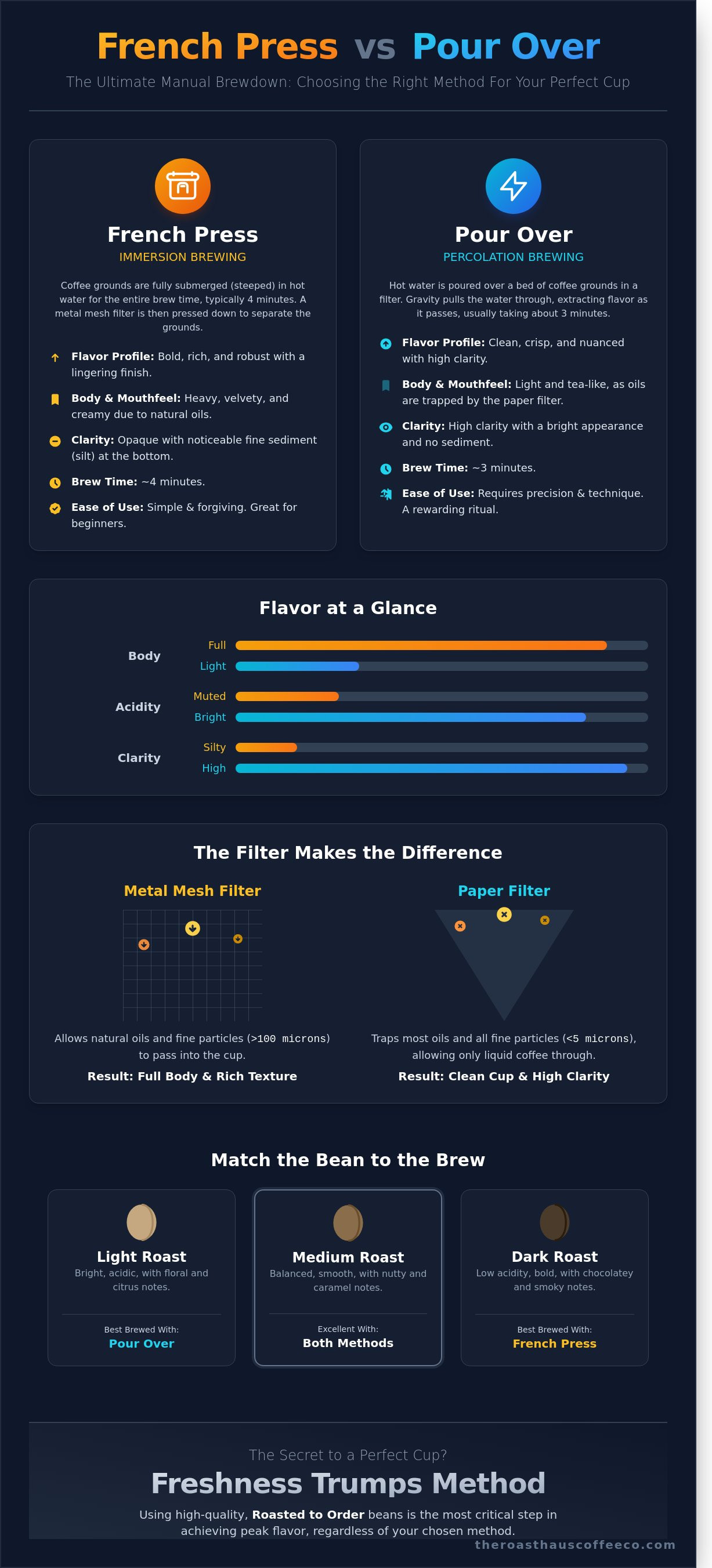
Immersion brewing is like steeping tea. You let the coffee grounds sit in hot water for the entire duration of the brew, typically 4 minutes. Because the grounds stay in contact with the water the whole time, the extraction is uniform and forgiving. The French Press uses a metal mesh filter rather than paper. This allows natural oils and fine particles to pass into your mug. The result is a cup with a heavy, creamy mouthfeel and a robust flavor that lingers. It's a simple, honest way to drink coffee.
What is Percolation Brewing? (Pour Over)
Percolation involves fresh water constantly flowing through a bed of grounds. In a french press vs pour over comparison, this method requires more precision. You use a paper filter to catch the sediment and most of the coffee oils. This creates a "clean" finish that lets subtle flavor notes shine. You must manage the "pour" carefully, often using a gooseneck kettle to ensure the water hits the grounds evenly. A standard brew takes about 3 minutes. This technique highlights the acidity and complex aromas of high-quality, artisan beans.
- French Press: Best for those who value body, texture, and a simple 4-minute steep.
- Pour Over: Ideal for coffee drinkers who enjoy clarity, brightness, and the ritual of a 3-minute pour.
- Freshness: Both methods perform best with beans roasted within the last 14 days.
Your equipment should match your lifestyle. If you enjoy a quiet, meditative process, the Pour Over is excellent. If you need a reliable, bold cup for a busy family morning, the French Press delivers every time. Both tools help you move away from the bland, mass-produced taste of grocery store cans. They allow you to taste the actual work that went into roasting the beans. Don't settle for mediocre coffee when better flavor is just a few minutes away.
Flavor Profiles and Body: Comparing the Results
Choosing between a french press vs pour over comes down to how you want the coffee to feel on your tongue. The French Press produces a heavy, velvety mouthfeel. It leaves the natural oils in the cup because the metal mesh filter doesn't trap them. This results in a rich brew with noticeable body. In contrast, the Pour Over method creates a tea-like consistency. It's clean and crisp. The paper filter removes almost all coffee oils and fine particles, which highlights the sparkle or brightness of the bean. You'll notice the difference in the very first sip.
Acidity and sweetness also behave differently in these two brewers. The French Press tends to mute high acidity, pushing sweet and savory notes to the front. Pour Over brewing does the opposite. It celebrates acidity. If you're brewing a light roast with citrus notes, the Pour Over will make those flavors pop. Some drinkers love the grit found at the bottom of a French Press cup. Others find it distracting and prefer the sediment-free finish of a filtered pour. A standard paper filter can remove particles as small as 5 microns, while a metal press filter often lets through particles up to 100 microns in size.
Temperature stability is a hidden factor in flavor quality. Glass carafes lose heat quickly, often dropping 10 to 15 degrees Fahrenheit during a four-minute steep. This matters because the chemistry of coffee extraction changes as the water cools. If the temperature falls below 195 degrees Fahrenheit too early, you won't extract the necessary sugars to balance the acids. Double-walled stainless steel presses or thick ceramic drippers retain heat 25% better than thin glass, leading to a more balanced and predictable flavor profile.
French Press: The Bold and the Beautiful
This method is the gold standard for drinkers who love chocolatey, nutty, and earthy flavors. It excels at highlighting the roast character of the bean. If you enjoy a dark roast, this is your brewer. You must pour the coffee out of the press immediately after the four-minute timer ends. Leaving it in contact with the grounds leads to over-extraction. This causes a harsh, bitter taste that ruins the profile of freshly roasted beans. Precision is key to avoiding that muddy aftertaste.
Pour Over: The Bright and the Nuanced
The Pour Over is ideal for highlighting fruity, floral, and acidic notes in single-origin beans. The paper filter provides high clarity of flavor. You can actually taste the individual notes of blueberry or jasmine in a high-quality Ethiopian coffee. There's a learning curve here. If your technique is inconsistent, your coffee might taste thin or sour. This usually happens if the water passes through the grounds in less than two minutes or if the grind size is too coarse for the specific dripper you're using. Mastering the french press vs pour over debate requires understanding these extraction variables.
- French Press: Best for body, texture, and deep sweetness.
- Pour Over: Best for clarity, acidity, and complex aromatics.
- Sediment: Expect some "silt" in the press; expect zero grit in the pour over.
- Brew Time: 4 minutes for press; 2.5 to 3.5 minutes for pour over.
Daily Grind: Comparing the Workflow, Time, and Cleanup
Your morning routine is the ultimate test for any coffee brewer. If you are rushing to an 08:00 AM meeting, a complex process will lead to frustration. The debate of french press vs pour over often comes down to how much active labor you want to perform before your first sip. One method demands your full attention for three minutes, while the other asks for a simple stir and a four-minute wait. Your choice depends on whether you view coffee making as a chore to automate or a craft to master.
Equipment needs vary significantly between these two styles. A French Press is a self-contained unit, usually consisting of a glass or stainless steel carafe and a mesh plunger. You only need a way to boil water and a coarse grind. A pour over setup is more demanding. To get the best results from our small-batch beans, you need a dripper, paper filters, and a gooseneck kettle. The narrow spout of a gooseneck kettle is essential for controlling the flow of 200-degree water over the coffee bed. Without it, you risk uneven extraction and a muddy cup.
The 4-Minute Ritual: French Press Workflow
The French Press is the champion of the "set it and forget it" philosophy. You start by adding 30 grams of coarsely ground coffee to the carafe. Pour in 500ml of hot water, give it a quick stir to ensure all grounds are saturated, and place the lid on top. You then wait exactly four minutes. This immersion method is forgiving and consistent because the coffee steeps evenly in the water. It is the perfect choice for a busy kitchen where you need to pack lunches or check emails while your coffee brews.
Cleanup is the main drawback of this method. Since there is no paper filter, you are left with a thick layer of wet, heavy grounds at the bottom of the glass. You cannot simply pour these down the sink without risking a clog. Most users must scoop the grounds into the trash or compost and then rinse the mesh filter thoroughly to remove trapped oils. This adds about 90 seconds of manual cleaning to your morning, which is a trade-off for the hands-off brewing process.
The Zen of the Pour: Pour Over Workflow
The pour over method is an active, meditative process that requires about three minutes of focused standing time. After placing a paper filter in the dripper, you perform a 30-second bloom by pouring just enough water to wet the grounds. This releases trapped gases and prepares the coffee for extraction. You then pour the remaining water in slow, steady concentric circles. This level of control allows you to highlight the delicate notes of a light roast, but it requires you to stay at the counter until the final drop falls.
Cleanup is where the pour over wins for the time-conscious professional. Once the brew is finished, you lift the paper filter and toss the entire bundle of grounds into the bin. A quick five-second rinse of the dripper is all that is required. Because the paper filter traps the sediment and oils, the dripper stays remarkably clean. This "toss and rinse" reality makes it a favorite for those who want a high-quality cup without the scrubbing. When comparing the french press vs pour over for durability, remember that a plastic or metal dripper is nearly indestructible and easy to pack for travel, whereas a glass French Press carafe can shatter with one accidental drop on a granite countertop.
Matching the Bean to the Brew: Finding Your Perfect Pair
Choosing between a french press vs pour over isn't just about the equipment sitting on your kitchen counter. It's about how that gear interacts with the chemistry of the bean. Different coffee origins and roast profiles react uniquely to immersion and percolation. At The Roast Haus Coffee Co., we roast in small batches under 50 pounds to ensure every bean reaches its peak flavor potential. This precision allows us to highlight specific characteristics that either shine in a heavy-bodied press or a clean, filtered pour over.
Grind size plays a massive role in the french press vs pour over experience. For a French Press, you need a coarse grind resembling sea salt. This prevents over-extraction during the four minute steep. Pour over methods require a medium-fine grind, similar to table salt, to create the necessary resistance as water flows through the bed. Matching these grinds with the right roast level is the secret to a professional-grade cup at home. Small-batch roasting ensures that these delicate cell structures in the bean aren't destroyed by mass-production heat.
- Light Roasts: These are best for pour over to preserve delicate acidity and floral notes.
- Medium Roasts: These are versatile enough to work well with both methods.
- Dark Roasts: These are ideal for French Press to emphasize body, oils, and natural sweetness.
Best Beans for French Press
The immersion environment of a French Press is perfect for extracting deep, comforting flavors. Our Honduras Morning Splendeur is a prime example. It thrives when soaked; the process releases rich notes of brown sugar and hazelnut that permeate the entire brew. If you enjoy adding cream or sugar, a dark roast is your best bet. The heavy body of a dark roast doesn't get lost when you add dairy; it stands its ground. You can explore these different profiles by trying The All Day Sampler to see which body type suits your morning routine best.
Best Beans for Pour Over
Pour over brewing acts like a magnifying glass for coffee. It unlocks the subtle, floral complexities of our Ethiopia Limu Organic. Because the paper filter removes most oils, you're left with a tea-like clarity that highlights the bean's natural heritage. Our Kenya AA Supreme is another standout for this method. It offers a complex, wine-like acidity that only reveals itself when water passes through the grounds at a steady, controlled pace. The rapid expansion of the coffee bed during the 30 second bloom phase reveals the escaping carbon dioxide, a direct indicator that your beans were roasted to order within the last 48 hours.
Experience the difference that small-batch roasting makes in your daily ritual. Shop our freshly roasted collection now to find your perfect brewing partner.
The Secret to Success: Why Freshness Trumps Method
You can spend hundreds of dollars on high-end equipment, but the debate of french press vs pour over is irrelevant if your beans are stale. The harsh reality of the coffee industry is that most bags on grocery store shelves were roasted 90 to 120 days ago. By the time you buy them, the volatile oils responsible for those complex notes of chocolate or citrus have evaporated. Manual brewing methods like the French press or Chemex are designed to highlight these delicate nuances, yet they can't extract what isn't there.
Oxidation is the primary enemy of great coffee. This process begins the second the roasting cycle ends. Data shows that coffee can lose up to 60 percent of its aromatic intensity within just 15 days of roasting if it isn't sealed properly. This is why we prioritize a 24-hour shipping promise. When you order from The Roast Haus, your beans are roasted to order and processed for delivery within one business day. This ensures you receive the product at its absolute peak flavor potential, usually arriving at your door within 48 to 72 hours of leaving our facility.
To keep that "just roasted" aroma alive at home, you must follow a few simple storage rules:
- Avoid the Freezer: Moisture is a silent killer of coffee quality; freezing creates condensation that ruins the oils.
- Use Opaque Containers: Light degrades the organic compounds in the bean, so keep them in a dark spot.
- Seal Out Oxygen: Use an airtight container at room temperature to extend the vibrant flavor for up to 21 days.
The Roast Haus Philosophy
We are a family-owned Oklahoma roastery built on the belief that small-batch quality beats mass production every time. Our team treats every roast as a craft, not a commodity. We don't want to be a giant corporation; we want to be your trusted local artisan. Supporting our small business means you're investing in a process that values flavor over profit margins. We believe the best cup of coffee is simply the one you look forward to making every morning.
Your Next Steps to a Better Brew
You don't need a $200 setup to taste a massive difference in your morning routine. If you're ready to improve your results, start with a quality burr grinder. Unlike blade grinders that hack beans into uneven chunks, a burr grinder provides the uniform particles necessary for a balanced extraction. You can find reliable entry-level burr grinders for under $55 that will immediately elevate your french press vs pour over experience. Check your current inventory and see what's missing.
Final Verdict: Choose the French press if you want a heavy, comforting cup that takes five minutes of your time. Choose the pour over if you want clean, tea-like clarity and enjoy the meditative process of the pour. Regardless of the tool, the beans are the foundation of the experience.
Shop our fresh-roasted beans and start your brewing journey today!
Elevate Your Morning Ritual
Choosing between the french press vs pour over depends on your personal taste for body or clarity. The French press delivers a robust, full-bodied experience by keeping the coffee's natural oils intact. In contrast, the pour over method uses paper filtration to produce a bright, clean cup that highlights subtle flavor notes. While the hardware matters, the true secret to a perfect cup is the age of the bean. Coffee begins losing its aromatic complexity just 14 days after it leaves the roaster.
We're a family-owned artisan roastery based in Wyandotte, Oklahoma, and we believe you deserve better than stale, grocery store shelves. Our small-batch process ensures a richer nutritional content and deeper flavor profile than standard industrial roasts. We roast every bag to order and ship within 24 hours so you receive your coffee at its absolute peak. When you start with beans this fresh, every brewing method becomes a success.
Browse Our Small-Batch, Roasted-To-Order Coffee
Enjoy the process and savor every sip of your next handcrafted brew.
Frequently Asked Questions
Is French Press coffee stronger than Pour Over?
French Press coffee feels stronger because it retains more natural oils and sediment. Since the metal mesh filter doesn't catch fine particles, you get a heavier body. Pour over coffee uses a paper filter to remove 99% of these oils and solids. This creates a cleaner cup that highlights subtle flavor notes. If you want a bold, heavy mouthfeel, the French Press is your best bet.
Which method is easier for beginners to learn?
The French Press is the easiest method for beginners because it's a simple immersion process. You just add water, wait 4 minutes, and press. Pour over brewing requires specific technique, including a circular pouring motion and 3 to 5 timed intervals. Most beginners find they can make a consistent cup with a French Press on their first try, while a pour over takes 5 to 10 practice sessions to master.
Can I use the same grind size for both French Press and Pour Over?
You cannot use the same grind size for both methods if you want a great cup. A French Press requires a coarse grind, about 1000 to 1500 microns, to prevent over-extraction during the 4 minute soak. Pour over needs a medium-fine grind, roughly 400 to 800 microns, so the water flows through at the right speed. Using a coarse grind in a pour over will result in a weak, watery brew.
Why does my Pour Over coffee taste bitter or sour?
Sour taste usually means your coffee is under-extracted, while bitterness comes from over-extraction. If it's sour, try a finer grind or hotter water, ideally between 195 and 205 degrees Fahrenheit. If it's bitter, your grind is likely too fine or your brew time exceeded 4 minutes. Small adjustments to your grind size or water temperature will fix these common flavor issues and help you master the french press vs pour over debate.
Do I really need a gooseneck kettle for Pour Over coffee?
You don't strictly need a gooseneck kettle, but it's the only way to get a consistent pour. These kettles allow you to control the flow rate at 5 to 10 grams of water per second. Standard kettles dump water too fast, which creates channels in the coffee bed and leads to uneven extraction. If you want the clarity and brightness that defines a pour over, a gooseneck kettle is a vital $30 investment.
How long does coffee stay fresh after the roast date?
Coffee hits its peak flavor between 7 and 21 days after the roast date. At The Roast Haus, we ship your order the same day or the day after roasting to ensure you get this maximum freshness. Once you grind the beans, they lose 60% of their aroma within 15 minutes. For the best experience, buy small batches and grind your beans right before you start your french press vs pour over brew.
Which method is better for making large batches of coffee?
The French Press is significantly better for serving groups or making large batches. Standard French Press carafes come in 34-ounce or 51-ounce sizes, allowing you to brew for 3 to 4 people at once. Most pour over drippers are designed for a single 12-ounce or 16-ounce cup. Trying to make a large batch with a pour over often leads to a long brew time that exceeds 6 minutes, resulting in a bitter taste.
Is French Press coffee unhealthy because of the oils?
French Press coffee contains cafestol and kahweol, which are diterpenes that can raise LDL cholesterol levels. Research shows that unfiltered coffee has 30 times more of these oils than coffee brewed with a paper filter. If you have high cholesterol, a pour over is a safer daily choice. However, drinking 1 or 2 cups of French Press a day is considered safe for most healthy adults without existing heart concerns.

