


That beautiful glass Chemex on your counter holds the promise of a perfect cup of coffee. But when the result is bitter, weak, or just plain disappointing, it's easy to feel frustrated. You've invested in great, fresh-roasted beans, and you shouldn't have to waste them on guesswork. The truth is, mastering coffee chemex brewing isn't about a secret, complicated recipe. It's about understanding a few key principles that put you in control of the final flavor.
In this complete 2026 guide, we cut through the confusion. We'll show you exactly how to dial in your grind size, control your water temperature, and perfect your pour. We believe that knowing the why behind each step is the key. It gives you the power to brew a consistently clean, vibrant cup and the confidence to adjust any variable to suit your taste. It's time to stop guessing and start brewing coffee you truly love, every single time.
Key Takeaways
- Understand why the Chemex's unique bonded paper filters are the secret to an exceptionally clean, sediment-free cup of coffee.
- Learn which two pieces of equipment are non-negotiable for achieving consistent flavor and extraction with every brew.
- Master your coffee chemex brewing technique by learning to diagnose and solve common problems like bitterness or a weak cup.
- Discover the ideal roast profiles and bean origins that truly shine when brewed with a Chemex, bringing out their most delicate notes.
What Makes Chemex Brewing Special? A First Look
The Chemex is more than just a coffee maker; it's an iconic piece of functional art that has earned a permanent spot in the Museum of Modern Art. Invented in 1941 by a chemist, its elegant hourglass shape is instantly recognizable. But its true beauty lies in its function. For a deeper look into the Chemex Coffeemaker history and design, you can see how its scientific origins directly influence the quality of the brew.
The secret is the filter. Chemex uses proprietary bonded paper filters that are 20-30% thicker than standard filters. This dense paper traps undesirable oils, sediment, and bitter compounds, allowing only the purest coffee flavors to pass through. The result is an exceptionally clean, bright, and nuanced cup of coffee with a tea-like clarity. It's a favorite among coffee purists for a simple reason: it lets the quality of the bean speak for itself.
Chemex vs. Other Pour-Over Methods
Compared to a V60, a Chemex brew will have a lighter body and higher clarity due to its thicker filter. While a French Press immerses grounds in water, resulting in a heavy, full-bodied cup with sediment, the Chemex produces the complete opposite. This ultra-clean profile makes it the perfect vessel for appreciating the delicate floral and fruit notes of high-quality, single-origin coffees like our Ethiopian Yirgacheffe.
The Core Principles of Chemex Brewing
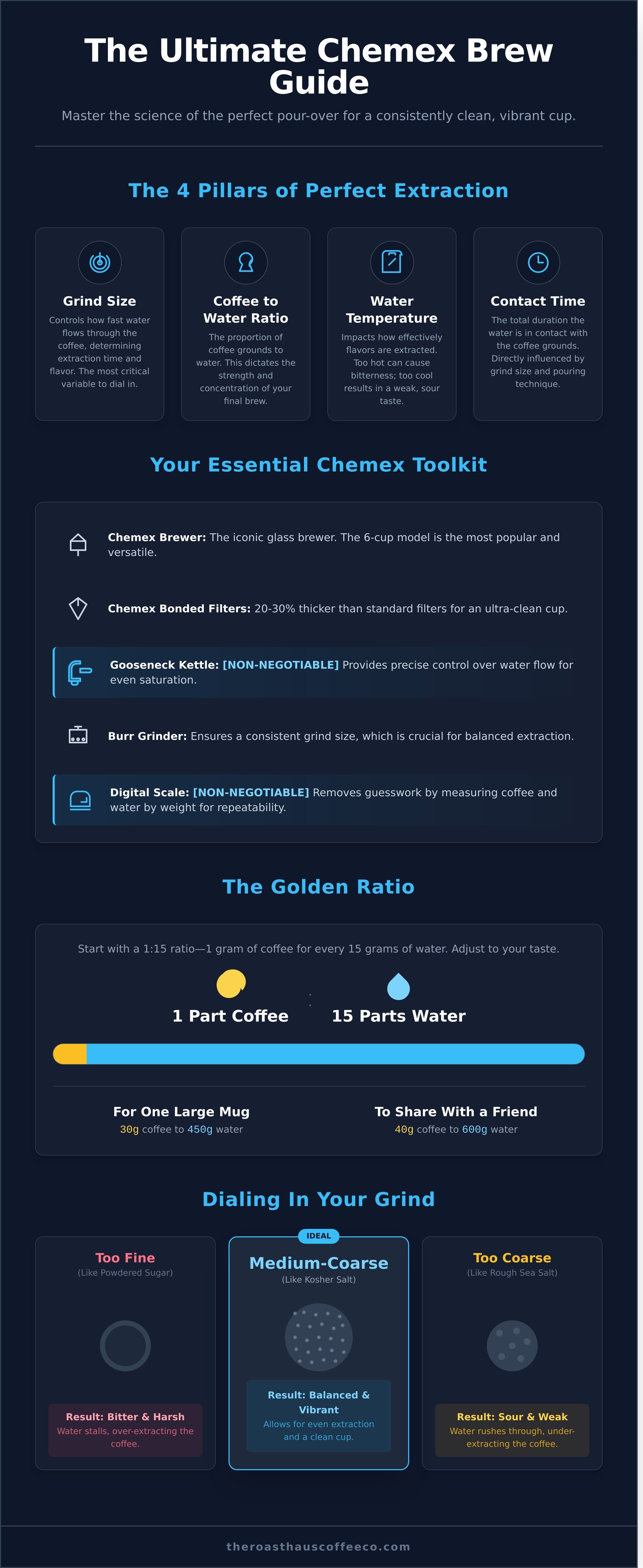
Great coffee chemex brewing is all about mastering extraction-the simple process of using hot water to pull flavor out of your coffee grounds. To do this well, you need to control four key variables:
- Grind: The size of your coffee grounds.
- Ratio: The amount of coffee you use for the amount of water.
- Temperature: The heat of your water.
- Time: How long the water is in contact with the grounds.
Learning to balance these elements gives you complete control. It’s not about complexity; it’s about precision. In the following sections, we'll show you exactly how to dial in each variable to unlock the best possible flavor from your freshly roasted beans.
Your Chemex Toolkit: Gear, Grind, and Golden Ratios
To truly honor the flavor of freshly roasted beans, you need the right tools. A great cup of coffee is a craft, not an accident. For clean, consistent results with your Chemex, you will need five essential pieces of equipment:
- A Chemex brewer (6-cup is most popular)
- Official Chemex bonded filters
- A gooseneck kettle
- A quality burr grinder
- A digital scale
While a grinder is a given, the kettle and scale are your non-negotiable tools for consistency. A gooseneck kettle gives you absolute control over your pour, ensuring all the coffee grounds are saturated evenly. A digital scale removes all guesswork, allowing you to measure your coffee and water by weight (in grams) so you can repeat that perfect cup, every single time.
The foundation of any great brew recipe is the ratio of coffee to water. We recommend starting with the "golden ratio" of 1:15. This simply means for every 1 gram of coffee, you will use 15 grams of water. It’s a reliable starting point you can adjust to your personal taste.
Common Brew Sizes:
- For one large mug: 30g coffee to 450g water
- To share with a friend: 40g coffee to 600g water
Choosing the Right Chemex and Filters
The 6-cup Chemex is the most versatile size for daily use. When it comes to filters, we recommend the bleached (white) ones because they have a neutral taste profile. Unbleached (brown) filters can impart a slight paper taste if not rinsed thoroughly. To fold, open the filter into a cone, making sure one side has three layers. You’ll place this thicker side against the pouring spout of the Chemex.
Dialing In Your Grind Size
For successful coffee chemex brewing, aim for a medium-coarse grind-think of the texture of kosher salt. If your grind is too fine, the water will stall, over-extracting the coffee and creating a bitter taste. If it's too coarse, water will rush through, leaving you with a weak and sour cup. Nailing the grind size is the most critical step to controlling the final flavor and quality of your brew.
The Perfect Pour: A Step-by-Step Chemex Brewing Recipe
This is our tried-and-true method for a perfect cup. Following these steps carefully will unlock the clean, bright flavors that make the coffee chemex brewing process famous. We recommend a coffee-to-water ratio of 1:16 or 1:17. For this guide, we’ll use 30 grams of coffee and 500 grams of water.
Step 1-3: Preparation and The Bloom
A great cup starts with a clean setup. These first steps ensure your equipment is ready and your coffee grounds are perfectly prepared for an even extraction.
-
Heat Your Water & Rinse the Filter
Place the Chemex filter in the brewer with the three-layered side facing the spout. Heat your water to 195-205°F (90-96°C). Pour hot water generously over the filter, wetting it completely. This rinses out any paper taste and preheats the glass. Discard the rinse water.- Why this matters: A paper-free rinse and a warm brewer are non-negotiable for a clean, vibrant cup. It removes anything that could interfere with the pure flavor of your coffee.
-
Add Coffee & Tare the Scale
Add your 30 grams of medium-coarse ground coffee to the filter, giving it a gentle shake to create a flat, even bed. Place the entire Chemex on your scale and tare it to zero.- Why this matters: Precision is key to repeatability. Using a scale ensures your coffee-to-water ratio is exact every single time, giving you a consistently delicious brew.
-
Start the Bloom
Start your timer and immediately pour about 60 grams of water over the grounds, ensuring they are all saturated. Watch the coffee expand and bubble for 45 seconds.- Why this matters: This is the bloom. It allows freshly roasted coffee to release trapped CO2 gas. Skipping this step leads to uneven, sour extraction as the gas repels water.
Step 4-6: The Main Pour and Drawdown
With the coffee bloomed, it’s time for the main pour. This is where you control the extraction and build the body of your brew. The goal is a steady, controlled process.
-
Begin the Main Pour
At the 45-second mark, begin pouring the rest of your water in slow, concentric circles. Start from the center and spiral your way out, avoiding pouring directly down the sides of the filter.- Why this matters: This technique gently agitates the coffee bed, ensuring all the grounds are extracting at the same rate. It prevents "channeling," where water finds a quick path through and bypasses coffee.
-
Reach Your Target Weight
Continue your slow, circular pour until the scale reads 500 grams. Aim to finish your pour by the 2:30 mark. The water level should stay well below the top of the Chemex.- Why this matters: Hitting your target water weight consistently is the foundation of proper coffee chemex brewing. It dictates the final strength and balance of your cup.
-
Allow Drawdown & Swirl
Once you've finished pouring, let all the water drain through the coffee bed. This is the "drawdown." Your total brew time should be between 3:30 and 4:30. Once it's done, remove the filter and give the Chemex a gentle swirl.- Why this matters: The drawdown time tells you if your grind was correct (too fast = too coarse; too slow = too fine). The final swirl mixes the coffee, which can stratify during brewing, ensuring every pour is perfectly balanced.
Troubleshooting Common Chemex Problems
Your first few attempts with a new bag of coffee might not be perfect, and that's a normal part of the process. We call this "dialing in" your brew. It’s the final, personal step where you adjust the variables to match your specific grinder and beans. Think of it as the true craft of coffee chemex brewing-making small, intentional changes to create a cup that is perfect for you. The two most common issues you'll encounter are bitterness and sourness, and both are easy to fix.
Coffee Tastes Bitter or Astringent
If your final cup has a harsh, lingering bitterness or a dry, chalky feeling (astringency), you are dealing with over-extraction. This happens when hot water pulls too many soluble compounds from the coffee grounds, including the unpleasant ones that dissolve last. Your goal is to extract the sweetness without pulling out these bitter elements.
- The Problem: Over-extraction.
- The Likely Cause: Your coffee grind is too fine. This creates a dense coffee bed that chokes the water flow, dramatically increasing contact time. A total brew time over five minutes is a clear sign this is happening.
- The Solution: Coarsen your grind. On your next brew, adjust your grinder 1-2 settings coarser. This will allow water to flow more freely, shortening the brew time and preventing those bitter flavors from dominating your cup.
Coffee Tastes Sour or Weak
When your coffee tastes unpleasantly acidic, sour, or even watery and thin, the culprit is under-extraction. This means the water passed through the grounds too quickly, leaving behind many of the deep, sweet flavor compounds that balance the coffee’s natural acidity. You've only extracted the first, fastest-dissolving (and most sour) flavors.
- The Problem: Under-extraction.
- The Likely Cause: Your coffee grind is too coarse. Large particles create wide channels for water to rush through, minimizing contact time and leading to a weak brew. A brew time under three minutes is a common giveaway.
- The Solution: Fine-up your grind. Adjust your grinder 1-2 settings finer for your next attempt. This will increase the surface area of the coffee and slow the water down, allowing for a richer, more balanced extraction.
Every coffee is unique, and adjusting your grind is the single most powerful tool you have for perfecting your brew. Don't be afraid to experiment to find that sweet spot. Of course, the best adjustments mean nothing without a great starting point. Using high-quality, freshly roasted beans is essential for truly exceptional coffee chemex brewing. Find your perfect roast at theroasthauscoffeeco.com and taste the difference freshness makes.
Selecting the Best Beans for Your Chemex
The Chemex brewer, with its thick paper filter, is designed for one thing: clarity. It strips away oils and sediment, producing an exceptionally clean cup that lets the coffee’s true character shine. This makes it the perfect stage for beans with nuanced, delicate flavors.
We recommend light to medium roasts, especially single-origin coffees. These roasts preserve the unique characteristics of the bean’s origin. Look for tasting notes that are bright and complex, such as:
- Floral notes like jasmine or honeysuckle
- Fruity flavors like stone fruit, berry, or citrus
- Bright, crisp acidity, similar to a good wine
To experience these delicate notes, your coffee must be fresh. Stale, oxidized beans lose their complexity, resulting in a flat, dull brew. At The Roast Haus Coffee Co., we roast your coffee to order and ship it the same day. This commitment to freshness is key for great coffee chemex brewing, ensuring a vibrant bloom and a cup packed with peak flavor.
Our Top Picks from The Roast Haus Coffee Co.
For a truly remarkable Chemex experience, we suggest starting with these two single-origins. Their distinct and bright flavor profiles are exactly what this brewing method was made to showcase.
- Kenya AA Supreme: Expect a bold cup with a vibrant, wine-like acidity and notes of blackcurrant. The Chemex highlights its clean finish perfectly.
- Ethiopia Limu Organic: This coffee offers delicate floral and crisp citrus notes. The Chemex method allows its subtle, tea-like body and complexity to come forward beautifully.
Start Your Brewing Journey
The best part of brewing is the discovery. Don't be afraid to experiment with different origins to find what you love. Just remember that every exceptional cup starts with exceptional beans. Freshness isn’t a luxury; it’s the foundation of great coffee. Start your journey with beans that are roasted just for you.
Explore our single-origin coffees perfect for your next Chemex brew.
Your Journey to a Perfect Chemex Brew
You now hold the keys to mastering one of coffee’s most elegant brewing methods. We've covered how the Chemex’s unique design and thick filters create an exceptionally clean, nuanced cup. You've learned that success truly lies in the details: achieving the right grind, respecting the golden ratio, and executing a patient, circular pour. With these fundamentals, you’re well on your way to transforming your morning ritual.
But the most important step in your coffee chemex brewing journey is starting with exceptional beans. As a family-owned Oklahoma roaster, we’re passionate about quality. We believe great coffee shouldn't sit on a shelf. That’s why our artisan, small-batch coffee is always roasted to order for maximum freshness. We ship it the same day it's roasted, so you can experience the full flavor potential your Chemex was designed to deliver. Shop our roasted-to-order beans and taste the difference in your Chemex.
Your perfect cup is waiting. Happy brewing!
Frequently Asked Questions
What is the best coffee to water ratio for Chemex?
A great starting point for coffee chemex brewing is a 1:16 ratio. This means for every 1 gram of coffee, you use 16 grams (or milliliters) of water. For a common 6-cup Chemex, try using 42 grams of coffee and 672 grams of water. This ratio highlights the clean, bright flavors the Chemex is known for. Feel free to adjust slightly to find the perfect strength for your taste.
What is the right grind size for Chemex coffee?
The ideal grind size for a Chemex is medium-coarse, similar in texture to coarse sand or sea salt. If your grind is too fine, it will clog the thick filter and lead to a slow, over-extracted brew that tastes bitter. If it’s too coarse, the water will pass through too quickly, resulting in a weak, under-extracted coffee. Getting the grind right is a key step for a balanced cup.
Why is my Chemex coffee taking so long to drain?
The most common reason for a slow drain time, or "stalling," is a coffee grind that is too fine. The small particles clog the pores of the thick Chemex filter, preventing water from passing through. This leads to over-extraction and a bitter taste. Try coarsening your grind slightly. Another cause could be pouring too aggressively, which pushes fine particles down and chokes the filter. Pour gently and evenly.
Can I use regular coffee filters in a Chemex?
While you technically can, we strongly advise against it. The signature clean, bright, and sediment-free cup from a Chemex comes from its proprietary bonded filters, which are 20-30% thicker than standard filters. Regular filters are too thin, won't fit the cone's angle correctly, and will allow more oils and fine particles into your brew. This will produce a cup with a heavier body and a completely different flavor profile.
How is Chemex different from a V60 or other pour-over brewers?
The main difference lies in the filter and the resulting flavor. The Chemex uses a very thick paper filter that removes most of the coffee oils and fine sediment, producing an exceptionally clean, bright, and tea-like cup. Brewers like the Hario V60 use a thinner filter and have a large single hole, allowing for a faster flow rate and resulting in a coffee with more body, complexity, and a richer texture.
Do I really need a gooseneck kettle for Chemex?
While not strictly necessary, a gooseneck kettle is highly recommended for brewing with a Chemex. It gives you precise control over the speed and placement of your pour. This control allows you to saturate the coffee grounds evenly, which is essential for a balanced extraction. Using a standard kettle makes it difficult to pour gently and accurately, often leading to an uneven and less flavorful brew. It’s a tool that makes a big difference.
How do I clean my Chemex coffee maker?
For daily cleaning, simply remove the filter, discard the grounds, and rinse the carafe thoroughly with hot water. For a deeper clean to remove coffee oil buildup, remove the wooden collar and use a bottle brush with warm, soapy water. To remove stubborn stains or mineral deposits, you can let a mixture of white vinegar and water sit in the Chemex for a few hours before scrubbing and rinsing completely.

