


Your French press isn't the reason your coffee tastes like burnt toast; it's the 180-day-old bag of beans sitting on the supermarket shelf. It's frustrating to invest in quality equipment only to end up with a bitter, muddy mess at the bottom of your mug. You want the best coffee for french press to deliver a signature rich, heavy body without the unpleasant grit or the "charred" flavor profile often found in mass-produced roasts. We understand that frustration because we see it every day with customers who are tired of inconsistent results.
Finding the perfect cup starts with understanding how immersion brewing interacts with bean freshness and roast level. We'll show you how to select beans that unlock a smooth, full-bodied flavor profile during the four-minute brew cycle while leaving the silt behind. We'll also explain why choosing a small-batch roaster ensures your beans are at peak flavor potential. You'll learn why "roasted to order" beans outperform store-bought options and how to identify the exact roast levels that prevent over-extraction in 2026.
Key Takeaways
- Understand how immersion brewing preserves natural coffee oils to deliver the rich, full-bodied texture your French press was designed for.
- Learn why peak freshness is the ultimate factor in flavor and how avoiding oxidation prevents the stale taste common in store-bought beans.
- Debunk the myth that you must use dark roasts and explore why a medium roast is often the best coffee for french press to achieve perfect balance.
- Discover how immersion brewing unlocks the unique wine-like acidity of Kenyan beans and the delicate floral notes of Ethiopian origins.
- Master the essential grind size and technique needed to ensure a clean, consistent cup without the fine sediment that ruins your brew.
Understanding Immersion: What Makes a Coffee Great for French Press?
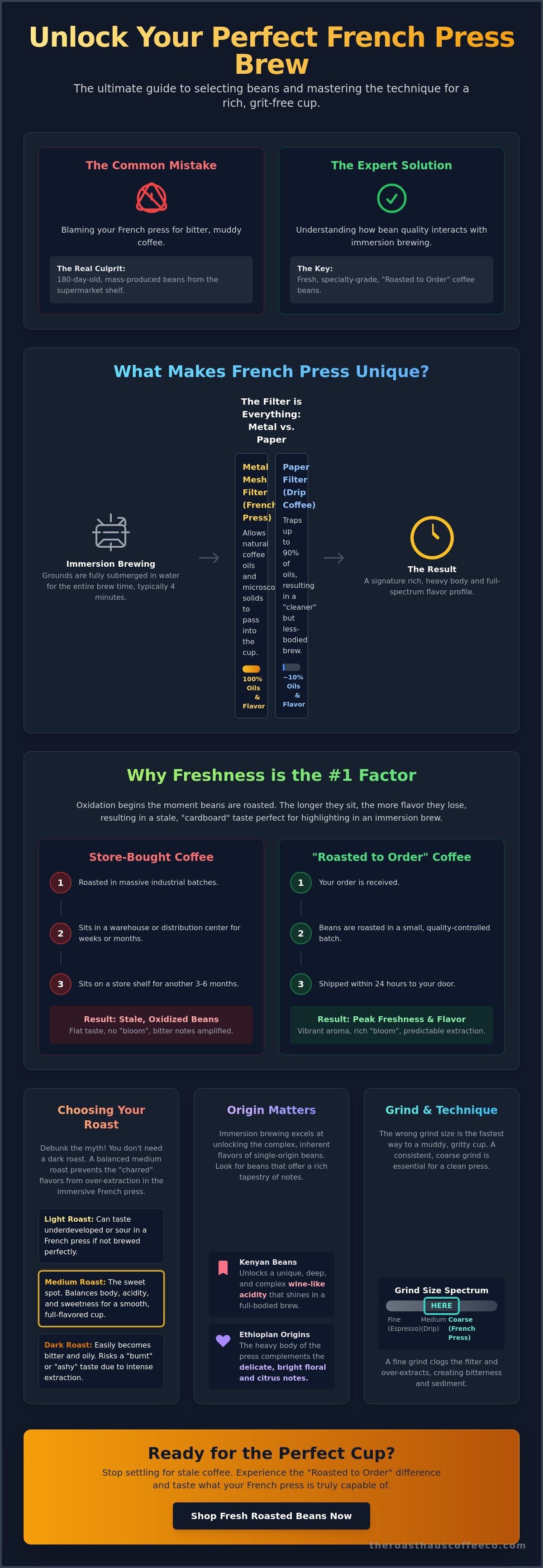
Immersion brewing is the prolonged contact of water and grounds. Unlike drip methods where water passes through a filter once, the French press keeps the coffee submerged for the entire extraction period, usually four minutes. This method relies on a metal mesh filter rather than paper. This design choice is critical because paper filters can trap up to 90% of the natural oils found in coffee beans. These oils carry the most complex flavor compounds and aromas. By using a metal mesh, those oils pass directly into your cup, creating a rich and heavy mouthfeel.
Finding the best coffee for french press involves selecting beans that can stand up to this intense extraction. Because the immersion process is so thorough, it highlights every characteristic of the bean. This is why specialty-grade beans are a requirement. Commodity-grade coffee often contains defects that lead to a "muddy" or "dusty" flavor profile when brewed this way. In 2026, specialty standards remain the benchmark for avoiding these off-flavors, ensuring that the heavy body of the coffee remains clean and vibrant on the palate.
The Science of the Metal Filter
The metal mesh filter in French press brewing allows colloidal solids to remain in the final liquid. These tiny particles contribute to the "body" of the coffee, giving it a weight that you won't find in a standard drip brew. However, these solids also mean that the coffee continues to extract even after you press the plunger. To avoid overwhelming bitterness, you must use a cleaner, more vibrant bean. At The Roast Haus Coffee Co., we focus on a "Roasted To Order" philosophy. Fresh beans have intact cell structures that release flavors predictably, preventing the bitter over-extraction common with stale, store-bought options.
Texture vs. Clarity: The French Press Trade-off
When you choose a French press, you're making a conscious choice of texture over clarity. A pour-over coffee might offer a "clean" cup that highlights a single high note of acidity, but the French press provides the "true" character of the roast. It's a full-spectrum experience. You taste the sweetness, the acidity, and the deep earthy notes all at once. This makes it the best coffee for french press when you want to experience the artisan craft of the roaster. Understanding how to make coffee starts with knowing that your equipment dictates the results. The French press doesn't hide anything, so starting with fresh, small-batch beans is the only way to ensure a superior cup.
- Immersion time: Typically 4 minutes for optimal extraction.
- Filter type: Reusable metal mesh that preserves essential oils.
- Flavor profile: Heavy body, rich mouthfeel, and full-spectrum flavor.
- Bean quality: Specialty-grade is necessary to avoid "muddy" tastes.
Why Freshness is the #1 Factor for French Press Success
Freshness isn't just a marketing buzzword; it's a chemical requirement for a great cup. When coffee beans are roasted, they begin a process called oxidation. Oxygen reacts with the delicate oils inside the bean, breaking down the complex flavor compounds that give coffee its character. This reaction eventually produces a flat, "stale" taste that many drinkers describe as reminiscent of cardboard or a damp basement. Because the French press is an immersion brewing method, it extracts every bit of flavor from the grounds. If those grounds are oxidized, you'll taste every bit of that staleness in your cup.
Most store-bought coffee sits on a shelf for three to six months before you ever see it. Industrial roasters produce thousands of pounds at a time, and the beans often sit in warehouses or distribution centers for weeks. By the time you use it, the peak flavor potential has vanished. Choosing the best coffee for french press means looking past the "Best By" date and finding a roaster that prioritizes speed. At The Roast Haus Coffee Co., we focus on an artisan approach. We roast in small batches to maintain strict quality control and ship your order within 24 hours of roasting. This ensures the beans arrive at your door while their natural oils are still intact and vibrant.
The "Roasted-to-Order" Difference
Freshly roasted beans go through a natural degassing period where they release carbon dioxide. When you pour hot water over fresh grounds, they "bloom," creating a thick layer of bubbles and foam on the surface. This bloom is essential for flavor extraction because it allows the water to fully penetrate the coffee particles. If your coffee doesn't bloom, it's a sign the beans are old and the flavor has escaped. We roast our beans in Wyandotte, Oklahoma, focusing on small-batch precision that industrial producers can't match. This hands-on process allows us to monitor every temperature change, ensuring a consistent profile. To keep these aromatics protected, always choose whole beans. Ground coffee has more surface area and can lose its aromatic intensity in as little as 15 minutes of exposure to air. Using fresh, whole beans is the only way to truly follow the National Coffee Association's brewing guide and achieve professional results at home.
Identifying Stale Coffee
You don't need to be a professional taster to spot stale beans. The first sign is a lack of aroma. When you open a fresh bag, the scent should fill the room. If you have to put your nose inside the bag to smell anything, the coffee is past its prime. On the palate, stale coffee tastes thin and one-dimensional. It lacks the bright acidity or deep sweetness found in fresh roasts. Always prioritize the "Roasted On" date over a "Best By" date. A "Best By" date is often set for 12 months after packaging, which is far too late for a quality brew. For more tips on selecting the right variety for your palate, see our coffee beans guide. If you're ready to experience the difference that 24-hour freshness makes, you can browse our latest roasts to find your perfect match.
Choosing Your Roast: Light, Medium, or Dark for Immersion?
A common misconception suggests that the best coffee for french press must be a dark, oily roast. This idea likely stems from a time when heavy roasts were used to hide the defects of low-quality beans. Today, the immersion method allows you to explore every flavor profile. Because the coffee grounds sit in water for a full four minutes, the extraction is thorough and forgiving. You aren't limited to a single style of bean.
The Classic Dark Roast Profile
If you enjoy a heavy body and smoky notes, a dark roast is your go-to. We recommend low-acidity beans like our Mexico or Honduras origins for this method. These beans provide a chocolatey, bold foundation that stands up well to the long steeping time. Many supermarket dark roasts taste burnt because they are roasted in massive batches and sit on shelves for 60 to 90 days. We roast to order in small batches. This ensures you get the oils and richness without the carbonized bitterness found in older coffee. It's the perfect choice for those who add cream or sugar to their cup.
- Mexico or Honduras Origins: Naturally low acidity makes these beans smooth and easy to drink.
- Avoid the Burnt Taste: Small-batch roasting prevents the "charcoal" flavor common in mass-produced bags.
- Rich Texture: Dark roasts produce more oils, which the French press mesh filter allows into your mug.
The Modern Medium Roast Approach
Medium roasts are the sweet spot for immersion brewing. They offer a balance of sweetness, body, and acidity that dark roasts sometimes lack. During our roasting process, we look for the exact point where natural sugars caramelize. This creates a smooth, syrupy texture that feels substantial on the tongue. Medium roasts preserve origin character while adding body. This means you can actually taste the difference between a bean grown in the volcanic soil of Central America and one from the high altitudes of Africa.
Light roasts offer a completely different experience in a French press. They produce a tea-like consistency with bright, floral, and fruity notes. While not the traditional choice, a light roast highlights the complex acidity of specialty beans. Whether you prefer light, medium, or dark, the quality of the best coffee for french press always comes down to the roast date. We ship our beans the same or day after roasting to ensure you experience peak flavor potential every morning. Freshness isn't just a buzzword; it's the difference between a flat cup and a glorious aroma.
Origin Matters: Best Regions for the French Press
Choosing the best coffee for french press starts with understanding where the beans grew. Origin defines the base flavor of your brew. Since the French press uses a metal mesh filter, every unique characteristic of the bean reaches your cup. You aren't just tasting coffee; you're tasting the soil and climate of a specific mountain range. At The Roast Haus Coffee Co., we focus on how these regional profiles react to our small-batch roasting process to ensure peak flavor.
Bold and Bright: East African Origins
Kenya AA Supreme is often called the connoisseur's choice for home brewing. The AA grade identifies beans that pass through a screen size of 17/64 of an inch. This size ensures uniform roasting in our drums, which is vital for consistency. These beans carry a bold, wine-like acidity and juicy fruit tones. A standard 4-minute immersion brew rounds out these sharp notes, turning them into a complex, full-bodied experience. Ethiopia Limu offers a similar magic. It brings floral and citrus tones that feel surprisingly rich when paired with the heavy body a press provides. These origins thrive in immersion because the long contact time extracts deep sweetness that balances the natural brightness.
Smooth and Balanced: The Americas
For a reliable daily driver, Central American beans are the standard. Our Honduras Morning Splendeur thrives in a French press because of its high-altitude origin. These beans are often grown at 1,500 meters or higher. This altitude creates a dense bean that doesn't produce "muddy" or thin flavors. You'll find deep chocolate and toasted nutty undertones in this region. Clean processing at these farms ensures the best coffee for french press results in a cup that is both smooth and balanced. It's a straightforward, honest flavor that appeals to everyone from the casual drinker to the dedicated artisan.
If you prefer to skip the caffeine, choose Swiss Water Process beans. This method removes 99.9% of caffeine using only water, temperature, and time. It avoids harsh chemicals that strip away the natural oils. Since the French press relies on those oils for flavor and mouthfeel, Swiss Water beans maintain their integrity better than chemically treated alternatives. You get the full origin profile without the jitters. We roast these to order just like our caffeinated options, ensuring you never sacrifice freshness for decaf.
Maximizing Your Brew: Grind and Technique Tips
Finding the best coffee for french press is only half the battle. To truly experience the depth of a small-batch roast, you must master the mechanics of the brew. In 2026, coffee lovers are moving away from automated convenience and returning to intentional, manual methods that respect the bean's integrity. Proper technique ensures that the "Roasted to Order" quality we provide actually makes it into your mug.
Grind Size and Equipment
Your grind is the foundation of your cup. For a French press, you need a coarse, consistent texture that resembles sea salt. If your grind is too fine, the water extracts flavor too quickly, resulting in a harsh, bitter taste. If it's too coarse, the water can't penetrate the bean, leaving you with a sour, thin liquid. Most blade grinders produce an uneven mix of large chunks and fine dust. This dust passes through the mesh filter and creates a muddy, gritty texture in your coffee. This is why a burr grinder is essential. It crushes beans to a uniform size, ensuring every particle extracts at the same rate. You can learn more about choosing the right gear in the ultimate guide to coffee grinders. Don't ever use espresso-ground coffee in this brewer. The fine particles will clog your filter and lead to massive over-extraction.
The Roast Haus Perfect Press Method
Freshly roasted beans contain carbon dioxide. When you add hot water, this gas escapes, often preventing water from fully reaching the coffee grounds. To fix this, start with a 30-second "bloom." Pour just enough water to soak the grounds, wait half a minute, then finish your pour. Use water heated to exactly 200°F (93°C). Water that's boiling (212°F) will scorch the delicate oils in our artisan roasts, while water below 195°F won't extract the full sweetness. Set a timer for 4 minutes. Once the time is up, try our "No-Press" technique. Instead of plunging immediately, use a spoon to gently break the "crust" of floating grounds. Most will sink to the bottom. Scoop away any remaining foam or floating bits. This creates a much cleaner, sediment-free cup than the traditional method. We take pride in our craft so you can take pride in your morning routine. Ready for a better morning? Browse our Roasted-to-Order Samplers and taste the difference that peak freshness makes.
Master Your Next Brew
Finding the best coffee for french press comes down to how recently the beans were in the roaster. Industry data shows that coffee begins to lose its aromatic complexity within 14 days of roasting due to oxidation. Most grocery store bags sit on shelves for 90 days or more, which kills the vibrant oils needed for a perfect immersion brew. You need a roast that handles a 4 minute steep time without becoming bitter. At The Roast Haus Coffee Co., we're a family-owned artisan roastery focused on small-batch quality control. We don't let beans sit in a warehouse. We roast every bag to order and ship it within 24 hours of roasting. This process guarantees you get the freshest flavor possible delivered straight to your door. Your French Press is only as good as the beans you put in it. Stop settling for stale coffee and start tasting the craft of a dedicated roaster.
Experience the difference of Roasted-to-Order coffee for your French Press
We're excited to help you brew the most flavorful cup you've ever had at home.
Frequently Asked Questions
Is coarse grind really better for French press?
Yes, a coarse grind is essential because the metal mesh filter in a French press allows fine sediment to pass through into your cup. You should aim for a grind size of approximately 1.5 mm, which looks similar to coarse sea salt. This specific size ensures the water extracts flavor over four minutes without clogging the filter or making the coffee muddy. Proper grind size is a key factor when selecting the best coffee for french press to ensure a clean finish.
Can I use regular ground coffee in a French press?
You can use regular pre-ground coffee, but it often results in a bitter and over-extracted brew. Most grocery store brands grind coffee to a medium size of 0.5 mm to 0.7 mm for drip machines. These small particles extract too quickly during the long immersion process. If you must use it, reduce your steep time to 2 minutes to avoid a harsh, dusty taste in your mug.
Why does my French press coffee taste bitter?
Bitterness usually comes from over-extraction or water that is too hot. If your water is 212°F, it scorches the grounds; you should aim for 195°F to 205°F instead. Steeping beyond the 4 minute mark also pulls out tannins that ruin the flavor. At Roast Haus, we roast to order so you get fresh oils, but even the best beans taste burnt if they sit in hot water for too long.
How long should I let my coffee steep in a French press?
You should let your coffee steep for exactly 4 minutes for a balanced extraction. This 240 second window allows the water to fully saturate the coarse grounds and release the natural oils. Once the timer hits zero, press the plunger down immediately. Leaving the coffee in contact with the grounds after pressing will continue the brewing process and lead to a bitter, unpleasant cup.
What is the best water-to-coffee ratio for French press?
The ideal ratio is 1:15, which means one part coffee to fifteen parts water. For a standard 17 ounce press, use 30 grams of coffee and 450 grams of water. This specific balance highlights the body and sweetness of the best coffee for french press. Using a digital scale ensures you get the same result every morning without guessing or wasting your small-batch beans.
Should I buy whole bean or ground coffee for my French press?
You should always buy whole bean coffee to preserve the delicate oils and aromatics. Research shows coffee loses 60% of its aroma within 15 minutes of grinding due to oxidation. We ship our coffee the same or day after roasting to ensure peak freshness. Grinding your beans right before you brew ensures you experience the full flavor potential of our artisan roasts.
Is light roast coffee good in a French press?
Light roast coffee is excellent in a French press if you enjoy bright, floral notes and higher acidity. The immersion method highlights the complex characteristics of the bean that a paper filter might strip away. Industry reports from 2026 show a 15% increase in enthusiasts using light roasts for French press. Just ensure your beans are roasted to order so those subtle notes haven't faded before they reach your door.
How do I clean my French press to keep the coffee tasting fresh?
You must disassemble the 3 piece filter assembly and wash it with warm, soapy water after every use. Old coffee oils stick to the metal mesh and turn rancid within 24 hours, which will ruin your next brew. Rinse every part thoroughly to ensure no soap residue remains. A clean press is the only way to taste the true quality of our small-batch, family-owned coffee.

