


You probably don't hate coffee; you just hate the way most commercial coffee is produced. If your experience is limited to the burnt, bitter sludge found at the bottom of an office pot or the stale beans sitting on grocery store shelves for months, it's no wonder you're skeptical. Finding the best coffee for people who don't like coffee starts with understanding that freshness is the most important factor in flavor. When beans are roasted in small batches and shipped immediately, the harsh acidity and lingering bitterness common in mass-produced brands simply disappear.
We understand how frustrating it is to feel overwhelmed by pretentious menus or to deal with the stomach discomfort caused by low-quality beans. You deserve a morning routine that feels like a treat rather than a chore. This guide will show you why you might actually love coffee once you move past the generic options and find the right roast for your specific palate. We'll walk you through the differences between roast levels, help you identify gateway coffees that are smooth and approachable, and teach you how to brew a perfect cup at home. It's time to discover a side of coffee that is naturally sweet, clean, and genuinely enjoyable.
Key Takeaways
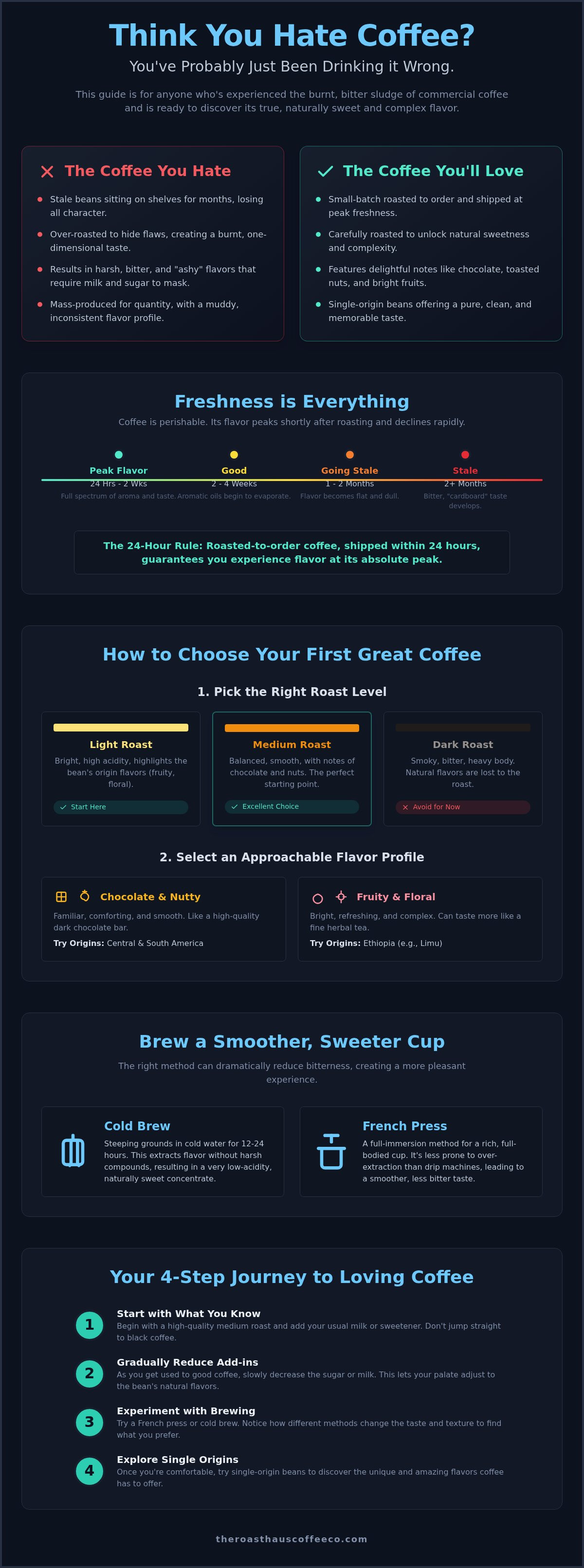
- Discover why stale grocery store beans create the bitter flavors you dislike and how small-batch roasting changes the taste profile completely.
- Identify the best coffee for people who don't like coffee by selecting light to medium roasts that feature natural notes of chocolate and nuts.
- Learn to use brewing methods like cold brew and French press to reduce acidity and create a smoother, sweeter cup.
- Follow a practical four-step strategy to transition from sweet, masked drinks to enjoying the authentic flavors of artisan beans.
- Understand the importance of the roasted-to-order model which delivers fresh coffee to your door within 24 hours of roasting.
Why You Might Actually Like Coffee (But Hate What You've Tasted)
Most people who claim to dislike coffee are actually reacting to stale, low-quality ingredients. Supermarket coffee often sits in warehouses or on shelves for months before it reaches your kitchen. During this time, the beans lose their character and develop a flat, "cardboard" or "ashy" flavor profile. This isn't the true taste of the bean. It is the result of oxidation and age. Mass-produced commodity coffee relies on quantity over quality. To hide the flaws in these cheap, inconsistent beans, industrial roasters often over-roast them until they are charred. This creates the intense, burnt bitterness that lingers on your tongue and ruins the experience.
Artisan roasting focuses on a process called the Maillard reaction. This chemical transformation occurs when heat interacts with the sugars and amino acids inside the bean. When done correctly, it creates natural sweetness and complex flavors like caramel, toasted nuts, or cocoa. Bitterness isn't a required feature of a good cup; it's often a defect caused by poor production or roasting choices. Finding the best coffee for people who don't like coffee means looking for beans where this natural sweetness is the star. When you move away from the industrial "burnt" style, you'll find a beverage that is smooth and genuinely pleasant to drink.
Bitterness vs. Acidity: Understanding Your Palate
Many beginners confuse bitterness with acidity. Bitterness is that harsh, dry, and sometimes metallic sensation found in dark "French" or "Italian" roasts. Acidity, often called "brightness" by experts, is a pleasant, tangy quality. Think of the crispness of a green apple or a squeeze of lemon. High-end beans, such as Kenya AA Supreme, are prized for this bright, refreshing profile. Specialty coffee is defined as beans scoring 80 points or higher on a 100-point scale. These beans are selected for their flavor integrity and lack of defects, ensuring a much cleaner taste than anything found in a grocery store aisle.
The Importance of Freshness in Flavor
Coffee is a perishable produce item. It's not a shelf-stable pantry staple like flour. From the moment beans are roasted, they begin to lose their volatile aromatic oils. These oils are responsible for the vibrant smells and tastes that make a cup of coffee special. Looking back at the history of coffee shows how cultivation has always aimed for peak flavor, yet modern industrial distribution often ignores this need for speed. Oxygen is the enemy of flavor. As beans sit, those delicate oils evaporate and the flavor turns sour or dull.
We believe the 24-hour rule is the ultimate differentiator for quality. When coffee is roasted to order and shipped within 24 hours, you get the full spectrum of flavor. This fulfillment model ensures the absence of the stale bitterness that beginners hate. Small-batch roasting allows for precise control over the heat, ensuring the beans are never scorched. This commitment to timing and craftsmanship means your coffee arrives at its absolute peak. If you've only had coffee from a dusty bag at the store, you haven't truly tasted what a fresh bean can offer.
Choosing the Best Coffee Beans for Beginners
Selecting the right roast is the first step in finding the best coffee for people who don't like coffee. Beginners often gravitate toward "dark" roasts because they sound sophisticated or bold. Avoid them. French and Italian roasts are cooked until the natural sugars are charred, leaving only a heavy, smoky bitterness that coats the tongue. Instead, look for light or medium roasts. These levels allow the bean's inherent personality to shine through without the burnt aftertaste that most people find repulsive.
Central and South American beans are excellent starting points. They typically offer a "chocolate and nut" profile that feels familiar and comforting, similar to a high-quality dark chocolate bar or toasted almonds. If you prefer something lighter and more vibrant, Ethiopian coffees often present a "fruit and floral" profile. These can taste more like a complex herbal tea than the heavy, oily sludge you might expect from a commercial pot. Many people start drinking these cleaner brews for the documented health benefits of coffee, which include improved heart health and lower risks of chronic disease. Choosing single-origin beans over generic blends is also vital. A single-origin bean comes from one specific farm, allowing you to experience a pure flavor profile rather than a muddy mix of leftover beans.
Top Origins for Non-Coffee Drinkers
If you want to avoid traditional bitterness, try Ethiopia Limu Organic. It features bright citrus and floral notes that are incredibly refreshing. For those who enjoy a smooth, caramel-like sweetness, Honduras Morning Splendeur is a perfect choice. It's approachable and lacks the "bite" found in cheaper beans. If you enjoy tart flavors, Kenya AA Supreme offers a bold, wine-like fruitiness that stands out. Finding the best coffee for people who don't like coffee is much simpler when you can compare these distinct profiles side-by-side.
Decoding the Coffee Bag Labels
Tasting notes on a bag don't mean the roaster added flavoring or syrups. These notes describe the natural nuances the roaster detected during a tasting session. You should also look at the processing method. "Washed" coffees tend to be clean and bright, while "Natural" coffees are often sweeter and fruitier. The roast date is the most critical piece of information. If a bag doesn't have a roast date, or if it's more than a few weeks old, it's already stale. To find your favorite without committing to a large bag, consider trying The All Day Sampler to experience these profiles side-by-side.
Brewing Methods That Reduce Bitterness and Acidity
Even the best beans can taste bad if you brew them wrong. The best coffee for people who don't like coffee is often defined by how it's extracted. If you use boiling water or tap water full of chlorine, you'll end up with a bitter mess. Using filtered water and keeping your temperature between 195 and 205 degrees Fahrenheit prevents the beans from scorching. This simple change preserves the natural sweetness and delicate oils we discussed in the previous sections. When you control the variables, you eliminate the "bite" that causes many people to reach for the sugar bowl.
Cold Brew: The Ultimate Gateway
Cold brew is the ultimate "cheat code" for beginners. Traditional brewing uses hot water to quickly pull flavors from the grounds. This heat also extracts acidic oils and bitter compounds that can be harsh on the palate. Cold brew uses time instead of heat. By steeping grounds in room-temperature water for 12 to 24 hours, you create a smooth concentrate that is naturally less acidic than hot coffee. This is why many consider cold brew the best coffee for people who don't like coffee. You can easily make this at home using a simple glass jar and a fine-mesh strainer. Pairing this concentrate with a splash of cream or a natural sweetener creates a dessert-like experience. Beyond the taste, people often stick with this method to enjoy the health benefits of coffee without the stomach irritation caused by high acidity.
French Press vs. Pour Over for Beginners
Choosing between French Press vs Pour Over: Which Method Is Best? depends on the texture you prefer. The French Press uses an immersion method. The grounds sit in the water, creating a rich, heavy body with a natural sweetness. It is very forgiving for beginners because you don't need a precise pouring technique or a scale to get a good result. In contrast, the Pour Over method uses a paper filter. This filter catches the oils and sediment, resulting in a clean, crisp cup that highlights delicate, tea-like notes in light roasts. Regardless of the method, you must use a coffee grinder to ensure the correct texture. A coarse grind is essential for the French Press to avoid a muddy taste, while a medium-fine grind works best for Pour Over clarity. Freshly grinding your beans right before brewing is the only way to ensure the volatile oils remain intact for your cup.
A 4-Step Strategy for Developing a Coffee Appreciation
Transitioning from a "coffee hater" to an enthusiast is a journey. It requires a progressive approach. Your palate needs time to adapt to new flavors. The best coffee for people who don't like coffee often starts as a vehicle for other tastes you already enjoy. Slowly reduce the "masks" of sugar and heavy dairy. Eventually, you'll uncover the natural sweetness of the beans. This four-step framework provides a clear path for home drinkers. It moves you from sugary treats to a clean, artisan cup.
Step 1: The Dessert Coffee
A Mocha is the perfect bridge for chocolate lovers. It combines the familiar comfort of cocoa with the subtle depth of a light roast. Focus on a ratio of one part coffee to three parts milk or flavor. If you're sensitive to caffeine jitters, use the Decaf Swiss Water Process. This method removes caffeine without using harsh chemicals. It preserves the bean's integrity and flavor. This stage isn't about the coffee itself. It's about getting comfortable with the underlying warmth of the beverage. You can also try a "Dirty Chai" to blend coffee with the spicy, aromatic notes of tea.
Step 2: The 'Add-In' Reduction
Once you enjoy a Mocha, start reducing the heavy syrups. Switch to simple spices like cinnamon or nutmeg. These add aromatic complexity without cloying sweetness. You should also experiment with oat or almond milk. These plant-based options have unique nutty profiles. They pair beautifully with Central American beans. If you prefer cold drinks, try a "Flash Chilled" iced coffee with a splash of cream. This method preserves more aromatics than standard iced coffee. It offers a refreshing, crisp experience.
The third step involves moving to a "Cafe Miel." This is a latte sweetened only with honey and a dash of cinnamon. Honey is a natural sweetener. It complements the floral notes in beans like our Ethiopia Limu Organic. It provides a cleaner finish than cane sugar. Finally, you take the "Final Leap" to black coffee. At this stage, you should use a high-quality coffee sampler to compare different origins side-by-side. Our roasted-to-order fulfillment model ensures you receive these beans at their absolute peak. You'll be surprised to find that when the beans are fresh and the roast is light, you no longer need the additives. You can finally taste the genuine craftsmanship in every bean.
Ready to put your palate to the test? Explore The All Day Sampler to find your perfect gateway roast today.
Why The Roast Haus Freshness Changes the Game
The best coffee for people who don't like coffee is the kind that never gets the chance to go stale. Throughout this guide, we've identified that bitterness and "ashy" flavors are usually the result of age and industrial over-roasting. At The Roast Haus Coffee Co., we solve this by roasting to order. Our commitment is simple: your beans are roasted and shipped within 24 hours. This fulfillment model ensures that the volatile oils and natural sugars we discussed earlier are preserved. When you open a bag from us, you're experiencing the peak flavor of the bean, not the cardboard-like taste of a supermarket shelf staple.
The Roast Haus Difference
Our small-batch approach is the direct solution to the staleness problem. Industrial roasters produce thousands of pounds at a time, often letting inventory sit for weeks before it even reaches a distribution center. We do things differently in Wyandotte, Oklahoma. As a husband-and-wife team, we personally oversee every roast to ensure the integrity of the product. We've selected specific single-origin beans like Ethiopia Limu Organic and Honduras Morning Splendeur because they naturally lack the harsh "bite" beginners fear. If you're unsure where to start, you can reach out to us directly. We're happy to provide personal recommendations based on the flavors you already enjoy in your food and other beverages.
Supporting an independent artisan roaster means you're investing in quality over commodity. Big-box brands focus on shelf life, which is why they roast beans so dark. We focus on sensory excellence. We designed The All Day Sampler specifically for people who are still finding their "flavor." It allows you to taste the difference between a bright Kenyan bean and a smooth Honduran roast without committing to a full pound of one variety. It's the most efficient way to discover that you don't actually hate coffee; you just haven't had it fresh.
Start Your Journey Today
The transition to becoming a coffee lover starts with a single fresh cup. You can Order the All Day Sampler and find your perfect match to begin your 4-step appreciation strategy. To ensure you never have to settle for stale grocery store beans again, we also offer a coffee subscription. This service guarantees a rotating selection of our freshest roasts delivered to your door on your schedule. For our local Oklahoma neighbors, we also offer order pickup right here in Wyandotte. Stop settling for bitter, industrial coffee and experience what happens when craftsmanship and timing come together.
Start Your Fresh Coffee Journey Today
You now have the tools to move past the bitter, stale experiences of the past. By choosing light roasts and experimenting with smoother brewing methods like cold brew, you can finally enjoy the natural sweetness of the bean. Finding the best coffee for people who don't like coffee isn't about hiding the flavor with sugar; it's about finding beans that are actually worth tasting. Our family-owned artisan roastery in Wyandotte, OK, is dedicated to this level of quality. We roast every batch to order and ship within 24 hours to guarantee sensory excellence. This small-batch approach ensures you receive a product that big-box grocery stores simply cannot match. It's time to stop settling for industrial sludge and start enjoying a cup crafted with integrity. The Roast Haus Coffee Co. is here to prove that a better experience is possible when you prioritize craft over commodity. Discover your new favorite roast with The All Day Sampler and experience the difference that true freshness makes. We're excited to help you find a brew you genuinely love.
Frequently Asked Questions
What is the least bitter coffee for a beginner?
Honduras Morning Splendeur is the least bitter option and is often the best coffee for people who don't like coffee because of its smooth, caramel-like sweetness. Most beginners struggle with bitterness because they've only had over-roasted grocery store beans. Choosing a medium roast from Central America provides a mild, approachable flavor that feels like a treat. This bean avoids the harsh "bite" of darker roasts. It's an excellent starting point for any new drinker.
Is light roast or dark roast better for people who don't like coffee?
Light roast is the superior choice for those who aren't fans of traditional, heavy coffee flavors. Dark roasts are heated until the beans' natural sugars char, which creates a heavy, smoky bitterness that coats the tongue. Light roasts preserve the unique characteristics of the bean, offering refreshing notes of fruit, flowers, or nuts. If you find standard coffee too intense, a light roast provides a much cleaner experience that won't linger unpleasantly on your palate.
How can I get caffeine if I hate the taste of coffee?
Cold brew is an excellent way to get a caffeine boost if you find the taste of hot coffee repulsive. Because it's steeped in cold water over many hours, it doesn't extract the bitter oils that hot brewing does. Many people consider it the best coffee for people who don't like coffee because it's naturally smooth and sweet. You can mix the concentrate with plenty of milk or cream to create a drink that tastes delicious.
Does adding salt to coffee really remove the bitterness?
Yes, adding a tiny pinch of salt to your grounds or your finished cup can effectively neutralize bitterness. Sodium ions interfere with the bitterness receptors on your tongue, making the coffee taste smoother and even slightly sweeter. This trick is especially helpful when you're stuck with low-quality or over-extracted beans at an office or restaurant. While it won't fix the flavor of stale coffee entirely, it can make a harsh cup much more drinkable.
What should I order at a coffee shop if I'm not a coffee drinker?
You should order a Mocha or a flavored Latte if you want to ease into the experience. A Mocha uses chocolate to bridge the gap between coffee and dessert, making it very approachable for any palate. To see how a specialty café curates a menu with these approachable options, find out more about their selection. If you prefer something less heavy, try a Chai Latte with a single "dirty" shot of espresso. These drinks allow you to participate in coffee culture without being overwhelmed by the intensity of a black cup or a straight espresso shot.
Is decaf coffee less bitter than regular coffee?
Decaf isn't inherently less bitter, but the method of decaffeination matters for the final flavor of the cup. Our Decaf Swiss Water Process uses only water, temperature, and time to remove caffeine without leaving a chemical residue. This results in a clean, smooth cup that maintains the bean's natural profile. If you've had bitter decaf in the past, it was likely processed with harsh solvents that stripped away the good flavors along with the caffeine.
What is 'White Coffee' and does it taste like regular coffee?
White coffee is roasted at a much lower temperature than traditional light roasts, resulting in a pale, nutty bean. It doesn't taste like regular coffee at all; instead, it has a flavor profile similar to roasted nuts or even a strong green tea. It's also much higher in caffeine because the roasting process doesn't break down the caffeine molecules. It's a unique alternative for those who want an energy boost without the traditional roasted coffee taste.
Can I learn to like coffee if I’ve always hated it?
You can absolutely learn to appreciate coffee by focusing on freshness and artisan quality. Most people who say they hate coffee have actually only tasted stale, mass-produced beans that were roasted months ago. When you try beans that were roasted to order and shipped within 24 hours, the experience changes completely. Starting with a sampler allows you to explore different origins and find the specific flavor profile that appeals to your unique, individual palate.

