


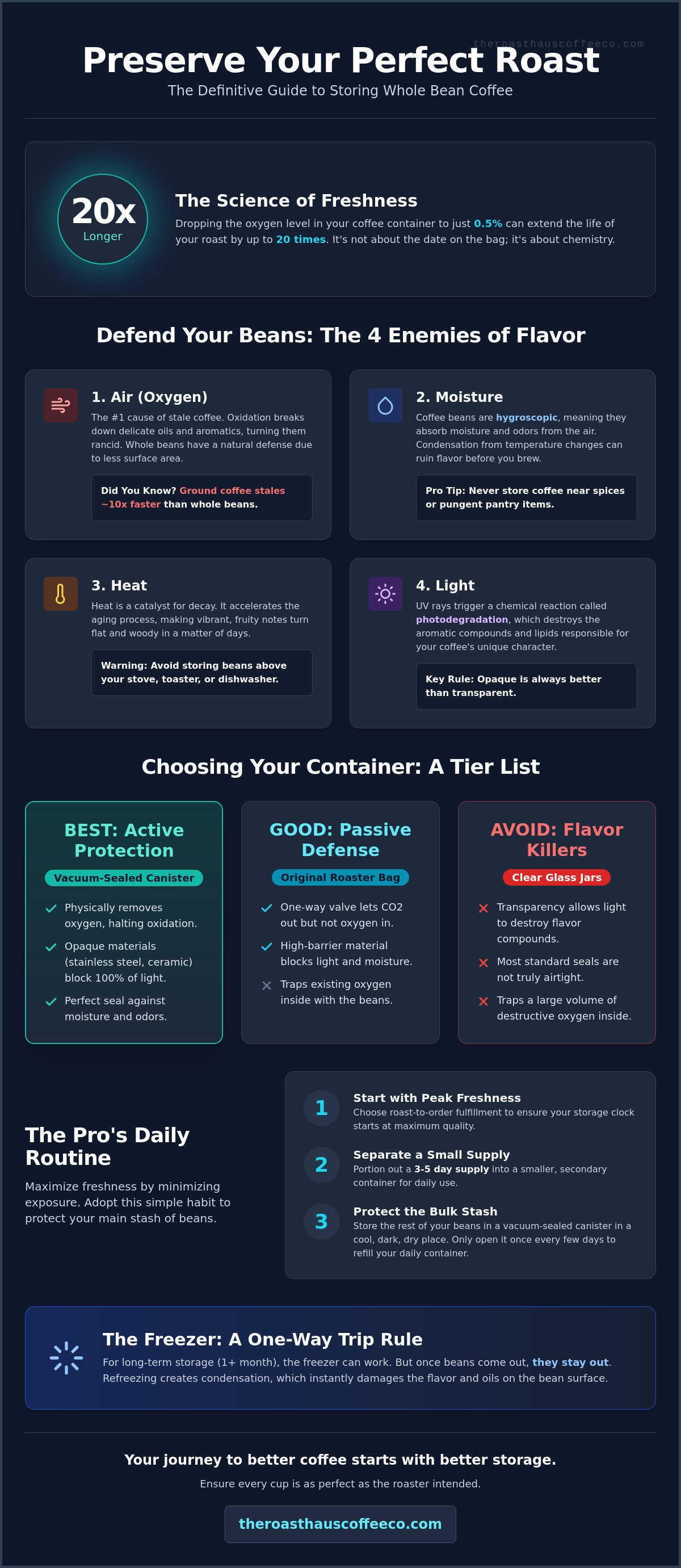
Did you know that dropping the oxygen level in your container to just 0.5% can extend the life of your roast by up to 20 times? Research from the Specialty Coffee Association proves that freshness isn't just about the date on the bag; it's about chemistry. If you're looking for the best way to store whole bean coffee, it's likely because you're tired of watching premium beans go stale. It's a waste of money when a bag of Kenya AA Supreme loses its vibrant, fruity notes and starts tasting flat after only a few days on the counter.
We believe every bean we roast deserves to be enjoyed at its peak. It's frustrating to settle for bitter coffee when you've invested in quality craftsmanship and independent business. This guide will teach you the exact science and simple routines needed to keep your beans tasting freshly roasted for weeks. We'll break down the four enemies of flavor and explain how to use tools like vacuum canisters to maintain peak quality for up to a month. You'll get a straightforward look at what works, what doesn't, and how to build a storage habit that honors the coffee you love.
Key Takeaways
- Identify the four natural enemies of flavor and learn why coffee acts like a sponge for unwanted kitchen odors.
- Discover why the best way to store whole bean coffee involves opaque, airtight canisters rather than clear glass jars.
- Understand the "one-way trip" rule for long-term freezing to prevent condensation from ruining your artisan beans.
- Adopt a roaster's daily routine by separating a small 3-5 day supply from the rest of your bulk stash.
- Learn how choosing roast-to-order fulfillment ensures you start with peak freshness before the storage clock even begins.
Understanding the Four Enemies of Coffee Freshness
Freshness is a measurable state of chemical integrity. To protect your flavor, you must defend it against four environmental threats: air, moisture, heat, and light. Understanding these elements is the first step in finding the best way to store whole bean coffee. Each factor works to strip away the complex notes in a bag of Ethiopia Limu Organic or Honduras Morning Splendeur. If you don't control these variables, your premium beans will lose their character within days.
Coffee beans are hygroscopic. They physically absorb moisture and odors from the air around them. This means your beans act like a sponge; it is the same reason they are used to reset the sense of smell in fragrance boutiques like عطررز. If you store your coffee near a spice rack or a pungent pantry item, your morning cup will take on those flavors. Oxidation is the primary cause of flavor degradation in roasted beans. As soon as the roasting process ends, the beans begin degassing. They release carbon dioxide (CO2). This gas acts as a protective shield that pushes oxygen away from the bean surface. High-quality bags feature a one-way valve for this reason. It lets the CO2 escape so the bag doesn't burst, but it prevents oxygen from entering. A bag that is slightly puffed is often a sign of very fresh, active beans.
The Science of Oxidation and Flavor Loss
Oxygen is the enemy of the delicate oils, or lipids, found inside the bean. These oils carry the aromatics that make a cup of Kenya AA Supreme so distinctive. When oxygen hits these oils, they break down and turn rancid. Whole beans have a smaller surface area than ground coffee, which provides a natural defense. Pre-ground coffee stales roughly 10 times faster because every tiny particle is exposed to the air. Keeping the bean whole is the best way to store whole bean coffee until the moment you brew. For a deeper look at how these plants are cultivated and processed globally, the history and production of coffee provides excellent context on the journey from farm to roaster.
Why Moisture and Heat are Silent Killers
Heat acts as a catalyst for chemical decay. It accelerates the aging process, making beans taste flat and woody. Moisture is equally destructive. If you move coffee between different temperature zones, you risk creating condensation. This moisture dissolves the flavorful solids on the surface of the bean before you even start brewing. Never store your coffee above the stove, near a toaster, or on top of a dishwasher. These areas are high-traffic zones for heat and humidity. A cool, dark, and dry cupboard is the minimum requirement for maintaining the integrity of your artisan roast.
Selecting the Ideal Storage Container for Whole Beans
Choosing the right vessel is as critical as the roast itself. Most people reach for a decorative glass jar, but transparency is a major flaw. Light triggers a chemical reaction called photodegradation. This process destroys the lipids and aromatics that give your morning cup its soul. If you want the best way to store whole bean coffee, prioritize opaque materials. Stainless steel and ceramic are excellent because they block 100% of UV rays. Plastic is acceptable if it is BPA-free and tinted, but it can absorb oils over time. These trapped oils can turn rancid and affect the flavor of your next batch.
You can evaluate any kitchen jar with a simple seal test. Close the lid and try to pull it off without releasing the latch. If you feel resistance or hear a "whoosh" of air, the gasket is doing its job. However, a simple seal only keeps new air out; it doesn't address the oxygen already trapped inside with your beans. For a high-quality experience, the container must do more than just sit there. It needs to defend the beans actively.
Airtight vs. Vacuum-Sealed Canisters
There is a big difference between passive airtight seals and active air-displacement systems. A standard jar is passive. It traps a pocket of oxygen right next to your beans. Active canisters, such as vacuum-sealed or plunger-style models, physically force the air out of the chamber. This reduces the oxygen concentration significantly. For those just starting their journey, understanding these technical details helps you appreciate the nuances of different varietals. You can learn more in our Coffee Beans: The Ultimate Beginner's Guide. Investing in a dedicated canister is worth it if you buy specialty beans and want them to last several weeks at peak flavor.
Reusing the Original Packaging
Don't dismiss the bag your coffee came in. Artisan roasters use high-barrier bags equipped with one-way degassing valves. These valves allow CO2 to escape without letting oxygen in. If you don't have a vacuum canister, keeping beans in their original valved bag is the next best way to store whole bean coffee. Squeeze as much air out as possible before sealing the bag tight. According to National Coffee Association guidelines, the goal is always to minimize exposure to the environment. Avoid thin paper bags. They lack a protective lining and are only suitable for a day or two of storage. If you're ready to put these storage tips to the test, browse our freshly roasted collections to find your next favorite roast.
The Freezer Debate: Long-Term Storage vs. Daily Use
The freezer is a polarizing topic in the coffee community. Many enthusiasts claim it destroys the bean, while others use it to build a library of rare roasts. The truth is simple: freezing is a powerful tool for long-term preservation, but it's a disaster for daily use. Never store your daily-use coffee in the refrigerator. The fridge is a damp environment filled with food odors. Because coffee is hygroscopic, it will absorb the scent of yesterday’s leftovers. This is never the best way to store whole bean coffee if you value the integrity of the roast. You'll end up with a cup that tastes like the back of a grocery store shelf instead of the vibrant Kenya AA Supreme you expected.
Freezing should be viewed as a one-way trip. When you move cold beans into room-temperature air, you trigger immediate condensation. This moisture settles on the surface of the beans and begins to degrade the oils. If you pull a bag out of the freezer every morning, you're essentially washing away the flavor before the bean even hits the grinder. Only use the freezer when you have more coffee than you can consume within three weeks. It's a strategy for bulk preservation, not a daily habit.
How to Freeze Coffee Correctly
If you must freeze, you need a plan. Standard packaging isn't enough to prevent freezer burn. You need a true vacuum seal to remove all air from the bag. This professional approach to preservation is the same standard used by Harvest to Home to ensure their flash-frozen, restaurant-quality meat and seafood stay perfectly fresh for home delivery. If you don't have a vacuum sealer, double-bag your coffee in heavy-duty freezer bags and squeeze out every bit of oxygen. Divide your bulk purchase into small, single-week portions. For bulk buyers, this portioning method is the best way to store whole bean coffee for months without losing the vibrant notes of the original roast. This allows you to thaw only what you need without disturbing the rest of your stash. When you're ready to use a portion, move it to the counter and wait. Do not open the seal until the beans have reached room temperature. This prevents moisture from forming on the cold beans.
Common Freezing Myths Debunked
A common myth is that freezing kills flavor. In reality, it pauses the aging process by slowing down the movement of volatile compounds. However, standard kitchen freezers aren't ideal for long-term storage because they have "defrost cycles." These cycles cause the temperature to fluctuate; this can lead to ice crystals forming inside the packaging. Deep-freezers that maintain a constant, sub-zero temperature are much more effective. Following the National Coffee Association guidelines ensures you avoid the moisture traps that ruin a good bag of Ethiopia Limu Organic. The fridge is never an option; it's too warm to stop aging and too wet to maintain dryness.
A Pro’s Routine for Daily Coffee Handling
Even the most expensive vacuum canister won't save your beans if your daily habits are sloppy. Every time you open a container, you invite fresh oxygen to start the oxidation process. To maintain peak flavor, you need a disciplined morning routine. The best way to store whole bean coffee for daily use is to adopt a two-tier system. This strategy protects your bulk investment while giving you easy access to your morning brew. It prevents you from exposing the entire bag to the air every single day.
Follow these four steps to preserve the integrity of your beans:
- Step 1: Transfer only a 3-5 day supply of beans into your primary daily container. This limits how many times the majority of your beans are exposed to the environment.
- Step 2: Seal the remainder of the original bag tightly, squeezing out as much air as possible. Store it in a cool, dark, dedicated cupboard far away from any heat sources.
- Step 3: Only grind the exact amount of beans you are about to brew. Once the bean is broken, the surface area increases, leading to instant flavor loss.
- Step 4: Work quickly. Minimize the time the container lid is open. Scoop your beans and seal the lid immediately before you even turn on the scale or grinder.
Grinding Fresh for Every Cup
Grinding is the point of no return for coffee freshness. Within minutes of grinding, the volatile aromatics that define a specialty roast begin to vanish. If you want to experience the full depth of our Kenya AA Supreme, you must grind right before the water hits the grounds. You can explore the mechanics of this in The Ultimate Guide to Coffee Grinders. If you accidentally grind too much, don't throw it away. Store the leftovers in a small, airtight jar and use them for cold brew the next day. Cold brew is more forgiving of slightly aged grounds than a hot pour-over.
Optimizing Your Brewing Environment
Where you brew is just as important as how you store. Many people keep their coffee canister right next to their espresso machine or kettle. This is a mistake. Steam-producing appliances create a micro-climate of heat and humidity that can penetrate even decent seals over time. Keep your storage area dry and stable. Additionally, you must keep your containers clean. Coffee beans leave behind oils that can turn rancid. If you don't wash your canister between batches, those old oils will taint your fresh Ethiopia Limu Organic. For more tips on perfecting your setup, check out How to Make Coffee: The Ultimate Guide. Ready to taste the difference that fresh handling makes? Order The All Day Sampler and start your new routine today.
Why Roast-to-Order is the Secret to Coffee Storage Success
Storage techniques only matter if the coffee you start with is actually fresh. Most grocery store bags feature a "Best By" date that is often set months or even a year after the beans were roasted. By the time you buy them, the volatile oils have already begun to oxidize inside the bag. The best way to store whole bean coffee is to ensure the storage clock starts the moment the beans leave the roaster. When you start with a bag of Honduras Morning Splendeur that was roasted yesterday, you have a much wider margin for error. Even a minor storage mistake won't ruin the cup because the beans are still at their peak chemical integrity.
At Roast Haus Coffee Co., we ship our beans within 24 hours of roasting. This timing is critical because coffee has a specific flavor timeline. For most origins, the "sweet spot" for flavor is between days 3 and 14 after roasting. During this window, the beans have finished their initial heavy degassing but still retain their full aromatic complexity. Starting with roast-to-order beans means you receive your coffee exactly when it enters this peak period. You aren't fighting a losing battle against months of shelf-aging.
The Advantage of Small-Batch Roasting
Our process is rooted in Wyandotte, Oklahoma, where we focus on small-batch craftsmanship. This isn't just about tradition; it's a chemical reality. Small batches allow for precise temperature control, ensuring every bean in the bag is roasted evenly. This consistency makes your storage routine more effective because you aren't dealing with unevenly aged beans. To make this process even easier, many of our customers use our monthly coffee subscription. It automates your freshness cycle, delivering a new bag just as your previous one reaches its limit. This ensures you never have to settle for stale beans again.
From Our Roastery to Your Kitchen
We take pride in our direct-to-consumer model. Whether it's a bag of Kenya AA Supreme or Ethiopia Limu Organic, the journey from our roastery to your kitchen is short and transparent. We don't use middle-men or warehouse storage. This commitment to quality means you get honest advice and a product that lives up to its promise. Proper storage is the final step in a journey that starts with ethical sourcing and careful roasting. Now that you know the best way to store whole bean coffee, it's time to put those habits to use with a fresh batch. Shop our freshly roasted-to-order coffee beans and experience the difference that true freshness makes in every cup.
Protect Your Daily Brew
Mastering the best way to store whole bean coffee is the final step in honoring the craftsmanship of specialty roasting. By defending your beans against air, light, heat, and moisture, you ensure every cup tastes exactly as the roaster intended. Remember to prioritize opaque, vacuum-sealed containers and keep your daily supply separate from your bulk stash. These simple habits prevent oxidation and keep those delicate lipids from turning flat or bitter. You've invested in quality; it's only right to protect that investment through better handling.
The most effective storage routine starts with the right product. At Roast Haus Coffee Co., we focus on small-batch artisan quality from our home in Wyandotte, Oklahoma. We ship our beans within 24 hours of roasting to ensure they arrive at your door during their peak flavor window. This direct-to-consumer model means you never have to settle for stale grocery store shelves again. It's about honesty, integrity, and a better experience for you. Experience the difference of roasted-to-order coffee at The Roast Haus and take control of your morning ritual. We are proud to support your journey toward the perfect cup.
Frequently Asked Questions
Is it better to store coffee beans in the fridge or freezer?
The freezer is better for long-term storage, but the fridge is never a good option. Refrigerators are humid and full of food odors that coffee beans easily absorb. If you use the freezer, ensure the beans are in a vacuum-sealed bag. Only take them out when you are ready to use the entire portion. Moving beans back and forth causes condensation that ruins the flavor.
How long do whole bean coffee beans stay fresh after opening?
Whole bean coffee stays at its peak flavor for 2 to 4 weeks after the bag is opened. After this window, the aromatic oils begin to dissipate and the flavor turns flat. Using a vacuum-sealed canister is the best way to store whole bean coffee to reach that 4-week mark. Once you grind the beans, the freshness window shrinks to just a few minutes.
Can I store coffee in its original bag?
You can store coffee in its original bag if it has a one-way degassing valve. These valves let carbon dioxide escape while preventing oxygen from entering. Squeeze as much air as possible out of the bag before sealing it tight with a clip. While a dedicated canister is superior, the original artisan bag is a solid secondary option for short-term use over a few days.
Does light really affect the taste of my coffee?
Light significantly degrades the quality of your coffee through a process called photodegradation. UV rays break down the chemical compounds and lipids responsible for the bean's unique flavor profile. This is why you should avoid clear glass jars. Always choose opaque containers made of stainless steel or ceramic to keep your beans in total darkness. Darkness is essential for preserving delicate notes.
What is the best type of container for storing whole bean coffee?
The best container is an opaque, airtight vessel with an active air-displacement system. This includes vacuum canisters or plunger-style containers that physically push oxygen out of the chamber. Stainless steel is the preferred material because it is durable and does not absorb old oils. This setup is widely considered the best way to store whole bean coffee for maintaining true artisan quality.
Should I grind my coffee all at once or as I need it?
Always grind your coffee as you need it. Grinding increases the surface area of the bean by thousands of times, exposing it to immediate oxidation. If you grind a whole bag at once, it will taste stale by the second day. For the best experience with a specialty roast like our Ethiopia Limu Organic, grind only the exact amount you plan to brew right now.
How can I tell if my coffee beans have gone stale?
You can tell if coffee is stale by its aroma and its behavior during the brewing process. Fresh beans have a vibrant, punchy scent, while stale beans smell flat, dusty, or like old cardboard. During brewing, fresh coffee "blooms" or bubbles as it releases gas. If your grounds sit still when hit with hot water, the beans have lost their gas and their freshness.
Does the roast level affect how I should store the beans?
Roast level does affect storage because dark roasts are more porous and have more surface oils. These oils are highly susceptible to oxidation and can turn rancid quickly. Darker beans generally stale faster than light roasts. If you prefer a dark roast, be even more diligent about keeping your container airtight and away from heat sources. This protects the fragile oils from spoiling your cup.

