


What if the bitterness you've come to expect from your morning shot isn't a feature, but a flaw? Most coffee drinkers accept that burnt, charcoal-like taste as the standard price for a caffeine boost. You've likely spent $20 on a bag of dark beans only to end up with a cup that feels heavy and harsh. It's frustrating when you're searching for the unique, vibrant notes of a blonde espresso but only find bitterness in your portafilter.
You deserve a cleaner, more flavorful cup. This guide will show you how to enjoy a smoother experience with a bright, citrusy profile that traditional roasts simply can't match. Because we roast these beans to approximately 400 degrees Fahrenheit instead of the traditional 440 degrees, they retain about 5% more caffeine and far more of their original character. We'll explain the real differences between blonde and light roasts so you know exactly what to buy. You'll also learn the specific techniques needed to brew these beans at home without any sourness, ensuring every shot meets our high artisan standards.
Key Takeaways
- Understand the smooth, citrusy profile that makes this light roast the perfect choice for those who want to avoid "burnt" or bitter flavors.
- Learn how the science of the "first crack" preserves natural sweetness and higher caffeine levels in every artisan bean.
- Master the specific grind and temperature adjustments needed to brew a perfect blonde espresso shot at home.
- Discover why our "Roasted to Order" mantra is vital for protecting the delicate flavors of light roasts from rapid oxidation.
- Identify the key differences in body and mouthfeel between artisan light roasts and traditional dark espresso.
What is Blonde Espresso? Defining the Light Roast Profile
Blonde espresso is a light-roasted coffee bean selected and ground specifically for high-pressure espresso extraction. Traditionally, espresso meant dark, oily beans that produced a heavy, smoky cup. Blonde espresso changes that approach entirely. It focuses on the bean's inherent characteristics rather than the flavors created by the roasting machine itself. This style gained massive traction in 2012 when major coffee chains began offering it as a permanent menu item, but artisan roasters have championed these vibrant profiles for much longer. It's a shift from the traditional "roasty" flavor toward something more delicate and complex.
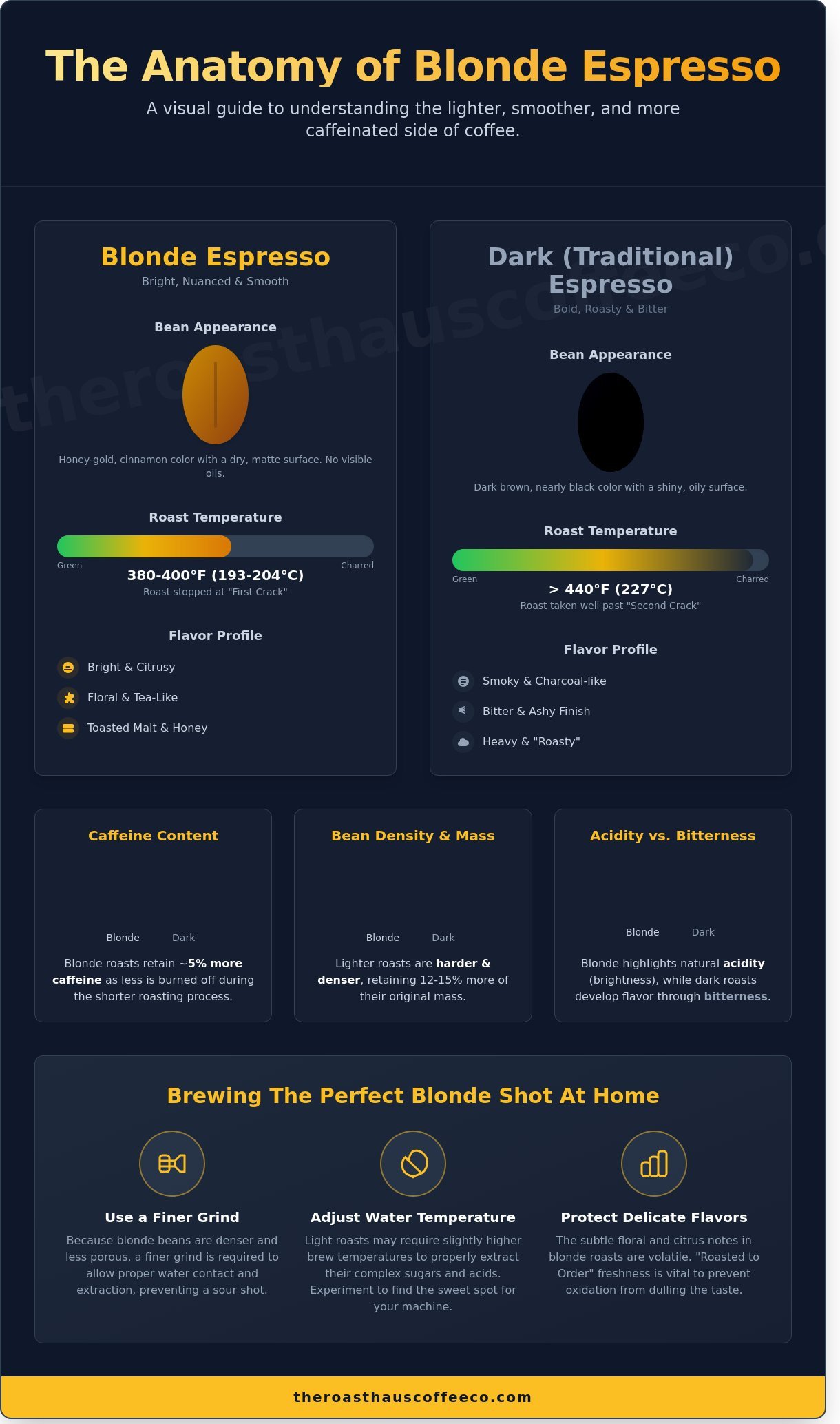
The visual differences are striking. You can spot a blonde roast by its honey-gold or cinnamon color. These beans have a matte finish because the internal oils haven't been forced to the surface by high heat. In a dark roast, oils migrate to the exterior at temperatures exceeding 440 degrees Fahrenheit. To understand why these beans look and taste different, we have to look at The Science of Roasting, which explains how heat transforms the chemical structure of the seed. Blonde roasts are pulled from the drum shortly after the "first crack," usually between 380 and 400 degrees Fahrenheit. This preserves the bean's physical integrity and its natural sugars.
Drinkers are making the switch to blonde espresso for its clarity. It doesn't hide behind a wall of bitterness or carbon. Instead, it offers a brighter, more acidic experience that highlights the specific origin of the bean. If you're drinking a bean from Ethiopia or Colombia, the blonde roast lets those unique regional traits shine through. It's a cleaner cup that feels lighter on the palate while still delivering a concentrated caffeine kick. Many find it's easier to drink black because it lacks the harsh finish associated with over-roasted commercial beans.
The "Blonde" vs. Light Roast Distinction
Many people ask if "blonde" and "light roast" are the same thing. In the specialty coffee world, these terms are often used interchangeably. However, "blonde" specifically signals that the roast is balanced for espresso machines. A standard light roast might be too acidic for a 9-bar extraction. Roasters develop blonde profiles to ensure the bean is soluble enough to produce a rich crema without being sour. Density matters here too. Light-colored beans are harder and denser than dark ones because they retain 12% to 15% more of their original mass. This requires a finer grind setting to get the extraction just right.
Flavor Profile: What to Expect in the Cup
A shot of blonde espresso offers a completely different sensory experience than a dark roast. You'll taste primary notes of citrus, floral tea, honey, and toasted malt. The smoky, ashy bitterness is almost entirely absent. This profile makes it incredibly versatile for modern drinks. When you add milk, the blonde roast doesn't fight against the creaminess; it complements it. In an oat milk latte, the cereal notes of the grain pair perfectly with the toasted malt flavors of the espresso. At The Roast Haus Coffee Co., we believe in small-batch roasting to lock in these delicate sugars. Our roasted-to-order philosophy ensures that these subtle floral notes don't oxidize before they reach your portafilter. You get the peak flavor potential every time you brew.
The Science of Roasting Blonde Espresso Beans
Roasting coffee is a precise thermal event that requires exact timing. We focus on the First Crack, which is a physical popping sound that occurs when internal steam pressure breaks the bean's cell walls. This usually happens at approximately 395 degrees Fahrenheit. While traditional espresso roasts continue through a second crack, we pull our blonde espresso right at the start of the first. This specific timing preserves the cell structure and the unique characteristics of the coffee's origin.
The flavor profile depends on the Maillard reaction. This chemical fusion between amino acids and reducing sugars creates hundreds of aromatic compounds. We manage the heat to balance these sugars without reaching carbonization. In a standard 12 minute roast cycle, the sugars begin to caramelize, but they don't burn. This prevents the bitter, ashy notes found in mass-produced coffee. Our small-batch approach allows us to monitor the drum temperature every 30 seconds. This ensures the heat penetrates the center of the bean, which eliminates the "grassy" taste often found in poorly managed light roasts.
Density plays a major role in how you brew your cup. Light roasted beans are physically harder and heavier than dark roasts. During the roasting process, a bean might lose only 14 percent of its weight to moisture evaporation. In contrast, dark roasts often lose 22 percent or more of their mass. This makes blonde beans less porous and more difficult to dissolve. When you pull a shot, you are working with a denser material that requires a finer grind and a precise water temperature to extract the full flavor potential. If you want to experience this density and flavor for yourself, you can order a bag of our artisan light roast today.
Does Blonde Espresso Have More Caffeine?
A common misconception is that dark roasts are more powerful. In reality, caffeine molecules remain stable until they reach 455 degrees Fahrenheit. Most roasters never hit that temperature, so the caffeine doesn't burn off. When comparing Blonde Espresso vs. Regular Espresso, the difference comes down to mass. Because blonde beans are denser, a 20 gram dose of light roast contains more physical coffee material than a 20 gram dose of dark roast. While caffeine stays stable during the roast, the high density of blonde beans leads to a more potent shot per gram.
Acidity vs. Bitterness: The Chemical Balance
Specialty coffee enthusiasts prize "bright" acidity. This isn't the same as sourness. It is a vibrant, crisp quality caused by organic acids like citric and malic acid that exist naturally in the coffee cherry. Shorter roast times preserve these delicate compounds. We also focus on chlorogenic acids, which provide the complex, tea-like finish that defines the blonde espresso experience. By stopping the roast early, we keep these acids intact rather than breaking them down into the bitter quinic acids found in darker, oily beans. This results in a cup that is sweet and clean rather than heavy and charred.
Blonde Espresso vs. Regular Espresso: A Direct Comparison
Understanding the difference between these two roasts starts with the physical transformation of the bean. A traditional dark espresso roast is oily, heavy, and pungent. It feels syrupy on the tongue, often leaving a thick coating. This happens because the beans reach internal temperatures of 440 degrees Fahrenheit, which forces natural oils to the surface. In contrast, blonde espresso is clean and light. Its mouthfeel is more akin to a structured tea than a heavy syrup. Because we pull these beans from the roaster at approximately 400 degrees, the cell structure remains intact. This preserves the brightness that dark roasts sacrifice for intensity.
Bitterness is the primary reason many people avoid straight espresso. Most "regular" espresso relies on carbonization to create flavor, which often results in a burnt or ashy taste. Blonde roasts provide a welcoming entry point for those with sensitive palates. Instead of charcoal notes, you taste the actual fruit. The Science of Roasting shows that shorter roast times preserve a higher concentration of organic acids. These acids translate to vibrant, citrus-like flavors rather than bitter ones. You don't have to hide the taste of the bean behind a wall of smoke.
Sugar requirements change drastically when you switch to a lighter roast. In a 2024 survey of specialty coffee shops, 58% of baristas noted that customers using blonde beans requested half the usual amount of syrup. The natural fruitiness of a light roast provides its own sweetness. You'll find notes of lemon, apple, or toasted malt that disappear in darker roasts. This makes it an ideal choice for health-conscious drinkers who want to enjoy coffee without the caloric load of added sweeteners.
Choosing the Right Roast for Your Drink
Your choice of roast should depend on what you're adding to the cup. For Americanos, blonde espresso is the clear winner. The added hot water acts like a magnifying glass for the coffee's subtle floral notes. It creates a complex, drinkable cup that doesn't feel heavy. If you prefer a Macchiato, stick with a dark roast. You need those bold, smoky flavors to pierce through even small amounts of milk foam. The milk will simply drown out the delicate profile of a lighter roast.
The "Iced Latte" test is where the blonde espresso truly shines. Industry forecasts for 2026 predict that light roast espresso will account for 65% of all cold coffee sales. Cold temperatures often mute the flavor of dark roasts, making them taste flat or bitter. A light roast maintains its acidity even when chilled. It pairs perfectly with oat milk or almond milk, highlighting the nuttiness of the dairy alternative rather than fighting against it.
Bean Origin and the Blonde Profile
Not every bean is suited for a light roast. We've found that high-altitude beans from East Africa are the most resilient. Ethiopian and Kenyan beans are dense enough to withstand the heat while retaining their complex sugars. Our Kenya AA Supreme: Bold Flavors From The Roast Haus is a perfect example. It offers a wine-like acidity that only a careful blonde roast can highlight. South American origins, particularly from Brazil, provide the essential nutty base for our blonde blends. We roast these beans to order in small batches to ensure that every citrus and cocoa note reaches your door at peak freshness.
How to Brew the Perfect Blonde Shot at Home
Brewing blonde espresso at home requires a technical shift from traditional dark roast methods. Light roast beans are physically denser because they spend less time in the roaster and retain more moisture. This density makes them harder to extract. You cannot treat these beans like a standard oily Italian roast; you must adjust your variables to unlock the hidden sugars and floral complexity. Following a precise routine ensures you don't end up with a cup that is unpleasantly sharp or thin.
Step 1: Adjust your grind size. You need a finer setting than you'd use for medium or dark roasts. Because the beans are dense, they offer less resistance to water flow. A finer grind increases the surface area and slows down the water, allowing for a thorough extraction. If your shot runs too fast, your coffee will taste salty or sour.
Step 2: Increase your water temperature. Heat is a catalyst for extraction. While 195°F works for dark roasts, blonde espresso needs a temperature between 200°F and 205°F. This higher heat helps break down the tough cellular structure of the light-roasted bean. If your machine allows for PID temperature control, set it to 203°F as a starting point.
Step 3: Extend the brew ratio. The traditional 1:2 ratio often fails with light roasts. Instead, try a 1:2.5 ratio. For example, if you put 18 grams of grounds in your portafilter, aim for 45 grams of liquid espresso in your cup. This extra volume provides more water to pull out the sweetness that balances the natural acidity of the bean.
Step 4: Use filtered water. Since espresso is 98% water, the mineral content matters. Tap water often contains chlorine or heavy minerals that mask delicate citrus and floral notes. Use a high-quality water filter to ensure a clean canvas for your coffee's flavor profile.
Dialing In: Troubleshooting Sour Shots
Under-extracted blonde espresso often tastes like "sour lemon" or has a metallic finish. To fix this, use the Salami Shot technique. Line up three cups and swap them every 10 seconds during a single 30-second pull. Taste each cup individually. You'll notice the first is highly acidic, the second is sweet, and the third is thin. This helps you identify exactly when the sweetness peaks so you can stop your brew at the right moment. If the sourness persists, increase your brew time by three seconds or slightly lower your pump pressure to 8 bars to prevent channeling.
Equipment Considerations for Light Roasts
Your equipment must be up to the task. High-density beans require a high-quality burr grinder with sharp, consistent burrs. Entry-level grinders often produce "fines" that clog the filter or "boulders" that lead to under-extraction. Similarly, many basic home machines lack the thermal stability to maintain 205°F throughout the shot. If your machine struggles, pre-heat your portafilter and group head by running a blank shot of hot water before brewing. For more details on preparation, see our guide on How to Grind Coffee Beans for Optimal Flavor.
We believe that every home barista can master these techniques with the right beans. If you are ready to experience the difference that fresh, small-batch roasting makes, shop our fresh roasted light roasts today and start brewing like a professional.
Why Freshness is the Secret to Great Blonde Espresso
Oxidation is the primary enemy of high-quality coffee. Light roasts are particularly vulnerable to this process because they retain more of the bean's original organic compounds and volatile oils. When these compounds meet oxygen, they begin to degrade immediately. A blonde espresso relies on bright, floral, and citrus notes that provide its signature "sparkle." These delicate flavors are the first to vanish when beans sit on a shelf. Within just 30 days of roasting, a light roast can lose up to 40% of its aromatic intensity if not handled correctly.
At The Roast Haus Coffee Co., we operate with a "Roasted to Order" mantra. We don't keep bins of pre-roasted beans waiting for a buyer in a warehouse. Most grocery store brands sit in distribution centers for 90 to 180 days before they ever reach a retail shelf. By the time you grind those beans, the natural oils have often turned flat or rancid. Our small-batch method ensures your beans are active and full of life when they arrive at your door. You'll notice the difference in the thick, golden crema that only fresh beans can produce.
You can protect your artisan beans by following a few simple storage rules. Keep your coffee in an airtight, opaque container to block out light and oxygen. Avoid the refrigerator or freezer, as moisture and fluctuating temperatures will ruin the flavor profile. Store your container in a cool, dark pantry away from the stove or direct sunlight. These steps ensure the complex acids in your blonde espresso stay vibrant until the last scoop.
- Oxygen: Use a vacuum-sealed canister to remove air.
- Light: Never store beans in clear glass jars on the counter.
- Heat: Keep beans away from ovens, toasters, and sunny windowsills.
- Moisture: Ensure the storage area stays dry to prevent condensation inside the bag.
From Our Roaster to Your Door in 24 Hours
The timeline of flavor is precise. Day 3 to day 14 after roasting is the absolute peak for brewing. During the first 48 hours, beans release excess carbon dioxide that can interfere with water saturation. By day 3, the flavors have stabilized and reached their full potential. We ship your order within 24 hours of roasting so that the coffee arrives exactly when it enters this peak window. This speed preserves the higher nutritional content and antioxidants that are naturally more abundant in light roasts. When you buy from us, you're supporting a small, family-owned business that values quality over corporate mass production.
Try Our Light Roast Selection
Our Ethiopia Limu is a standout candidate for anyone looking to brew a world-class blonde espresso. It features distinct notes of jasmine and bright citrus that only a fresh, artisan roast can maintain. If you want to explore how roast levels affect the bean, our All-Day Sampler is the perfect tool. It allows you to compare our light, medium, and dark roasts side-by-side to see how our "Roasted to Order" philosophy changes the experience. You'll taste the clarity and care that goes into every small batch we produce.
Elevate Your Morning with Fresh Artisan Roasts
Choosing a blonde espresso means you're prioritizing the bright, citrus-forward flavors that only a precise light roast can offer. You've learned that the secret to a perfect shot isn't just the grind size; it's the time elapsed since the roast. At The Roast Haus Coffee Co. in Wyandotte, Oklahoma, we focus on the science of freshness to eliminate the bitter, burnt notes common in mass-produced beans. Every bag is part of a 100% small-batch artisan process that respects the bean's natural profile. We roast your coffee to order and ensure it's shipped within 24 hours of leaving the roaster. This ensures you receive your beans at their absolute peak flavor potential. You deserve a cup that reflects the precision of our family-owned craft. Stop settling for stale, over-roasted coffee from a grocery store shelf that has sat for months. It's time to transform your home kitchen into a high-end coffee house with beans that are actually fresh. We're proud to be a local business that treats every single roast with the care it deserves.
Shop Our Freshly Roasted Small-Batch Coffee Beans
We're excited to help you brew the best cup of your life.
Frequently Asked Questions
Is blonde espresso stronger than regular espresso?
Blonde espresso is often stronger in caffeine than dark roasts because the beans are denser. When measured by volume, a 2017 study found light roasts can contain 15% more caffeine than traditional dark roasts. Darker roasts lose more mass during the heating process, which reduces the caffeine concentration per bean. It tastes milder, but the kick is more intense for your morning routine.
Why does my blonde espresso taste sour?
Your coffee tastes sour because of under-extraction, which happens when the water doesn't pull enough flavor from the grounds. Light roasts are harder to extract than dark roasts because they're less porous. To fix this, increase your water temperature to 203 degrees Fahrenheit or use a finer grind setting. This helps the water penetrate the dense bean structure effectively, avoiding the sourness found at 190 degrees.
Can I use regular light roast coffee beans for blonde espresso?
You can use any high-quality light roast beans for your drink. The name refers to a roast profile where beans are pulled at a temperature around 400 degrees Fahrenheit, just before the second crack. We recommend using fresh, small-batch beans to ensure the floral and citrus notes remain intact. Just ensure your grinder is set for the increased hardness of a light roast bean.
Does blonde espresso have more sugar?
It doesn't have added sugar, but it retains more natural sucrose than dark roasts. During the roasting process, sugars begin to break down and caramelize at 320 degrees Fahrenheit. Since this light roast is heated for a shorter duration, more of the 6% to 9% natural sugars remain in the bean. This results in a sweeter, brighter profile compared to the smoky bitterness of longer roasts.
What is the best milk for blonde espresso lattes?
Oat milk is the best choice because its creamy texture balances the high acidity of the roast. A 2021 consumer survey showed that 45% of specialty coffee drinkers prefer oat milk for its ability to mimic dairy without masking delicate flavors. If you prefer dairy, use whole milk with a 3.25% fat content. The fat coats the tongue and rounds out the citrus notes perfectly.
How should I store blonde espresso beans to keep them fresh?
Store your beans in an opaque, airtight container at a room temperature of 68 degrees Fahrenheit. Oxygen is the enemy of freshness, and beans begin to lose their peak flavor profile within 14 days of roasting. Avoid the refrigerator, as moisture can damage the cell structure of the bean. Our roasted to order philosophy ensures you receive beans that haven't sat on a shelf for months.
Is blonde espresso better for people with sensitive stomachs?
It's generally not better for sensitive stomachs because light roasts have a higher acid concentration. A study published in the Journal of Agricultural and Food Chemistry noted that dark roasts contain N-methylpyridinium, which helps suppress stomach acid. This light roast has a pH level near 4.5, while darker roasts sit closer to 5.1. If you struggle with acid reflux, a darker roast might be a safer choice.
Does The Roast Haus offer a blonde espresso roast?
We provide several artisan light roasts that are perfect for your home espresso machine. Every bag is roasted to order and shipped within 24 hours to ensure you experience the full flavor potential of the beans. We focus on small-batch production to maintain strict quality control. This process guarantees a bag of blonde espresso that's significantly fresher than any mass-produced coffee found on a grocery store shelf.

