


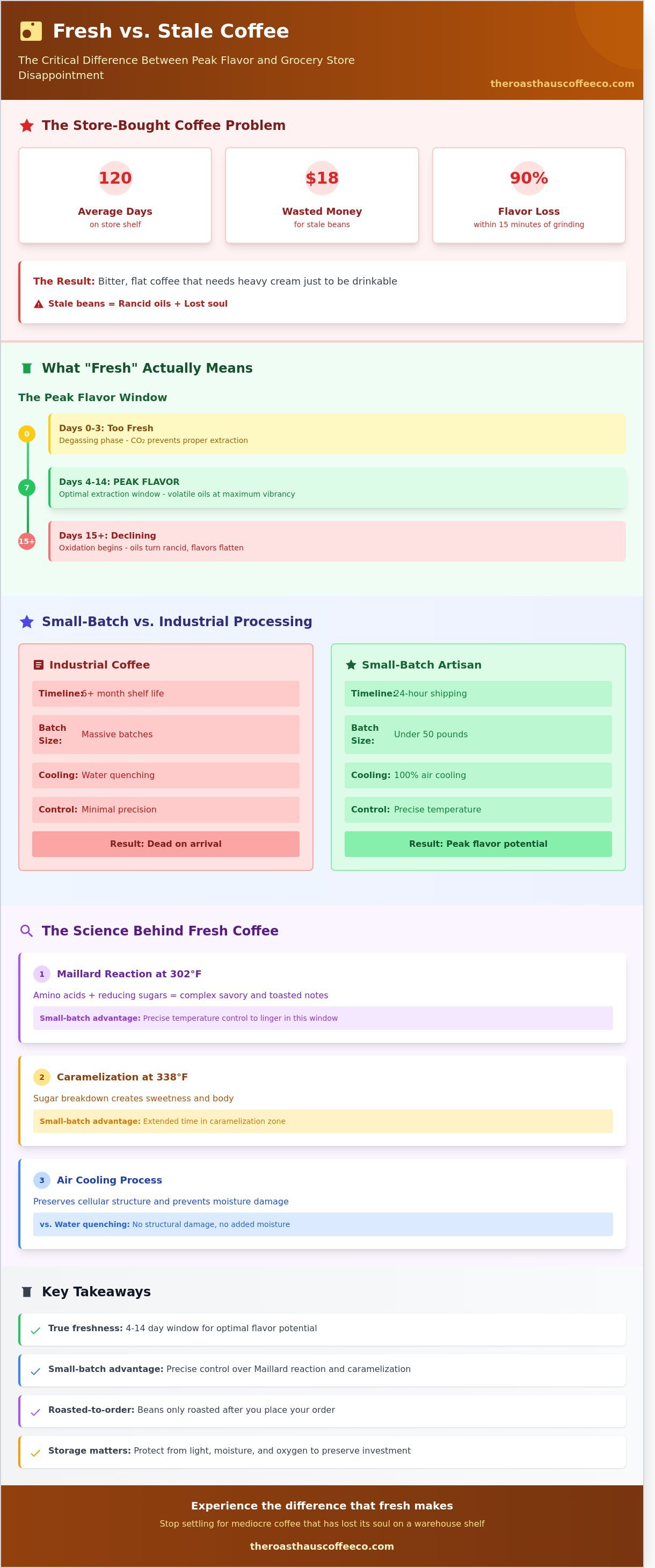
Most "premium" coffee bags spend an average of 120 days on a store shelf before you ever touch them. By the time you brew it, the beans are stale and the delicate oils have often turned rancid. You probably know the feeling of spending $18 on a bag only to end up with a bitter, flat cup that needs heavy cream just to be drinkable. It is frustrating to pay for quality and receive a product that lacks life. If you are tired of dull flavors, switching to artisan freshly roasted coffee ensures your morning brew reaches its peak flavor potential through careful, small-batch processing.
At The Roast Haus Coffee Co., we believe you shouldn't have to guess when your beans were prepared. This guide will show you why roasted-to-order beans are the only way to experience the true potential of every origin. We'll break down how to choose the right roast for your palate and explain why supporting a small, family-owned business ensures you get peak freshness and richer nutritional content. You're about to learn how to find a reliable source for fresh beans and finally stop settling for mediocre coffee that has lost its soul on a warehouse shelf.
Key Takeaways
- Learn the definition of true freshness and why coffee roasted coffee within a 4-14 day window offers the best flavor potential.
- Discover how small-batch profile roasting unlocks rich caramelization and natural oils that mass-produced grocery store beans cannot match.
- Understand the differences between roast levels and single-origin terroirs to help you choose the beans that best fit your palate.
- Master the "Golden Rule of Storage" to protect your investment and keep your beans away from flavor-killing elements like light and moisture.
- See how our "Roasted to Order" guarantee ensures your coffee is never roasted until the moment you place your order.
What Does 'Freshly Roasted Coffee' Actually Mean?
Freshness in the coffee world isn't a vague marketing term. It's a specific window of time where the bean's chemical properties are at their absolute peak. For a professional roaster, fresh roasted coffee refers to beans used within 4 to 14 days of the roast date. During this period, the organic compounds and volatile oils are most vibrant, providing the rich sensory experience that coffee lovers crave. When you choose high-quality coffee roasted coffee from an artisan source, you're prioritizing chemistry over convenience.
Commercial coffee found on grocery store shelves is often dead on arrival. These bags frequently sit in warehouses and on display for 180 days or more. While the coffee is technically safe to drink, the soul of the bean has vanished. By the time you break the seal on a mass-produced bag, the complex sugars have broken down and the vibrant acidity has turned flat. You're left with a bitter, one-dimensional cup that requires cream and sugar to be palatable.
The science of freshness starts the moment the beans leave the drum. During the roasting process, beans undergo intense physical and chemical changes that trap carbon dioxide inside their cellular structure. This comprehensive guide to coffee explains how the roasting process transforms the green seed into the aromatic bean we recognize. After roasting, the beans begin a process called degassing. If you brew coffee that's too fresh, the escaping carbon dioxide creates a gas barrier that prevents water from fully extracting the flavor, often resulting in a metallic or sour taste.
Oxidation acts as the final enemy of quality. Once the beans are exposed to oxygen, the delicate oils that carry the aroma begin to go rancid. Pre-ground coffee is particularly vulnerable, losing up to 90 percent of its peak flavor within just 15 minutes of grinding. Small-batch roasting protects these oils by keeping the beans whole and moving them to the customer quickly, ensuring the flavor stays in the bean until it hits your grinder.
The Peak Flavor Window
You shouldn't brew coffee the second it drops from the roaster. Most beans need a resting period of 3 to 5 days to settle. The sweet spot for most origins is the 7-to-21-day window. This is when the degassing has slowed enough to allow for optimal extraction, but oxidation hasn't yet dulled the profile. You can identify stale beans by a lack of oily sheen on dark roasts or a dull, cardboard-like scent. During brewing, fresh coffee will "bloom" or bubble vigorously as gas escapes; stale beans will simply sit flat and lifeless.
Industrial vs. Artisan Timelines
Large corporations rely on a 6-month shelf life to maintain their global supply chains. They often use nitrogen flushing to push oxygen out of the bags, but this is a temporary fix that can't replicate the vibrancy of a recent roast. We operate on a different scale, focusing on a 24-hour shipping promise to ensure your beans arrive exactly when the flavor window opens. We believe the distance between the roaster and your doorstep should be as short as possible. Roasted-to-order is the process where the roaster only fires the drum after an order is placed.
- Commercial: Roasted in massive batches and stored for months.
- Artisan: Roasted in small batches and shipped within 24 hours.
- Result: A cup that features the true characteristics of the farm and soil.
The Small-Batch Advantage: Why Roasting Process Matters
Small-batch roasting isn't a marketing gimmick; it's a technical requirement for high-quality coffee. When we roast in quantities under 50 pounds, we maintain total control over the thermodynamic environment inside the drum. This precision allows us to trigger the Maillard reaction at exactly 302°F. This chemical reaction between amino acids and reducing sugars creates the complex savory and toasted notes that define a great cup. Following this, caramelization begins around 338°F, where sugars break down to create sweetness and body. In a small-batch environment, we can linger in these windows for seconds longer to pull out specific flavor notes that would be lost in a massive industrial heater.
The cooling process is just as critical as the heating phase. We utilize 100% air cooling to bring the beans down to room temperature quickly. Many commercial operations use water quenching, which involves spraying the hot beans with a fine mist. While this stops the roast instantly and adds 2% to 5% back to the harvest weight, it damages the cellular structure of the bean and introduces moisture that leads to rapid staling. Our air-cooling method preserves the integrity of the bean, ensuring your coffee roasted coffee remains stable and flavorful. Because we focus on preserving these delicate oils, how you handle the beans after they arrive is vital. A scientific study on coffee storage shows that temperature fluctuations can quickly degrade the chemical compounds we work so hard to develop during the roast.
Mastering the Drum Roaster
Our drum roasters function like a giant, precision-controlled oven that keeps beans in constant motion. This movement ensures even heat application, preventing the scorched spots common in inferior roasting methods. We track the "First Crack" at approximately 380°F, which is the audible sound of steam escaping the bean as it expands. For darker roasts, we monitor for the "Second Crack" near 440°F, where the cellular matrix begins to fracture. Our roasters monitor temperature curves to the second, adjusting gas pressure and airflow to match the unique moisture content of every harvest. This level of detail ensures that every bag of coffee roasted coffee we produce meets our exact quality standards.
The Problem with Mass Production
Industrial roasters prioritize throughput over taste. They often process 500 to 1,000 pounds in a single cycle, using temperatures exceeding 550°F to finish a roast in under 6 minutes. This aggressive heat flash-cooks the outside of the bean while leaving the inside underdeveloped, resulting in a cup that tastes both burnt and sour. These high-volume methods destroy the unique origin characteristics, like the citrus notes of an Ethiopian Yirgacheffe or the chocolate undertones of a Guatemalan bean. We choose a slower, 12 to 15-minute roast profile to let those flavors mature naturally. You can find a deeper breakdown of these differences in our Artisan Roasting Guide.
We believe that you deserve a product that reflects the hard work of the farmers who grew it. By sticking to small batches, we guarantee that our "Roasted to Order" promise isn't just a slogan, it's our standard operating procedure. If you want to taste the difference that careful heat management makes, browse our current roasts to find your perfect match.
Choosing Your Roast: From Single-Origin to Signature Blends
Roast level isn't just a color palette; it's a precise chemical transformation that defines every sip you take. At The Roast Haus Coffee Co., we believe the best cup starts with small-batch precision. We roast every bag to order because coffee begins to lose its aromatic complexity within 14 days of roasting. This ensures your coffee roasted coffee arrives with its full nutritional and flavor profile intact. While an estimated 64% of American adults drink coffee daily, many don't realize that the roasting process is what unlocks the 800 plus aromatic compounds hidden inside a green bean.
Light roasts usually stop before the "first crack," a physical sound beans make at roughly 385 degrees Fahrenheit. These roasts highlight the bean's natural sugar and fruit notes. Dark roasts go past the "second crack," reaching temperatures near 440 degrees. This process shifts the focus from the farm's terroir to the roaster's skill in caramelizing sugars without burning them. Our small-batch coffee roasted coffee process allows us to monitor these temperatures within a one-degree margin of error.
The Flavor Spectrum of Our Origins
Single-origin beans tell the story of a specific geography. When you buy a single-origin bag, you're tasting the soil, altitude, and climate of one specific region. We source from three primary locations to give you a diverse range of profiles that represent the best of global coffee production:
- Kenya AA Supreme: This bean is famous for its bold acidity and wine-like dark fruit notes. It's a heavy hitter for those who like a complex, savory cup.
- Ethiopia Limu Organic: These beans provide a bright, floral, and citrus-forward experience. It's tea-like and refreshing, perfect for those who enjoy higher acidity.
- Honduras Morning Splendeur: A smooth, chocolatey option that stays balanced. It's our top recommendation for a reliable, low-acid early morning brew.
If you want to experience the full range of these flavors, we recommend the All Day Sampler. It's the most effective way to compare these distinct profiles and find your personal favorite.
Roast Levels and Caffeine Myths
A common misconception is that dark roasts pack a bigger caffeine punch because of their intense flavor. The truth is actually the opposite. Caffeine is remarkably stable during the roasting process, but beans lose mass and expand in size as they get darker. If you measure your coffee by the scoop, a light roast actually has more caffeine because the beans are denser and smaller. Understanding the science of coffee roasting helps you see how heat alters chemical structures like chlorogenic acids and lipids, which directly impacts your health and energy levels.
Light roasts preserve the "origin character," meaning you're tasting the farm's unique environment. We recommend these for pour-overs or Chemex brewers to let the bright acidity shine. Dark roasts emphasize the roaster's influence, offering smoky, caramelized, and toasted notes. These are better suited for French Press or espresso, where a heavy body and oil content create a rich mouthfeel. We ship every bag within 24 hours of roasting to ensure you experience these flavors at their absolute peak potential. Whether you prefer a bright Kenyan or a dark blend, freshness is the non-negotiable factor for quality.
Brewing and Storage: Protecting Your Investment
You've spent time and money selecting high-quality coffee roasted coffee. Now you need to protect that flavor. Freshness is a ticking clock. Once the beans leave our roaster, they begin to degas and oxidize. You can't stop this process, but you can slow it down. The four enemies of freshness are light, heat, moisture, and air. Exposure to any of these elements will turn a vibrant, artisan bean into a flat, stale disappointment in a matter of days.
Don't put your beans in the refrigerator or freezer. It's a common mistake that ruins good coffee. Every time you open that bag, moisture from the air condenses on the cold beans. This moisture speeds up the degradation of the oils that provide the flavor you love. Coffee beans are hygroscopic, meaning they absorb moisture and odors from their environment, which is why a dedicated airtight canister is essential. Your beans shouldn't taste like last night's leftovers or the humidity of your fridge.
Grind your beans right before you brew. It's the single best way to improve your cup at home. Whole beans act as a protective shell for the volatile oils inside. Once you break that shell, the surface area increases by over 1,000 percent. This massive increase in exposure causes the coffee to lose up to 60 percent of its delicate aroma and flavor compounds within just 15 minutes. Pre-ground coffee is convenient, but it can't compete with the punchy, fresh taste of coffee roasted coffee that's ground seconds before the water hits it.
Water quality is the hidden ingredient in your morning routine. Your brewed coffee is roughly 98.5 percent water. If your tap water has a heavy chlorine smell or high mineral content, your coffee will taste muddy or metallic. Use filtered water to ensure the natural sweetness of the bean shines through. This simple change can be the difference between a mediocre cup and a professional-grade experience.
How to Store Coffee Beans for Freshness
Use an opaque, airtight container. Clear glass jars look nice on a counter, but light penetration causes photo-oxidation, which breaks down organic molecules in the beans. Look for canisters with one-way CO2 valves. These valves allow the gas naturally released by fresh beans to escape without letting oxygen in. Keep this container in a cool, dark pantry away from the oven or direct sunlight to maintain peak flavor.
Optimizing Your Brew at Home
Precision matters for a perfect extraction. Your grind size must match your brewing method. A coarse grind works for a French Press, while a medium-fine grind is better for a pour-over. Keep your water temperature between 195°F and 205°F. If the water is boiling at 212°F, you'll scorch the grounds and create a bitter taste. For more specific steps, check out our French Press Brewing Guide to master your technique.
Ready to experience the difference of truly fresh beans? Shop our freshly roasted selections and taste the quality of our small-batch process.
The Roast Haus Promise: Small-Batch Coffee from Oklahoma
Our story began in 2014. What started as a simple kitchen hobby quickly grew into a deep obsession with the perfect cup. By 2016, we moved operations from our home to a dedicated roastery in Wyandotte, Oklahoma. We believe that great coffee shouldn't be a mystery. It should be a fresh, honest product that you can trust every single morning. We've spent the last decade refining our craft to ensure that every bag reflects our commitment to the artisan tradition.
The "Roasted to Order" guarantee is the foundation of our business. Most commercial coffee brands roast massive batches and let them sit in warehouses for 120 days or longer before they even reach a store shelf. We don't do that. We don't even turn on the roaster for your specific bag until you click the buy button. This ensures you receive coffee roasted coffee at its absolute peak flavor potential. When coffee sits, it oxidizes. This process destroys the delicate oils and aromatics that give each bean its unique character. By roasting to order, we lock in those flavors so they land in your mug instead of dissipating in a storage bin.
We ship every order within 24 hours of roasting. This speed is vital for quality. Coffee typically needs 48 to 72 hours to degas, which means your beans arrive exactly when they are ready to be brewed. Choosing a family-owned business in Oklahoma means you are getting a product handled by people, not automated industrial machines. We inspect every batch visually and through scent to ensure it meets our standards before it leaves our doors. This hands-on approach is why our coffee roasted coffee maintains a level of consistency that large corporations simply cannot match.
Meet the Roasters
We are a husband-and-wife team that manages every aspect of the Roast Haus process. Our philosophy focuses on transparency and global relationships. We source our beans by building connections with farmers in regions like Ethiopia, Colombia, and Sumatra. We chose Wyandotte as our home because we value the community and the hardworking spirit of Oklahoma. Every bag we ship carries that local pride to your doorstep, regardless of where you live in the country.
Join the Roast Haus Community
You can make your morning routine easier with our coffee subscription service. Members save 10% on every order and can choose delivery intervals that fit their specific consumption needs. This ensures you never run out of fresh beans again. For our neighbors in the Wyandotte area, we offer local pickup options to save on shipping costs. We want you to feel like part of our family with every sip. Our goal is to provide a better product through better practices and a personal touch.
Elevate Your Morning with Small-Batch Quality
You shouldn't settle for stale beans that have sat on a grocery shelf for 3 or 4 months. Real flavor comes from understanding that timing is everything. Our small-batch process ensures that every single bean reaches its peak flavor potential because we focus on quality over mass production. At The Roast Haus Coffee Co., we believe your morning routine deserves better than generic, pre-packaged options. We are a family-owned and operated business located in Wyandotte, OK, dedicated to the artisan craft of roasting. When you choose our coffee roasted coffee, you're getting a product that is roasted to order and shipped within 24 hours of leaving the roaster. This speed guarantees you receive beans at their absolute freshest, preserving the rich nutritional content and aroma that disappears in standard retail bags. We don't take shortcuts; we roast in small quantities to maintain total control over the heat and timing. Support a local business that puts your experience first.
Experience the difference of Roasted-to-Order Coffee, Shop Now
We can't wait to help you brew the best cup of your life.
Frequently Asked Questions
How long does roasted coffee stay fresh?
Peak freshness lasts for 7 to 14 days after roasting. After 30 days, oxidation degrades flavor profiles significantly. For the best experience, consume your coffee roasted coffee within 21 days of the roast date printed on the bag. This ensures you enjoy the rich nutritional content and the artisan flavors we work hard to preserve in every small batch.
Is whole bean coffee better than ground coffee?
Yes, whole bean coffee is superior because it maintains freshness 50% longer than pre-ground options. Once you grind a bean, the surface area increases by 1,000 times, which accelerates oxidation and flavor loss. We recommend grinding your beans right before brewing to capture the peak aroma. It's the most effective way to support the quality of our small-batch roasting process.
What is the difference between single-origin and a coffee blend?
Single-origin coffee comes from 1 specific farm or region, while a blend combines beans from 2 or more locations. Single-origin beans highlight the unique soil and climate of 1 geographic spot. Blends are crafted to create a consistent, balanced flavor profile year-round. We offer both to ensure every customer finds a cup that fits their specific palate and preference.
Does the Roast Haus ship coffee the same day it is roasted?
We ship your order the same day or the day after roasting to guarantee maximum freshness. Our Roasted To Order promise means your beans don't sit on a shelf for 180 days like grocery store brands. By shipping within 24 hours of the roast, we ensure you receive the product at its absolute flavor peak. You'll see the exact roast date on every bag.
What is the best way to store my coffee beans?
Store your beans in an airtight container in a cool, dark place at a temperature below 70 degrees Fahrenheit. Avoid the refrigerator or freezer, as moisture levels can fluctuate by 15% and ruin the bean's cell structure. A simple opaque canister kept in a pantry is the most effective way to protect your coffee roasted coffee from light, heat, and oxygen.
Can I pick up my coffee order locally in Oklahoma?
Yes, local customers can pick up orders at our Oklahoma location during our 9:00 AM to 5:00 PM business hours. This option allows you to skip shipping times and meet the family behind the brand. Choosing local pickup supports our 1 small business and ensures you get your artisan coffee the moment it's ready. Check your confirmation email for the exact pickup instructions.
What coffee roast has the most flavor?
Light roasts generally retain the most original flavor of the coffee cherry, while dark roasts feature bold, smoky notes from the roasting process. A light roast often has 2 times the acidity and complex fruity notes compared to a dark roast. Medium roasts offer a balanced 50/50 split of bean character and roast intensity. We roast in small batches to highlight these differences.
Why is my coffee bitter even if the beans are fresh?
Bitterness is usually caused by over-extraction, often from water temperatures exceeding 205 degrees Fahrenheit or a brew time longer than 5 minutes. If your water is too hot, it pulls 20% more tannins from the grounds, creating that harsh taste. Try using water between 195 and 205 degrees. Adjusting your grind size to be slightly coarser can also fix this issue immediately.

