


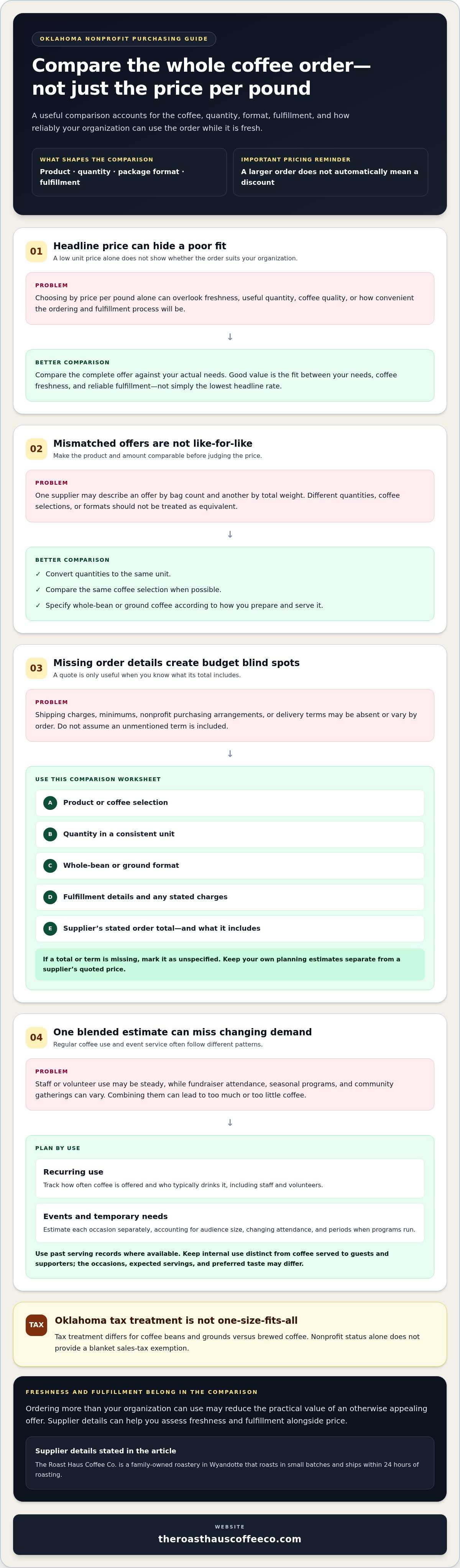
The lowest price per pound may not be the best-value coffee order for an Oklahoma nonprofit. Comparing bulk coffee pricing for non-profits Oklahoma organizations can mean looking beyond the headline figure: order size, freshness, and how the coffee will be served all affect whether a purchase fits the budget.
If event turnout changes from month to month or regular coffee demand is hard to predict, you’re not alone. You need an order that’s practical to serve, enjoyable for supporters, and sized to limit waste. Oklahoma’s tax treatment also differs for coffee beans and grounds versus brewed coffee, and nonprofit status alone doesn’t provide a blanket sales-tax exemption.
This guide will help you compare the full order cost, estimate a sensible amount for events or ongoing service, and account for the details that shape your budget. It also explains how to weigh freshness and fulfillment alongside price. The Roast Haus Coffee Co. is a family-owned roastery in Wyandotte that roasts in small batches and ships within 24 hours of roasting. Those details offer a practical starting point when you’re comparing fresh-coffee options.
Key Takeaways
- Compare bulk coffee pricing for non-profits Oklahoma organizations by looking at the full order and fulfillment value, not just the price per pound.
- Separate recurring volunteer or staff use from one-time events to build a realistic estimate of coffee demand.
- Use serving records, a clear usage estimate, and a sensible buffer to plan for changing attendance.
- Compare formats and supplier details, including freshness information, coffee choices, and the ordering process.
- Consider how small-batch, roasted-to-order coffee from an Oklahoma roastery fits your organization’s freshness and fulfillment needs.
Why Oklahoma Non-Profits Consider Buying Coffee in Bulk
A nonprofit needs to serve good coffee without letting a variable budget or changing attendance turn a simple purchase into a costly guess. Bulk purchasing means buying coffee in a larger planned order rather than making frequent small purchases. It doesn’t automatically mean a discount or a set order size. The right quantity depends on how your organization serves coffee and how reliably it can use what it buys.
Start by separating steady demand from occasional demand. Coffee used regularly by staff or volunteers follows a different pattern from coffee served at a fundraiser, community gathering, or seasonal program. Estimating those needs separately helps avoid ordering too much after an event or too little for the people who rely on coffee week to week.
Which nonprofit coffee needs suit a bulk order?
For predictable office or community-program use, track how often coffee is offered and who typically drinks it. Then account for temporary needs, such as a fundraiser with variable attendance or a program that runs only during part of the year. Keep coffee for internal use distinct from coffee served to guests and supporters. The occasions, expected servings, and preferred taste may differ. Past serving records help turn those patterns into a more realistic order estimate.
Ask three practical questions before comparing orders:
- How large is the audience for each regular or one-time serving occasion?
- How often will coffee be offered, and are there periods when demand changes?
- Is the coffee for staff and volunteers, or will guests and supporters be drinking it too?
The answers show whether one planned order can serve several needs or whether event and recurring use should be budgeted separately. They also help you judge whether the quantity is likely to be used while the coffee is still fresh.
What does good value mean beyond a low price?
A low unit price looks appealing, but it doesn’t show whether the order fits your actual use. Consider the coffee’s quality and freshness, how much you can reasonably use, and how convenient the ordering and fulfillment process will be. Coffee production, from crop to finished bean, also shapes what’s in the bag. Coffee Production Process and Global Market offers background on production and the global coffee trade.
Compare the full order against your organization’s needs. A purchase that’s easy to plan around and delivers coffee your audience enjoys may be better value than a lower unit cost attached to an unsuitable quantity or format. Freshness matters, too. Ordering more than you can use can reduce the practical value of an otherwise appealing offer.
Bulk coffee value is the fit between your needs, the coffee’s freshness, and how reliably the order is fulfilled. Use that standard to assess bulk coffee pricing for non-profits Oklahoma organizations may encounter, rather than judging an offer by its headline price alone.
What Shapes Bulk Coffee Pricing for Oklahoma Non-Profits?
Bulk coffee pricing isn’t one universal rate. The comparison depends on the coffee, quantity, package format, and fulfillment details. A useful budget accounts for each of these factors instead of treating price per pound as the whole story.
Bulk pricing varies with order specifications and fulfillment, so compare complete, like-for-like orders rather than headline rates. A larger order doesn’t automatically earn a discount, and pricing structures can differ.
Which order details can change the comparison?
Begin with quantity and consistent units. If one offer is described by bag count and another by total weight, convert them to the same unit before comparing. Then record whether you need whole-bean or ground coffee. The format should suit how your organization prepares and serves coffee, and different formats aren’t automatically equivalent.
Coffee selection matters, too. Different origins and products may have different stated prices, so compare the same coffee when possible. Separate documented product details from order-specific terms, such as minimums, shipping charges, or nonprofit purchasing arrangements. Don’t count an unmentioned term as included.
How can a nonprofit compare the full order value?
Use a simple worksheet to capture the details that determine what you’re comparing. For each offer, record:
- Product or coffee selection
- Quantity, expressed in a consistent unit
- Whole-bean or ground format
- Fulfillment details and any stated charges
- The supplier’s stated order total and what it includes
Compare like with like. Don’t set a larger quantity of one coffee beside a smaller amount of another and treat them as a direct price comparison. If a total or term is missing, mark it as unspecified. Label your own estimates as planning figures, not as a roaster’s quoted price.
For example, an organization considering coffee for staff and a separate community event can use two worksheet lines. That makes it easier to see whether one order fits both needs or whether different quantities and formats make more sense. It also keeps the budget tied to expected use rather than an appealing unit price alone.
For bulk coffee pricing for non-profits Oklahoma organizations should compare the stated product and fulfillment details together. Don’t assume a nonprofit discount, minimum order, or delivery term unless it’s provided for that order. The Roast Haus Coffee Co. is an Oklahoma-based, small-batch roaster. Its small-batch roasted coffee is one option to include when comparing fresh-roasted coffee.
How to Compare Bulk Coffee Options for Your Oklahoma Organization
A useful comparison starts with how coffee will be prepared and who will drink it. A familiar format may be easier for volunteers to serve, while a different origin could better suit an audience’s taste. Compare the details that affect day-to-day use, not just the labels on the bags.
Which coffee format fits the way your group serves it?
Whole-bean coffee needs to be ground before brewing, while ground coffee skips that step. Ready-to-use formats may remove other preparation tasks, depending on the product. Match the format to the equipment your organization already has and the experience of the people preparing coffee. This comparison is about coffee formats, not a recommendation to buy brewing machinery.
| Format | Preparation and fit | What to compare |
|---|---|---|
| Whole bean | Requires grinding before brewing. Consider whether your current setup and volunteers can handle that step. | Check the coffee selection, freshness information, and how the order will be fulfilled. |
| Ground | Skips grinding, which may simplify preparation for volunteer-led service. | Compare the same coffee and quantity, and note the stated format and fulfillment details. |
| Ready-to-use | May suit situations where reducing preparation steps is a priority. | Compare what the format includes and whether it fits your serving routine. |
Keep the audience in mind, too. Coffee served during a staff meeting may call for a straightforward, easy-to-prepare option. A fundraiser or community gathering may put more emphasis on offering a choice supporters will enjoy. Write down the preparation steps so volunteers aren’t left to resolve format issues during service.
How should an organization compare coffee choices?
Start with the preferences of the people you serve. Some audiences may prefer familiar, balanced coffees; others may welcome a more distinctive cup. Use tasting notes and product descriptions to guide your choice rather than assuming an origin alone tells you exactly how a coffee will taste. The Roast Haus Coffee Co. offers coffees from Kenya, Ethiopia, Honduras, Colombia, Mexico, and Guatemala. Its beginner’s guide to choosing coffee beans can help your team think through flavor preferences and bean selection.
Compare freshness information alongside selection. Look for clear details about how the coffee is roasted and when it ships. Then consider whether the available coffee suits your audience and whether fulfillment details give your team enough information to plan. For recurring replenishment, assess the ongoing purchasing approach separately from a one-time event order.
- Match the format to the preparation routine and volunteer experience.
- Compare product descriptions and freshness information, not origin names alone.
- Check that fulfillment details support your schedule and intended use.
For bulk coffee pricing for non-profits Oklahoma organizations, a strong comparison connects the coffee choice to the people serving it and the people drinking it. That makes it easier to choose an option your team can prepare consistently and your guests will enjoy.
How to Estimate Your Non-Profit’s Bulk Coffee Needs and Budget
A sensible coffee order starts with what your organization actually serves, not a guess about how much a nonprofit should buy. Use past records where available, and write down any assumptions that fill the gaps. Keep regular staff or program use separate from a one-time event so a busy fundraiser doesn’t distort your everyday estimate.
Estimate quantity from actual use
Review expected attendance, how often coffee is served, and what your organization has used at similar occasions. If records are incomplete, note the uncertainty rather than treating your estimate as exact. Estimate ongoing use and event demand separately, then combine them only if one order genuinely suits both.
Follow this four-step method:
- Count servings. List the serving occasions in your planning period. Separate regular staff or program gatherings from special events and seasonal activities.
- Estimate coffee use. Use your records to connect past servings with the amount of coffee used. If records don’t exist, make a planning assumption and label it clearly. Don’t rely on an unsupported servings-per-pound conversion.
- Choose a buffer. Decide how much room you need for attendance changes or unexpected demand. Base the buffer on your organization’s experience and storage capacity, not an arbitrary amount.
- Compare order terms. Use the planned quantity to compare product format and stated fulfillment details. Keep missing terms visible, and don’t treat an estimate as a supplier’s quoted price.
Plan replenishment without over-ordering
Before settling on an order, consider where you’ll store the coffee, how quickly you expect to use it, and how you want to manage freshness. A single order may suit a one-time event or a predictable period of use. Recurring replenishment may fit steady demand if its timing and terms work with the organization’s budget and routine.
For example, a community program that serves coffee regularly can estimate its usual use separately from an annual fundraiser. That gives the team a clearer view of baseline demand and the additional amount an event may require. If demand changes by season, record those periods rather than averaging them into one figure. Actual use will help refine future estimates.
A coffee subscription is a separate purchasing approach from a bulk order. The coffee subscription guide explains recurring delivery considerations, but subscription terms shouldn’t be assumed to apply to wholesale purchasing.
Careful estimates make bulk coffee pricing for non-profits Oklahoma easier to assess because your team can compare offers against a realistic need. Fresh-roasted coffee from The Roast Haus is another option to consider when planning an order around your organization’s use and budget.
Plan a Fresh-Roasted Bulk Coffee Order with The Roast Haus
For Oklahoma organizations considering a local roasting partner, The Roast Haus Coffee Co. brings small-batch coffee production to Wyandotte. It’s a family-owned roastery operated by a husband-and-wife team, with a focus on roasting coffee to order. Products ship within 24 hours of roasting, a specific freshness detail to factor into fulfillment planning.
What The Roast Haus Coffee Co.’s freshness approach means for buyers
Small-batch roasting means coffee is roasted in batches rather than treated as an anonymous, long-stored commodity. Roast-to-order fulfillment connects production to incoming orders, while shipping within 24 hours of roasting gives organizations a concrete point of reference when planning around freshness. It doesn’t determine how quickly coffee will reach your organization or how long it will stay fresh after arrival, so plan around your actual use and storage conditions.
The Roast Haus Coffee Co. offers coffees from origins including Kenya, Ethiopia, Honduras, Colombia, Mexico, and Guatemala. These choices can help your team match a coffee to the people it serves, whether the priority is a familiar daily cup or an origin that invites supporters to try something distinctive. Consider both audience preferences and how quickly your organization expects to use the coffee.
Build an order plan that fits your organization
Before placing an organizational order, bring your decisions into one short plan. Record:
- Use: Staff or volunteer service, recurring programs, a one-time gathering, or a combination.
- Estimated need: The amount suggested by your serving records, with assumptions clearly identified.
- Format: The format that fits your existing preparation routine.
- Coffee preference: The origin or flavor direction that suits your audience.
- Budget framework: The amount your organization has set aside and the order details needed to compare the total.
Let actual use guide the order. An arbitrary “bulk” quantity can create waste if demand is lower than expected, or leave you short if regular service and an event are combined without planning. Keep those needs distinct in your estimate, then decide whether one order fits both. Freshness-conscious fulfillment is most useful when it aligns with the rate at which your organization expects to serve the coffee.
Comparing bulk coffee pricing for non-profits Oklahoma organizations may encounter means weighing the coffee, order fit, and fulfillment approach together. The Roast Haus Coffee Co.’s small-batch, roasted-to-order process offers a local option to include in that planning. Explore fresh-roasted coffee from The Roast Haus Coffee Co. and start shaping an order around your organization’s needs.
Make Your Next Coffee Order Easier to Plan
Turn your estimate into a short buying brief before your organization commits. Note who the coffee is for, when it will be served, the format your team can prepare, and the amount your records support. Share the brief with the people responsible for approving the budget and organizing service. Clear assumptions help everyone understand why an order fits, even when attendance or program needs change.
After serving the coffee, gather feedback from volunteers and guests. Did the amount suit the occasion? Was the selection right for the people you serve? Use those observations to refine your next estimate instead of starting from scratch. This simple habit makes future decisions about bulk coffee pricing for non-profits Oklahoma organizations face more grounded in actual use.
The Roast Haus Coffee Co. is a family-owned roastery in Wyandotte, Oklahoma, with small-batch, roasted-to-order coffee that ships within 24 hours of roasting. Explore fresh-roasted coffee from The Roast Haus and plan a coffee order your organization can feel good about serving.
Frequently Asked Questions
How much does bulk coffee cost for non-profits in Oklahoma?
There isn’t one standard price for every nonprofit order. The total depends on the coffee selected, quantity, format, and fulfillment details. For a useful budget figure, compare stated totals for the same product and amount, and note what each total includes. Don’t treat a general retail listing or an estimated unit cost as a quote for your organization. Local taxes or other order details may also affect the final amount.
Do coffee roasters offer discounts to non-profits?
Some roasters may have nonprofit purchasing terms, but a discount shouldn’t be assumed automatically. Build your budget around the actual order total and terms available to your organization, rather than an unverified reduction. Nonprofit status doesn’t create a blanket Oklahoma sales-tax exemption. Keep any tax treatment separate from a supplier’s price or discount when preparing your records.
Is buying coffee in bulk cheaper than buying individual bags?
Not always. A larger order may change the per-unit comparison, but it can be poor value if your organization can’t use the coffee in time or has limited storage. Compare the full amount you’ll pay with the amount you expect to serve. For example, an organization with irregular programs may find smaller purchases easier to manage, even if a larger order appears more economical per unit.
How much coffee should a non-profit order for an event?
Base the estimate on expected attendance and records from similar events, not a universal servings-per-pound rule. Note how many people are likely to drink coffee, whether other beverages will be served, and whether the event schedule includes more than one serving occasion. If attendance is uncertain, record a low and high planning estimate, then choose an amount your team can store and use after the event.
Can an Oklahoma nonprofit order whole-bean or ground coffee in bulk?
Organizations can compare bulk offers for whole-bean or ground coffee, depending on the supplier and product. Whole beans need grinding before brewing; ground coffee skips that step. Consider the preparation process volunteers can manage with the equipment already on hand and whether it suits the event pace. Keep format consistent when comparing offers, since whole-bean and ground coffee aren’t identical options.
What should a nonprofit compare before choosing a bulk coffee supplier?
Compare the coffee itself, freshness information, available formats, order quantity, and fulfillment details. Look for clear product descriptions so the selection fits the people you serve, and keep the full stated total with your budget records. For bulk coffee pricing for non-profits Oklahoma buyers, a useful comparison also notes what information is missing so estimates aren’t mistaken for confirmed order terms.
What happens if our nonprofit’s coffee demand changes?
Update your estimate as your program schedule or attendance changes. Keep a simple record of what was ordered, what was used, and what remained after each event or service period. If an event is canceled or turnout shifts, that record helps you adjust the next plan instead of repeating the same quantity. Storage space and freshness priorities can also guide whether to order less at once or replenish more often.

