


Your $1,500 espresso machine is essentially a high-priced paperweight if you pair it with an inferior espresso grinder. It’s a hard truth we see often at The Roast Haus. You spend $22 on a bag of our Roasted To Order beans, wait for that peak freshness, and then watch inconsistent grounds ruin the extraction. It feels like a waste of craft and money when a shot comes out sour or watery. We agree that nothing is more frustrating than fighting your equipment when you just want a clean, cafe-quality cup at home.
This guide will help you choose a machine that actually honors the hard work of the farmer and the roaster. You'll learn why flat burrs can improve flavor clarity by 25% and how low-retention designs prevent you from wasting 2 grams of coffee every single morning. We’re stripping away the confusing technical jargon to give you a clear path to the perfect purchase. By the end, you’ll know exactly which tool will help you unlock the full flavor potential of every small-batch bag you buy from us.
Key Takeaways
- Learn why a quality espresso grinder is more critical than your machine for achieving a perfect, uniform extraction.
- Understand the difference between conical and flat burrs to choose a flavor profile that highlights clarity or body.
- Identify the right setup for your kitchen by comparing manual, entry-level, and prosumer models.
- Unlock the peak flavor of roasted-to-order beans with a step-by-step guide to dialing in your equipment.
Why an Espresso Grinder is the Most Important Tool in Your Kitchen
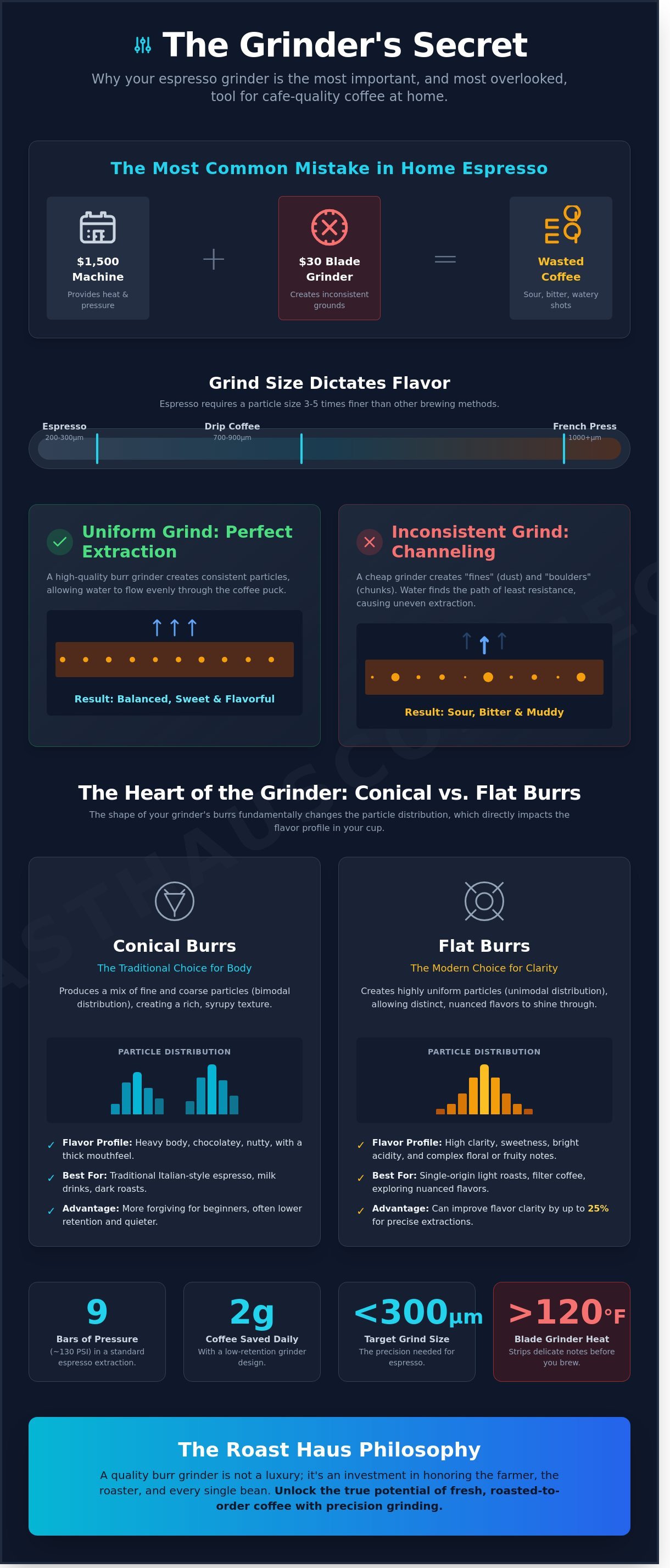
You might think the shiny Italian machine on your counter is the star of the show. It isn't. At The Roast Haus Coffee Co., we see customers invest $1,500 in a high-end machine only to pair it with a $30 blade mill. This is the fastest way to ruin a bag of fresh, small-batch beans. The grinder, not the machine, dictates the quality of your extraction. While the machine provides the pressure, the espresso grinder creates the surface area that makes flavor possible. If you don't get the grind right, the machine is just a very expensive water heater.
Espresso requires a specific particle size, typically between 200 and 300 micrometers. This is significantly finer than the 700 to 900 micrometers used for drip coffee or the 1,000 plus micrometers needed for a French press. Because espresso is an "unfiltered" brewing method, the metal basket allows fine particles and oils to pass directly into your cup. This creates the heavy body and intense flavor you love, but it also means there's no paper filter to hide your mistakes. Every uneven grain contributes to the final profile. If your particle distribution is off, your morning shot will taste muddy instead of clear.
When you brew espresso, you're forcing water through a compacted puck of coffee at 9 bars of pressure. This is roughly 130 pounds per square inch. If the particles aren't uniform, the water finds the path of least resistance. It blasts through gaps in the coffee, a process called channeling, and leaves the rest of the grounds dry. You end up with a shot that's both sour and bitter at the same time. A dedicated burr grinder is the only way to ensure the water flows evenly through every single milligram of coffee.
The Difference Between a Coffee Grinder and an Espresso Grinder
A standard coffee grinder isn't built for the precision espresso requires. You need an espresso grinder that offers micro-adjustment capabilities. These machines allow you to move the internal components by fractions of a millimeter to "dial in" your shot. Blade grinders are the enemy of quality; they chop beans into random, jagged shards and generate friction heat that often exceeds 120 degrees Fahrenheit. This heat starts the oxidation process before the water even touches the grounds, stripping away the delicate notes of a fresh roast. High-quality units utilize a conical vs. flat burrs design to keep the coffee cool and the size consistent. This mechanical precision is what separates a professional result from a kitchen disaster.
How Grind Consistency Impacts Flavor
Consistency is about managing "fines" and "boulders." Fines are dust-like particles that over-extract instantly, turning your shot bitter and ashy. Boulders are large chunks that the water can't penetrate, leaving the center of the grain sour and salty. When your machine applies 9 bars of pressure, the water hits the surface area of the coffee with incredible force. If the grind is uniform, the extraction happens at the same rate across the entire basket. This prevents the dreaded "sour" shot that happens when water moves too fast, or the "bitter" shot that occurs when it's choked by dust. Achieving a uniform grind ensures you capture the peak freshness and flavor potential we work so hard to roast into every bean.
Understanding Burrs: Conical vs. Flat and Why it Matters
The burr set is the heart of any espresso grinder. It's the component that physically breaks down the beans you've trusted us to roast. While we ensure every bag is roasted to order for peak flavor, the geometry of your burrs determines how that flavor translates into your cup. You'll generally choose between two shapes: conical and flat. Each creates a different particle distribution, which changes how water moves through the coffee bed. Understanding the science of extraction is vital here because particle consistency dictates which organic compounds end up in your shot and which stay behind.
Conical Burrs: The Traditional Choice for Body
Conical burrs consist of a cone-shaped center burr that sits inside a ring-shaped outer burr. This design produces a bimodal grind distribution. This means the grinder creates two distinct groups of particle sizes: very fine "fines" and larger "boulders." The fines restrict water flow, while the boulders provide the path for extraction. This combination creates the thick, syrupy mouthfeel associated with traditional Italian espresso. If you enjoy a dark, chocolatey profile with a heavy body, a conical espresso grinder is your best friend. These burrs are also more forgiving. If your dose is off by 0.5 grams, the bimodal distribution helps mask the error, making it easier for beginners to pull a drinkable shot.
Flat Burrs: The Modern Choice for Clarity
Flat burrs are two identical rings that sit parallel to each other. They use centrifugal force to push beans through the cutting teeth. Unlike conical sets, flat burrs aim for a unimodal distribution where every coffee particle is nearly the same size. This uniformity allows for incredible flavor clarity. When you use our single-origin beans, flat burrs help you identify specific notes like citrus, jasmine, or stone fruit. The trade-off is that they require much higher precision. A tiny adjustment to the grind setting can drastically change the taste. You'll need to be diligent with your puck preparation, but the reward is a clean, vibrant cup that highlights the artisan quality of the roast.
Burr size and material also play a massive role in your daily routine. Most entry-level grinders use 50mm burrs, while prosumer models jump to 64mm or even 80mm. Size matters for two reasons: speed and heat. A 64mm burr set can grind an 18-gram dose in roughly 7 seconds. A smaller 50mm set might take 15 seconds or more. This extra time creates friction, and friction creates heat. If your burrs exceed 140 degrees Fahrenheit during a rush, they can actually start to "re-roast" the oils in the beans, destroying the delicate aromatics we worked so hard to preserve.
- Stainless Steel Burrs: These are the industry standard. They're incredibly sharp and produce high clarity, though they do absorb heat faster than ceramic.
- Ceramic Burrs: These stay cooler during long grinding sessions and stay sharp for about twice as long as steel. However, they can chip if a small stone accidentally makes its way into your hopper.
We recommend starting with stainless steel for most home setups. The sharpness provides the clean cut necessary for those bright, sweet notes found in small-batch coffee. Once you've selected your hardware, pair it with our freshly roasted espresso blends to truly taste the difference that precision grinding makes. Don't let a dull or inconsistent grind ruin a bean that was at peak freshness just days ago.
Choosing the Right Grinder for Your Home Setup
Selecting an espresso grinder is the most critical decision you'll make for your home coffee bar. Even the most expensive espresso machine cannot fix the uneven extraction caused by a poor grind. We roast our beans to highlight specific flavor profiles, and a quality burr set is the only way to unlock them. You should categorize your search into three main tiers: manual, entry-level electric, and prosumer units. Each serves a different type of coffee drinker, but they all share the same goal of consistency.
You should follow the 50/50 rule as a firm guideline for your budget. If you have a total budget of $1,200, you should allocate $600 to your grinder. It sounds extreme to beginners, but the grinder determines the texture and clarity of your espresso more than the machine does. Experts from America's Test Kitchen emphasize this in a roaster's guide to equipment. They note that the grinder is the true heart of the system. Spending 90% of your budget on a shiny machine and using a cheap grinder will only result in bitter, inconsistent shots.
Low retention is another must-have feature for home users. Many commercial grinders hold 5 to 10 grams of coffee in the "dead space" between the burrs and the exit chute. This coffee goes stale within hours. If you only brew two drinks a day, you'll spend half your morning drinking old, oxidized grounds. Look for "single-dose" grinders designed for near-zero retention. These machines ensure that the 18 grams of beans you put in is exactly what comes out. This prevents oxidation and protects the peak freshness and flavor potential of your small-batch coffee.
Manual vs. Electric Espresso Grinders
Manual grinders provide the best value for your money. For $150, you can get a hand grinder with professional-grade 40mm steel burrs that rival $500 electric models. It's an honest, simple tool that doesn't take up counter space. However, grinding by hand for a 1:2 ratio shot takes about 45 seconds of physical effort. Electric grinders are built for convenience. They use powerful motors to spin the burrs, delivering a dose in under 10 seconds. If you value speed during a busy morning or make drinks for a family, an electric espresso grinder is the right choice.
Stepped vs. Stepless: Finding the Sweet Spot
Stepless adjustment is the only way to achieve true precision in your kitchen. Espresso is sensitive to changes as small as one micron. Stepped grinders use fixed "clicks," which can leave you trapped. You might find that click number 4 is too coarse and the shot runs too fast, but click number 5 chokes the machine entirely. Stepless grinders let you stop the adjustment dial anywhere in between. This allows you to fine-tune the flow rate to hit a perfect 25 to 30-second extraction window. Don't settle for being "between clicks" when you're trying to pull a professional shot.
Dialing In: How to Get the Perfect Shot with Your New Grinder
Getting your new espresso grinder onto the kitchen counter is only half the journey. To see real results, you must use beans that haven't sat on a grocery shelf for months. We provide roasted-to-order coffee because freshness dictates how the water moves through the puck. When beans are more than 21 days past their roast date, they lose the internal CO2 pressure necessary to create resistance. Without that resistance, your shots will be thin and sour regardless of how expensive your equipment is. Our small-batch roasting process ensures that 100% of the aromatic compounds are intact when the bag reaches your door.
The "First Shot" Protocol
Success requires a disciplined workflow and a reliable digital scale. Start by setting your espresso grinder to a medium-fine position, usually marked near the center of the manufacturer's suggested espresso range. Use your scale to measure exactly 18 grams of freshly ground coffee into your portafilter. Your goal is to produce 36 grams of liquid espresso in a window of 25 to 30 seconds. This 1:2 ratio provides a reliable baseline for flavor and texture. Watch the flow carefully; it should look like warm honey dripping from a spoon. If the results taste off, change only the grind size. Adjusting the dose and the grind at the same time makes it impossible to track what actually fixed the shot.
Troubleshooting Common Extraction Issues
If your shot finishes in 15 seconds, it'll taste salty and sharp. This means the water found too much space between the coffee particles. You need to move your adjustment collar toward the finer setting to slow the flow. If the machine struggles to push water through or only produces a few dark, bitter drops, you've choked the portafilter. Move the adjustment toward the coarser setting immediately. Small changes matter more than you think. Even a 5 degree shift in room temperature or a 10 percent rise in humidity can alter how your beans behave. Fresh beans are organic material, so they react to the air around them. You might need to adjust your espresso grinder by a few notches every morning to maintain that peak flavor potential.
You can see the quality of the extraction in the color of the crema. A perfect shot starts with a dark reddish-brown hue and transitions into a golden "tiger striping" pattern. If the stream turns pale and watery before you hit your 36-gram target, the coffee is over-extracting. Stop the shot early and tighten the grind. We've spent years perfecting our roasting process so you don't have to fight your equipment. When you start with beans that were shipped the same day they were roasted, the sweet spot for dialing in becomes much wider and easier to find.
Ready to put your new gear to the test? Buy fresh, roasted-to-order beans to ensure your first shot is a success.
Fresh Beans and Precision Grinding: The Roast Haus Philosophy
Investing in a high-quality espresso grinder is a major step toward better coffee, but the equipment is only as good as the raw material you feed it. Even the most precise espresso grinder can't extract flavor that isn't there. When you use stale, grocery-store beans, you're fighting a losing battle. These mass-produced bags often sit on warehouse shelves for 120 days or more before they ever reach your kitchen. By that point, the vital aromatic oils have oxidized and the bean's internal structure has turned brittle and hollow.
The Roast Haus philosophy centers on the synergy between small-batch roasting and precision grinding. We believe that coffee is a fresh agricultural product, not a non-perishable pantry staple. When beans are roasted to order, the natural oils remain trapped inside the bean until the moment you grind them. These oils are what create a rich, persistent crema and a heavy mouthfeel. Without them, your shots will look thin and taste bitter, regardless of how much you spent on your gear. Our process ensures that 100% of the coffee we ship is handled with the respect it deserves.
Why Freshness is the Ultimate Variable
Freshness acts as a critical variable in the physics of espresso. Freshly roasted beans contain high levels of CO2. During the extraction process, this gas creates internal pressure within the coffee puck, providing the resistance needed for a slow, syrupy pour at the industry-standard 9 bars of pressure. If your beans are more than 21 days past their roast date, that gas has largely dissipated. You'll find yourself chasing an impossibly fine grind setting just to get enough pressure to register on a gauge. This often leads to "channeling," where water rushes through cracks in the puck, resulting in a sour and uneven cup.
Supporting a small business like ours means you get beans that still have their "soul" intact. We focus on specific roast profiles that highlight the origin's unique characteristics. This elevates your home coffee from a simple caffeine fix to a genuine artisan experience. By choosing fresh beans, you're ensuring that the precision of your burr grinder actually translates into better flavor in the cup. It's about honesty in the process and quality in the results.
Start Your Espresso Journey with the Right Beans
If you're ready to test the limits of your new espresso grinder, start with beans that have a clear, defined flavor profile. Our Kenya AA Supreme offers a bright acidity and wine-like complexity that shines when ground precisely. For those who prefer a smoother, citrus-heavy experience, the Ethiopia Limu provides a floral aroma that rewards a careful dial-in process. These beans are selected for their density and quality, making them perfect for home baristas who want to master their craft.
We also offer a subscription service to ensure you never run out of "dialing-in" fuel. Since coffee hits its peak flavor between 4 and 14 days after roasting, our schedule ensures you always have beans at the perfect age for extraction. You won't have to worry about the quality of your morning routine again. It's time to pair your precision equipment with beans that are worthy of the effort.
Ready to taste the difference? Shop our Roasted-To-Order Coffee Beans and experience peak freshness today.
Take Control of Your Coffee Ritual
Your journey to a cafe-quality shot starts with precision. You now know that choosing the right espresso grinder is more than just a purchase; it's an investment in flavor. Whether you prefer the clarity of flat burrs or the body of conical ones, your hardware needs the right fuel. Even the most expensive equipment can't fix stale beans. That's why we focus on the science of small-batch roasting to ensure every bean reaches its peak potential. Precision grinding requires a bean that's still full of its natural oils and gasses.
At The Roast Haus Coffee Co., we're a family-owned artisan roastery dedicated to the craft. We roast our coffee in small batches to maintain total quality control over every single profile. We guarantee your order is shipped within 24 hours of roasting so you never have to settle for dull, oxidized coffee again. You've done the work to understand your equipment. Now, give your machine the fresh, vibrant beans it deserves. We're excited to help you pull the best shot of your life.
Shop Fresh Roasted-To-Order Beans for Your New Grinder
Frequently Asked Questions
Can I use a regular burr grinder for espresso?
No, most standard burr grinders can't achieve the fine, consistent powder required for a proper 9 bar extraction. An espresso grinder is built with micro-adjustments that allow you to change the particle size by as little as 10 microns. A regular drip grinder usually has steps that are too large, which means your shot will either flow too fast or choke the machine entirely.
Is a manual espresso grinder worth the effort?
Yes, manual grinders provide the best grind quality for your money if you don't mind a bit of physical work. A high-quality hand grinder like the 1Zpresso J-Max can grind an 18 gram dose in roughly 45 seconds. You'll often save $200 or more compared to an electric model with the same burr quality. It's a smart way to support your small-batch coffee habit on a budget.
How much should I realistically spend on an espresso grinder?
You should plan to spend at least $200 for a reliable entry-level electric espresso grinder. While a $50 blade grinder is fine for spices, it can't create the uniform particles needed for espresso. If you want professional results at home, most enthusiasts invest between $400 and $600. This price range ensures the motor is strong enough to handle light roasts without stalling during the 30 second grind process.
What is "grind retention" and why should I care?
Grind retention is the amount of coffee, typically between 1 and 5 grams, that stays trapped inside the grinder's internal chambers. You should care because these trapped grounds go stale quickly and mix with your fresh beans. If your grinder has 3 grams of retention, your first shot of the day will be 15% old coffee. Low-retention grinders ensure you actually taste the peak flavor of our roasted to order beans.
How often should I clean my espresso grinder burrs?
You should deep clean your burrs every 4 to 6 weeks to prevent oil buildup. Coffee oils begin to oxidize and turn rancid after about 30 days, which will ruin the flavor of even the best artisan roasts. Use a stiff brush to scrub the steel teeth and a vacuum to pull out loose debris. Regular maintenance extends the life of your burrs, which are usually rated for 500 to 1,000 pounds of coffee.
Do I need to change my grind setting every day?
You'll likely need to adjust your dial every 24 to 48 hours as your beans age and lose moisture. As the coffee stays in your hopper, it becomes more brittle and requires a slightly finer setting to maintain a 25 to 30 second extraction time. Small changes in your kitchen's humidity, even a 10% shift, can also change how the beans shatter. Checking your shot time daily is the only way to ensure consistent quality.
What is the difference between ceramic and steel burrs for espresso?
Steel burrs produce a very uniform grind that highlights acidity and flavor clarity, while ceramic burrs create more "fines" for a traditional, heavy body. Steel is the preferred choice for most modern specialty drinkers because it's durable and stays sharp for years. Ceramic burrs are often found in cheaper units; they don't conduct heat as much as steel but can crack if a small pebble accidentally enters the hopper.
Why does my grinder produce static and how do I fix it?
Static is caused by friction and low humidity, which makes grounds stick to the chute and create a mess. You can fix this instantly by using the Ross Droplet Technique, or RDT. Just take a small spray bottle or a damp spoon and add 1 or 2 drops of water to your beans before you grind them. This tiny amount of moisture neutralizes the static charge and ensures 100% of your coffee ends up in the portafilter.

