


You can spend $3,500 on a high-end espresso machine and still pull a shot that tastes like bitter charcoal. It's a common trap for home baristas in 2026. Many people believe that more stainless steel and higher pressure gauges automatically equal better flavor. You probably feel the pressure to buy every accessory on the market just to avoid a sour cup. It's frustrating to invest your hard-earned money and still wonder if your technique is the problem or if you've simply overpaid for features you don't need.
For those ready to invest, exploring the full range of professional equipment is the next step. Online retailers specializing in high-quality coffee gear, like Neominoa, offer curated selections for both enthusiasts and experts.
I'm here to clear up that confusion. This guide will show you exactly how to choose an espresso machine that fits your lifestyle without wasting a dime on unnecessary tech. You'll also discover why even the best hardware requires small-batch, roasted to order beans to truly succeed. We'll walk through the 4 essential machine types, identify the 5 most reliable brands for this year, and give you the exact steps to pull a "god shot" in your own kitchen. Let's get your home cafe started with honesty and quality.
Key Takeaways
- Understand the differences between manual lever machines and high-tech boilers to find a setup that matches your desired level of control.
- Master technical jargon like PID controllers and temperature stability to ensure every shot you pull is consistent and repeatable.
- Explore our top 2026 recommendations to select the best espresso machine for your specific budget and kitchen space.
- Discover why stale grocery store beans are the leading cause of poor crema and how fresh "software" transforms your results.
- Learn how our small-batch, roasted-to-order philosophy helps you unlock the full flavor potential of your home barista investment.
Understanding the Different Types of Espresso Machines
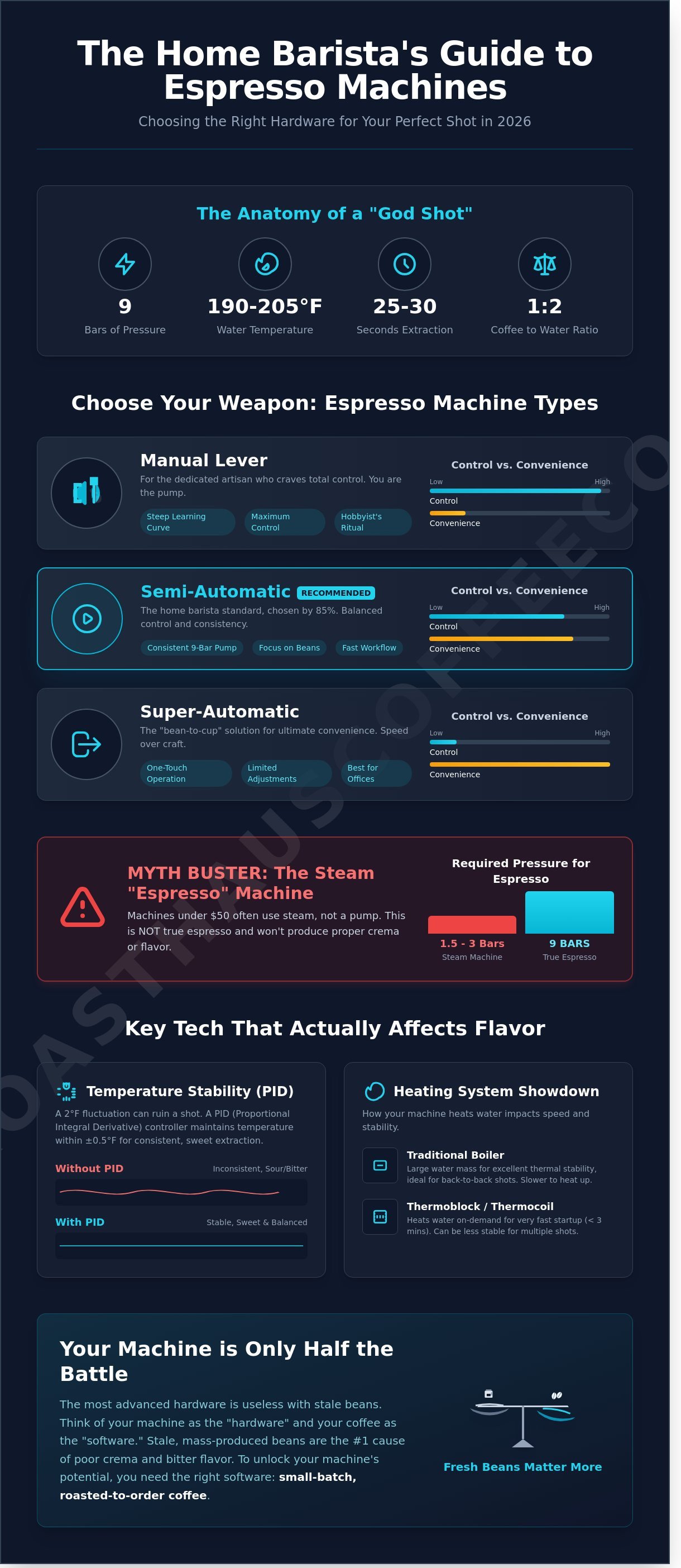
Espresso is not simply a dark roast or a small cup of coffee. It is a specific extraction method where hot water, typically between 190 and 205 degrees Fahrenheit, is forced through a puck of finely ground coffee at 9 bars of pressure. This 130 psi of force creates a concentrated 1:2 ratio of coffee to water in about 25 to 30 seconds. This process emulsifies oils and traps CO2 to create crema, the golden foam that defines a quality shot. To understand how to achieve this at home, you need to understand Espresso machine history and technology and how different drive systems impact your final cup.
The manual lever machine is the choice for the dedicated artisan. These machines date back to the 1940s and require the user to physically pull a lever to move water through the coffee. There is no electric pump. You are the pump. This gives you total control over the pressure profile during the entire shot. It is a steep learning curve that requires patience and practice. If you want to feel the resistance of the coffee puck and adjust your force in real-time, a manual machine like a Flair or a La Pavoni is your best tool.
Semi-automatic machines are the standard for 85% of home baristas. They use an electric pump to maintain a steady 9 bars of pressure while you control the grind, dose, and tamping. Brands like Breville, Gaggia, and Rancilio dominate this space because they offer a consistent platform for high-quality extraction. You get the benefit of a professional pump without the physical labor of a lever. This balance allows you to focus on the freshness and flavor potential of your beans rather than struggling with mechanical consistency.
Super-automatic machines prioritize convenience. These "bean-to-cup" systems grind the coffee, tamp it, and brew the shot with a single button press. While they are efficient, they often limit your ability to fine-tune the extraction. You cannot easily adjust the dose or the tamping pressure, which can lead to a less vibrant flavor profile compared to manual or semi-automatic methods. They are designed for speed, not for the person who wants to master the craft of roasting and brewing.
Manual vs. Semi-Automatic: Which Barista Are You?
Choosing between a manual and a semi-automatic machine depends on your goals. A manual machine requires about 10 to 15 minutes of pre-heating and a refined technique to avoid "channeling," where water bypasses the coffee. Semi-automatics offer a faster workflow for busy mornings. If you enjoy the ritual of a hobby, go manual. If you want a café-quality latte in under 5 minutes, choose a semi-automatic. Super-automatics are best for office environments or users who value a one-touch experience over artisanal control.
The Steam Machine Myth
Many retailers sell "espresso" machines for under $50 that actually lack the hardware to produce a real shot. These are steam-driven machines that rely on internal steam pressure, usually topping out at 1.5 to 3 bars. This is essentially an electric Moka pot and cannot produce the crema or body found in a true 9-bar extraction. True espresso requires a pump-driven system to achieve the consistent 9 bars of pressure necessary for proper extraction. Without a pump, you are simply drinking very strong, aerated coffee that lacks the rich nutritional content and complexity of a pressurized shot.
Key Technical Features: Demystifying the Jargon
Every espresso machine is a collection of specific mechanical parts designed to manage heat and pressure. To get the best results from your beans, you need to understand which components actually affect the flavor in your cup. We focus on these technical specs because they directly impact the freshness and quality of your daily ritual. Investing in the right hardware ensures your coffee tastes exactly how the roaster intended.
Temperature Control (PID) and Why It Matters
Coffee extraction is a precise chemical reaction. A 2-degree fluctuation in water temperature can be the difference between a sweet, balanced shot and one that is sour or unpleasantly bitter. This is especially true for light roasts, which require higher and more stable temperatures to extract fully. A Proportional Integral Derivative (PID) controller is a digital component that replaces the old mechanical thermostats found in older machines. It uses a specific algorithm to keep the water temperature within 0.5 degrees of your target.
Beginners should prioritize a machine with a PID because it removes the guesswork from the brewing process. You will also see machines using thermoblocks or traditional boilers. A traditional boiler holds a large mass of water to maintain thermal stability. A thermoblock heats water on demand as it flows through a metal coil. While thermoblocks are ready to brew in under 3 minutes, they often lack the consistent heat needed for back-to-back shots. For those who value the health benefits of coffee and the clarity of flavor, a PID-controlled boiler is the superior choice.
The Boiler Debate: Speed vs. Power
Your choice of boiler system dictates your entire morning workflow. There are three main configurations to consider:
- Single Boiler: These machines use one tank for both brewing coffee and steaming milk. You must wait 45 to 90 seconds for the machine to reach steam temperature after pulling your shot. It is a great, cost-effective option for people who primarily drink straight espresso.
- Heat Exchanger (HX): This system uses one large steam boiler with a copper pipe running through it for brewing. It allows you to brew and steam at the same time. It is a solid middle-ground for home baristas who want efficiency without the high price of a dual boiler.
- Dual Boiler: This is the ultimate setup. One boiler is dedicated to the group head for brewing, while the second is dedicated to the steam wand. You get 100 percent temperature stability and high steam pressure simultaneously. It is the best choice for anyone making more than two milk-based drinks every morning.
Pumps are the heart of the espresso machine. Vibratory pumps are small and common in entry-level models. They are budget-friendly but produce a noticeable buzzing sound. Rotary pumps are larger, much quieter, and allow you to plumb the machine directly into your home water line. If you value a quiet kitchen at 6:00 AM, a rotary pump is worth the extra 500 dollars in your budget.
Finally, look at the portafilter size. The 58mm diameter is the commercial gold standard. Choosing a machine with a 58mm portafilter gives you access to a wide variety of precision baskets, tampers, and distribution tools. Smaller 50mm or 54mm sizes often limit your ability to upgrade your accessories as your skills grow. Once you have the right hardware in place, ensure you are using a freshly roasted bean to truly see what your machine can do.
The Best Espresso Machines for Every Budget in 2026
Choosing an espresso machine requires a balance between your daily routine and your long-term goals. For those starting out with a budget of $300 to $600, the Breville Bambino and Gaggia Classic Pro dominate the market. The Bambino heats up in exactly 3 seconds. It's perfect for a quick morning latte when you're short on time. The Gaggia Classic Pro takes about 10 minutes to stabilize but uses a standard 58mm portafilter. This allows you to use professional-grade baskets and tampers immediately. These entry-level options are the gateway to better coffee at home.
Moving into the $700 to $1,500 range brings you into the world of dual boilers and thermal stability. Investing in a mid-range espresso machine like the Lelit Elizabeth provides a dedicated steam boiler. You can pull a shot and steam milk at the same time without losing pressure. The Profitec Move is a 2025 release that focuses on compact German engineering. It features a vibratory pump that is 20% quieter than previous models. These machines provide the consistency needed to taste the subtle notes in our small-batch roasts.
High-end setups exceeding $2,000 are built for total precision. La Marzocco machines, like the Linea Micra, bring commercial-grade saturated groups into your kitchen. These are built to last decades with stainless steel internals. Decent Espresso takes a different path by using software to control pressure, flow, and temperature in real-time. These machines are tools for those who want to master the science of extraction. They allow you to save specific profiles for different beans, ensuring you get the same result every morning.
Budgeting for the hardware is only the first step. You should allocate an additional 15% of your total budget for maintenance and water filtration. Scale buildup accounts for 70% of machine failures. Using a BWT filter pitcher or a dedicated soft water system will extend the life of your boilers by years. You also need backflushing powder and group head brushes to keep your coffee tasting clean. A dirty machine will make even the best beans taste bitter and flat.
Top Picks for Beginners
The Gaggia Classic Pro is often called a "forever machine" because every single part is replaceable. You can buy a new pump for $40 or a heating element for $50. This repairability is rare in modern appliances. The Breville Barista series is different. It's built for convenience with an integrated grinder. However, you must remember that the grinder is the most critical component. A $500 machine paired with a $500 grinder will always outperform a $2,000 machine with a cheap blade grinder. We always recommend focusing on the grind first.
The Enthusiast’s Upgrade Path
Upgrading from a thermoblock to an E61 group head adds 4 kilograms of brass to your workflow. This mass ensures the water temperature stays within 0.5 degrees of your target. Adding flow control allows you to mimic the pressure profiles of vintage lever machines. This level of control is how a complex bean like Kenya AA Supreme truly shines. Its bright acidity and blackcurrant notes require precise temperature management to avoid bitterness. High-end gear reveals the hard work we put into our roasted to order process.
The Missing Link: Why Your Beans Matter More Than Your Machine
You can spend $3,000 on a high-end espresso machine and still pull a shot that tastes like battery acid. The machine is simply the hardware. Your coffee beans are the software. If the software is buggy or outdated, the hardware cannot perform. Many new home baristas focus 90% of their budget on the equipment and only 10% on the coffee, which is a recipe for frustration. A professional-grade machine only amplifies what is already present in the bean. It cannot create flavor where none exists.
The biggest hurdle for most beginners is the grocery store problem. Coffee bags on supermarket shelves often sit for 3 to 6 months before you buy them. During this time, the beans lose their internal carbon dioxide. This gas is vital because it creates the resistance needed for proper extraction. Without it, your water will rush through the coffee puck too fast. This results in a thin, watery liquid with no crema. Crema is the golden, aerated foam that signifies a healthy extraction, and it is physically impossible to produce with stale, store-bought beans.
Freshness: The Non-Negotiable Factor
Freshness is a scientific requirement, not a luxury. The moment a bean is roasted, it begins to oxidize. This process is similar to an apple turning brown when cut. Pre-ground coffee is essentially dead for espresso purposes within 15 to 20 minutes of being ground because the increased surface area accelerates this decay. You should always look for a "Roasted On" date rather than a "Best By" date. A "Best By" date is a marketing term that often hides the fact that the coffee was roasted a year ago. To get the best flavor, espresso requires beans roasted within the last 7-21 days for optimal results. This window allows the beans to degas their harshest carbon dioxide while retaining the volatile oils that create a rich mouthfeel.
Choosing the Right Roast for Espresso
Roast level determines how easy it is to dial in your shot. Medium-dark roasts are the gold standard for beginners. These beans have been roasted long enough to become porous, which makes them easier to extract at standard pressures. Light roasts are much denser and often require a high-end espresso machine with precise temperature control to avoid tasting sour. If your water temperature drops even 2 or 3 degrees during the pull, a light roast will fail. If you are unsure where to start, you can try The All Day Sampler to test different roast profiles and see which one works best with your specific grinder and machine setup.
We believe in the power of small-batch roasting. While industrial roasters process 500 pounds of coffee at once, we focus on 10 to 20 pound batches. This allows us to monitor the heat application with extreme precision. Every bean in the bag receives the same amount of energy, leading to a consistent extraction every morning. Our "Roasted To Order" philosophy means your coffee is often in the mail within 24 hours of leaving the cooling tray. This ensures you receive the beans exactly when they are entering their peak flavor window.
Ready to stop wasting your equipment on stale beans? Experience the difference of Roasted To Order coffee today.
Maximizing Your Investment with Roasted-to-Order Coffee
Buying a high-quality espresso machine is a major step toward coffee independence. It's an investment in your daily ritual and your kitchen's capabilities. However, even the most expensive equipment can't fix stale beans. At The Roast Haus Coffee Co., we operate with a dedicated artisan philosophy from our facility in Wyandotte, Oklahoma. We believe that the journey of a great shot starts long before the water hits the portafilter. Our 100% small-batch process ensures that every bean receives individual attention, which translates to a more predictable and flavorful extraction in your home.
Consistency is the biggest challenge for any home barista. You need to pull dozens of shots to truly understand how grind size and temperature affect your flow. A coffee subscription provides the steady supply of fresh beans you need for this essential practice. When you use the same high-quality roast every morning, you remove a frustrating variable from the equation. You can focus on your tamping technique and timing instead of wondering why your shots changed flavor overnight. We're a family business, and we're here to support your growth. If you're struggling to dial in a specific roast, you can reach out to us directly for honest brewing advice.
From Our Roaster to Your Portafilter
We stand by a strict "Roasted to Order" promise. This isn't just a marketing slogan; it's our standard operating procedure. We ship every single bag within 24 hours of roasting. This speed is critical because coffee is a perishable product that begins to oxidize the moment it leaves the roaster. Beans typically need about 48 hours to degas, meaning our coffee arrives at your door exactly when it hits its peak flavor window. Compare this to grocery store coffee, which often sits on a shelf for 90 days or more. By then, the volatile oils have vanished, leaving your espresso thin, bitter, and lacking crema. Our Oklahoma roots mean we value hard work and transparent quality in every shipment we send.
The Ultimate Espresso Setup
Your journey to the perfect shot relies on a three-part foundation. To succeed, you must balance these three elements:
- The Machine: A reliable espresso machine that maintains stable pressure and temperature.
- The Grinder: A burr grinder capable of the fine, uniform adjustments required for espresso.
- The Beans: Fresh, artisan-roasted coffee that hasn't lost its soul to a warehouse shelf.
If one part of this trio fails, your coffee suffers. We recommend starting your journey with one of our sampler packs. It's the most effective way to explore different flavor profiles and find the specific roast level that suits your palate. Don't let your new espresso machine sit idle or settle for lackluster, stale beans from a massive corporation. You deserve the richness and aroma that only comes from a true craftsman's roast. Shop our fresh-roasted beans today.
Start Pulling Better Shots Today
Selecting the perfect espresso machine for your home setup involves balancing technical features like pressure stability with your specific daily needs. You've seen how the right hardware makes a difference, but your journey doesn't end with a new appliance. The truth is that your machine is only as good as the coffee you put into it. Stale beans from a grocery store shelf will always produce a flat, bitter cup regardless of how much you spent on your gear.
Since 2014, our family-owned business has focused on one goal: delivering peak flavor through artisan quality. We don't let coffee sit in a warehouse. We roast every bag in small batches right here in Wyandotte, Oklahoma. To ensure you experience the richest nutritional content and maximum aroma, your order is shipped within 24 hours of roasting. It's the most direct way to get fresh coffee from our roaster to your kitchen. Upgrade your espresso game with our Roasted-to-Order beans and taste the difference that true freshness makes. You've invested in the equipment; now give it the quality it deserves.
Frequently Asked Questions
Is a $1,000 espresso machine worth it for a beginner?
A $1,000 espresso machine is worth the investment because it provides the 9-bar pressure and PID temperature stability needed for consistent shots. Entry-level machines under $200 often fluctuate by 10 degrees during a brew cycle, which ruins the flavor. High-end machines like the Rancilio Silvia or Gaggia Classic Pro last 10 years or longer with proper care. You'll save money by skipping the $5 daily cafe trips while enjoying artisan quality at home.
Can I use regular coffee beans in an espresso machine?
You can use any coffee beans, but you'll get the best results with beans roasted specifically for espresso. We recommend using beans within 14 days of their roast date for peak flavor. Using oily, dark supermarket beans can clog your espresso machine grinder and produce a flat taste. Freshly roasted, small-batch beans provide the thick crema and rich nutritional content that defines a true artisan shot.
How often do I need to descale my home espresso machine?
You should descale your machine every 90 days to prevent mineral buildup from damaging the heating element. If you live in an area with hard water, increase this frequency to every 60 days. Regular maintenance reduces the risk of mechanical failure by 50% over the life of the appliance. Use a dedicated citric acid based descaler rather than vinegar to protect the internal seals and maintain steady water flow.
What is the most important accessory for a new espresso machine?
A dedicated burr grinder with 40mm steel burrs is the most critical accessory for your setup. Pre-ground coffee loses 60% of its aroma within 15 minutes of being milled. You need a grinder that offers 0.1 gram precision to dial in your shots correctly. Without a consistent grind size, even the most expensive espresso machine will fail to produce a balanced and flavorful cup.
Do I need a separate grinder if my machine has one built-in?
You don't need a separate grinder if your machine has a built-in unit like the Breville Barista Express. These integrated systems are convenient and save counter space. However, separate grinders often provide 100 or more micro-adjustments compared to the 30 settings found on most built-in models. If you want to explore complex light roasts, a standalone artisan grinder gives you the precision required for those delicate flavors.
What is the difference between pressurized and non-pressurized baskets?
Pressurized baskets use a single small hole to create back pressure, which helps beginners get a decent shot with pre-ground coffee. Non-pressurized baskets have 500 or more precision-drilled holes and rely entirely on the coffee puck for resistance. Professional baristas prefer non-pressurized baskets because they allow for true flavor extraction. You'll need a high-quality grinder to use these effectively, but the taste difference is 100% noticeable.
How do I know if my espresso beans are fresh enough?
Your beans are at peak freshness between 7 and 21 days after roasting. At Roast Haus, we ship your coffee the same day or the day after roasting to ensure you hit this window. Fresh beans will bubble or bloom when they hit hot water, indicating the presence of CO2. If your coffee is more than 30 days old, it has likely lost its vibrant flavor profile due to oxidation.
Why does my espresso taste sour or bitter even with an expensive machine?
Sour tastes usually mean your shot is under-extracted, often because the water passed through the grounds too quickly in under 20 seconds. Bitter flavors indicate over-extraction, where the water stayed in contact with the coffee for more than 35 seconds. Aim for a 25 to 30 second pull at 200 degrees Fahrenheit. Even a $3,000 machine can't fix a shot if the grind size or water temperature is incorrect.

