


The "Best By" date on your coffee bag is a marketing trick that hides the truth about flavor decay. If you're drinking beans roasted months ago, you're consuming what experts call a "dead bean," which is a flat and oxidized shell of what coffee should actually be. We believe coffee for people who love freshness shouldn't be a guessing game. You've likely noticed that even at an average price of $22.40 per bag in February 2026, many specialty brands still leave you with a bitter aftertaste and zero aromatic complexity. It's frustrating to pay premium prices for stale results that lack the vibrant soul of the bean.
You deserve a cup that tastes as rich as the day it was roasted. This guide will teach you how to reclaim those bold, artisan flavors by focusing on the "Roasted On" date rather than a vague expiration. We'll explore the critical 48 to 72 hour degassing window, explain how new 2026 supply chain transparency rules impact your morning brew, and show you exactly how to source small-batch beans that are roasted to order and shipped the same day.
Key Takeaways
- Learn why true freshness is a biological timeline that ends just four weeks after roasting, unlike the stale options found on grocery store shelves.
- Discover how the "Roasted to Order" process provides the ultimate coffee for people who love freshness by shipping beans within 24 hours of their roast date.
- Understand the science of degassing and why a 24 to 48 hour rest period is the secret to unlocking peak flavor and aroma.
- Master the "Sight, Smell, and Bloom" test to identify dead beans and learn why you should never store your coffee in the freezer.
- See how choosing a family-owned artisan roastery ensures you receive small-batch quality that mass-market logistics simply cannot match.
The Great Freshness Lie: Why Grocery Store Coffee Is Already Stale
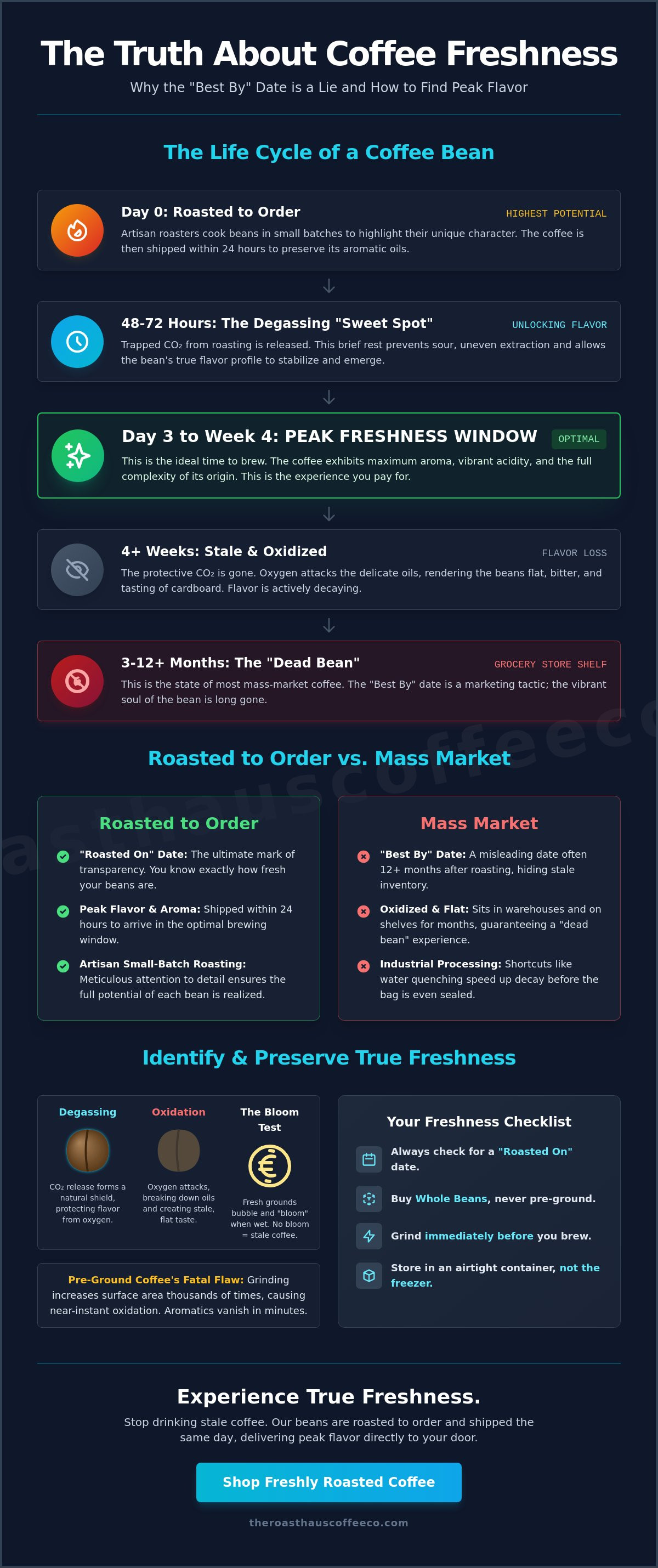
The grocery store shelf is where flavor goes to die. Most bags you find in the aisle were roasted three to six months before you ever touch them. By the time you bring them home, the beans are oxidized and flat. We believe coffee for people who love freshness should be a vibrant, sensory experience, not a dull routine. True freshness is measured on a strict timeline. You should use your beans within 14 to 28 days of the roast date to capture the full, complex profile of the origin. Anything beyond that is simply a "dead bean."
Industrial coffee relies on "Best By" dates to keep inventory moving. These dates are often set 12 months after the coffee was bagged. This is a misleading practice. It tells you when the coffee becomes technically "expired," not when it tastes good. A "Roasted On" date is the only metric that matters for quality. Understanding The Science of Peak Flavor helps you see that chemical and physical changes happen rapidly. Once the roast ends, the beans begin a biological race against oxygen. In a market where specialty coffee prices rose to $32.75 per pound in early 2026, you deserve the peak flavor you're paying for.
The Problem with Pre-Ground Coffee
Buying pre-ground coffee is the fastest way to ruin your morning cup. When you grind a bean, you increase its surface area by thousands of times. This exposes the delicate oils to oxygen instantly. Those volatile aromatics that create a "glorious aroma" vanish within minutes of the seal being broken. If you want to stop drinking stale coffee, you have to grind at home right before you brew. It's a simple change that makes a massive difference. You can find the right tools in our ultimate guide to coffee grinders to ensure your freshness starts with the grind.
How Industrial Roasting Sacrifices Quality
Large corporations roast in massive batches to maximize profit and efficiency. They focus on volume, not the individual character of the bean. Industrial roasters often use high-volume water quenching to cool beans quickly. This process introduces moisture into the bean, which speeds up decay before the bag even leaves the warehouse. Artisan small-batch roasting is a completely different world. We monitor every roast to ensure the beans reach their peak potential without shortcuts. It's about the craft of the roast and the honesty of the process. When you're choosing the best coffee beans, look for a roaster that prioritizes quality over mass-market logistics. Coffee for people who love freshness requires a direct connection between the roaster and your kitchen.
The Science of Peak Flavor: Degassing and Oxidation
Freshness isn't just a marketing buzzword. It's a specific chemical state. During the roasting process, beans develop carbon dioxide (CO2). This gas acts as a natural shield. It keeps oxygen out and traps the delicate flavor compounds inside the bean structure. As long as the bean is pushing CO2 out, oxygen cannot get in. This is why coffee for people who love freshness tastes so much more complex than the flat, cardboard-like beans found in bulk bins. Once that CO2 is gone, the protective barrier vanishes. Oxygen moves in, and the flavor begins to die.
The "bloom" is your visual proof of this chemistry in action. When you pour hot water over fresh grounds, they swell and bubble. That's the CO2 escaping rapidly. If your coffee doesn't bloom, the gas is already gone. This means oxygen has already started to degrade the bean's cellular structure. You can Preserve True Freshness at Home by understanding these shifts, but you can't revive a bean that has already lost its gas. Without the bloom, you lose the vibrant acidity and sweetness that define high-quality artisan coffee.
What Happens During Degassing?
Degassing is the release of gases, primarily carbon dioxide, that were trapped inside the coffee bean during the roasting process. While you want some gas for protection, too much gas is actually a problem for brewing. If you brew beans immediately after they leave the roaster, the escaping CO2 creates a turbulent environment. This prevents water from fully saturating the grounds, leading to uneven extraction and a metallic taste. Most experts now agree that a 48 to 72 hour rest period is the "sweet spot" for peak flavor. The one-way valve on your coffee bag is a specialized tool for this. It lets CO2 escape without letting oxygen in. It's not a "smell hole" for customers. It's a precision vent designed to keep your beans stable and flavorful.
The Role of Lipids and Volatile Aromatics
Coffee beans contain lipids, or oils, that hold the volatile aromatics responsible for the smell and taste we love. Oxidation is the enemy of these oils. When oxygen replaces CO2, it turns these delicate lipids rancid. This chemical reaction destroys the natural sweetness of the bean and replaces it with a bitter, ashy aftertaste. Dark roasts are particularly vulnerable to this. The longer roasting time brings oils to the surface of the bean, exposing them directly to the air. These surface oils oxidize almost immediately. If you want to experience the full potential of your brew, you should browse our roasted-to-order selections to ensure you're getting beans that still have their protective CO2 intact. coffee for people who love freshness depends on understanding this delicate balance between gas and flavor.
Roasted to Order vs. Off-the-Shelf: A Comparison
The "Roasted to Order" model is a simple promise. We don't turn on the roaster until your order comes through. This is the gold standard for coffee for people who love freshness. While a bag on a retail shelf might sit in a distribution center for three to six months, our beans move from the cooling tray to a shipping box within 24 hours. This speed preserves the chemical integrity of the bean. Research into Roasted to Order vs. Off-the-Shelf storage shows that even the best home containers can't fix beans that started their journey stale. By shipping immediately, we ensure you receive the full spectrum of antioxidants and nutrients that begin to degrade the moment the roast finishes.
Transparency is another key difference. Artisan roasters provide the specific farm origin and the exact roast date. In 2026, with the EU Deforestation Regulation (EUDR) requiring GPS coordinates for every farm, this transparency is becoming an industry requirement. We embrace it. We want you to know exactly where your coffee grew and when it was perfected. This honesty is rare in mass-market brands where "Best By" dates hide a six-month-old product. When specialty coffee prices are averaging $32.75 per pound, you shouldn't have to guess when your beans were roasted.
The Supply Chain Difference
A small-batch bean follows a direct path. It goes from the farm to the roaster, then straight to your door. This skips the complex distribution networks that national brands use. Large brands must account for weeks of transit and months of warehouse storage. They prioritize shelf life over flavor life. You can bypass this stale cycle by using coffee subscription services that deliver beans at their absolute peak. It's the most efficient way to keep your kitchen stocked with coffee for people who love freshness without relying on grocery store logistics.
Flavor Profile Comparison
Artisan coffee is vibrant. You'll taste distinct origin notes like bright citrus, deep berry, or smooth chocolate. These flavors are delicate and disappear as the bean oxidizes. Commercial coffee often tastes "generic" or ashy because it's stale. To hide this staleness, large roasters often over-roast their beans. This creates a uniform, burnt flavor that never changes. If your grocery coffee always tastes the same, it's because the unique character of the bean died months ago. Fresh coffee is alive with flavor that changes and develops as the beans degas. It's a dynamic experience that mass-produced coffee simply cannot replicate.
How to Identify and Preserve True Freshness at Home
Identifying stale beans is a skill every enthusiast needs. You can't rely on the bag's label alone. Look at the beans first. Fresh medium roasts should have a matte finish, while very dark roasts might show a slight, healthy sheen. If the beans look dusty or grey, they're likely past their prime. Smell them next. The aroma should be sharp and distinct. If it smells like nothing, or like wet cardboard, the volatile oils have already evaporated. This is the reality of coffee for people who love freshness; your nose rarely lies.
Many people think the freezer is a safe haven. It's actually a flavor killer. Coffee beans are porous. They act like sponges, absorbing moisture and odors from everything else in your freezer. Every time you open the bag, warm air enters and creates condensation. This moisture accelerates the staling process and can even lead to mold. Keep your beans in a cool, dark cupboard instead. Room temperature is fine as long as the beans are away from the stove or direct sunlight. You want to avoid any environment that fluctuates in temperature.
Mastering the Bloom Test
The bloom is the most reliable way to check for CO2. When you use a pour-over or French press, pour just enough water to saturate the grounds. Wait 30 seconds. You should see the coffee bed rise and bubble. This is the degassing process in action. A flat, stagnant bed of grounds means the beans are old and the protective gases have escaped. If you're pulling shots, you'll need to adjust your espresso technique for fresh beans. Very fresh coffee produces a lot of crema, which can sometimes taste overly acidic if the grind isn't dialed in correctly to account for the gas release.
Smart Storage Solutions
Airtight is non-negotiable. Vacuum-sealed canisters are excellent because they actively remove oxygen. However, the original bag we provide is also a great tool because of the one-way valve. Never transfer your beans to a clear glass jar on the counter. Light triggers photo-oxidation, which destroys flavor even faster than air. If you buy in bulk, use the "split and seal" method. Divide the beans into smaller, airtight containers and only open one at a time. This keeps the rest of the batch protected from oxygen until you're ready to brew.
To truly preserve coffee for people who love freshness, you must change your buying habits. Only purchase what you can reasonably drink in 14 days. This ensures you're always using beans at their peak flavor potential. Buying a massive bag that lasts two months is a recipe for stale coffee, no matter how good your storage canister is. If you're ready to experience the difference that real freshness makes, shop our freshly roasted beans today and have them delivered to your door.
Experience the Difference: The Roast Haus Small-Batch Commitment
We started The Roast Haus Coffee Co. with a simple realization. Most people have never actually tasted fresh coffee. Based in Wyandotte, Oklahoma, our family-owned roastery was built to change that. We don't operate like a large corporation with massive warehouses and complex logistics. Instead, we focus on a "Roasted to Order" model. This means your beans are still in their green, raw state until you place your order. We roast them in small batches and ship them within 24 hours. This level of dedication makes us the premier choice for coffee for people who love freshness. You aren't just buying a product; you're supporting a small business that cares about every single bean.
Our commitment to quality extends to the variety we offer. We source premium single-origin beans from the world's most renowned regions. Whether you prefer the bright, wine-like acidity of a Kenya AA or the smooth, citrusy notes of an Ethiopia Limu, you're getting the true profile of the origin. These flavors are delicate. They require the precision of artisan roasting to shine. By skipping the retail shelf, we ensure those vibrant notes reach your kitchen before they have a chance to fade. It's an honest approach to a craft we love, and it's why our community of freshness-obsessed coffee lovers continues to grow.
From Our Kitchen to Your Cup
The Roast Haus is a husband-and-wife-led operation. We don't hide behind a board of directors or a marketing team. Our Oklahoma roots influence everything we do. We believe in an unpretentious, craftsman-like approach to roasting. We monitor the temperature and airflow of every batch by hand to reach the peak flavor potential of the bean. This personal touch is something you won't find in industrial coffee. We take pride in being transparent about our process. When we say "Roasted to Order," we mean it. It's a mantra that defines our identity and ensures you never have to settle for a stale "dead bean" again.
Customizing Your Freshness Journey
If you're new to the world of artisan small-batch roasting, we recommend starting with our All Day Sampler. It's a great way to explore different flavor profiles and see how freshness impacts the taste. For those who want to ensure their cupboard is never empty, our flexible subscription model is the best solution. You choose the frequency, and we handle the roasting. It's the most reliable way to source coffee for people who love freshness without the hassle of checking "Roasted On" dates at the store. We invite you to Shop our freshly roasted beans and taste the difference today! You'll soon realize that once you've had coffee roasted specifically for you, there's no going back to the shelf.
Reclaim the Vibrant Flavor You Deserve
Stop letting grocery store "Best By" dates dictate your morning routine. You've learned that true flavor lives in the two to four week window following the roast. By choosing artisan beans and mastering the bloom test at home, you ensure every cup is rich with the antioxidants and volatile oils that define specialty coffee. We believe coffee for people who love freshness should be the standard, not a luxury. You deserve a cup that's alive with the unique notes of its origin.
Since 2014, our family-owned and operated roastery in Wyandotte, OK, has focused on quality over volume. We don't roast until you buy. Our roasted-to-order guarantee means your beans move from our small-batch roaster to your doorstep within 24 hours. This process preserves the chemical integrity that industrial brands lose during months of warehouse storage. You don't have to settle for flat, oxidized beans anymore. Get Freshly Roasted Coffee Shipped Within 24 Hours and experience the difference that artisan care makes. Your journey to a better brew starts here, and we're excited to help you discover the vibrant flavors you've been missing.
Frequently Asked Questions
How can I tell if my coffee beans are fresh without a roast date?
You can use the Ziploc bag test to check for freshness at home. Place a half-cup of beans into a freezer bag, press out all the air, and seal it tightly. Let it sit on your counter for 12 hours. If the bag has inflated with gas, your beans are still degassing and are fresh. If the bag remains flat, the carbon dioxide has already escaped, meaning the beans are likely stale.
Is it better to buy whole bean or ground coffee for freshness?
Whole bean is the only choice for quality. Ground coffee loses 60% of its delicate aroma within 15 minutes of grinding because the increased surface area speeds up oxidation. When you buy whole beans, the outer shell protects the volatile oils and lipids from the air. Buying whole bean is the best habit for coffee for people who love freshness who want a vibrant cup.
Does the roast level affect how fast coffee goes stale?
Dark roasts go stale faster than light roasts. The longer roasting process makes the bean structure more porous and brings internal oils to the surface. These surface oils oxidize immediately when exposed to oxygen. On average, a dark roast will lose its peak flavor profile 7 days sooner than a light roast of the same origin. Store dark roasts with extra care in airtight containers.
Can I freeze my coffee beans to keep them fresh longer?
You should not freeze your coffee beans. Freezers are full of moisture and food odors that porous coffee beans absorb easily. Every time you open a frozen bag, condensation forms on the beans. This moisture breaks down the cell structure and ruins the flavor. A cool, dark pantry is a much better environment for maintaining the integrity of your small-batch coffee.
What is the "bloom" and why does it only happen with fresh coffee?
The bloom is the bubbling reaction that happens when hot water hits fresh coffee grounds. It's the visual release of carbon dioxide that was trapped during roasting. This gas naturally dissipates over a 30 day period. If your coffee doesn't expand and bubble during the first pour, it's a sign the protective gases are gone and oxygen has already begun to degrade the flavor.
How long does roasted-to-order coffee stay at its peak flavor?
Peak flavor usually lasts between 4 and 21 days after the roast date. While the beans are safe to drink for months, the complex notes like citrus or jasmine begin to fade after the third week. This is why our coffee for people who love freshness is shipped within 24 hours of roasting. It ensures the beans arrive at your door just as they enter their flavor prime.
Is expensive coffee always fresher than grocery store coffee?
Price does not guarantee freshness. High prices often reflect the rarity of the bean or the cost of 2026 shipping tariffs rather than the roast date. You can easily find a premium bag of Kona that has sat on a retail shelf for 180 days. Always ignore the price tag and look specifically for a "Roasted On" date to ensure you are getting a fresh product.
How often should I have my coffee delivered to ensure I never run out of fresh beans?
A 14 day delivery cycle is the ideal frequency for most households. Since coffee flavor begins to decline significantly after 21 days, a bi-weekly subscription ensures you always have a new bag ready before the previous one goes stale. This schedule prevents you from having to buy emergency grocery store bags that have been sitting in a warehouse for months.

