


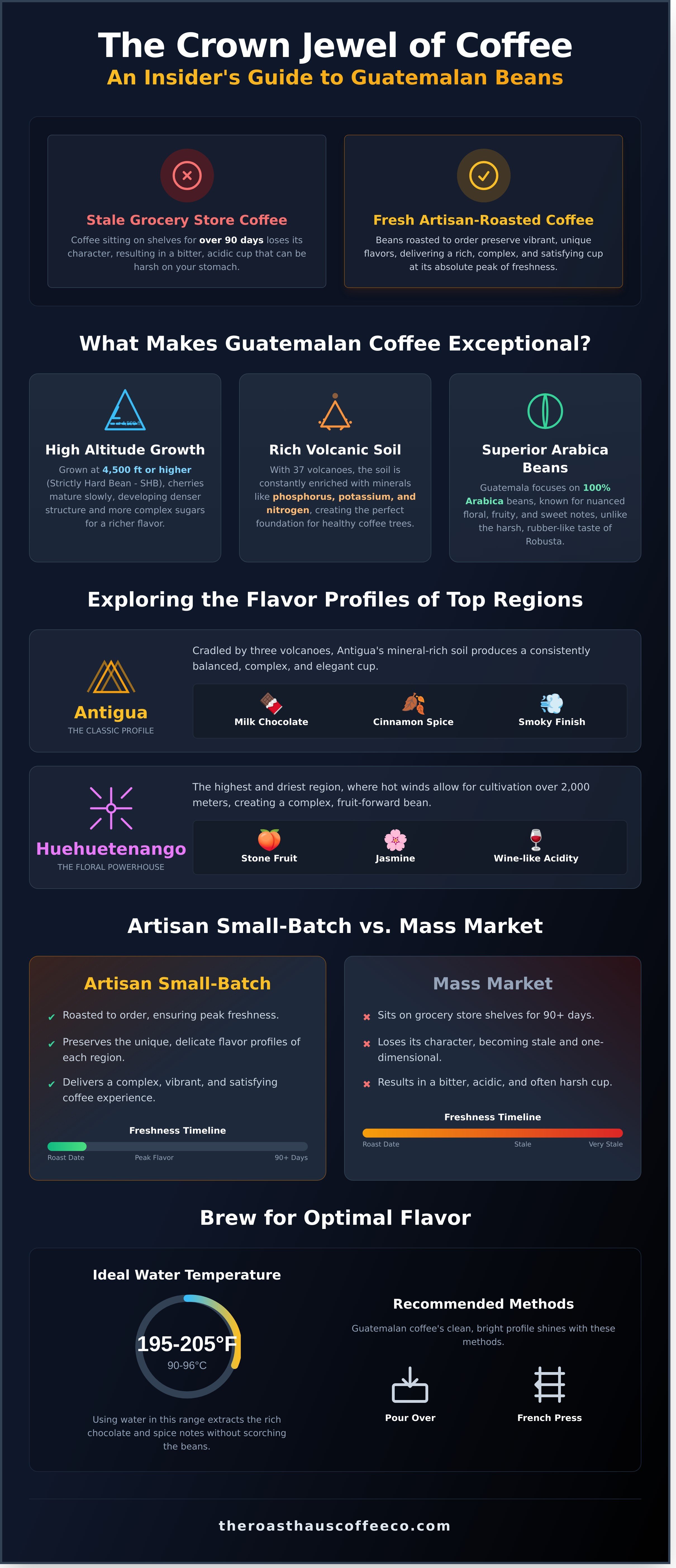
Your morning coffee is probably stale. That's a hard truth, but coffee sitting on a grocery store shelf for more than 90 days loses its character. We know you've tasted the result: a bitter, acidic cup that can be harsh on your stomach and a world away from the vibrant flavors the farmers worked so hard to create.
When you buy specialty guatemala coffee, you are almost certainly getting 100% Arabica beans. Unlike other countries that grow large amounts of the hardier, higher-caffeine Robusta variety, Guatemala's industry is built on the superior flavor of Arabica. Arabica beans are known for their nuanced aromatic qualities, offering the floral, fruity, and sweet notes that coffee lovers seek. Robusta, in contrast, often has a harsher, more rubber-like taste. To preserve this delicate flavor, most Guatemalan smallholders use the traditional washed process. This method removes the fruit from the bean before drying, producing an exceptionally clean, bright, and consistent cup that lets the bean's true origin shine through. Online retailers like Roy's Coffee often feature single-origin Guatemalan beans that showcase these distinct qualities.
You deserve a better, fresher cup. This guide will show you exactly why guatemala coffee is the crown jewel of Central America, celebrated for its deep chocolate and warm spice notes. We'll explain how our small, family-owned business preserves these unique flavors by roasting your beans to order, not weeks in advance. Get ready to explore Guatemala's famous coffee regions without the confusing jargon, learn the best way to brew these incredible beans, and finally taste coffee at its peak freshness.
Key Takeaways
- Understand how different growing regions produce unique flavor profiles, helping you select the perfect beans for your taste.
- Learn why the unique combination of volcanic soil and high altitude makes guatemala coffee one of the most sought-after in the world.
- Discover the difference between artisan and mass-market coffee to ensure you're buying beans at their peak freshness and flavor.
- Master the ideal water temperature and brewing methods to unlock the rich chocolate and spice notes in your coffee at home.
What Is Guatemala Coffee and Why Is It So Special?
Guatemala coffee is celebrated worldwide for its perfect balance of bright, crisp acidity and deep, chocolatey sweetness. It’s a cup that feels both complex and incredibly satisfying. But what makes these beans from a relatively small Central American nation so consistently exceptional? The answer isn't a single factor; it's a powerful combination of geography, geology, and generations of dedicated farming.
The country is world-renowned for producing high-altitude Arabica beans. This reputation for quality isn't a recent trend. The rich history of coffee in Guatemala shows a commitment to excellence that began in the mid-19th century. The secret lies in the country’s rugged topography, which creates over 300 distinct microclimates. This incredible diversity allows for a stunning range of flavor profiles, from the bright citrus notes of Antigua to the rich, buttery body of Huehuetenango.
Most of the nation's premium export is graded as "Strictly Hard Bean" (SHB). This classification means the coffee was grown at altitudes of 4,500 feet (about 1,370 meters) or higher. At these elevations, the coffee cherries mature slowly, developing more complex sugars and a denser structure. The result is a harder, more flavorful bean that can stand up to roasting and unlock an incredible spectrum of taste.
The Role of Volcanic Soil and High Altitude
You can't talk about Guatemalan coffee without talking about volcanoes. The country's highlands are dominated by a chain of 37 volcanoes, many of which are still active. This volcanic activity constantly enriches the soil, depositing a fresh layer of ash full of essential minerals. This soil is packed with nutrients like phosphorus, potassium, and nitrogen that coffee trees need to thrive. This natural fertilization process creates the perfect foundation for healthy plants and flavorful coffee cherries, making Guatemala the undisputed "crown jewel" of Central American coffee production.
Arabica vs. Robusta: The Guatemalan Standard
When you buy specialty guatemala coffee, you are almost certainly getting 100% Arabica beans. Unlike other countries that grow large amounts of the hardier, higher-caffeine Robusta variety, Guatemala's industry is built on the superior flavor of Arabica. Arabica beans are known for their nuanced aromatic qualities, offering the floral, fruity, and sweet notes that coffee lovers seek. Robusta, in contrast, often has a harsher, more rubber-like taste. To preserve this delicate flavor, most Guatemalan smallholders use the traditional washed process. This method removes the fruit from the bean before drying, producing an exceptionally clean, bright, and consistent cup that lets the bean's true origin shine through.
Exploring the Flavor Profiles of Top Guatemalan Regions
Saying you like "Guatemalan coffee" is like saying you like "American wine." It's a great start, but it doesn't tell the whole story. The country's dramatic landscape creates a series of unique microclimates that produce wildly different cups of coffee. What you taste from one valley will be completely different from what you taste in another. Anacafé, Guatemala's National Coffee Association, officially recognizes eight Guatemalan coffee regions, each defined by its specific altitude, soil, and weather patterns. Let's look at three of the most celebrated regions we often source from.
Antigua Coffee: The Classic Profile
Antigua is probably the most famous coffee-growing region in Guatemala, and for good reason. The valley is cradled by three massive volcanoes: Agua, Fuego, and Acatenango. This volcanic activity has blessed the soil with a rich supply of minerals and pumice, which helps retain moisture. The result is a coffee that's consistently balanced and complex. You get that classic, satisfying cup with deep notes of milk chocolate, a touch of warm cinnamon spice, and often a subtle, pleasant smokiness that lingers on the finish. It’s a rich and elegant profile that stands up well to a medium roast. If you enjoy the deep, layered flavors found here, you'll also appreciate the bold character of our Kenya AA Supreme.
Huehuetenango: The Floral Powerhouse
Head to the remote western highlands and you'll find Huehuetenango (pronounced way-way-ten-AN-go). This is one of the most exciting regions for guatemala coffee. It's the highest and driest of the growing areas, and it's unique because hot, dry winds sweep up from Mexico's Tehuantepec plain. These winds protect the coffee plants from frost, allowing farmers to cultivate coffee at incredible altitudes, some over 2,000 meters. This high-altitude growth slows the cherry's maturation, leading to a more complex and fruit-forward bean. The cup is distinctly different from Antigua; it's lighter, with a crisp, wine-like acidity and delicate floral notes. Think less chocolate bar, more stone fruit and jasmine. For us, Antigua is a comforting classic. Huehuetenango is a thrilling adventure.
The coffee from Atitlán offers yet another distinct experience, shaped entirely by the massive lake it surrounds. Grown on the steep slopes of the volcanoes ringing Lake Atitlán, these beans benefit from rich volcanic soil and the strong daily winds, known as the Xocomil, that stir the air. This unique environment produces a coffee with a wonderfully bright, crisp acidity. The flavor profile is often full of sparkling citrus notes, like lemon and green apple, balanced by a full body and a clean, nutty finish. It’s a refreshing and aromatic cup that truly reflects its lakeside origins. Understanding these regional differences is the first step to finding the coffee you'll love. When you're ready, you can explore our current single-origin offerings and taste this incredible diversity for yourself.
Artisan Small-Batch vs. Mass-Market Guatemala Coffee
You can find coffee from Guatemala on almost any grocery store shelf. But there's a world of difference between that bag and the one you get from an artisan roaster. The coffee in a supermarket has likely been sitting for months, first in a distribution center and then on the shelf. During that time, a quiet but destructive process is happening: oxidation.
Coffee beans are packed with volatile oils and aromatic compounds. These are responsible for the incredible flavors and smells we love. Once the beans are roasted and exposed to oxygen, these compounds begin to degrade. The vibrant, complex notes flatten out, replaced by a generic, stale taste. Freshness isn't a marketing gimmick; it's a chemical necessity for great coffee. Mass-market coffee prioritizes shelf life. We prioritize flavor.
At The Roast Haus, our philosophy is simple: Roasted to Order. The journey to peak freshness doesn't start until you click "buy." We don't roast our beans and hope someone buys them. We wait for your order, then we roast your coffee. This ensures you receive beans at the absolute height of their potential.
The Problem with Grocery Store "Roast Dates"
Don't be fooled by the "Best By" date on a bag of coffee. That date is often set 12 to 18 months after roasting, long after the coffee's true character has vanished. The only date that matters is the "Roast Date." Coffee flavor hits its peak between 3 and 14 days after roasting. This window allows the beans to degas (release trapped CO2) while the aromatic oils are still vibrant. Our promise is straightforward: your coffee is shipped within 24 hours of roasting, so it arrives on your doorstep ready to enter that perfect flavor window.
Why Small-Batch Roasting Matters for Single Origins
The unique, delicate flavor profile of guatemala coffee demands respect. Large, industrial roasters often use scorching-hot temperatures to process thousands of pounds at once, a method that can burn the delicate sugars within the beans. The subtle notes of milk chocolate and bright citrus are lost forever. The delicate nature of these beans, as detailed in an FAO report on Guatemalan coffee, requires a roaster's full attention.
Small-batch roasting gives us that control. We can precisely manage the heat and timing, guiding the beans through the "Maillard reaction" where sugars and amino acids combine to create rich, complex flavors. It’s a hands-on process that allows us to unlock the bean’s true potential, not just char it brown. For a deeper look at this process, check out our Art of Roasting Guide.
How to Brew Guatemalan Coffee for Optimal Flavor
You've chosen a fantastic bean. Now, it's time to brew it right. The way you prepare your guatemala coffee is just as important as the quality of the roast itself. A few simple adjustments can transform a good cup into an unforgettable one, highlighting the specific notes the farmers and roasters worked so hard to cultivate. Getting it right isn't about expensive equipment; it's about respecting the coffee with the right technique.
We believe great coffee is simple. It follows a few core principles that ensure you extract the best flavor every single time. Before you choose a specific method, lock in these fundamentals:
- Grind Fresh, Always. Coffee's flavor is locked in volatile aromatic compounds. Once ground, the surface area increases dramatically, and these compounds begin to oxidize and disappear. Flavor loss starts in as little as 15 minutes. Grinding just before you brew is the single most impactful step for a better cup.
- Use Filtered Water. Your coffee is over 98% water. If your water has off-flavors from chlorine or minerals, your coffee will too. Use simple filtered water for a clean, pure taste.
- Watch Your Temperature. Boiling water at 212°F will scald your coffee grounds, creating a bitter, harsh flavor. The ideal temperature for extraction is between 195°F and 205°F. This range is hot enough to extract flavor without burning the delicate notes.
- Stick to the Golden Ratio. For a balanced and rich cup, we recommend a coffee-to-water ratio of 1:16. That means for every 1 gram of coffee, use 16 grams (or milliliters) of water. This standard ensures you're tasting the coffee's character, not just hot water.
The French Press Method for Guatemala Beans
For a medium or dark roast, like a classic Antigua with its deep chocolate and nutty profile, the French Press is a perfect match. Its metal mesh filter allows the coffee's natural oils and some fine sediment to pass into the cup. This creates a full-bodied, rich texture that enhances those decadent, chocolatey notes. Use a coarse grind to prevent sediment and get the best results. For specific instructions, check out our complete French Press Recipe for the right timing and grind size.
Pour Over for Huehuetenango and Light Roasts
If you have a high-altitude Huehuetenango or another light roast, the pour over method will make its delicate flavors sing. The paper filter traps the oils, resulting in a cleaner, brighter cup that clarifies the subtle floral and bright citrus notes characteristic of these beans. The key here is the "bloom," a 30 to 45-second phase where you pour just enough hot water to saturate the grounds. This releases trapped CO2 from the fresh roast, preventing sour flavors and allowing for an even extraction. To learn more, you can compare the results of a French Press vs Pour Over and find what you like best.
Ultimately, the best brewing method is the one that you enjoy. These guidelines are a starting point for exploring the incredible diversity of flavor that guatemala coffee has to offer. The best brewing starts with the freshest beans. Experience the difference with our single-origin Guatemalan beans, always roasted to order.
Experience Fresh Guatemala Coffee from The Roast Haus
You’ve learned what makes Guatemalan coffee special, from its rich volcanic soil to its distinct flavor profiles. Now, it’s time to experience it at its peak. At The Roast Haus Coffee Co., we are a family-owned artisan roastery right here in Wyandotte, Oklahoma, and we live by a simple, powerful mantra: Roasted to Order. This isn't just a tagline; it's our promise to you. We believe that coffee’s best flavor is fleeting, and we’re dedicated to making sure you never miss it.
We don’t have bags of roasted coffee sitting on a shelf waiting for a buyer. The moment you place your order, we get to work. We roast your beans with precision and care, capturing the exact notes that make our guatemala coffee so exceptional. The beans we source are exclusively Strictly Hard Bean (SHB) grade, grown at altitudes over 1,350 meters where cooler temperatures allow the coffee cherries to mature slowly. This develops a denser, more complex bean, and we see it as our duty to unlock that potential for your cup.
By choosing The Roast Haus Coffee Co., you’re doing more than just buying incredible coffee. You’re supporting a small, family-run business and the craft we pour our hearts into. You’re joining a community of coffee lovers who understand that freshness is not a luxury; it's a requirement. We’re for people who are done with the stale, bitter taste of mass-produced coffee that has sat in a warehouse for months.
From Our Oklahoma Roastery to Your Door
Our process is designed for maximum freshness. It’s straightforward and honest. We roast your coffee the day your order is processed and ship it the very next day. This ensures the beans arrive at your door within their peak flavor window, just days after being roasted. For our neighbors in Wyandotte and the surrounding Oklahoma area, we offer local pickup to get it in your hands even faster. To keep that freshness coming, check out our Coffee Subscription and never run out of your favorite beans again.
Why Our Customers Love The Roast Haus Coffee Co. Difference
We can talk about freshness all day, but our customers say it best. Just last week, a customer named David from Tulsa wrote to us: “The moment I cut open the bag, the most glorious aroma filled my entire kitchen. It smelled more alive than any coffee I’ve ever bought.” That’s the difference. It’s an experience that starts before you even grind the beans. It’s our commitment to artisan quality and genuine service, delivered in every single bag. See for yourself.
Shop our Guatemala Coffee and experience the peak of freshness.
Experience True Guatemalan Coffee Freshness
You now know that an incredible cup is defined by its origin, from Antigua's rich chocolate notes to Huehuetenango's bright fruit flavors. You've also learned the most important secret: freshness is everything. Coffee that sits on a shelf for months loses the very complexity that makes it special. The vibrant character of high-altitude Guatemalan beans can only be truly appreciated when they are freshly roasted.
This is where our commitment at The Roast Haus makes a difference. As a family-owned small business in Oklahoma, we don't roast until you order. We use a meticulous small-batch artisan process for every bag of our guatemala coffee. Your beans are roasted and then shipped within 24 hours, locking in the peak flavor that mass-market brands simply can't deliver.
Stop settling for stale coffee. It's time to taste what you've been reading about. Shop Freshly Roasted Guatemala Coffee from The Roast Haus today. We're passionate about our craft, and we know you'll taste the difference in every single cup.
Frequently Asked Questions About Guatemalan Coffee
Is Guatemala coffee acidic or bitter?
Guatemala coffee is known for its bright, pleasant acidity, not bitterness. This acidity is often described as crisp and clean, similar to a green apple or citrus fruit. Bitterness in any coffee is typically a result of over-roasting or improper brewing, not the origin of the bean. We carefully roast our beans to highlight their natural sweetness and complex flavors, ensuring you get a balanced cup without any harsh bitterness.
What is the best roast level for Guatemalan coffee beans?
A medium roast is the best level for most Guatemalan beans. This roast profile preserves the coffee's delicate and complex flavor notes, which often include milk chocolate, nuts, and bright citrus. Roasting darker can overwhelm these unique characteristics. Our small-batch, artisan approach allows us to dial in the perfect medium roast, ensuring the bean's true origin flavor shines through in every single bag we ship.
How long does Guatemalan coffee stay fresh after roasting?
Your coffee beans will achieve peak flavor between 3 to 7 days after the roast date and should be used within 30 days for optimal freshness. Because we roast to order and ship the same day, you receive them with their full potential intact. Storing whole beans in an airtight container away from light and heat is the best way to preserve their quality. Ground coffee loses its freshness much faster, often in just 15 minutes.
Does Guatemala coffee have more caffeine than other origins?
No, Guatemala coffee does not have significantly more caffeine than other Arabica coffees. Caffeine content is primarily determined by the coffee species. Since over 98% of coffee from Guatemala is of the Arabica species, it contains a typical caffeine level of about 1.5% by weight. In contrast, Robusta beans, grown elsewhere, can contain 2.5% caffeine or more. The origin's soil and climate affect flavor, not caffeine.
What does "SHB" mean on a bag of Guatemalan coffee?
SHB stands for Strictly Hard Bean. It's a grade given to coffee grown at high altitudes, specifically above 1,350 meters (approximately 4,500 feet). Coffee cherries ripen more slowly in the cooler temperatures at this elevation. This slower maturation process produces a denser, harder bean packed with more complex sugars and nuanced flavors. SHB is a reliable indicator of a high-quality, flavorful coffee.
Can I use Guatemalan coffee for espresso?
Yes, Guatemalan coffee is an excellent choice for espresso. Its inherent balance, full body, and rich notes of chocolate and toffee create a fantastic single-origin shot. It also produces a thick, stable crema. We find that a medium roast provides a sweet and complex shot that works beautifully on its own or as a base for milk drinks like lattes and cappuccinos. It's a versatile coffee that truly performs well under pressure.
Why is Guatemalan coffee often described as having "smoky" notes?
The famous "smoky" notes are specific to coffee from the Antigua region, which is surrounded by three active volcanoes: Fuego, Acatenango, and Agua. The volcanic pumice in the soil is rich in minerals and contributes a unique, subtle spice and smokiness to the coffee's flavor profile. It's an attribute that makes Antigua Guatemala coffee sought after worldwide. Not all coffees from the country have this note; it’s a signature of that specific terroir.

