


You spent twenty-four hours waiting for that smooth, chocolatey concentrate, but your first sip tastes like bitter medicine or oxidized cardboard. It's a frustrating moment that every home brewer faces eventually, especially when you've invested time and high-quality beans into the process. Before you pour that liquid gold down the sink, you need to know how to fix a bad batch of cold brew using professional troubleshooting techniques. We understand the disappointment of a wasted roast. Our family roastery, The Roast Haus Coffee Co. in Wyandotte, is built on the belief that every cup should reflect the hard work put into the beans.
We agree that confusing dilution ratios and conflicting online advice make salvaging a brew feel like a guessing game. This guide will teach you how to identify exactly why your coffee tastes off, whether it's a metallic tang from stale grocery store beans or a muddy texture from poor filtration. We'll walk you through practical fixes like the saline drop method for bitterness and secondary filtering for clarity. You'll also learn the critical signs that tell you when a batch is truly unsalvageable, ensuring you get back to a perfect cup of Kenya AA Supreme or Ethiopia Limu without the guesswork.
Key Takeaways
- Identify if your brew is under-extracted or over-extracted by testing for sour or bitter notes to choose the correct recovery path.
- Learn how to fix a bad batch of cold brew using a simple saline solution to suppress bitterness receptors on your tongue.
- Use secondary paper filtration to strip out sediment and fines that create a muddy texture and lead to faster oxidation.
- Ensure your next batch succeeds by switching to filtered water and maintaining a consistent, extra-coarse grind size.
- Prevent metallic off-flavors by choosing small-batch, roasted-to-order beans instead of oxidized, pre-ground grocery store options.
Diagnosing the Problem: Why Does Your Cold Brew Taste Bad?
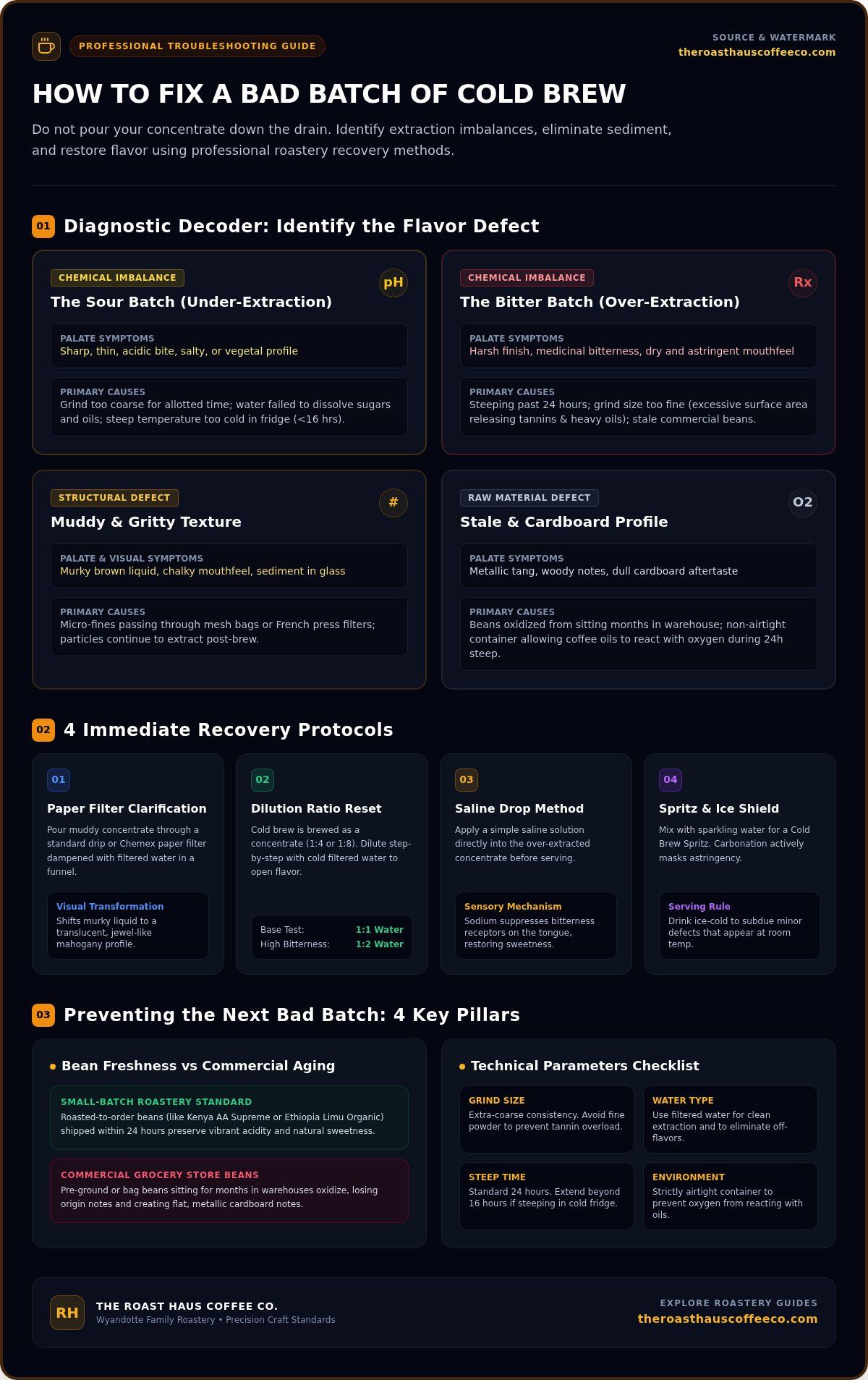
Before you can apply a recovery method, you must identify the symptom. Learning how to fix a bad batch of cold brew starts with a simple taste test. Most defects are not random; they are the result of specific chemical imbalances during the immersion process. If you understand these signals, you can often save your concentrate before it hits the drain.
Common flavor defects like metallic or "stale" notes often point to the quality of the raw material. Grocery store coffee typically sits in a warehouse for months, allowing volatile oils to oxidize and turn rancid. This creates a woody, cardboard-like profile that no amount of filtering can remove. We prevent this at The Roast Haus Coffee Co. by shipping beans like our Kenya AA Supreme within 24 hours of roasting. Freshness is the foundation of a clean cup.
Oxidation also plays a role during the long 24-hour steep. If your container isn't airtight, the coffee oils react with oxygen, leading to a flat and dull taste. Over-extraction is the primary cause of harsh bitterness in cold brew. This happens when the water pulls out too many organic compounds, leaving you with a liquid that feels dry and astringent.
The Sour Batch (Under-Extraction)
Under-extraction presents as a sharp, thin, or even salty flavor. It feels incomplete on the palate because the water failed to dissolve the necessary sugars and oils. If your brew is sour, your grind was likely too coarse for the allotted time. While we recommend an extra-coarse grind for cold brew, using chunks that are too large can lead to a vegetal profile. Water temperature also matters. If you steep in a very cold refrigerator, you may need to extend your time beyond 16 hours to reach full extraction and avoid that acidic bite.
The Bitter Batch (Over-Extraction)
A bitter batch is often the result of steeping for too long or using a grind that is too fine. Fine grinds increase the surface area, causing an excessive release of tannins and heavy oils. This creates a muddy mouthfeel and a harsh finish that masks the natural sweetness of the bean. If you are using our Ethiopia Limu Organic and notice a drying sensation, you've likely over-steeped. Stale beans from large commercial roasters are particularly prone to this, as they lack the vibrant acidity needed to cut through the bitterness. Understanding these nuances is the first step toward knowing how to fix a bad batch of cold brew and preventing the same mistakes in your next carafe.
Immediate Fixes for Texture and Strength
If your coffee is safe to drink but tastes heavy or looks cloudy, you don't need to start over. Most texture issues stem from the filtration stage. When you use a French press or a metal mesh bag, micro-fines escape into the concentrate. These tiny particles continue to extract even after you've removed the main grounds, leading to a chalky mouthfeel and increasing bitterness over time. Learning how to fix a bad batch of cold brew often starts with cleaning up the liquid itself.
Fixing Muddy or Gritty Cold Brew
Mesh strainers are convenient, but they lack the precision of paper. To fix a gritty batch, use the paper filter trick. Place a standard drip coffee filter or a Chemex paper into a funnel and dampen it with filtered water to remove any papery taste. Slowly pour your cold brew through this setup. The paper captures the insoluble solids and oils that a mesh screen misses. This process clarifies the brew and creates a much cleaner, sweeter profile on the palate. You will see a visible difference in the glass, moving from a murky brown to a translucent, jewel-like mahogany.
The Dilution Ratio Reset
Sometimes the flavor isn't "bad," it's just too concentrated. Cold brew is typically brewed as a concentrate at a 1:4 or 1:8 ratio, which is far too strong to drink straight. To find the sweet spot, start by testing a 1:1 ratio with cold filtered water. If the bitterness is still too aggressive, move to a 1:2 ratio. Dilution "opens up" the coffee, allowing the subtle notes of the bean to emerge. For an extra layer of troubleshooting, try using sparkling water. A Cold Brew Spritz uses carbonation to mask minor astringency, making a slightly over-extracted batch much more refreshing.
If you find yourself constantly struggling with ratios, it might be time to revisit your base technique. Our guide on how to make coffee provides a solid foundation for getting your measurements right the first time. Remember that serving temperature also plays a role. Drinking your brew ice-cold helps hide subtle flavor defects that become more apparent as the coffee warms up. If you've tried these fixes and the taste is still flat, you might need to upgrade your beans to a The Roast Haus Coffee Co. sampler to ensure you're working with peak freshness.
The Roaster's Secret: Using Additives to Balance Flavor
When you are learning how to fix a bad batch of cold brew, you shouldn't just reach for the sugar bowl. Professional roasters know that sugar often just creates a sweet, bitter mess. Instead, you should use additives that chemically balance the flavor profile. These methods work by suppressing harsh notes or adding body to a thin extraction. It is about salvage, not just masking. You can transform a harsh concentrate into a smooth drink by understanding a few basic principles of taste chemistry.
The Saline Solution Trick
Bitterness is the most common complaint in home brewing. It usually stems from over-extraction or using beans that aren't fresh. Sodium ions are incredibly effective at blocking the receptors on your tongue that detect bitterness. By adding a tiny amount of salt, you neutralize the harshness without making the drink taste like the ocean. Salt suppresses bitterness better than sugar. We recommend using a saline solution of one part salt to four parts water. Add two drops to an eight-ounce glass and taste the difference. This is a primary technique for how to fix a bad batch of cold brew that has steeped for too many hours.
Fats and Emulsifiers
If your batch feels astringent or has high tannin levels, fat is your best friend. Heavy cream or high-fat oat milk works better for high-tannin batches because the lipids coat your palate. This creates a physical barrier between the bitter compounds and your taste buds. You can also experiment with coconut oil or grass-fed butter to create a creamy, rich texture. These fats add a rich mouthfeel that masks a thin, under-extracted body. A single drop of pure vanilla extract is another useful tool. It provides an aromatic sweetness that tricks your brain into sensing sugar without the need for heavy syrups.
Spices like cinnamon or cardamom are excellent for hiding "woody" or "stale" notes. These off-flavors are common if you're using grocery store beans rather than our roasted-to-order Ethiopia Limu Organic. Simply add a pinch of ground spice to your glass and stir well. If you must use a sweetener, stick to liquid options like simple syrup or agave. These dissolve instantly in cold liquid, whereas granulated sugar will just sink to the bottom. These tools ensure you can enjoy your coffee today while you wait for a fresh shipment of quality beans from our Wyandotte roastery.
Preventing the Next Bad Batch: Grind, Water, and Time
While knowing how to fix a bad batch of cold brew is a vital skill, the goal should always be a perfect extraction on the first try. Consistent results come from controlling the three variables that most home brewers overlook: grind uniformity, water mineral content, and the precise timing of the steep. If you master these three pillars, you won't have to spend your morning balancing bitterness or filtering out silt. Prevention is always more efficient than salvage.
Mastering the Grind Size
Precision starts with your grinder. For cold brew, your coffee should look like coarse sea salt, not fine table salt. Blade grinders are the enemy of good cold brew because they create a chaotic mix of dust and boulders. The dust over-extracts instantly, while the larger boulders remain under-extracted. This imbalance is why many batches taste both bitter and sour at once. Use a quality burr grinder to achieve a uniform, extra-coarse setting that allows water to flow evenly around every particle. You can find more details on selecting the right equipment in The Ultimate Guide to Coffee Grinders.
Water Quality and Ratios
Coffee is roughly 98% water, so the quality of your tap matters. Hard water contains high levels of calcium and magnesium that can make your brew taste chalky or dull. Conversely, water that is too soft lacks the minerals needed to pull the complex flavors out of the bean. We recommend using filtered water to ensure the bright, floral notes of beans like our Ethiopia Limu Organic can shine. For a consistent strength, use a digital scale to measure by weight rather than volume. Volumetric measurements like scoops vary wildly depending on the roast level and bean density.
Our recommended ratios for a successful steep are:
- Concentrate: 1:4 coffee-to-water ratio by weight.
- Ready-to-Drink: 1:8 coffee-to-water ratio by weight.
Time is your final variable. Many generic recipes suggest a full 24 hours, but we find the 12-to-18 hour window is the sweet spot for most single-origin roasts. Steeping beyond 18 hours often pulls out woody tannins that mask the natural sweetness of the roast. If you are steeping in the refrigerator, aim for 16 hours. If you are steeping at room temperature, 12 hours is usually sufficient. This control is just as important as knowing how to fix a bad batch of cold brew when things go wrong. To guarantee your next batch has the best possible flavor profile, buy a fresh-roasted sampler bag today and experience the difference that small-batch quality makes.
The Permanent Fix: Why Fresh, Small-Batch Beans Matter
You can follow every technical brewing rule and still end up searching for how to fix a bad batch of cold brew if your raw materials are compromised. The most common reason for a flat, cardboard-like, or metallic taste isn't your technique; it's the age of your beans. Most supermarket coffee sits in warehouses and on shelves for months before it reaches your kitchen. During this time, the volatile oils responsible for flavor and aroma oxidize and turn rancid. Cold brew's long immersion time acts like a magnifying glass for these defects. If the oils are already stale, the resulting cup will be dull and bitter regardless of your equipment.
Fulfillment as a Flavor Differentiator
At The Roast Haus, we treat fulfillment as a critical part of the flavor profile. We ship our beans within 24 hours of roasting to ensure they arrive at your door during their peak flavor window. This rapid turnaround prevents the development of the "stale" defect that ruins so many home batches. Our artisan approach focuses on small-batch quality over mass production. We believe that supporting independent business values leads to a better product for the consumer. You can learn more about selecting the right variety in our Coffee Beans: The Ultimate Beginner's Guide.
Best Roasts for Cold Brew
Single-origin beans offer a level of complexity that generic blends cannot match. For cold steeps, origins like our Kenya AA Supreme or Ethiopia Limu Organic excel because their natural acidity and floral notes remain vibrant during the slow extraction process. While dark roasts are traditional for cold brew, they can sometimes become overly smoky or ashy if over-steeped. Medium or lighter roasts are often more forgiving and preserve the unique characteristics of the soil where they were grown.
Understanding how to fix a bad batch of cold brew is a necessary skill for any enthusiast, but starting with the right beans is the only way to guarantee a superior result every time. If you want to stop troubleshooting and start enjoying your coffee, you need beans that haven't lost their integrity on a grocery store shelf. Shop Fresh Roasted-to-Order Beans from The Roast Haus to experience the difference that peak freshness makes in your next carafe.
Master Your Next Carafe
You now have the tools to identify whether your brew is under-extracted or suffering from the bitterness of over-steeping. Remember that a pinch of salt can neutralize harshness, and a paper filter can clear up a muddy mouthfeel. Learning how to fix a bad batch of cold brew saves your morning coffee today, but long-term success depends on the variables you control before the steep begins. Small-batch precision, filtered water, and a consistent grind are the foundations of a smooth concentrate that never needs fixing.
Since 2014, our family-owned roastery has focused on the integrity of every bean. We believe you shouldn't have to troubleshoot your coffee. By choosing beans that are roasted and shipped within 24 hours, you eliminate the stale, cardboard flavors found in mass-produced grocery stock. Our small-batch methods ensure you receive peak freshness every time you order. Stop settling for bad batches; get fresh, roasted-to-order beans delivered today. You deserve a cup that reflects the true craftsmanship of the roast. Happy brewing.
Frequently Asked Questions
Why is my cold brew bitter even after diluting it?
Bitterness remains after dilution because the water has pulled out heavy tannins and organic acids that water alone cannot mask. This often happens if you steep longer than 18 hours or use a grind that is too fine. To salvage the flavor, try the saline drop method. A tiny pinch of salt blocks bitterness receptors on your tongue, which is a more effective way to learn how to fix a bad batch of cold brew than simply adding more water.
Can I re-steep cold brew if it's too weak?
You can re-steep a weak batch by adding fresh grounds and letting it sit for another 4 to 6 hours. However, it is often easier to brew a very small, highly concentrated batch and blend the two together. Weak coffee usually results from an excessively coarse grind or steeping for less than 12 hours. Ensure your next batch uses the correct 1:4 ratio by weight to avoid a thin, vegetal profile.
How long can I store cold brew before it goes bad?
Freshly made cold brew concentrate stays chemically stable in a refrigerator at or below 41°F for 10 to 14 days. If you have already diluted the coffee with water, you should consume it within 5 to 7 days for the best flavor. Because cold brew isn't pasteurized, it is susceptible to microbial growth. Always store your coffee in an airtight glass container to prevent oxidation and keep it away from pungent foods in your fridge.
Does the roast level affect how long I should steep cold brew?
Roast level significantly impacts extraction speed. Dark roasts are more porous and release their oils quickly, so they often reach peak flavor in 12 hours. Lighter roasts, like our Ethiopia Limu Organic, are denser and require a longer 16 to 18 hour steep to fully develop their complex floral and citrus notes. If you treat all roasts the same, you'll likely end up searching for how to fix a bad batch of cold brew that is either too smoky or too thin.
Can I use a French press to fix a muddy batch of cold brew?
A French press will not fix a muddy batch because its metal mesh filter is designed for coarse particles. It allows micro-fines and silt to pass through, which is exactly what causes that chalky texture. To achieve true clarity, you must use a secondary pass through a dampened paper filter. This strips out the diterpenes and sediment that a French press leaves behind, resulting in a cleaner mouthfeel and a brighter finish in your glass.
Why does my cold brew taste like metal or chemicals?
A metallic or chemical taste is a classic sign of oxidized oils in stale coffee beans. Coffee beans are perishable, and grocery store stock often sits for months, leading to rancidity. When these old beans are steeped for 24 hours, the bad flavors are magnified. At The Roast Haus, we prevent this by shipping our Kenya AA Supreme within 24 hours of roasting. Freshness is the only way to avoid the metallic defects common in mass-produced beans.
Is it better to steep cold brew in the fridge or on the counter?
Steeping in the refrigerator is the professional standard for safety and flavor consistency. While counter-top brewing is faster, the warmer environment accelerates oxidation and increases the risk of bacterial fermentation. Steeping at 38°F to 40°F for 16 to 24 hours results in a much smoother, cleaner concentrate. It also ensures your coffee stays below the FDA safety threshold for Time/Temperature Control for Safety foods, preventing funky or sour off-flavors from developing.
How do I know if my cold brew is over-extracted or just too strong?
You can distinguish between the two by focusing on the finish. A batch that is simply too strong will taste intense and heavy but will still have recognizable sweetness and acidity once you add water. Over-extracted coffee will have a lingering, dry, and astringent finish that feels like it is sucking the moisture from your tongue. If dilution doesn't remove that harsh, drying sensation, you have over-extracted the beans and may need to use fats or salt to balance it.

