


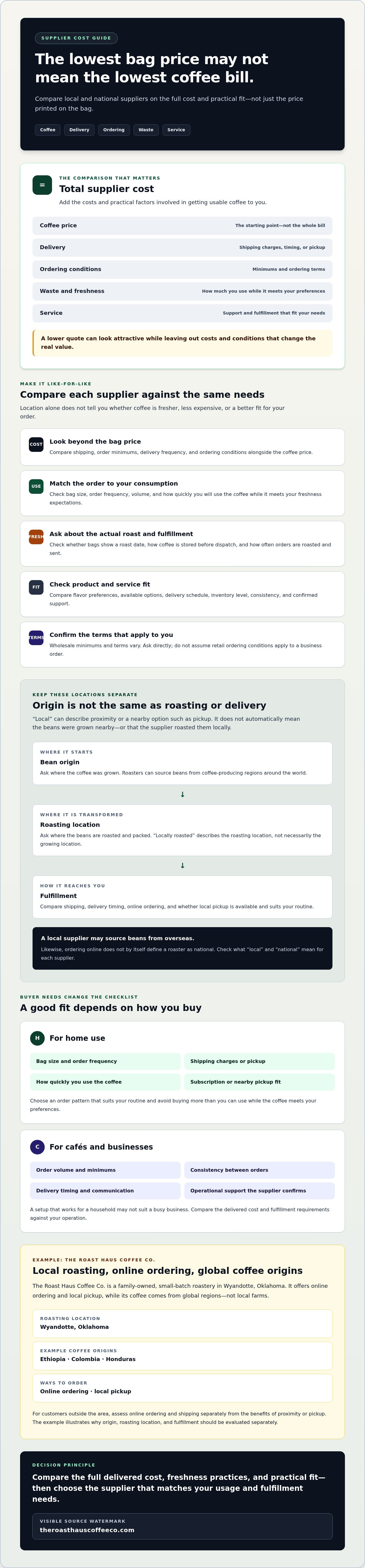
The lowest bag price can lead to the higher coffee bill. A cost analysis of local vs national coffee suppliers should include shipping, order minimums, delivery timing, and how much coffee you’ll use while it meets your freshness expectations. A lower quote may look attractive, but it doesn’t tell the whole story.
It makes sense to start by comparing prices, but location alone doesn’t tell you whether coffee is fresher or less expensive. A local roaster may source beans from overseas, and a nearby supplier may not offer the best fit for your order size. Check the roast date, delivery schedule, and how well the supplier’s options match your volume.
This guide gives you a like-for-like way to compare the full cost and practical value of local and national suppliers. You’ll see what to include beyond the listed bag price, how freshness and fulfillment affect usable value, and what to ask before choosing. The Roast Haus Coffee Co., a small-batch roaster in Wyandotte, Oklahoma, offers one example of how local roasting and online ordering can work together.
Key Takeaways
- Compare local and national suppliers on the same terms, including shipping, order minimums, delivery frequency, and ordering conditions, not just bag price.
- Check where coffee is grown, roasted, packed, and delivered to understand what “local” means for each supplier.
- Match supplier options to your coffee usage, flavor preferences, delivery schedule, and preferred inventory level.
- Ask about roast dates and fulfillment practices. A supplier’s location alone doesn’t tell you when the coffee was roasted.
- Consider whether local pickup or online ordering suits your needs, and confirm current terms before deciding.
Local vs. national coffee suppliers: what are you actually comparing?
Total supplier cost includes the coffee, delivery, ordering, waste, and service involved in getting usable coffee to you. That definition applies whether you’re buying a few bags for home or ordering for a café. The details that matter most depend on your order size and how the supplier roasts, packs, delivers, and supports its coffee.
“Local” and “national” can describe more than distance. A local supplier is generally close to the buyer or offers a nearby option, such as local pickup. A national supplier may be a large brand, a distributor, or an online roaster that serves customers across the country. Ordering online doesn’t automatically make a roaster national, just as a nearby brand isn’t necessarily the one that roasted the coffee.
What counts as a local or national coffee supplier?
Separate where the beans are grown from where they’re roasted and supplied. A roaster can be local to you while sourcing beans from coffee-producing regions elsewhere. The global economics of coffee helps explain why both local and national suppliers are connected to international production and trade.
The Roast Haus Coffee Co. is one example: it’s a family-owned, small-batch roastery in Wyandotte, Oklahoma, with online ordering and local pickup. Its coffee comes from global regions, not local farms. If you’re outside the area, assess its online ordering and shipping separately from the benefits of proximity or pickup. “Locally roasted” describes where the coffee is roasted, not necessarily where it’s grown or where every customer lives.
Why buyer type changes the comparison
For home use, compare bag size, order frequency, shipping charges, and how quickly you’ll use the coffee. A subscription or nearby pickup may suit your routine; ordering less often may work better for someone else. Include freshness in your decision, and avoid buying more than you can use while it meets your preferences.
Cafés have additional needs. Along with the delivered cost, consider order volume, consistency between orders, delivery timing, communication, and any operational support the supplier confirms it can provide. An arrangement that works for a household may not suit a busy business. Wholesale minimums and terms vary, so ask directly rather than assuming they match online retail conditions.
A sound cost analysis of local vs national coffee suppliers starts with your buyer type and fulfillment needs. Compare each supplier against the same requirements. That gives you a fair basis for weighing price and practical fit, without treating “local” or “national” as a cost verdict on its own.
How sourcing, roasting, and delivery shape coffee supplier costs
Coffee passes through several stages before it reaches you. Green beans are sourced and transported, then stored, roasted, packed, and shipped or picked up. Each stage can affect supplier costs and the buyer’s experience. Local roasting changes where some of this work happens, but it doesn’t remove the costs of sourcing coffee from global growing regions.
Bean origin and roasting location are different
Coffee sold by U.S. roasters is commonly made from green beans brought in from producing countries and roasted domestically. The USDA Foreign Agricultural Service tracks the supply, demand, and trade factors behind world coffee markets and trade. These broader market conditions affect the raw coffee input for roasters of different sizes and locations.
The Roast Haus illustrates the difference: its coffees include origins such as Ethiopia, Colombia, and Honduras, while the roasting takes place in Wyandotte, Oklahoma. Origin tells you where the beans were grown; roasting location tells you where they were turned into the coffee you buy. For more on how origin and other bean qualities affect selection, see this beginner’s guide to choosing coffee beans.
Freshness, batch size, and fulfillment
Roasting scale and batch size can affect how a supplier schedules production, manages inventory, and fulfills orders. A larger operation may handle substantial volumes through established distribution, while a small-batch roaster may produce in smaller runs. Neither approach automatically means a lower delivered cost or a better fit. Compare what each supplier can provide with your actual usage.
Look beyond a general freshness claim. Ask whether bags show a roast date, how coffee is stored before dispatch, and how often orders are roasted and sent. The Roast Haus ships products within 24 hours of roasting. That tells you something about its fulfillment schedule, but it doesn’t guarantee lower total cost or a flavor you’ll prefer. Delivery time after dispatch, storage at home or at your business, and how quickly you use the coffee also matter.
For a fair cost analysis of local vs national coffee suppliers, follow each supplier’s process from green coffee to your door. Record roast and fulfillment details alongside the quote. Treat freshness as a quality and inventory consideration, not an assumed saving. If you’re weighing origin options, you can also browse The Roast Haus coffee selection.
Local vs. national coffee suppliers: compare the full cost, not just the bag
Start with the same time period and the same coffee needs. Record each supplier’s quote, then add charges and conditions that affect what you receive. Leave unknowns blank until the supplier confirms them. Wholesale minimums, payment terms, and delivery arrangements vary, so don’t assume one supplier’s terms apply to another.
Which costs belong in the comparison?
Use this worksheet for household or business orders. Enter quoted figures for each supplier and note any non-price differences that affect your routine.
| Cost or condition | Local supplier | National supplier |
|---|---|---|
| Coffee purchase for the same period | Enter quote | Enter quote |
| Shipping or delivery charges | Enter quote | Enter quote |
| Pickup travel, if applicable | Enter your cost | Enter your cost |
| Order minimum and any unmet quantity | Confirm with supplier | Confirm with supplier |
| Delivery frequency and recurring-order conditions | Confirm with supplier | Confirm with supplier |
| Payment or subscription terms | Confirm with supplier | Confirm with supplier |
For cafés and other business buyers, also consider staff time spent placing and receiving orders, storage needs, stock rotation, consistency between deliveries, and coffee that goes unused. Track stockouts as well: a low quote may not suit your operation if supply interruptions affect service. These are buyer-specific impacts, not standard supplier fees. Ask each supplier to confirm its wholesale requirements directly.
How to compare cost per cup or serving
Once you have the figures, use the same accounting period and recipe for each supplier:
Cost per usable serving = total delivered spend for the period ÷ usable servings brewed from the coffee purchased.
Include coffee purchases, delivery, and any relevant pickup travel or ordering costs in total spend. To estimate servings, use the weight of the bags you bought and the coffee dose in your recipe. Don’t compare one supplier’s larger or stronger servings with another’s smaller ones. Spills, discarded coffee, and differences in extraction preferences can change the number of usable servings, so use your own records where possible.
This cost analysis of local vs national coffee suppliers gives you a clearer picture than bag price alone. Compare equivalent orders, then weigh the calculated cost against the ordering and service fit you need.
A practical checklist for choosing a local or national coffee supplier
Use your buying pattern to narrow the options before weighing personal preference or brand familiarity. A supplier should fit the coffee you use, the way you order, and the amount of inventory you can manage. Work through these steps, then compare the finalists using the same criteria.
Match supplier strengths to your buying pattern
- Define usage. Estimate how much coffee you use in a typical ordering period. At home, consider bag size and how quickly you finish it. At a café, account for menu demand and the need to keep core coffees available.
- Set your flavor needs. Decide whether you want a focused range or several distinct origins and roast profiles. For a café, consider whether repeatability or a distinctive menu matters more.
- Choose your preferred fulfillment. Local pickup may suit buyers who value proximity and direct communication, if the supplier offers it. National delivery may fit better when reach, assortment, or centralized purchasing matters more. In either case, confirm delivery timing and terms.
- Set an inventory limit. Decide how much coffee you can store and use while it meets your freshness expectations. A recurring order can make reordering routine, but only if the schedule and quantity match your consumption. See this coffee subscription services guide for factors to consider when weighing scheduled delivery.
Questions to ask before placing an order
Get details that affect fit in writing, or confirm them directly with the supplier. Ask about:
- Current shipping or pickup terms, order minimums, and estimated delivery timing.
- Whether bags show roast dates and how to understand the supplier’s roasting and fulfillment schedule.
- How often products are available and what happens if an item is temporarily unavailable.
- For business orders, wholesale requirements, payment terms, stock availability, and the support the supplier can confirm.
Consider more than the first reply. Clear answers, responsive communication, consistent coffee, and practical reorder flexibility can make a supplier easier to work with. Don’t assume a local roaster always offers more personal service or a national supplier always delivers more consistent coffee. Assess what each supplier demonstrates.
If possible, compare trial orders using the same coffee quantity and evaluation period. Note the delivery experience, product consistency, ordering effort, and how much coffee remains at the end. This gives your cost analysis of local vs national coffee suppliers a practical check: the right choice is the one that fits your actual buying routine, not just the quote.
To assess a local roaster’s options, explore The Roast Haus coffee selection.
When a local roaster makes sense, and how to evaluate The Roast Haus
A local roaster may suit you if you value roast-date information, smaller-scale production, or a direct way to ask questions about the coffee. Treat these as things to assess, not assumptions: look for clear product details, responsive communication, and a supply schedule that works for you. A national supplier may be a better fit if its assortment, reach, or purchasing process better matches your requirements.
When a local roaster is a strong fit
Proximity can make local pickup practical for nearby buyers and may eliminate the wait for a shipped order. Direct contact can also give you a way to ask about origins, roast profiles, and fulfillment. Still, judge the coffee and ordering arrangement on their own merits. “Local” alone doesn’t establish freshness, consistency, or value.
For a business, a personal connection is useful only if the supplier can meet your operating needs. Ask about current wholesale terms, product availability, order requirements, and capacity before relying on a roaster for regular service. If a specific coffee is central to your menu, discuss how the supplier handles availability and consistency. Confirm details directly rather than assuming retail and wholesale orders follow the same terms.
How The Roast Haus fits the comparison
The Roast Haus Coffee Co. is a family-owned roastery based in Wyandotte, Oklahoma. It sources coffee from global regions, so its local identity comes from its roasting and business location, not locally grown beans. The company offers online ordering, local order pickup, recurring coffee subscriptions, and wholesale partnerships with local coffee shops. Products ship within 24 hours of roasting, a fulfillment detail you can weigh alongside delivery estimates and your inventory needs.
Subscriptions can make recurring orders convenient, but check the current terms before choosing one. Confirm how delivery timing and frequency work, and whether you can manage preferences or adjust the schedule to match your usage. Don’t count recurring delivery as a saving unless its quantity and timing prevent excess coffee or emergency reorders.
For a fair cost analysis of local vs national coffee suppliers, compare your needs with each supplier’s current terms: coffee selection, roast-date information, ordering options, delivery, and the communication or business support you need. The right fit may be local or national. Choose based on what the supplier can confirm and what works for your household or operation.
To review available coffees and ordering options, explore The Roast Haus coffee.
Choose the supplier that fits your coffee routine
A fair cost analysis of local vs national coffee suppliers compares more than the bag. Include delivery, order minimums, ordering effort, and any coffee you can’t use while it meets your freshness expectations. Then weigh those costs against roast-date clarity, consistency, and the supplier’s fit with your household or business.
Local isn’t automatically cheaper or fresher, and national isn’t automatically more consistent. Compare current terms using the same quantities and ordering period. The best choice for your needs is the one that provides the coffee you want in a way that works for your budget, inventory, and schedule.
The Roast Haus Coffee Co. is a family-owned roastery run by a husband-and-wife team in Wyandotte, Oklahoma. Its products ship within 24 hours of roasting, and customers can choose individual orders, subscriptions, or local pickup. Wholesale partnerships are also available for local coffee shops. Confirm current terms directly.
Explore freshly roasted coffee from The Roast Haus and compare the available options with your needs.
Frequently Asked Questions
Is coffee from a local roaster more expensive than coffee from a national supplier?
Not necessarily. Bag price reflects factors such as bean origin, quality, roasting, and supplier operations, not location alone. Compare the same quantity and coffee type, then add shipping or pickup travel, order minimums, and recurring-order terms. A local option may offer convenient pickup or direct contact, while a national supplier may better suit other ordering needs. Check current quotes to find out which costs less for you.
How do I calculate the true cost of coffee from different suppliers?
Add the coffee purchase, shipping or delivery, relevant pickup travel, and other ordering costs for the same period. Then divide the total by the usable servings you brew. This cost analysis of local vs national coffee suppliers is most useful when you use the same bag weight, recipe, coffee dose, and accounting period for each option. Base the serving count on your own brewing, since spills and recipe preferences affect how much coffee is usable.
Does locally roasted coffee mean the beans are locally grown?
No. “Locally roasted” describes where the roaster processes the beans, not where the coffee was grown. Roasters may source green beans from producing regions around the world before roasting them closer to customers. The Roast Haus Coffee Co., based in Wyandotte, Oklahoma, sources coffee globally, including from Ethiopia, Colombia, and Honduras. If either origin or roasting location matters to your choice, ask the supplier about both.
Can a local coffee supplier meet a café’s wholesale needs?
Some local roasters supply cafés, but the fit depends on their current capacity and wholesale terms. Ask about order minimums, availability, delivery timing, payment terms, and consistency across orders. Also discuss what support the supplier can provide and what to expect if a coffee is unavailable. The Roast Haus partners with local coffee shops, but cafés should confirm current wholesale requirements directly rather than assume retail ordering terms apply.
What costs should I include when comparing coffee suppliers?
Start with the coffee purchase and add shipping or delivery, pickup travel, and any costs tied to minimum quantities or recurring orders. For a business, consider staff time spent ordering and receiving stock, storage, rotation, and coffee that goes unused. Note stockouts and consistency differences as operational impacts, too. Separate confirmed charges from estimates, and ask each supplier to verify any terms that aren’t clear in the quote.
Is a coffee subscription cheaper than ordering coffee as needed?
Not always. A subscription’s value depends on its current price and terms, including delivery charges, order frequency, quantity, and any conditions for changing or pausing deliveries. Compare the total cost over the same period with what you’d spend ordering as needed. Consider whether scheduled deliveries match your actual use. If they leave you with excess coffee or don’t arrive when you need them, the convenience may not make the arrangement worthwhile.
How does roast freshness affect the value of coffee?
Freshness helps you assess the coffee and plan how much to keep on hand, but it doesn’t automatically lower total cost or guarantee a flavor you’ll prefer. Check whether the supplier provides roast-date information and how coffee is stored and fulfilled. The Roast Haus ships products within 24 hours of roasting. Your storage, delivery timing, and rate of use still matter when assessing freshness and value.

