


One default roast can turn the office coffee pot into the least-loved part of the break room. Finding office coffee that employees actually like Seneca MO teams can share starts with recognizing that preferences differ: some people want a full-bodied cup, while others prefer decaf or a lighter option.
If your current coffee goes untouched, the problem may not be the brewing routine. The choice may be too narrow, stale, or poorly matched to the equipment you already use. A small-batch lineup gives your team room to compare options without making the process complicated. The Roast Haus Coffee Co. roasts to order and ships products within 24 hours of roasting, with choices such as Kenya AA Supreme, Decaf Swiss Water Process, and The All Day Sampler.
This guide will help you match coffee to employee preferences and your existing brewing setup, then create a simple, repeatable restocking routine. You’ll learn how to use a sampler to identify office favorites, account for freshness, and make dependable coffee part of the workday without adding unnecessary steps.
Key Takeaways
- Choose office coffee that employees actually like Seneca MO teams can enjoy by gathering preference feedback before ordering.
- Start with your existing brewer so the coffee suits the equipment and routine already in place.
- Compare an everyday coffee, an option that includes decaf, and sampler-led trials to find a practical fit.
- Use a short buying checklist to estimate demand, note decaf needs, and make restocking more consistent.
- Consider roasted-to-order coffee and a sampler to explore fresh options without making office coffee more complicated.
Why Seneca, MO Offices Need Coffee Employees Will Choose to Drink
A coffee station earns its place in the workplace when people use it. If employees avoid the pot, the coffee may not suit their preferences, the brewer, or the way the break room operates. Choosing office coffee that employees actually like Seneca MO workplaces can serve consistently means considering all three before setting a regular order.
This is a coffee selection decision. Start with the brewing equipment already in the break room, then choose coffee that works with it and suits the people who drink it. Make replenishment practical, too: a well-liked choice won’t help if no one knows when to reorder. Coffee has long played a role in daily routines and shared culture; the global history of coffee offers wider context for that familiar workplace ritual.
What does employee-approved office coffee mean?
Employee-approved coffee is coffee people willingly choose and can prepare through the workplace’s existing brewing routine. Approval doesn’t require pleasing every palate with one bag. It could mean finding a reliable everyday favorite or keeping a small selection so employees have a meaningful choice. No single origin or roast style suits every team. Ask what people enjoy rather than assuming.
What should Seneca office buyers decide first?
Clarify the practical details before selecting coffee. Check whether the brewer uses whole beans or ground coffee, and whether the team can grind beans as part of its routine. Estimate how many people drink coffee, then ask whether decaf belongs in the lineup. Finally, decide who will choose, prepare, and replenish the coffee. Clear responsibilities keep the station usable and prevent ordering and restocking from being left to chance.
These decisions narrow the choices without turning a simple office purchase into a complicated program. Gather a few employee preferences, match the coffee and preparation steps to the brewer, and consider trying more than one option before setting a regular selection. The Roast Haus Coffee Co. offers roasted-to-order beans and samplers for exploring different preferences, with products shipping within 24 hours of roasting.
Practical takeaway: Ask employees what they’ll drink, sample a manageable range of options, then choose coffee that fits the equipment and a clear replenishment routine.
How Seneca Offices Can Choose Coffee by Taste, Freshness, and Fit
Use a short comparison before settling on an office favorite. The goal isn’t to guess which coffee everyone will love. It’s to learn what employees prefer, then narrow the choices to coffee that suits the brewer and the team’s daily routine.
| What to compare | Question to answer | Practical fit |
|---|---|---|
| Flavor preference | Do employees prefer a familiar daily coffee or want to try different origins? | Ask for quick feedback, then sample a small range. |
| Regular or decaf | Would employees use a decaf option alongside regular coffee? | Include decaf if it meets a real workplace need. |
| Bean format | Can the office grind whole beans, or does its routine require another format? | Choose coffee that fits the preparation steps staff will actually follow. |
| Brewer compatibility | What coffee format does the existing brewer use? | Match the selection to the equipment already in the break room. |
How can an office account for different coffee preferences?
Keep feedback simple. Ask employees about strength, roast preference, and whether they drink regular coffee, decaf, or both. Then offer a small tasting before choosing a regular office coffee. The Roast Haus’s The All Day Sampler lets a workplace explore several coffees; use employee feedback to see which options deserve a place in the repeat order.
Kenya AA Supreme, Ethiopia Limu Organic, and Honduras Morning Splendeur are distinct coffees to compare, not guaranteed matches for particular palates. Let the team taste them rather than assuming an origin or style will suit everyone. The National Coffee Association’s coffee industry trends can provide broader industry context, but your employees’ own preferences should guide the office choice.
How do freshness and brewing setup affect the choice?
Roasted-to-order means coffee is roasted in response to an order rather than sitting as finished roasted coffee for an extended period before it is ordered. The Roast Haus ships products within 24 hours of roasting. That timing is useful when planning an order, while the office’s storage and brewing routine still affect the coffee’s condition when it is used.
Check whether your brewer takes whole beans or ground coffee, and whether staff can grind beans as part of preparation. Match the coffee to the equipment and habits already in place. For offices considering office coffee that employees actually like Seneca MO, this simple process connects preference, freshness, and day-to-day fit. Explore The Roast Haus coffee range as you compare options for your team.
How to Compare Office Coffee Options for a Seneca, MO Workplace
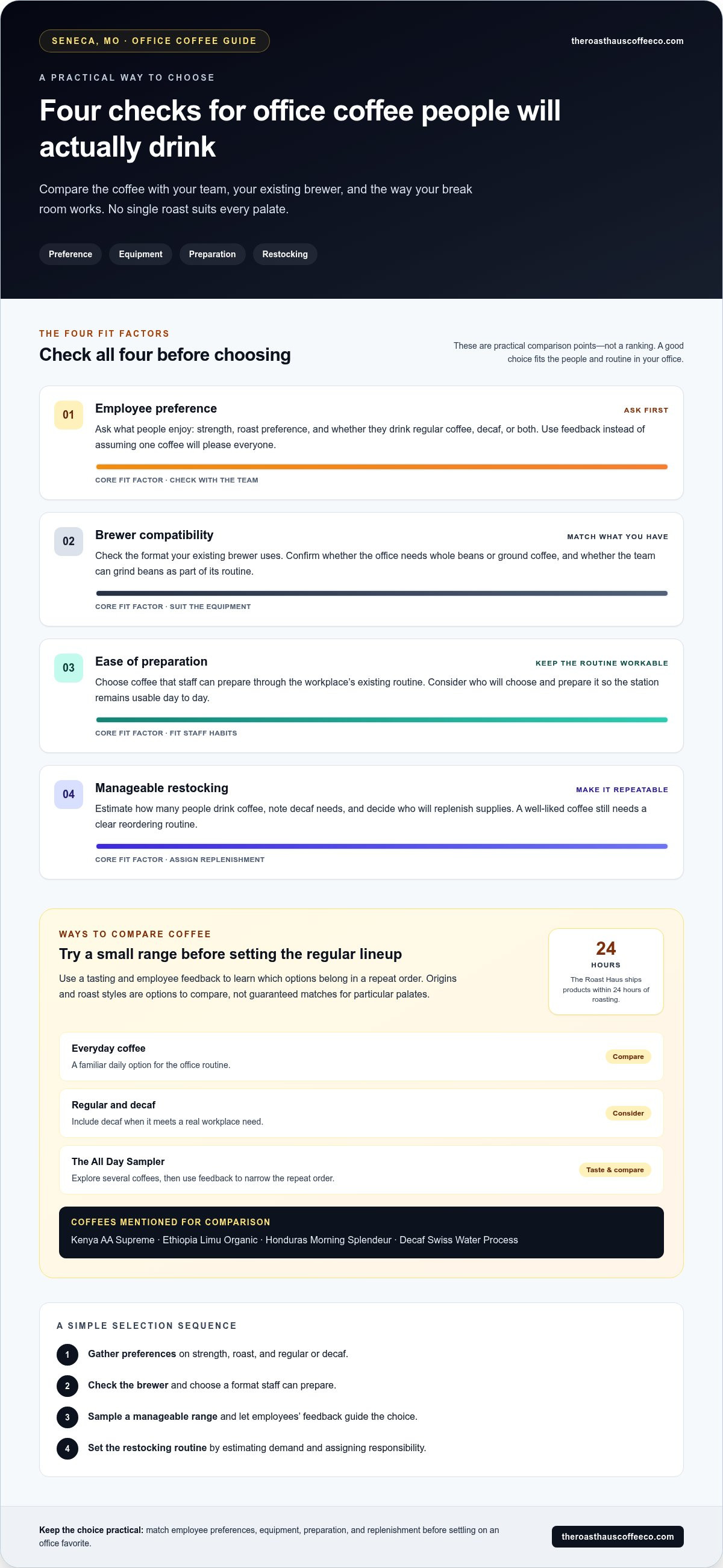
Compare office coffee by how well it works for the people, equipment, and ordering routine you already have. A useful shortlist might include one everyday coffee, a small selection with regular and decaf options, or a sampler-led trial before choosing a regular lineup. Assess each approach by four practical measures: employee acceptance, brewer fit, ease of preparation, and how manageable it will be to reorder.
| Approach | Employee acceptance | Brewer fit and preparation | Repeat-order practicality |
|---|---|---|---|
| One everyday coffee | Simple if the team shares a favorite, but may not suit every preference. | Easy to prepare if its format suits the existing brewer. | One selection keeps ordering straightforward. |
| Regular coffee plus decaf | Serves different routines without creating a large menu. | Check that staff can identify and prepare each option correctly. | Two choices are manageable if both get used. |
| Sampler-led trials | Lets employees compare options before the office settles on favorites. | Keep the trial compatible with the brewer and preparation habits. | Useful for discovery, but not necessarily a permanent routine. |
Should an office choose one coffee or offer a small selection?
One shared favorite is the simplest approach, especially if employee feedback points to a clear preference. The tradeoff is that a single choice can leave out people who want something different. Adding decaf alongside regular coffee can serve distinct routines without requiring a broad lineup. Treat a wider tasting as a short discovery step: use it to learn what people enjoy, then keep the everyday selection practical.
How can buyers assess coffee suppliers and ordering models?
Keep the equipment decision separate from the coffee order. Evaluate coffee against the office’s current setup rather than treating the purchase as a machine or full-service program. The Roast Haus offers individual bags, samplers, subscriptions, and wholesale coffee shop partnerships. A sampler can support a trial; individual bags can suit a chosen favorite; and a subscription can structure recurring orders. Subscribers can manage preferences and delivery frequency through a customer portal.
Before choosing an ordering model, consider who tracks supply, how often the office wants to review its selection, and whether the team has settled on a repeat favorite. A guide to the best coffee subscription services can offer broader recurring-order context, while your office’s own usage should determine what feels manageable. For employees weighing coffee as part of their personal routine, Harvard’s overview of the health benefits of coffee provides research-based background.
A Practical Office Coffee Buying Checklist for Seneca Teams
A little preparation makes an office coffee order easier to get right. Use this checklist to turn employee preferences and workplace habits into clear buying criteria, then trial a few options before establishing a repeat-order routine.
- 1. Identify the brewer. Record what equipment the office already uses and whether it takes whole beans or ground coffee. Note whether anyone can grind beans as part of the usual preparation routine.
- 2. Name the coffee lead. Decide who will prepare coffee, track what’s left, and place repeat orders. A clear owner helps prevent the station from running out or orders being duplicated.
- 3. Estimate actual use. Count the people who regularly drink office coffee and consider how often it’s prepared. Use your workplace routine to estimate what to order, rather than relying on a one-size-fits-all consumption figure.
- 4. Ask employees what they prefer. Gather quick feedback on strength, flavor direction, and whether decaf is needed. A short poll or informal conversation can reveal whether one everyday choice is enough or a small selection would be more useful.
- 5. Choose a limited set to taste. Select a few distinct coffees that fit the brewer. Invite employees to try them and rate each one for enjoyment, ease of preparation, and whether they’d drink it regularly.
- 6. Set the repeat-order approach. Use the tasting results to choose an everyday favorite, add a useful decaf option, or keep a small rotation. Decide who will monitor supply and when they’ll review employee feedback again.
How can a team trial coffee without overcomplicating the decision?
Keep the trial focused. Brew each option using the office’s usual equipment and preparation routine, then ask tasters the same simple questions: Did you enjoy it? Did it work well with the brewer? Would you choose it for a regular cup? Consistent questions make comparisons more useful than a general thumbs-up.
A sampler such as The All Day Sampler can help a team explore several coffees before settling on its everyday selection. For office coffee that employees actually like Seneca MO teams can rely on, let the tasting guide the choice, then keep the ongoing lineup as simple as the feedback allows.
For another straightforward way to compare coffee-bean choices, use a coffee beans guide alongside this checklist. Ready to put a small tasting together? Explore the coffee sampler and options for your office’s next trial.
Fresh-Roasted Coffee for Seneca Offices: Choosing a Simple Next Step
A workable office coffee choice comes down to three things: select coffee that suits the existing brewer, use employee feedback to narrow the options, and settle on an ordering routine someone can manage. You don’t need a large menu to make a thoughtful choice. Start with a few options, learn what the team reaches for, then make the favorite easy to reorder.
Which Roast Haus options may suit an office tasting?
The Roast Haus Coffee Co. is a family-owned roastery in Wyandotte, Oklahoma, offering fresh-roasted coffee and samplers. For a small workplace tasting, compare Kenya AA Supreme, Ethiopia Limu Organic, and Honduras Morning Splendeur. They’re distinct options for employees to try, not guaranteed matches for particular tastes. If the team wants decaf in the mix, Decaf Swiss Water Process offers a named decaf choice.
The All Day Sampler is another way to explore the coffee selection as a group. Keep the tasting practical: brew options using the office’s usual setup and invite employees to share which they enjoyed and would choose regularly. The Roast Haus also has wholesale coffee shop partnerships, supplying coffee to business partners.
What should the office do after choosing a favorite?
Once employees identify a favorite, confirm that its format works with the office brewer and preparation routine. Then choose an ordering approach that fits the person responsible for restocking. Individual bags may suit a simple selection; a sampler can help with exploration; and a subscription is a recurring-order model to consider when the office wants a repeatable cadence. The subscription guide can help explain that model, while the team’s actual usage should shape its decision.
For offices looking for office coffee that employees actually like Seneca MO teams will use, keep the next step uncomplicated: choose compatible coffee, gather feedback, and build a routine around what gets brewed and enjoyed. Explore the Roast Haus coffee options and choose a starting point for your team.
Make Your Office Coffee Choice a Team Favorite
Good office coffee starts with a few practical decisions: match the coffee to your existing brewer, ask employees what they enjoy, and choose an ordering routine that’s easy to maintain. A small tasting can help Seneca teams move from guesswork to a favorite, with decaf available for employees who want another option.
For office coffee that employees actually like Seneca MO teams can enjoy, consider fresh-roasted choices from The Roast Haus Coffee Co. This family-owned roastery was founded in 2014 and offers single-origin coffees, Decaf Swiss Water Process, and The All Day Sampler. Its products ship within 24 hours of roasting, giving offices a clear freshness detail to factor into their ordering plans.
Start with a manageable selection, listen to the people who’ll drink it, and build your routine around what works. Explore fresh-roasted coffee from The Roast Haus and choose a promising starting point for your team.
Frequently Asked Questions
What is the best coffee for an office in Seneca, MO?
The best office coffee depends on employee tastes, the existing brewer, and whether the team wants regular coffee, decaf, or both. To find office coffee that employees actually like Seneca MO teams can share, ask what coworkers enjoy and taste a few suitable options before choosing a regular order. The Roast Haus offers Kenya AA Supreme, Ethiopia Limu Organic, Honduras Morning Splendeur, Decaf Swiss Water Process, and The All Day Sampler, so offices can compare without assuming one choice fits everyone.
How do I choose office coffee employees will actually drink?
Ask employees about strength, flavor preferences, and decaf needs, then check whether the office brewer uses whole beans or ground coffee. Compare a small number of coffees that suit the equipment and invite staff to taste them using the workplace’s usual preparation routine. Keep feedback consistent: ask what people enjoy and would choose again. A manageable everyday selection, with decaf if employees want it, is often easier to maintain than a large inventory.
Can a small office buy freshly roasted coffee beans?
Yes, a small office can choose coffee in quantities and formats suited to its brewing routine. First consider how the team prepares coffee, how quickly its supply is used, and whether employees want to start with an everyday option or try a sampler. The Roast Haus sells individual bags and samplers. Its products ship within 24 hours of roasting, a useful detail to consider when planning the office’s ordering and storage routine.
Is decaf worth offering in an office coffee station?
Decaf can be a useful choice if employees want coffee without regular caffeine. Ask whether team members would drink it, then decide if it makes sense alongside a regular option in your workplace routine. The Roast Haus offers Decaf Swiss Water Process. Let employees guide the decision rather than assuming everyone wants decaf or that one decaf option will suit every taste. Keep the selection easy to distinguish and prepare.
How much coffee should an office order?
Estimate the amount from your workplace’s actual coffee use rather than a generic per-person figure. Track how much the team prepares over a representative period, note changes in attendance, and record how quickly current supplies run out. Begin with an amount that feels manageable for your office, then review what employees drink and adjust future orders based on observed use. This keeps the routine grounded in your team’s habits instead of guesswork.
Do office coffee beans work with any coffee maker?
No, coffee formats and preparation needs don’t suit every brewer. Check whether your office setup accepts whole beans or requires ground coffee, and whether it calls for a particular grind or preparation method. Choose coffee to fit the equipment already in place, along with the routine staff can follow. If the brewer’s requirements aren’t clear, consult its instructions before selecting beans or a grind. The coffee choice should follow the equipment, not the other way around.
Can a coffee sampler help an office choose its regular coffee?
Yes, a sampler can help employees compare several coffees before the office settles on a regular favorite. Brew the options using the team’s usual setup, then ask tasters which they enjoyed and would drink again. The Roast Haus offers The All Day Sampler for exploring its coffee selection. Treat the tasting as a practical trial, not a promise that everyone will prefer the same coffee. Use the feedback to keep the final lineup useful and manageable.
Does The Roast Haus offer coffee for business customers?
The Roast Haus sells roasted coffee beans and has wholesale partnerships with coffee shops. Offices can explore individual bags, samplers, and subscriptions as ways to purchase coffee, then choose an option that suits their preferences and ordering routine. Start by identifying the office’s brewer, the coffee employees want, and how the team plans to reorder, then explore the available coffee through the company’s online storefront.

