


Let's be honest: most coffee on grocery store shelves was roasted weeks, if not months, ago. By the time it reaches your cart, its peak flavor is long gone, no matter what the "best by" date says. We see the frustration this causes. You invest in a classic french press, expecting a rich, full-bodied brew, but instead, you get a cup that’s disappointingly bitter or gritty. It's a common problem that has nothing to do with your brewing skills and everything to do with the beans you're using.
This guide is our promise to fix that. We'll show you exactly how to master the art of immersion brewing to get a consistently smooth and flavorful cup from your press every single morning. You'll learn why starting with freshly roasted coffee, shipped right after it's made, is the secret to unlocking the deep, complex notes your brewer was designed to extract. We'll walk through the simple steps, from the perfect coarse grind to the final plunge, ensuring your next cup is your best one.
Key Takeaways
- Learn how total immersion brewing works to extract the deep, complex flavors hidden inside your coffee beans.
- Discover why freshly roasted coffee is the single most important ingredient for a rich, full-bodied brew.
- Master the key variables of grind size and water ratio to brew a consistently perfect cup with your french press.
- Move beyond the basic recipe with simple techniques that elevate your coffee from good to truly exceptional.
What is a French Press? The Timeless King of Home Brewing
At its heart, the French press is an immersion brewer. It’s a beautifully simple device: a carafe where coffee grounds steep directly in hot water, and a plunger with a fine mesh filter that separates the grounds from the final brew. There are no paper filters, no complex machinery. Just coffee, water, and time. This simplicity is its greatest strength.
Its journey from a simple concept to a kitchen staple is a testament to its design. While early patents were filed by French inventors in the mid-1800s, the press we recognize today was patented by Italian designer Attilio Calimani in 1929. The full History of the French Press shows a rich European heritage, leading to the beloved cafetière that has earned a permanent spot on countertops worldwide. Even in 2026, with countless high-tech brewers on the market, surveys from the Specialty Coffee Association consistently place it among the top three most-owned manual coffee makers in North America.
The core appeal is undeniable. A French press produces a cup with a full, heavy body and a rich, velvety mouthfeel. It doesn’t strip away the coffee’s natural oils, giving you a brew that is robust, aromatic, and deeply satisfying. It’s coffee in one of its most honest and unadulterated forms.
Immersion vs. Drip: Why the French Press Wins
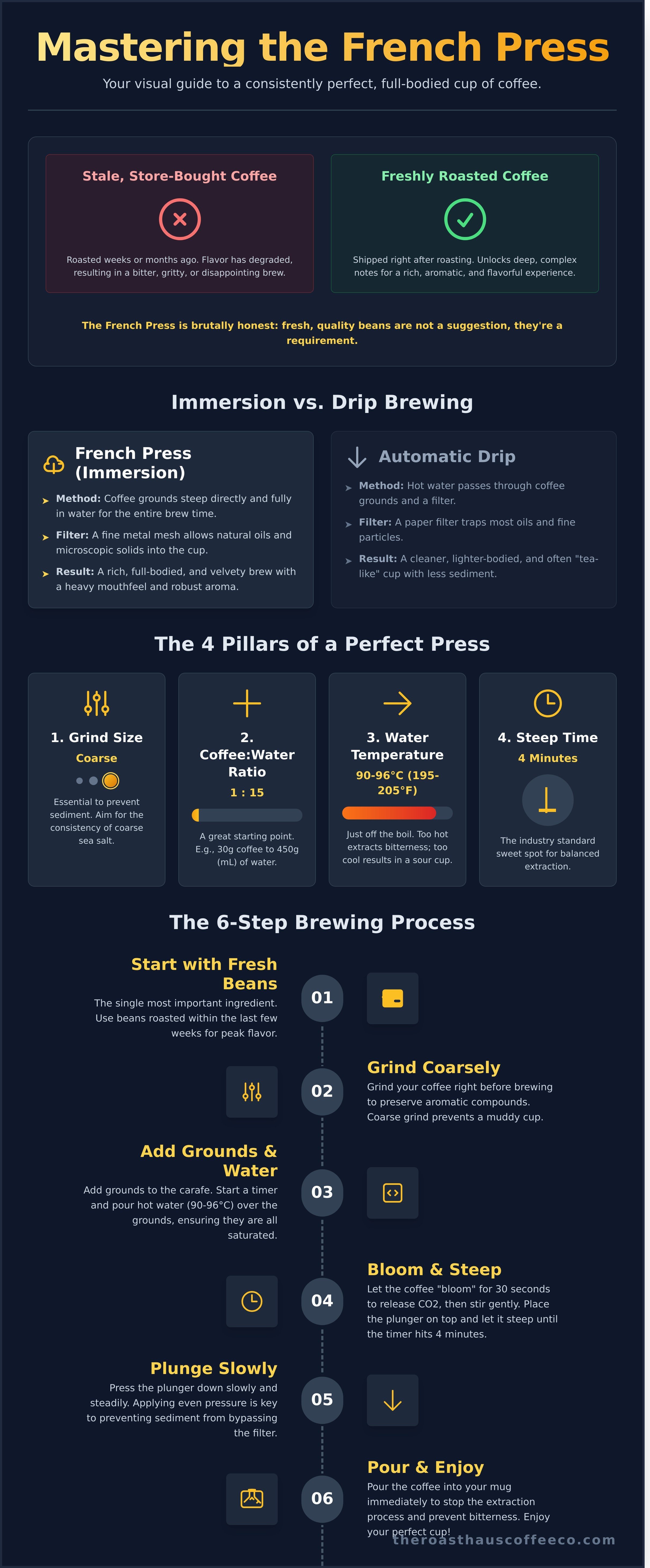
Most automatic coffee makers use a drip (or percolation) method, where water passes through coffee grounds and a paper filter. Immersion brewing is different. The coffee grounds and water sit together, fully submerged, for the entire brew cycle. This direct contact allows for a fuller, more even extraction of flavor compounds. The metal mesh filter is key; unlike paper, it allows the coffee’s natural, flavorful oils and microscopic solids to pass into your cup. This is why the brew feels so much richer on the palate.
Is the French Press Right for You?
This brewer is a fantastic tool, but it's not for everyone. It excels at delivering a consistent, full-bodied cup with minimal fuss. But its greatest strength is also its biggest challenge: it hides nothing.
- Pros: The initial cost is low, often under $40 for a quality press. You’ll never buy paper filters again. It’s simple to master and produces incredibly consistent results. It's also perfect for brewing multiple cups at once.
- Cons: You need a consistent, coarse grind to avoid sediment in your cup. Cleanup is manual and takes a minute longer than tossing a paper filter. If you prefer a very light, clean, tea-like coffee, this method’s heavy body might not be for you.
Most importantly, the French press is brutally honest. Because immersion extracts so much from the bean, you can’t hide stale or poorly roasted coffee. Any off-flavors will come through loud and clear. That’s why we insist that a great press requires great beans. Using coffee that is roasted to order isn't just a suggestion; it’s the only way to unlock the rich, clean, and complex flavor this timeless brewer was designed to produce.
The Science of Immersion: How the French Press Extracts Flavor
Unlike drip methods where water passes through grounds, the french press uses total immersion. Every single grain of coffee is in constant contact with all the water for the entire brew time. This simple, direct contact is what unlocks the deep, full-bodied flavor profile that this method is famous for. It’s a patient process that allows the water to saturate the coffee completely, pulling out a huge range of compounds.
The delicious, complex notes in your coffee begin during roasting. The Maillard reaction, a chemical process between amino acids and reducing sugars, creates the browning and hundreds of aromatic compounds that give coffee its character. Total immersion brewing ensures these compounds, from sweet caramels to rich chocolates, are fully dissolved into the water. The plunger doesn't just separate grounds; it brings the full story of the roast directly into your cup.
Steep time and temperature are the two most critical variables you control. A four-minute steep is the industry standard because it hits the sweet spot for extraction. Too short, and your coffee is sour and thin. Too long, and it becomes bitter and harsh as unwanted compounds dissolve. Temperature stability is just as vital. Hot water acts as a solvent, and its ability to extract flavor drops right along with its temperature. A stable environment creates a balanced, repeatable brew every single time.
The Role of Soluble Solids and Oils
That signature velvety, heavy body in a French press brew comes from coffee oils and microscopic solids. The metal mesh filter allows these elements, including diterpenes like cafestol and kahweol, to pass into your cup. Paper filters, used in most drip brewers, trap nearly all of these oils, which is why a French press coffee feels so much richer. The bloom you see when you first add hot water is a rapid release of carbon dioxide gas trapped in the beans since roasting. This initial release is critical for even saturation, a key principle explained in The Science of Coffee Extraction. A vigorous bloom is a direct sign of freshness; you'll see a much more active bloom with our freshly roasted beans, which is your first sign of a better cup.
Thermal Dynamics in Your Carafe
Your carafe material directly impacts temperature stability. Over a standard four-minute steep, a double-walled stainless steel press can retain heat up to 60% more effectively than a standard single-walled glass model. Pre-warming your press by swirling hot water in it for 30 seconds is a non-negotiable step. This simple action prevents the cold carafe from immediately dropping your water temperature, which is a primary cause of sour, under-extracted coffee. A 10-degree drop in water temperature can reduce total soluble extraction by up to 15%, leading to a noticeably weak and acidic cup.
The Secret Ingredient: Why Freshness Defines the Experience
You can have the perfect grinder, the right water temperature, and a flawless technique, but one thing will ruin your brew every time: stale coffee. The French press is a full-immersion brewer, meaning the coffee grounds and water steep together for the entire brew time, typically around four minutes. This direct contact is incredible for extracting deep, rich flavors and a full-bodied texture. It also means there's nowhere for bad flavors to hide. Immersion brewing magnifies every characteristic of your beans, both the best and the worst.
This is what we call the 'Grocery Store Problem.' That bag of coffee on the supermarket shelf might have been roasted six months ago. It sat in a distribution center for 60 days, then on a truck, then on a shelf. By the time you get it home, it’s a shadow of its former self. Coffee’s peak flavor window is incredibly short, usually between 4 and 14 days after roasting. Old, oxidized beans taste flat, woody, and lifeless in a press. The volatile aromatic compounds that create coffee’s incredible smell and nuanced flavor have long since vanished, leaving behind a dull, cardboard-like taste.
Our entire philosophy is built to solve this. We are a 'Roasted-to-Order' company. It’s the ultimate brewing hack. We don’t roast a single bean until you place your order. Your coffee is then shipped within 24 hours, arriving at your door right as it enters that perfect window of peak freshness. This isn't a gimmick; it’s the only way to guarantee the flavor potential your coffee deserves.
Small-Batch Artisan Roasting vs. Mass Production
Roasting coffee in a 10lb batch gives our roastmaster precise, minute-by-minute control. They can listen for the cracks and watch the color development to bring out the exact flavor profile we want. Compare that to a 1,000lb industrial roaster, where consistency is a challenge and nuance is lost. 'Freshness' isn't just a buzzword; it's a chemical state. It's the period before significant oxidation has degraded the beans' cellular structure. Supporting a family-owned roastery like ours means your coffee goes from our roaster directly to your grinder. The supply chain is as short as it gets.
Choosing the Right Origin for Immersion
The full-bodied nature of the french press makes it a perfect match for certain origins. If you love a classic, rich, and heavy cup, you can't go wrong with coffees that have deep, earthy notes.
- For a Classic Cup: Our Mexico Chiapas or single-origin Honduras beans thrive in a press. The immersion process pulls out their incredible notes of dark chocolate, nuts, and brown sugar, creating a brew that is both comforting and complex.
- For a Brighter Cup: If you prefer something more vibrant, try our Kenya AA Supreme. The press captures its bold, winey acidity and bright berry notes without any harshness, producing a truly memorable and lively cup.
Mastering the Variables: Beyond the Basic Recipe
You've followed the basic steps. You have a good cup of coffee, but you know it can be great. The difference between good and great lives in the details. Perfecting your brew means taking control of the key variables that define your final cup. It's about moving from a recipe to a personal ritual. Let's dial in your process.
The foundation of any great brew is the coffee-to-water ratio. The Specialty Coffee Association suggests a "golden ratio" starting point between 1:15 and 1:17. This means for every 1 gram of coffee, you use 15 to 17 grams of water. For a standard 34 oz (1 liter) press, a 1:16 ratio works out to about 63 grams of coffee. A 1:15 ratio will give you a stronger, more robust cup, while a 1:17 ratio yields a lighter-bodied brew. Don't guess. Use a digital scale. Consistency is your goal.
The Importance of a Consistent Coarse Grind
Your grinder is the single most important piece of coffee gear you can own besides the brewer itself. A blade grinder smashes beans into a mix of dust and boulders, leading to uneven extraction and a muddy cup. A burr grinder mills beans to a uniform size. For a french press, you want a coarse grind, similar in texture to kosher salt. This consistency is everything. It prevents over-extraction, which creates bitterness, and minimizes the fine sediment that makes the last sip gritty.
Water quality is simple: if your tap water tastes bad, your coffee will taste bad. Chlorine or other off-flavors become concentrated in an immersion brew. Your coffee is over 98% water, so using filtered or spring water is a non-negotiable step for a clean, sweet cup. Don't ruin premium beans with poor-quality water.
Finally, consider your technique. The traditional method involves stirring, steeping for four minutes, and plunging. It’s classic and produces a heavy-bodied cup. An alternative, popularized by 2007 World Barista Champion James Hoffmann, involves a longer steep (closer to 7-8 minutes), gently breaking the top crust of grounds, and letting them settle before pressing the plunger just to the surface of the coffee. This method dramatically reduces sediment and creates a cleaner, more tea-like clarity of flavor.
Troubleshooting Your Brew
Is your coffee not quite right? Your taste buds are the best guide. A few simple adjustments can fix most common problems.
- Too Bitter or Harsh? This is over-extraction. Your grind is likely too fine, or you steeped it for too long. Try a coarser grind setting or shorten your brew time by 30 seconds.
- Too Sour or Weak? This is under-extraction. Your grind is too coarse, or your water isn't hot enough. Try a slightly finer grind or ensure your water is between 195-205°F (90-96°C).
- Too Much Sediment? Before plunging, use two spoons to gently skim the floating grounds and foam from the surface. This "two-spoon trick" removes a huge portion of the fine particles that cause sludge.
Dialing in these variables is the most rewarding part of brewing. To ensure your adjustments have the biggest impact, you need beans that can express this newfound nuance. Start with our perfectly roasted whole beans, delivered at peak freshness and ready for your grinder.
Elevate Your Morning with The Roast Haus Coffee Co.
You've mastered the grind, the water temperature, and the timing. You have the perfect technique. But the ultimate quality of your brew comes down to one non-negotiable element: the freshness of your coffee beans. The immersion method of a french press is beautifully simple, but it's also incredibly revealing. It extracts everything from the bean, meaning stale, off-the-shelf coffee will taste dull and lifeless, no matter how perfect your process is.
This is where we come in. At The Roast Haus, we live by a simple, powerful promise: Roasted to Order. We don’t roast a single bean until your order is placed. This isn't a gimmick; it's our commitment to quality. Coffee beans reach their peak flavor potential between 24 and 72 hours after roasting. By shipping your coffee within 24 hours of roasting, we ensure it arrives on your doorstep right in that perfect window, ready to unlock a depth of flavor you simply can't get from a bag that has sat on a store shelf for weeks.
Using our beans means you're not just brewing coffee; you're experiencing it at its absolute best. The rich crema, the vibrant aroma, the complex flavor notes-it's all preserved. And with every bag, you're directly supporting a family-owned, Oklahoma-based roastery dedicated to the craft of exceptional coffee.
Our Top Recommendations for French Press
Ready to explore? The full-bodied nature of immersion brewing makes it a fantastic way to experience different single-origin coffees. Here are three of our favorites that truly shine:
- Kenya AA Supreme: If you love a bold, complex cup, this is your bean. The immersion process perfectly captures its deep, wine-like acidity and rich notes of blackcurrant, creating a full-bodied and unforgettable experience.
- Honduras Morning Splendeur: This is the ultimate daily driver. It produces an incredibly smooth, balanced, and comforting cup with classic flavor notes of milk chocolate, caramel, and toasted nuts. It's everything a great morning coffee should be.
- Ethiopia Limu: For those who think immersion brewing can't be delicate, this bean will prove you wrong. It yields a surprisingly bright and clean cup with distinct floral and citrus notes, offering a refreshing and nuanced brew.
Join the Roast Haus Family
We believe great coffee should be simple to get and consistently fresh. Our coffee subscription is designed to make that a reality. You'll never have to worry about running out of beans or making a late-night run for a stale bag again. Freshly roasted coffee arrives at your door, right when you need it.
Joining is about more than convenience. It’s about becoming part of a community that values quality and craft. Subscribers save 10% on every order and get free shipping, making it the most affordable way to drink better coffee every single day. Stop settling for less. Experience the difference that peak freshness makes in your cup.
Shop our Roasted-to-Order Coffee Beans now and taste what your morning has been missing.
Your Perfect Brew Starts with Peak Freshness
You now understand that the rich, full-bodied flavor and velvety texture from your french press comes directly from total immersion. It’s a beautifully simple process. But you also know the secret that unlocks its true potential: starting with incredibly fresh coffee beans. The quality of your final brew is decided long before the hot water ever hits the grounds.
Don't let stale, mass-produced beans from a grocery store shelf hold your coffee back. At The Roast Haus Coffee Co., we've been a family-owned and operated business dedicated to small-batch, artisan quality since 2014. We believe great coffee shouldn't be complicated. That's why every single bag is roasted to order and shipped the same or the very next day. This isn't just a marketing promise; it's our entire process. Ready to taste the difference that true freshness makes in your cup? Experience peak freshness with our Roasted-to-Order Sampler.
Go on, brew something truly special.
Frequently Asked Questions About French Press Coffee
What is the best coffee-to-water ratio for a French press?
The best coffee-to-water ratio for a rich brew is 1:15. This means for every 1 gram of coffee, you should use 15 grams (or 15 milliliters) of water. For a standard 34-ounce French press, this works out to about 55-60 grams of coffee. Using a kitchen scale is the only way to guarantee this consistency. This ratio creates a full-bodied cup that highlights the coffee's natural character without being overpowering or weak.
Why is my French press coffee so muddy or silty?
Your coffee is muddy because the coffee grounds are too fine. A French press requires a coarse, even grind, similar to the texture of coarse sea salt. Finer particles, called "fines," slip through the metal filter and end up as sediment in your cup. Using a quality burr grinder can reduce these fines by over 40% compared to a blade grinder. Also, be sure to press the plunger down slowly and steadily; a fast plunge agitates the grounds and forces sediment through.
Can I use regular ground coffee in a French press?
No, you shouldn't use standard pre-ground coffee. Most pre-ground coffee is a medium grind intended for automatic drip machines and is too fine for immersion brewing. Using it will result in a muddy, over-extracted, and bitter cup. For the best flavor and clarity, always buy whole beans and grind them fresh right before you brew. Freshness is key, as ground coffee loses its flavor compounds 60% faster than whole bean coffee.
How long should I actually let my French press steep?
You should let your coffee steep for exactly 4 minutes. Start your timer the moment you finish pouring the hot water over the grounds. A 4-minute steep time provides the ideal balance, extracting the desirable flavors and oils without pulling out the bitter compounds. Steeping for less than 3 minutes will likely taste sour and weak, while steeping for more than 5 minutes will result in a harsh, bitter brew. Consistency here is critical for a great cup.
Is French press coffee stronger than drip coffee?
Yes, French press coffee typically has a stronger flavor and a fuller, heavier body than drip coffee. This is because the metal filter allows microscopic coffee particles and natural oils to pass into your cup. Paper filters used in drip machines absorb nearly all of these oils. In terms of caffeine, an 8-ounce cup of French press can contain 80-135mg, which is often slightly higher than the 65-120mg found in a standard drip coffee, depending on the beans and ratio used.
How do I clean my French press without making a mess?
To clean your press easily, first discard the bulk of the grounds into your compost or trash, not your sink drain. Add a bit of warm water to the carafe, swirl it around to loosen the remaining grounds, and then pour the slurry through a fine-mesh sieve over the sink. Tap the grounds from the sieve into the trash. Finally, disassemble the plunger and wash all parts with warm, soapy water. This method prevents clogged pipes and keeps your sink clean.
Should I buy a glass or stainless steel French press?
Choose stainless steel for durability and heat retention; choose glass for aesthetics and lower cost. A double-walled stainless steel model is nearly unbreakable and can keep coffee hot for over an hour. A classic glass carafe lets you watch the brewing process, but it's fragile and loses significant heat within 15-20 minutes. If you drink your coffee slowly or want a brewer that will last for years, stainless steel is the superior investment.
What is the best roast level for French press brewing?
Medium to dark roasts are typically best for French press brewing. The full-immersion method excels at extracting the deep, rich flavors associated with these roasts, such as notes of chocolate, nuts, and caramel. The coffee's natural oils, which are more prominent in darker roasts, are preserved by the metal filter, contributing to a heavy body and smooth finish. Lighter roasts can sometimes taste overly acidic when brewed in a French press if your technique isn't perfect.

