


Bitterness in your morning mug isn't a sign of strength; it's a warning that something went wrong during the journey from bean to cup. If you've ever stood over your kitchen counter wondering why does my coffee taste bitter even after buying premium beans, you aren't alone. It's frustrating to invest in high-quality bags like our Ethiopia Limu Organic only to end up with a harsh, mouth-drying finish that masks the bean's true character.
We understand that you want a smooth, naturally sweet cup that justifies the effort of brewing at home. You can learn to distinguish between the pleasant, cocoa-like bitterness of a well-roasted bean and the aggressive over-extraction that ruins a morning ritual. This guide will teach you how to master the variables needed to brew a balanced cup every day. We'll cover five professional fixes, from adjusting your water temperature to the SCA standard of 195°F to 205°F, to refining your grind size. You'll gain the confidence to dial in any new bag and finally stop wasting your best beans.
Key Takeaways
- Distinguish between "good" bitterness and the harsh, drying sensation caused by over-extraction.
- Identify exactly why does my coffee taste bitter by examining your water temperature and grind consistency.
- Learn why fresh beans are essential for avoiding the metallic, rancid notes caused by oxidation.
- Follow a barista's method for "dialing in" a new bag to achieve a balanced, sweet flavor every morning.
- Understand how origin impacts flavor so you can choose beans that naturally resist harshness.
Bitter vs. Bold: Understanding Coffee Extraction
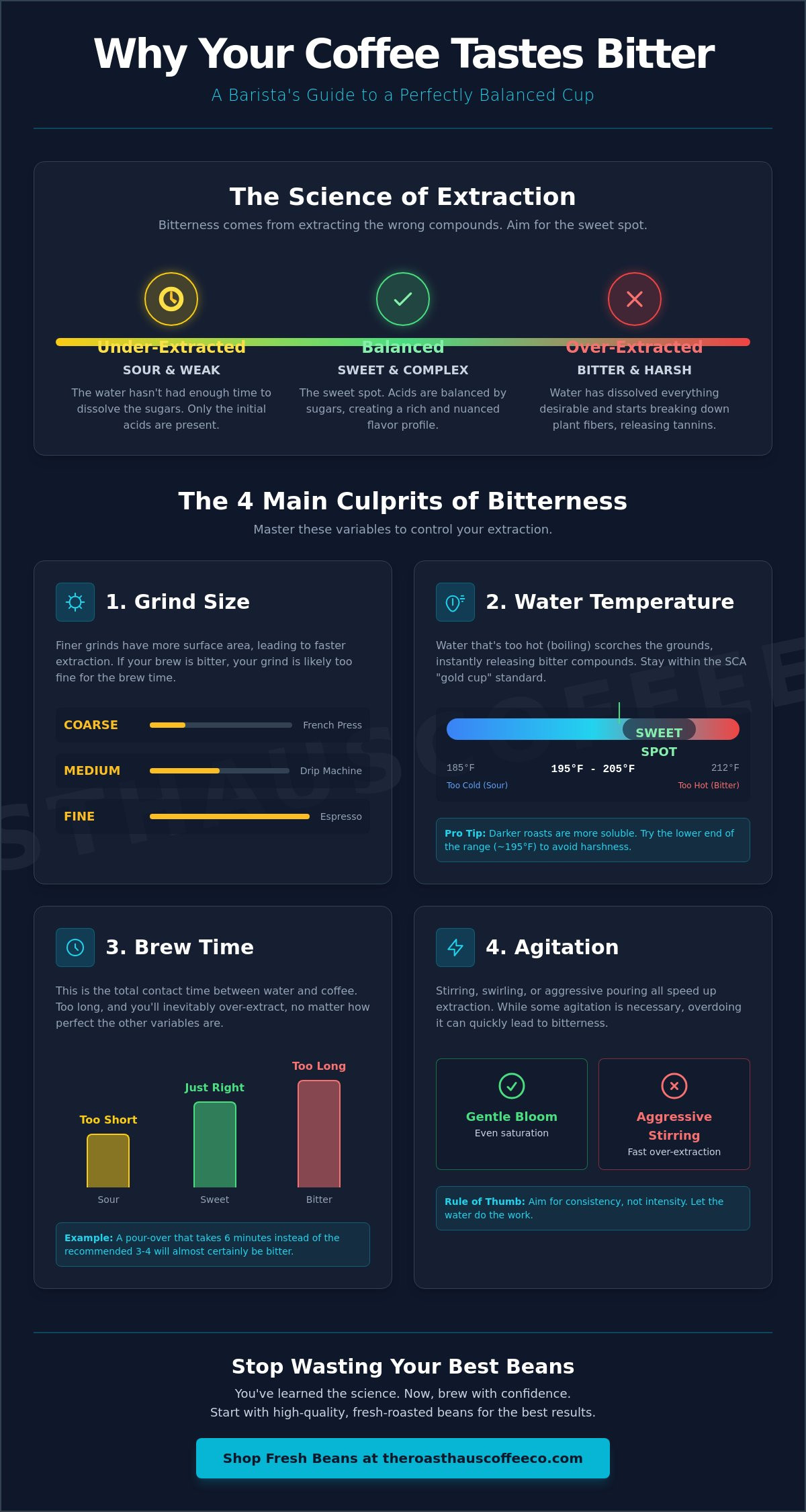
Bitterness is a physical sensation as much as it is a flavor. It manifests as a harsh, drying feeling on the back of your tongue that lingers long after you finish your sip. To fix this, you must understand Coffee extraction. Think of extraction as a timeline. When hot water hits the grounds, it dissolves acids first, then sugars, and finally plant fibers. If the process stops too early, the coffee is under-extracted and tastes sour. If it goes too long, it becomes over-extracted and bitter. A balanced cup sits right in the middle where the sweetness peaks.
Many coffee drinkers ask, why does my coffee taste bitter when I only wanted it to be strong? There's a massive difference between strength and extraction. Strength refers to the concentration of coffee particles in the water, technically known as Total Dissolved Solids (TDS). A high TDS means the cup is intense and "bold," but it can still be sweet and smooth. Bitterness occurs when you've pulled out the wrong compounds, not just "more" compounds. You can enjoy a heavy, rich cup of our Kenya AA Supreme without any harshness if the extraction is dialed in correctly.
The Sour-Bitter Confusion
Beginners often mistake acidity for bitterness. Bright, fruity notes in a light roast might feel "sharp," leading you to believe the cup is bitter. If you aren't sure what you're tasting, try the aspirin test. True chemical bitterness is the dry, puckering sensation you get if you've ever let an aspirin tablet dissolve on your tongue. If your cup feels like that, it's over-extracted. This balance is particularly difficult to achieve with espresso because the high pressure and fine grind size leave very little room for error.
What Happens During Over-Extraction?
When water stays in contact with coffee grounds for too long, the chemistry of the cup changes. Once the desirable oils and sugars are gone, the water begins to break down the actual organic plant fibers of the bean. This process releases tannins and polyphenols into your brew. These are the same compounds found in over-steeped tea or dry red wine. They don't provide flavor; they provide irritation. Adding more time to your brew doesn't mean you're getting more of the "good stuff." It simply means you're dissolving wood-like materials that belong in the compost bin. Understanding this timeline is the first step in solving the mystery of why does my coffee taste bitter.
The Brewing Culprits: Grind Size, Time, and Temperature
Most brewing errors come down to simple physics. If you find yourself asking why does my coffee taste bitter, you're likely dealing with a breakdown in one of four main variables: grind size, water temperature, brew time, or agitation. These factors control the speed at which water pulls flavor from the beans. When any of these are dialed too high, you cross the line from sweetness into harshness.
Grind Size: The Surface Area Battle
Surface area determines how quickly water can access the soluble compounds inside your coffee. Finer grounds have significantly more surface area than coarse ones. If your grind is too fine for your specific brewing method, the water will extract the bitter plant fibers before the brew cycle is even finished. Using high-quality coffee grinders is the only way to ensure your particles are uniform and appropriately sized. For a French press, aim for a coarse grind similar to sea salt. For standard drip machines, a medium grind like table salt works best. Espresso requires a fine, powdery texture to handle the high pressure.
The "Goldilocks" Temperature Range
Boiling water is a common enemy of good coffee. At 212°F, water is aggressive enough to scorch the delicate oils in the bean. The Specialty Coffee Association (SCA) verified standard for water temperature is between 195°F and 205°F. This range is hot enough to extract the sweetness of a bean like our Ethiopia Limu Organic without pulling out the astringent compounds. If you don't have a temperature-controlled kettle, let your water sit for about 30 seconds after it reaches a boil before pouring. Interestingly, darker roasts are more soluble and often taste better when brewed at the lower end of that range, around 195°F.
Time and agitation also play critical roles in the final flavor. If your pour-over takes six minutes to drain instead of three, it will be bitter. Similarly, if you leave your coffee in a French press after plunging, it continues to extract. Agitation, such as aggressive stirring, also speeds up the process. Excessive stirring triggers a specific response in the molecular biology of taste, where our tongues detect the heavy polyphenols released by over-worked grounds. If you're still practicing your timing, our All Day Sampler provides a variety of roasts to help you test how different beans respond to your brewing adjustments. Mastering these variables is the fastest way to stop wondering why does my coffee taste bitter and start enjoying a clean, sweet cup every morning.
The Freshness Factor: Why Stale Beans Mask Flavor
Freshness is often treated as a luxury, but it's actually a technical requirement for a balanced brew. When you ask why does my coffee taste bitter, the answer might lie in oxidation rather than your brewing technique. Once coffee is roasted, the natural oils inside the bean begin to react with oxygen. Over time, these oils turn rancid, creating a sharp, metallic bitterness that no amount of skill can fix. Supermarket beans often sit on shelves for months, long after their peak flavor has vanished. At The Roast Haus Coffee Co., we eliminate this delay by roasting in small batches in Wyandotte, OK, and shipping within 24 hours of roasting.
Fresh beans contain carbon dioxide (CO2) which acts as a functional barrier. During the brewing process, this gas creates resistance, forcing the water to move slowly and evenly through the grounds. Stale beans have lost their CO2, making them porous and brittle. According to An Engineer's Guide to Coffee, the physical structure of the bean changes as it ages, which fundamentally alters how water interacts with the soluble solids. Without that gas resistance, water rushes through the gaps, leading to uneven extraction and a hollow, bitter finish.
The Science of Bean Staling
As beans degas and lose their internal pressure, they become less soluble. To compensate for the lack of flavor, many home brewers use a finer grind. This creates a frustrating paradox. The finer grind increases the surface area of an already compromised bean, causing the water to pull out harsh plant fibers even faster. This is a primary reason why does my coffee taste bitter even when you think you're following the instructions. To avoid this, always look for a "Roasted On" date rather than a "Best By" date. A "Best By" date is a marketing guess; a "Roasted On" date is a guarantee of quality.
Roast Profile Matters
The roast level itself sets the baseline for bitterness. Darker roasts spend more time in the roaster, undergoing the Maillard reaction and eventually carbonization. This creates the smoky, charred notes found in traditional bold coffees. However, commercial brands often over-roast beans to hide defects in low-quality crops. Our artisan roasting process focuses on precision, applying heat carefully to develop natural sweetness without crossing into the "burnt" territory common in mass-produced coffee. If you're still exploring your palate, our coffee sampler allows you to compare different roast profiles and find your personal tolerance for bitterness. Choosing the right roast and ensuring it's fresh is the most effective way to guarantee a smooth experience.
How to Fix Bitter Coffee: A Barista’s Troubleshooting Guide
Troubleshooting a bad cup is a process of elimination. If you've ruled out stale beans and you're still asking why does my coffee taste bitter, it's time to apply specific technical fixes. Professional baristas use a systematic approach to "dial in" a brew. You can replicate this at home by making small, intentional adjustments to your daily routine. Follow these five steps to rescue your morning mug.
- Step 1: Coarsen your grind. If your coffee tastes harsh and dry, move your grinder one or two notches toward a coarser setting. This reduces the total surface area and slows down the extraction process.
- Step 2: Lower your water temperature. Boiling water is often too aggressive. Try brewing at 195°F, especially for darker roasts like our Honduras Morning Splendeur, to prevent scorching the grounds.
- Step 3: Shorten your brew time. If you use a French press, press the plunger at exactly four minutes. Leaving the grounds in contact with water for even an extra minute can push the brew into over-extraction.
- Step 4: Check your water quality. Coffee is 98% water. If your tap water has a strong chemical taste, your coffee will too. Always use a basic charcoal filter to remove chlorine and impurities.
- Step 5: Clean your equipment. Old coffee oils are highly resilient. They stick to the walls of your brewer and turn rancid over time. Deep clean your carafe and filter basket weekly to remove these bitter residues.
The "One Variable at a Time" Rule
Success in brewing comes from isolation. Never change your grind size and your water temperature in the same session. If you change two things at once, you won't know which adjustment actually fixed the problem. Keep a simple brew journal to track your results. Use a digital scale to ensure your measurements are identical every time. Mastering this how to make coffee routine will transform your results from inconsistent to professional. If you want a fresh start with a bean that is naturally forgiving, try our Honduras Morning Splendeur for a balanced, sweet profile.
Water: The 98% Ingredient
The minerals in your water act as "magnets" that pull flavors out of the coffee grounds. Water hardness is a measure of dissolved minerals, primarily calcium and magnesium, which determines how effectively water can pull flavors out of the coffee grounds. According to 2026 SCA standards, your brewing water should have a Total Dissolved Solids (TDS) level between 75 and 250 ppm and a neutral pH of 7.0. If your water is too hard, it over-extracts the beans and creates a flat, chalky bitterness. If it's too soft, the coffee can taste sharp and vinegary. A simple charcoal filter is usually enough to bring most municipal water into a usable range for specialty coffee.
Beyond Bitterness: Choosing Better Beans
Even with perfect technique, you can't brew a sweet cup from a poor-quality bean. If you've mastered your variables and still ask why does my coffee taste bitter, it's time to look at the origin and roast quality of your coffee. Mass-market coffee is often roasted in giant industrial drums where temperature control is difficult. This lack of precision leads to scorching, where the outside of the bean burns before the inside is cooked. Small-batch roasting allows us to monitor the roast curve second by second. We ensure every bean in the batch reaches its sweet spot without crossing into the carbonized, bitter territory that defines commercial brands.
The coffee beans you choose define the potential of your morning ritual. For example, the natural, tea-like sweetness of an Ethiopia Limu Organic is vastly different from the heavy, earthy body often found in Mexican beans. By selecting beans from regions known for their sweetness and processing them in artisan batches, we can highlight specific flavor notes while avoiding the harshness found in mass-produced coffee. Choosing the right origin is the final step in moving beyond bitterness and toward a cup you can enjoy black.
Sweet Origins to Explore
The terroir of a coffee farm dictates the base flavor of your brew. High-altitude African beans, like our Ethiopia Limu Organic or Kenya AA Supreme, offer a complex acidity that tastes more like citrus or berries than traditional "coffee." These beans are naturally lower in the heavy, bitter compounds found in low-altitude crops. If you prefer something with more weight but less harshness, Central American origins are the ideal choice. Our Honduras Morning Splendeur provides a smooth, chocolatey profile that balances body with a clean finish. Light and medium roasts are the best way to explore these nuances. They preserve the organic acids and sugars inherent in the coffee cherry, which is a common reason why does my coffee taste bitter in commercial dark roasts that have been roasted too long.
The Roast Haus Promise
Our business is built on the belief that everyone deserves a better experience with their daily cup. Based in Wyandotte, Oklahoma, we operate as a dedicated, independent venture focused on sensory excellence and the integrity of our product. We don't believe in the supermarket model where coffee sits in a warehouse for months. Instead, we use a roast-to-order system. This means your beans are roasted specifically for you and shipped immediately. This commitment to timing and small-scale production is the only way to prevent the oxidation that causes flavor degradation. We invite you to join our community of enthusiasts who value quality and support independent craftsmanship. Signing up for a coffee subscription is the easiest way to guarantee you never run out of fresh beans. Shop our fresh-roasted collections and taste the difference.
Master Your Morning Brew
A better cup of coffee is within your reach. You now have the technical knowledge to balance extraction and adjust your brewing variables. By coarsening your grind or lowering your water temperature, you can move past harshness and find the natural sweetness of the bean. However, even the best technique can't save a stale product. Stop wondering why does my coffee taste bitter and start with a foundation of quality. Freshness isn't just a suggestion; it's the core of a balanced morning ritual.
Since 2014, our family-owned artisan roastery in Wyandotte, OK has focused on the integrity of every small batch. We roast to order and ship within 24 hours to ensure you receive your beans at their absolute peak. This commitment to timing and craftsmanship is what sets us apart from mass-produced brands. Upgrade to fresh, roasted-to-order beans from The Roast Haus and experience the difference that small-scale production makes. You've mastered the variables. Now, give yourself the quality beans you deserve.
Frequently Asked Questions
Why does my coffee taste bitter but not strong?
This happens when you use too little coffee but extract it for too long. Bitterness is a result of over-extraction, while strength is the concentration of coffee solids. If you use a small amount of grounds and a large amount of water, you're washing the grounds until the bitter plant fibers dissolve. The result is a thin, watery cup that still has a harsh, drying finish.
Can I fix bitter coffee by adding salt?
Yes, salt can physically suppress your tongue's ability to perceive bitterness. Sodium ions interfere with the bitter receptors on your palate. While a tiny pinch of salt can make a bad cup drinkable, it's a temporary fix for a brewing error. It's better to address the root cause, such as your grind size or water temperature, to achieve a naturally sweet flavor without needing additives.
Does the type of coffee filter affect bitterness?
The filter material determines how many oils and fine particles reach your cup. Paper filters trap most oils and "fines," leading to a cleaner, brighter taste. Metal filters allow more oils and micro-grounds through, which increases body but can also highlight bitterness if the coffee is over-extracted. If you're constantly asking why does my coffee taste bitter, switching to a high-quality paper filter can provide a smoother, more refined profile.
Why is my French Press coffee always bitter?
Bitterness in a French Press is usually caused by a grind that is too fine or a brew time that is too long. Because the grounds remain in contact with the water throughout the process, even a slightly fine grind will over-extract quickly. Additionally, if you don't pour the coffee out of the press immediately after plunging, it continues to steep. This "passive brewing" is a common culprit for a harsh finish.
Is dark roast coffee always more bitter than light roast?
Dark roasts are naturally more bitter because the roasting process carbonizes the bean's fibers. Light roasts preserve the organic acids and sugars of the fruit. As you roast darker, those sugars caramelize and eventually burn. While a well-crafted dark roast like our Honduras Morning Splendeur is bold and chocolatey, low-quality commercial dark roasts often taste charred and acrid because they use high heat to mask bean defects.
Can dirty coffee makers make coffee taste bitter?
Accumulated coffee oils turn rancid and add a stale, bitter flavor to every new brew. Coffee contains natural oils that stick to plastic, glass, and metal surfaces. When these oils sit in your machine, they oxidize and develop a metallic, pungent bitterness. Regular cleaning of your carafe and filter basket is essential. If your equipment is clean and you still wonder why does my coffee taste bitter, the issue likely lies with your beans or water.
How do I tell the difference between sour and bitter coffee?
Sour coffee is sharp and acidic like a lemon, while bitter coffee is dry and harsh like an aspirin. Sourness is a sign of under-extraction, meaning the water didn't pull enough out of the grounds. It often hits the sides of your tongue. Bitterness is the result of over-extraction and is felt at the back of the tongue. If your cup tastes thin and sharp, grind finer; if it tastes heavy and dry, grind coarser.

