


With specialty coffee prices reaching an average of $32.75 per pound in early 2026, every gram of coffee you use is a significant investment. Watching a thin, watery brew swirl down the kitchen drain is more than just a morning disappointment; it's a waste of the craftsmanship that went into those beans. Troubleshooting weak coffee is rarely a "bad bean" problem. It is usually a mechanical mismatch between your water temperature, your grind surface area, and the solubility of your specific roast.
We know how frustrating it is to struggle with conflicting ratios when you just want a rich, full-bodied cup of Kenya AA Supreme or Ethiopia Limu Organic. You deserve a brew that honors the integrity of the product and your own hard-earned money. This guide provides the exact adjustments to ratio, grind, and temperature needed to turn a watery cup into a bold, artisan-quality experience. We will explain the "why" behind extraction and how to follow the SCA Golden Cup standards of 196 to 205 degrees Fahrenheit. By the end, you'll have the confidence to dial in any roast for a perfect result every time.
Key Takeaways
- Learn why weak coffee is often a result of under-extraction and how to distinguish between a thin body and a sour flavor profile.
- Stop relying on scoops and start using a scale to maintain a precise 1:15 to 1:17 coffee-to-water ratio for consistent strength.
- Master the mechanics of troubleshooting weak coffee by adjusting your grind size and water temperature to maximize flavor extraction.
- Discover how using fresh, small-batch beans like Kenya AA Supreme provides the essential oils needed for a rich, full-bodied mouthfeel.
- Follow five immediate, actionable steps to rescue your morning brew and turn a watery cup into a bold, artisan-quality drink.
Why Does My Coffee Taste Weak? Identifying the Root Causes
Coffee that tastes like tinted water is a failure of extraction. Troubleshooting weak coffee starts with understanding that your brew is a chemical solution. When hot water passes through your grounds, it must dissolve and carry away specific oils and solids. If the water fails to pull enough of these solubles from the grounds, the result is an under-extracted cup that lacks character and depth.
To fix this, you must master the key variables in coffee preparation. These are dosage, surface area, and contact time. Troubleshooting weak coffee requires you to look at these three pillars together. If any of these are out of balance, the coffee will lack the punch you expect from a premium bean. It doesn't matter if you're using the best beans on the market; if the mechanics of the brew are off, the flavor won't follow.
It's helpful to distinguish between a watery texture and a sour flavor profile. A watery cup usually means your concentration is too low. You simply didn't use enough coffee for the amount of water in the pot. A sour or acidic cup often means your extraction is too low. In this case, you might have the right amount of coffee, but you didn't pull the sweetness out of the grounds because the water moved through too quickly or wasn't hot enough.
Many people think grocery store coffee is "stronger" because it's bitter. Stale, dark-roasted beans often provide a harsh, burnt taste that mimics strength. In contrast, a nuanced roast like our Kenya AA Supreme offers complex acidity and fruit notes. If you're used to bitterness, these bright flavors might feel thin at first. However, they represent a higher standard of quality and a more honest expression of the bean's origin.
Under-Extraction vs. Low Concentration
Strength is measured by Total Dissolved Solids (TDS). This is the literal percentage of coffee solids in your water. Extraction is the percentage of the actual bean that you managed to dissolve. You can have a strong cup that is still under-extracted. This happens when you use a lot of coffee but grind it too coarse. The cup will be thick and dark but will taste salty or sharp because the water couldn't reach the sweet, deep flavors inside the large particles.
The Role of Water Quality in Extraction
Your brew is 98 percent water. If your water is "empty," like distilled or reverse osmosis water, it can't effectively pull flavor from the beans. You need minerals like magnesium and calcium to grab the flavor molecules and oils. Water hardness acts as a powerful solvent that helps transport coffee oils from the cellular structure of the bean into your cup. Without these minerals, even a vibrant Ethiopia Limu Organic will taste flat and lifeless.
The Math of a Bold Cup: Fixing Your Coffee-to-Water Ratio
The most common culprit when troubleshooting weak coffee is a simple math error. Many home brewers rely on "scoops" or "heaping tablespoons" to measure their coffee. This is a mistake. The Golden Ratio is the industry standard for a reason. It defines the relationship between coffee grounds and water by weight, not volume. For a rich, bold cup, most professionals recommend a ratio between 1:15 and 1:17. This means for every 1 gram of coffee, you use 15 to 17 grams of water. If your coffee feels thin, moving toward a 1:15 ratio will immediately increase the concentration of solids in your cup.
Calculating your dose is straightforward once you know your carafe size. If you want to brew a standard 1,000ml (1,000g) pot of coffee at a 1:16 ratio, you divide 1,000 by 16. This tells you that you need 62.5 grams of coffee. Adjusting for roast level is also critical. Lighter roasts, such as our Ethiopia Limu Organic, are more dense and harder to extract than dark roasts. To get a full-bodied result from these nuanced beans, you should use a tighter 1:15 ratio. This smaller amount of water ensures the coffee doesn't taste "stretched" or hollow.
Why You Must Use a Digital Scale
Bean density varies wildly between different origins and roast profiles. A scoop of a dark roast like Honduras Morning Splendeur weighs significantly less than a scoop of a light roast because the beans expand during the longer roasting process. If you use the same scoop for both, your light roast will be far too strong and your dark roast will be weak. Consistency is the only way to troubleshoot your brew. A scale provides a repeatable baseline so you can change one variable at a time. Learning how to make coffee with precision starts with weighing your ingredients every single morning.
Ratio Adjustments for Different Brew Methods
Different tools require different math. Drip coffee machines are often misleading; the "10-cup" mark usually refers to 5-ounce cups, not 8-ounce mugs. If you fill the water to the 10-line but only use five scoops of coffee, you are brewing at a ratio closer to 1:25. This will always result in a watery mess. For a French Press, you are using an immersion method which is less efficient at extracting flavor. You might need a 1:14 or 1:15 ratio to achieve a heavy mouthfeel. In a pour-over, a 1:16 ratio is ideal. It highlights the bright acidity of the bean without losing the body. If you want to practice these ratios with a variety of profiles, our All Day Sampler is an excellent way to test how different beans react to ratio adjustments.
Grind Size and Temperature: The Mechanics of Flavor
Troubleshooting weak coffee often leads you to the grinder. Think of coffee extraction as a race against time. When water hits your grounds, it begins dissolving flavor. The smaller the particles, the more surface area you expose to the water. A coarse grind, similar to Kosher salt, has less surface area. This means the water cannot reach the center of the particle quickly enough. If your coffee tastes both weak and sour, your grind is likely too coarse. You are leaving the best flavors trapped inside those large chunks while the water passes by.
Freshness plays a hidden role here that many generic guides ignore. Because we roast to order and ship within 24 hours, our beans are incredibly active. They are still degassing, which means they are releasing CO2. This gas can actually act as a barrier, pushing water away from the grounds. If you use a coarse grind with extremely fresh beans, the gas prevents the water from making deep contact. You might perceive this as "weak" coffee when it is actually a mechanical blockage. Grinding slightly finer helps break through this gas barrier to ensure a rich extraction.
Consistency is your best friend in this process. Many home brewers use blade grinders, but these tools are the enemy of a bold cup. They create "boulders," which are massive chunks that don't extract, and "fines," which are dust-like particles that over-extract. This creates a cup that is simultaneously watery and bitter. For a repeatable, artisan-quality brew, you need a burr grinder. You can learn more about why equipment matters in the ultimate guide to coffee grinders.
Fine-Tuning Your Grinder for Success
Visual cues are more helpful than arbitrary settings on a dial. If your drip coffee feels thin, look at your spent grounds. If they look like sea salt, try moving toward the consistency of table salt. This finer texture slows down the water flow, which is often called the Bialetti effect. By increasing the resistance, you force the water to spend more time in contact with the coffee, pulling out the oils and sugars that provide body and sweetness.
The Temperature Trap
Heat is the energy that breaks down coffee cellulose. The Specialty Coffee Association (SCA) specifies a brewing temperature between 196 and 205 degrees Fahrenheit. Many standard home drip machines peak at 185 degrees, which is far too cool to extract the complex notes in a Honduras Morning Splendeur. If your water is too cold, it won't have the energy to pull out the solids, resulting in a flat, watery brew. Always pre-heat your French press or ceramic dripper with hot water first. A cold vessel can steal up to 10 degrees from your slurry instantly. For pour-over brewing, use the "off-the-boil" rule: let your kettle sit for 30 seconds after boiling to hit that perfect 200-degree mark.
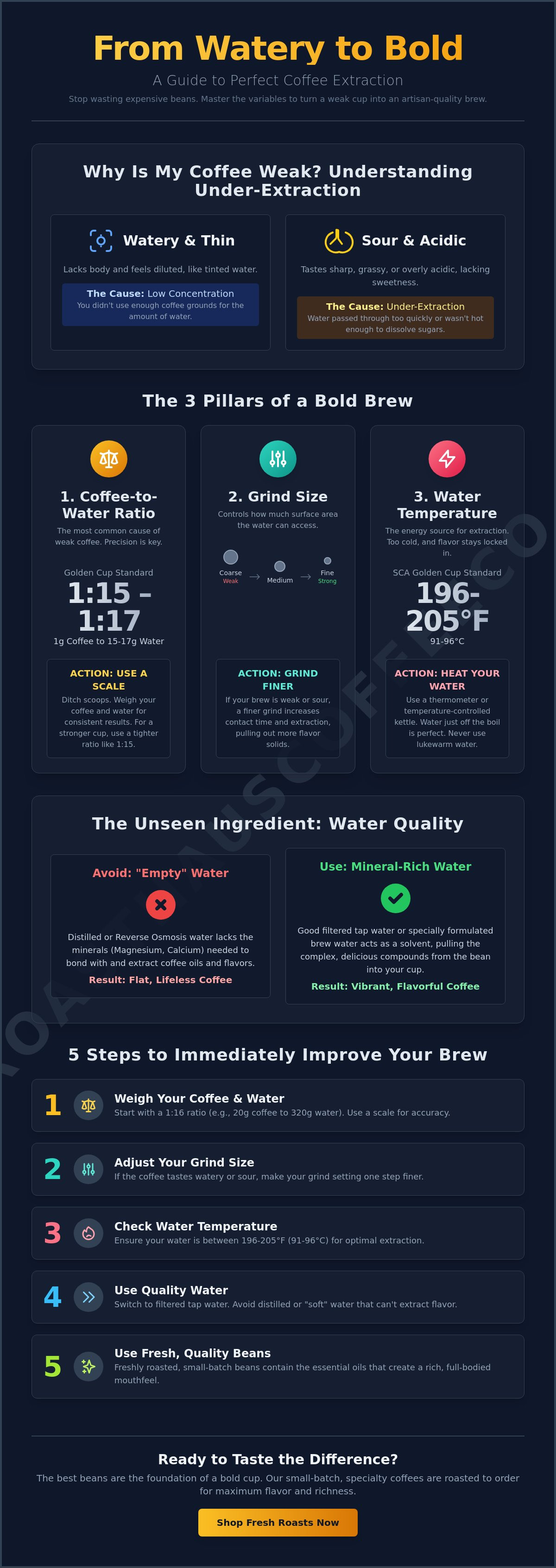
5 Immediate Steps to Rescue Your Morning Coffee
Fixing a thin brew requires a systematic approach. You have already learned the theory behind extraction and ratios. Now, it's time to apply these principles to your daily routine. Troubleshooting weak coffee is most effective when you follow a logical order of operations. Follow these five steps to diagnose and correct your brew immediately.
- Step 1: Weigh everything. Stop using scoops. Use a digital scale to confirm you are hitting a 1:16 ratio. If you use 30 grams of coffee, you must use 480 grams of water.
- Step 2: Verify your temperature. Use a kitchen thermometer to check your water. You need to hit the 200°F to 205°F range to dissolve the solids that provide a heavy mouthfeel.
- Step 3: Refine your grind. If the coffee still tastes watery and sour, move your grinder one notch finer. This increases the surface area and slows the water flow.
- Step 5: Check the roast date. Look for beans roasted within the last 14 days. Stale beans lose the essential oils that create body; no amount of technique can fix a bean that has gone dry.
If you want to practice these steps with a variety of flavor profiles, try our All Day Sampler to see how different origins respond to these adjustments.
The 'One Variable' Rule of Troubleshooting
Success in troubleshooting weak coffee depends on patience. Never change your grind size and your coffee-to-water ratio at the same time. If you change two things at once, you won't know which adjustment actually fixed the problem. Keep a simple brew log on your counter to track your grams, temperature, and grind settings. The "sweet spot" is the exact point where the watery sourness disappears but the harsh, dry bitterness has not yet arrived.
The Bloom: A Secret to Full Extraction
Freshly roasted coffee contains carbon dioxide. When you pour water over the grounds, this gas escapes in the form of bubbles. This is called the "bloom." If you don't allow 30 seconds for this gas to escape, the bubbles will act as a physical shield, pushing the water away from the coffee particles. You'll see a healthy, rising bloom with an artisan roast like our Kenya AA Supreme. This pause ensures the water can fully saturate the grounds, leading to a much richer and more consistent extraction.
Why Fresh, Small-Batch Beans Solve the Weakness Problem
While technique is vital, troubleshooting weak coffee eventually leads back to the raw ingredient. Even the most precise 1:16 ratio cannot recover flavors that have already evaporated from the bean. Industrial roasting operations prioritize volume, often leaving beans on shelves for months. This causes the essential oils, which provide the body and mouthfeel of your brew, to oxidize and disappear. The Roast Haus Coffee Co. operates on a different philosophy. We roast to order and ship within 24 hours. This ensures the cellular structure of the bean remains intact, holding the volatile compounds that create a rich, artisan-quality experience.
Small-batch roasting at our family-owned facility in Wyandotte, Oklahoma, allows for meticulous heat control. Unlike industrial roasters that process thousands of pounds at once, we monitor every minute of the roast to ensure a uniform density across the entire batch. When your beans are roasted consistently, they respond predictably to your grinder and water temperature. This level of quality control is why supporting independent roasters is the most effective way to eliminate watery, inconsistent coffee from your morning routine. You aren't just buying beans; you are buying the integrity of a carefully managed process.
Understanding Origin and Solubility
The density of a bean is determined by its growing altitude. High-altitude origins like Kenya AA Supreme and Ethiopia Limu Organic are naturally harder and more compact. These beans require more aggressive extraction techniques than the softer, lower-altitude beans found in grocery stores. If you find yourself troubleshooting weak coffee with these premium origins, remember that their density demands the high-temperature water (202°F-205°F) we discussed earlier. Learning the relationship between altitude and extraction is a major part of choosing high quality coffee beans that fit your specific brewing method.
The Roast Haus Coffee Co. Commitment
We treat every roast as a bespoke project. Our family-led team in Oklahoma is dedicated to the integrity of the product and the satisfaction of the home brewer. The Roast Haus Coffee Co. commitment means you never receive a bag that has been sitting in a warehouse. We wait for your order before we start the roaster, ensuring you receive the freshest possible product. This fulfillment model is our ultimate differentiator. It gives you a vibrant starting point for every brew. If you are ready to experience the difference that small-scale production makes, explore our small-batch samplers today.
Master the Art of a Bold Extraction
You now have a clear roadmap for transforming your morning routine. By applying the "One Variable" rule and respecting the natural density of high-altitude beans, you have moved beyond the frustration of thin, watery results. Troubleshooting weak coffee is a skill that improves with every pot you weigh and every temperature you verify. These small, intentional adjustments to your mechanical process honor the craftsmanship that goes into every harvest and ensure your investment in quality beans never goes to waste.
The final step is ensuring your ingredients match your new expertise. The Roast Haus Coffee Co. provides the foundation for sensory excellence through our small-batch, bespoke fulfillment model. By roasting in Wyandotte, Oklahoma and shipping within 24 hours, we guarantee you are working with the most vibrant beans available. Stop brewing brown water; get fresh, roasted-to-order beans from The Roast Haus Coffee Co. You have mastered the mechanics; now it is time to taste the reward of your own craftsmanship. Keep brewing with confidence.
Frequently Asked Questions
Why does my coffee taste like water but look dark?
Your coffee looks dark because of the roasted pigments in the bean, but it tastes like water because it lacks dissolved solids. This is a common issue when troubleshooting weak coffee. You probably have the right color but the wrong ratio. Increase your coffee dose by weight to ensure you have enough material to provide the rich, heavy mouthfeel you expect from a premium roast.
Can I fix weak coffee after it's already brewed?
You cannot effectively fix a watery brew once the process is complete. Adding more grounds to the finished liquid or re-heating it will only lead to a bitter, muddy mess that ruins the integrity of the beans. It is better to start over and apply the ratio and grind adjustments we discussed. Think of every failed pot as a necessary step toward mastering your home brewing technique.
Does using more coffee make it stronger or just more bitter?
Using more coffee increases the concentration of the brew, making it taste stronger and more intense. Bitterness is actually a result of over-extraction, which happens when you grind too fine or steep for too long. If you want a bolder taste without the harshness, increase your dose while keeping your grind size consistent. This creates a full-bodied cup that highlights the bean's natural profile.
Is it better to grind coffee finer or use more coffee for a bolder taste?
Grinding finer increases extraction, while using more coffee increases concentration. If your cup tastes sour and thin, you should grind finer to pull more flavor from the grounds. If the flavor is balanced but the texture feels watery, you simply need more coffee. Mastering this distinction is the core of troubleshooting weak coffee and achieving a professional, artisan-level result in your own kitchen.
Why does my French Press always come out tasting weak?
French Press coffee often tastes weak because immersion brewing is less efficient at pulling out solids than drip methods. Most people use a grind that is too coarse for a four-minute steep. Try a medium-coarse grind and a tighter ratio, such as 1:14. This allows the water more opportunity to saturate the grounds and produce the heavy, velvety texture that French Press enthusiasts expect.
Does the type of water I use really affect how strong the coffee tastes?
Water quality is vital because it acts as the solvent for your coffee. Distilled or reverse osmosis water lacks the minerals, like magnesium and calcium, needed to "grab" flavor molecules from the bean. If your water is too soft, the coffee will taste flat and weak no matter how much you use. For a vibrant cup, use filtered tap water that retains some mineral content to ensure a proper extraction.
How many tablespoons of coffee should I use for a 12-cup pot?
A standard 12-cup pot usually holds about 60 ounces of water. Relying on tablespoons is risky because bean density varies between roasts. For a bold result, you should weigh out approximately 111 grams of coffee. If you must use a scoop, start with 15 to 18 level tablespoons. However, using a digital scale is the only way to ensure you don't waste your expensive artisan beans on a weak pot.
What is the best water temperature for brewing light roast coffee?
Light roasts, like our Ethiopia Limu Organic, are denser and require more energy to extract. You should use water at the higher end of the SCA standard, specifically between 202°F and 205°F. This extra heat helps break down the tough cellular structure of the light-roasted bean. Using cooler water will leave the best flavors trapped inside, resulting in a cup that tastes thin, grassy, and undeveloped.

