


Last Tuesday, you opened a fresh $24 bag of small-batch beans only to have your first sip result in a sharp, puckering sensation. It's a common frustration for home brewers who want to support small businesses but end up pouring money down the sink. You're likely asking yourself, why does my coffee taste sour, especially when the label promised notes of bright citrus or berry. It feels like a waste of artisan craft and your own hard-earned money when the results don't match the quality of the roast.
We understand that frustration because we roast every bag to order to ensure peak flavor. It's disappointing when that freshness is masked by poor extraction. You already know that coffee should be vibrant, but there's a thin line between pleasant acidity and a sour defect. This guide will show you how to identify the exact cause of your sour brew and provide three simple adjustments to achieve a balanced cup every morning. We'll break down the science of extraction and give you the confidence to master your morning routine with 100% consistency.
Key Takeaways
- Learn to distinguish between unpleasant, vinegar-like sourness and the bright, sparkling acidity found in high-quality artisan beans.
- Master the science of extraction to understand exactly why does my coffee taste sour and how to pull out natural sugars for a sweeter finish.
- Apply simple adjustments to your grind size and water temperature to eliminate under-extraction and achieve a perfectly balanced brew at home.
- Discover how small-batch roasting and peak freshness prevent the vegetal and metallic off-flavors common in mass-produced coffee.
Understanding the Difference Between Sourness and Bright Acidity
If you find yourself asking "why does my coffee taste sour" after your first sip, you aren't alone. Many coffee drinkers mistake the natural, vibrant acidity of specialty beans for a brewing error. At The Roast Haus Coffee Co., we focus on highlighting the best traits of every bean, but there's a clear line between a complex cup and a bad one. Sourness is an unpleasant, sharp, or vinegar-like sensation that hits the sides of your tongue. It's often aggressive and makes your mouth pucker. Bright acidity is a desirable, crisp, and sparkling quality found in high-quality beans that score above 80 points on the Specialty Coffee Association scale.
You can use the "Fruit Test" to tell the difference at home. Imagine biting into an unripe lemon; that harsh, biting sting is sourness. Now, imagine the refreshing tang of a ripe Granny Smith apple. That crispness is the acidity we look for in a well-roasted light or medium roast. While light roasts are intentionally brighter, they should never taste like battery acid. If the flavor is thin and sharp rather than juicy and sweet, your extraction is likely off.
The Sensory Guide to Your Tongue
You'll feel true sourness primarily on the edges of your palate. This sensation often comes with "grassy" or "hay-like" notes, which signal that the beans are under-roasted or the brewing water didn't get hot enough. These flavors mean the bean's cell structure didn't break down sufficiently to release its natural sugars. Sourness is a flavor defect caused by incomplete chemical extraction. When you don't pull enough flavor out of the grounds, the acids dominate the cup without any sweetness to balance them.
Why Acidity is the Life of the Coffee
Acidity isn't a bad word in the world of artisan roasting. Specialty coffee contains organic acids like citric, malic, and tartaric. These are the same compounds that give life to oranges, apples, and grapes. Our small-batch roasting process transforms these raw acids into complex sweetness. Without them, a cup of coffee tastes flat, muddy, or even dusty. A balanced brew uses these acids to provide a clean finish. When you understand "why does my coffee taste sour," you can start adjusting your grind or temperature to find that sweet spot where acidity becomes a highlight rather than a distraction.
Under-Extracted Coffee: The #1 Reason for Sour Brews
When you wonder why does my coffee taste sour, the answer usually lies in extraction. This is the simple physical process where water dissolves chemical compounds from your coffee grounds. It happens in a specific order. Organic acids dissolve first. These provide brightness and fruitiness. Sugars and oils follow, adding sweetness and body. Finally, plant fibers and tannins dissolve, which contribute bitterness.
Under-extraction occurs when the brewing process stops before the water reaches the sugars. You're left with a cup full of acids but no sweetness to balance them. Two common mistakes cause this. First, your water temperature is too low. Ideally, brew water should stay between 195 and 205 degrees Fahrenheit. Second, your brew time is too short. If a pour over takes 2 minutes instead of the standard 3.5 minutes, it'll likely taste sharp and aggressive.
The Science of the Extraction Sequence
Think of extraction as a flavor curve. On the left, you have sharp acids. In the middle, you find the sweet spot. On the right, you hit harsh bitterness. Under-extracted coffee often looks translucent and thin because it lacks the 1.15% to 1.35% Total Dissolved Solids (TDS) found in a well-balanced cup. Without these solids, the coffee lacks the physical weight to coat your tongue. Understanding this sequence helps you diagnose why does my coffee taste sour during your morning routine.
How Your Equipment Affects Extraction
Quality coffee grinders are the most important tool for fixing sourness. Cheap blade grinders are problematic because they shatter beans into inconsistent sizes. Small "dust" particles extract instantly and get bitter, while large "boulders" remain under-extracted and sour. Different brewers need specific contact times to work correctly:
- French Press: Requires a 4-minute steep with a coarse, even grind.
- Pour Over: Needs a medium-fine grind to create enough resistance for a 3 to 4-minute draw down.
- AeroPress: Can vary, but a 2-minute total brew time is a common baseline.
If your equipment doesn't match your method, your flavor will suffer. To get the most out of your equipment, start with fresh roasted to order beans that are easier to extract properly and provide a more predictable flavor profile.
The Role of Coffee Bean Quality and Roasting Style
If you find yourself asking why does my coffee taste sour, the culprit is often the bean itself rather than your brewing technique. Quality starts at the roaster. Under-roasted beans, often called "cinnamon roasts," are pulled from the heat early, usually around 385 degrees Fahrenheit. These beans haven't spent enough time in the drum to develop their natural sugars. Instead, they retain a raw, vegetal sourness that tastes more like grass or hay than coffee. While some specialty shops prize this extreme acidity, it often lacks the balance needed for a smooth morning cup.
Regional origin also plays a major role in your cup profile. Beans grown at high altitudes, specifically those above 1,500 meters in regions like Ethiopia or Kenya, are naturally packed with citric and malic acids. These beans are prized for their brightness, but if you prefer a chocolatey or nutty profile, that natural tang might register as unpleasant. We focus on a small-batch approach to ensure every bean reaches its peak flavor potential. Our roasted-to-order philosophy means you aren't fighting against the chemical breakdown that happens in mass-produced coffee.
Freshness vs. Staling: The 24-Hour Rule
Coffee is a fresh agricultural product, not a shelf-stable pantry staple. Within 24 hours of roasting, beans begin a rapid process of degassing and oxidation. This process turns delicate, flavorful oils into rancid, metallic compounds over time. Most grocery store coffee sits on a shelf for 120 to 180 days before it ever reaches your kitchen. This extreme age is a primary reason why does my coffee taste sour or thin. Choosing freshly roasted coffee beans ensures you experience the rich, sweet notes intended by the farmer. We ship our beans the same day or the day after roasting to guarantee you receive them at their absolute peak.
Roast Levels and Their Natural Profiles
- Light Roasts: These retain the most original bean characteristics and have the highest acidity. They require precise brewing temperatures above 202 degrees Fahrenheit to avoid a sharp, under-extracted sourness.
- Medium Roasts: This is the sweet spot for 85 percent of home brewers. The roasting process has lasted long enough to caramelize sugars, which balances the natural acidity with a pleasant sweetness.
- Dark Roasts: These have the lowest natural acidity. If a dark roast tastes sour, it's almost certainly because the beans are over 90 days old and the oils have oxidized.
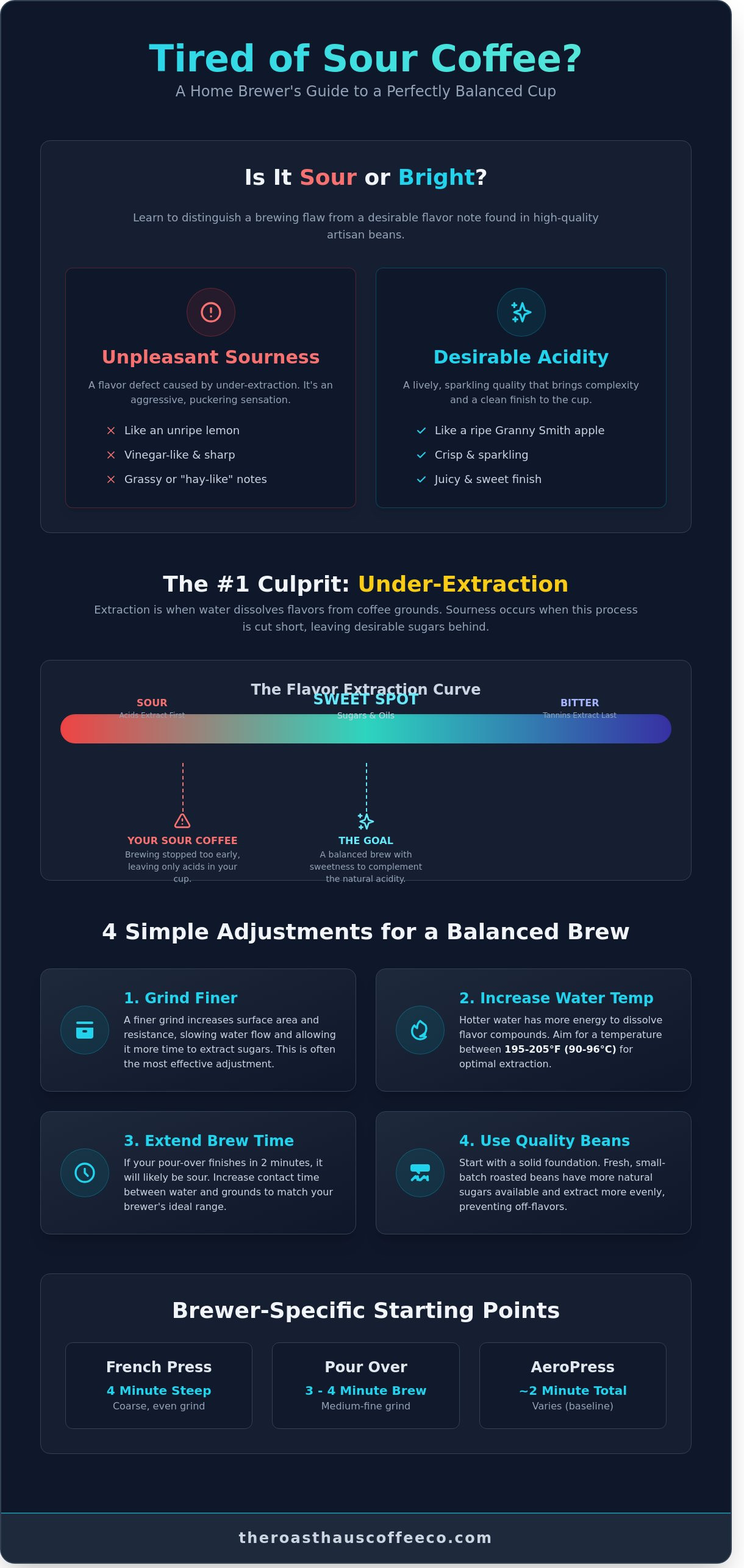
4 Simple Ways to Fix Sour Coffee at Home
Sourness is a clear sign of under-extraction. It means the water didn't stay in contact with the coffee long enough, or at the right intensity, to pull out the sweetness that balances the natural acids. You can fix this by adjusting four specific factors in your kitchen.
- Grind your beans finer: This is the most effective change. Finer grounds create more surface area for the water to hit. It also slows down the flow of water, giving it more time to dissolve the sugars.
- Increase your water temperature: Heat acts as a catalyst. If your water is below 195°F, it won't have the energy to extract the heavy, sweet compounds. Aim for a range between 195°F and 205°F.
- Extend the brew time: If you use a French Press or an AeroPress, let the coffee steep for an extra 30 to 45 seconds. This extra time allows the water to move past the bright acids and into the deeper chocolate and caramel notes.
- Adjust your brewing ratio: Use more water or slightly fewer coffee grounds. A ratio of 1:17 (one gram of coffee for every 17 grams of water) provides enough solvent to fully process the dry grounds.
Understanding why does my coffee taste sour is the first step toward a better morning. By making these small adjustments, you'll move past the sharp, vinegar-like notes and into the rich profile we work hard to develop during the roasting process.
The One-Variable-at-a-Time Rule
Precision is vital for consistency. We roast our beans in small batches to maintain total control, and you should approach brewing with that same mindset. Never change your grind size and your water temperature at the same time. If the flavor improves, you won't know which change was responsible. Use a digital kitchen scale to measure your coffee and water to the gram. To stay organized, follow this how to make coffee checklist during your next brew. It helps you track your changes so you can repeat a perfect cup every day.
Water Quality: The Hidden Ingredient
Your coffee is 98% water. If your tap water has a high mineral count, it can physically block the water from absorbing coffee solids. Conversely, water that is too soft can make the coffee taste thin and sharp. Perform the "Filtered Water" test by brewing one batch with a gallon of store-bought spring water. If the flavor improves immediately, your home's plumbing or local water supply is the issue. Avoid distilled water. It lacks the essential minerals like magnesium and calcium that are required to bind with coffee particles and pull flavor out of the bean.
Experience the difference that small-batch roasting makes in every cup. Shop our fresh roasted to order beans today.
Starting with the Right Beans: The Roast Haus Advantage
You can follow every brewing rule and still ask why does my coffee taste sour. Often, the problem isn't your technique; it's the beans. At The Roast Haus Coffee Co., our small-batch, family-owned approach eliminates the roast defects common in mass-produced coffee. Large commercial roasters often produce underdeveloped beans that taste sharp and metallic because they prioritize speed over quality. We monitor every batch to ensure the sugars caramelize perfectly. This precision prevents the grassy, sour notes found in low-quality, uneven roasts.
Freshness is our second secret weapon. We ship every order within 24 hours of roasting to capture peak flavor. Most grocery store coffee sits in a warehouse for 180 days before it hits the shelf. By then, the oils have turned rancid and the bean has lost its sweetness. Our coffee subscription solves this by delivering artisan beans directly to your door on your schedule. You get the benefit of supporting a small business while ensuring you never brew stale, sour beans again.
Our Roasted-to-Order Commitment
We believe in transparency. Big brands use "Best By" dates to hide how old their coffee actually is. We only use "Roasted On" dates. This tells you exactly when the flavor was locked in. We source premium origins like Kenya AA and Ethiopia Limu because they offer balanced, wine-like acidity. These beans provide a complex brightness that is very different from a sour extraction error. If you're exploring new flavors, try our 3-bag sampler to find your perfect roast level without the guesswork.
A Final Word from the Roaster
Coffee is a journey, not just a drink. It takes time to learn why does my coffee taste sour and how to adjust your variables. We're here to help you master your home barista game. If our beans aren't tasting quite right in your specific brewer, reach out to us for advice. We provide direct brewing tips to help you get the best extraction possible from every bag. Support a dedicated craftsman and shop our latest small-batch roasts today to experience coffee the way it was meant to be: fresh, bold, and never sour.
Take Control of Your Morning Brew
Understanding why does my coffee taste sour is the first step toward fixing a bad morning. Most issues come down to under-extraction. You can fix this by increasing your water temperature to at least 195 degrees or using a finer grind size. However, the best brewing technique won't save stale, mass-produced beans. Quality starts with the roast date.
At The Roast Haus Coffee Co., we focus on 100% small-batch artisan quality. We're a family-owned and operated business in Oklahoma. We don't let beans sit on a shelf for months. Every bag is shipped the same day or within 24 hours of roasting to ensure you get peak flavor. This process preserves natural sweetness and eliminates the harsh sourness found in old coffee. You deserve a cup that tastes exactly how you want it every single time.
Stop settling for mediocre coffee. Shop our Roasted-to-Order Small Batch Beans today and experience the difference that 24-hour freshness makes. Your perfect cup is just a few clicks away.
Frequently Asked Questions
Is sour coffee safe to drink?
Yes, sour coffee is perfectly safe to drink because the acidity comes from organic compounds like citric and malic acid. While it's safe, the sourness is a clear sign of under-extraction during the brewing process. You aren't drinking "bad" beans, but you're missing out on 100 percent of the balanced sweetness that our artisan roasting provides. It's a chemistry problem, not a food safety issue, so don't worry about getting sick.
Can I fix a cup of coffee that is already brewed and tastes sour?
You can salvage a sour cup by adding a tiny pinch of table salt to neutralize the acidity. Just 0.1 grams of salt can block the sour receptors on your tongue and make the coffee taste smoother. Another option is to add a tablespoon of 212 degree water to the cup to slightly increase the perceived temperature. These quick fixes help, but adjusting your next brew's grind size is the only way to get true quality.
Why does my French Press coffee always taste sour?
Your French Press coffee tastes sour because the water didn't extract enough flavor from the coarse grounds. If you're wondering why does my coffee taste sour in a press, it's often because the 4 minute steep time was too short for the water temperature used. Try extending your brew time to 6 minutes or pre-heating your carafe to maintain a steady 200 degree temperature throughout the process. This extra time allows the water to penetrate the larger particles.
Does light roast coffee always taste more sour than dark roast?
Light roast coffee contains 15 percent more organic acids than dark roast, which gives it a brighter, fruitier profile. This brightness can easily turn into sourness if your brew water isn't hot enough to extract the sugars. Dark roasts are roasted for 3 to 5 minutes longer, which burns off those acids and replaces them with bitter, roasty notes. Our light roasts are designed for clarity, but they require precise brewing to shine without being sour.
What is the best water temperature to prevent sour coffee?
Use water heated between 195 and 205 degrees Fahrenheit to ensure proper extraction. If your water temperature drops to 185 degrees, you'll extract 25 percent less solubles, leaving the coffee tasting thin and acidic. We recommend using a digital kettle to hit exactly 202 degrees for our light roasts. This precise heat breaks down the bean's structure and releases the rich flavors we worked hard to develop during our small-batch roasting process.
How do I know if my beans are stale or just under-roasted?
Stale beans lose their punch and taste like dry cardboard, while under-roasted beans have a sharp, grassy acidity. At The Roast Haus Coffee Co., we ship our small-batch beans within 24 hours of roasting to ensure you never deal with staleness. If your beans are more than 21 days past their roast date, they've likely lost 50 percent of their peak flavor potential, which often explains why does my coffee taste sour and flat.
Can the type of coffee filter make my brew taste sour?
Yes, a thick paper filter can cause sourness if it slows down the water flow too much or if it isn't rinsed first. Paper filters remove 95 percent of the coffee's natural oils, which can make the remaining acidity feel sharper and more aggressive. If you prefer a fuller body with less perceived sourness, try a stainless steel mesh filter. This allows more oils into your cup, which coats the tongue and balances the bright notes effectively.
Should I use more or less coffee if my brew is sour?
Use slightly less coffee or more water to fix a sour brew. A standard 1:16 ratio means using 1 gram of coffee for every 16 grams of water. If that tastes sour, try a 1:17 ratio instead. Adding more water allows the liquid to pull more sweetness out of each individual coffee ground. This simple 6 percent change in your recipe can transform a sharp, unpleasant cup into a balanced and flavorful experience that highlights our roasted to order beans.

