


What makes a coffee sourcing story useful is not the size of its promise, but how clearly you can explain it. The benefits of a direct trade wholesale coffee supplier may include closer insight into origin, more direct producer relationships, and coffees selected around specific quality goals. But direct trade is not a certification, and the label alone does not guarantee better quality, fairer compensation, or a steady supply.
For a café or other coffee business, dependable day-to-day service matters as much as a compelling story. You need to understand the sourcing claims behind a coffee and how they fit your standards, menu, and customers’ questions. A useful partnership connects what’s in the cup with information your team can share accurately.
This article covers potential business advantages of direct trade, how to compare sourcing models, and why transparency and supply planning matter. The Roast Haus is a family-owned Oklahoma roastery offering wholesale partnerships and small-batch, roasted-to-order coffee. Its roasting and ordering approach is distinct from a claim about direct-trade sourcing, so it helps to consider each separately when choosing coffee for your business.
Key Takeaways
- The benefits of a direct trade wholesale coffee supplier depend on the relationship, quality expectations, and supply planning, not the sourcing label alone.
- Traceable origin details can help your team answer customer questions and describe coffee more clearly on your menu.
- Compare sourcing models by relationship structure, transparency, standards, and the origin information available to buyers.
- Start with your menu, customer preferences, and purchasing needs when assessing whether a supplier’s approach fits your café.
- The Roast Haus’s wholesale partnerships and roasted-to-order approach offer a practical example of how a roastery can serve business buyers.
What Does a Direct Trade Wholesale Coffee Supplier Actually Do?
Direct trade is a relationship-led approach to coffee sourcing. A roaster may build ongoing relationships with producers, communicate quality expectations, and make purchasing decisions around specific coffees. The term does not describe one universal supply-chain structure, and it is not a certification with a shared rulebook. Its meaning depends on the practices behind the claim.
A wholesale supplier connects sourcing decisions with the coffee a café serves. Those decisions can shape which origins and lots are selected, how the roaster evaluates green coffee, and what information reaches the café team. The potential benefits of a direct trade wholesale coffee supplier therefore depend on the relationships and practices involved, not just the label.
How Does Direct Trade Work in Coffee Wholesale?
Communication may involve producers, roasters, and supply-chain partners. A roaster can share its quality preferences, while producers provide information about a coffee’s origin and harvest. Shared quality expectations can then guide selection and purchasing. For example, a roaster might look for a particular cup profile or consistent quality across repeat purchases. The details vary by relationship.
“Direct” does not necessarily mean every intermediary has been removed. Exporters, importers, and other partners may still help move coffee, manage logistics, or handle documentation. The distinction lies in the relationship and purchasing communication, not simply in the number of organizations involved. Useful sourcing information explains each party’s role and how coffee moves from producer to roaster and café.
Is Direct Trade a Certification or a Sourcing Approach?
Direct trade is not a universal third-party certification with one set of requirements. There is no single rulebook that makes every supplier using the term follow identical practices. Direct Trade on Wikipedia offers background on the term and its place among coffee-sourcing models, but a label alone does not verify a supplier’s particular relationships or outcomes.
Direct trade describes a sourcing approach, while a formal certification follows a defined standard. To understand a claim, look for specific details: who the roaster works with, what origin information it shares, and how its purchasing and quality practices work. Clear explanations help café owners speak accurately with staff and customers without treating the term as proof of quality, farmer compensation, or supply reliability.
For a café, useful points to compare include:
- How the sourcing relationship works and what roles supply-chain partners play.
- Whether origin information is specific enough to support accurate staff and menu descriptions.
- Whether quality expectations are explained in concrete terms rather than implied by the label.
- How repeat orders and changes in available coffee are handled.
These details will not make every sourcing arrangement identical. They do give you a clearer basis for comparing claims and deciding whether a supplier’s approach fits your café’s quality goals and customer story.
How Direct Trade Can Benefit a Coffee Business Beyond the Cup
A sourcing relationship can matter to a café in practical ways beyond flavor. Clear quality expectations may help a roaster select coffees that fit a café’s menu, while useful origin information gives staff a more confident answer when customers ask where their coffee comes from. These are potential advantages, not automatic results of using the term “direct trade.”
Can Sourcing Relationships Support Coffee Quality?
When a roaster and producer share quality expectations, feedback can help guide which coffees are selected and purchased. A café can then make a more informed choice about coffee for its espresso or filter menu. But the source relationship is only one part of the result: farming, harvesting, processing, storage, roasting, and brewing all affect what reaches the cup.
Direct trade alone does not guarantee superior flavor, because cup quality depends on production and handling, the roaster’s decisions, and the café’s brewing practices. For a wholesale buyer, the practical questions are how a supplier translates its expectations into selections and communicates changes that could affect the menu. A close relationship may support feedback and planning, but it cannot ensure the same coffee or profile will always be available.
How Can Origin Transparency Strengthen a Café’s Offer?
Specific, documented details give staff something concrete to share. Depending on the information available, a menu note might name a country or region, identify a producer group, or describe a processing method. Keep the language accurate and concise. Avoid broad claims about farmer pay, environmental impact, or ethical sourcing unless the details support them.
Clear sourcing information can help staff explain a coffee’s character and make a menu more informative without turning it into a long sourcing statement. It also gives the team a consistent answer to common questions. Put the relevant details in staff notes, then use only the most useful points on the menu.
The National Coffee Association Industry Statistics page provides broader context on the coffee sector. For a café, the day-to-day value of sourcing information is more immediate: it connects a coffee’s documented origin to the product customers order and the story staff can explain.
Continuity in a sourcing relationship may also make communication and planning easier. Updates about coffee selections can help a café prepare for changes, consider alternatives, and keep menu descriptions current. This does not guarantee uninterrupted supply. It does make decisions easier to base on current information rather than a label alone.
The benefits of a direct trade wholesale coffee supplier may include better-informed selection and a more distinctive customer story, but customer loyalty depends on the full experience. Coffee quality, service, pricing, atmosphere, and consistency all shape whether guests return. Use sourcing details to support what your café already does well, not as a substitute for it. Explore The Roast Haus coffee offerings to see how coffee selection can fit your business.
Direct Trade vs. Other Wholesale Coffee Sourcing Models
Wholesale sourcing models describe different things. Some focus on the structure of buyer-producer relationships; others use a certification framework with defined requirements. Compare them by looking at how coffee is sourced, what information is shared, and how well the model supports your menu and purchasing needs. The table below shows common distinctions, not rules that apply identically to every supplier.
| Model | Relationship structure | Transparency and standards | What a café buyer may see |
|---|---|---|---|
| Direct trade | Emphasizes relationships between roasters and producers, sometimes involving ongoing communication. | Practices vary by supplier; the term itself is not a universal certification. | May include more detail about origin, producer relationships, or selection decisions when the supplier shares it. |
| Conventional multi-step sourcing | Coffee may pass through several trading and logistics partners before reaching a roaster. | Transparency depends on the supplier and supply chain; multiple steps do not automatically mean information is unavailable. | May range from basic origin details to more extensive sourcing information. |
| Fair Trade-certified sourcing | Uses a certification framework that applies standards to participating supply-chain actors. | Requirements depend on the certification scheme and its rules. | Certification offers a defined reference point, while the coffee’s specific origin and menu suitability still need to be considered. |
These models are not always mutually exclusive. Coffee can move through importers or exporters and still be part of a relationship-led sourcing arrangement. A supplier may also share origin details alongside a certification. Focus on what each claim means in practice instead of assuming one label tells the whole story.
Direct Trade and Fair Trade: What Is the Difference?
Direct trade describes a sourcing approach centered on relationships and purchasing practices. Fair Trade refers to certification frameworks with established standards. One is not automatically a substitute for the other, and either approach may reflect efforts to support producers. Their requirements and evidence differ, so compare the details rather than assuming one always pays more or produces better coffee.
For a café, the distinction matters when explaining coffee to customers and deciding what sourcing information belongs on a menu. A certification can provide a recognizable standards framework. A direct-trade claim may instead describe a particular roaster-producer relationship. In both cases, precise descriptions help staff avoid making promises the sourcing information does not support.
What Direct Trade Can and Cannot Promise
A relationship-led model may support more direct communication, clearer origin visibility, and collaboration around quality expectations. Those practices can help a wholesale buyer plan a menu or train staff. Their value depends on what the supplier documents and shares.
Direct trade is not, by itself, a guarantee of coffee quality or positive social and environmental impact. Look for evidence of specific practices, such as named origins, explained purchasing relationships, or clear quality criteria. Treat broad claims about ethics or sustainability separately from verifiable details. The benefits of a direct trade wholesale coffee supplier are best judged by the practices and information behind the claim, alongside the coffee’s fit for your business.
How to Assess Whether a Direct Trade Supplier Fits Your Café
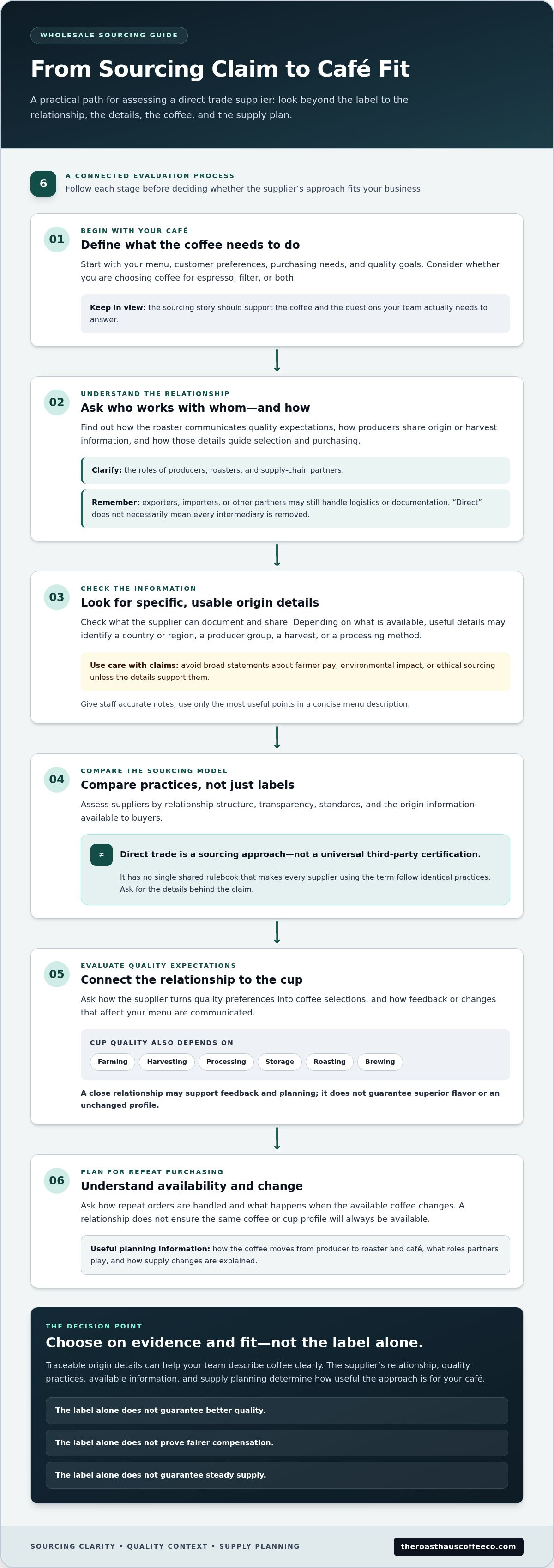
Start with the way your café serves coffee, not with the sourcing label. A supplier’s approach is a good fit only if the coffee, information, and ordering routine support your menu and day-to-day work. Use this framework to compare what matters to your business:
- Define your menu and purchasing needs. Note which coffees you need for espresso, batch brew, or other service uses, along with customer preferences and an ordering cadence your team can manage. These are practical criteria for evaluating a supplier’s offer.
- Review the origin information. Look for clear, specific details about the coffee’s origin and any producer or processing information that is documented. Consider whether those details help staff explain the coffee accurately.
- Set quality expectations. Identify the cup characteristics that matter to your menu, then review how the supplier describes and evaluates its coffees. Sourcing language alone will not tell you whether a coffee suits your recipes.
- Understand communication and change. Consider how product descriptions, quality feedback, ordering routines, and updates about available coffees will fit your operation. Clear communication helps your team prepare, though it cannot guarantee uninterrupted supply.
Match Coffee and Sourcing Details to Your Menu
Choose coffees around their intended use and the experience you want to serve. A café building an espresso menu may prioritize a different flavor profile from one focused on filter coffee. Origin and processing details can help staff describe a coffee’s character, but keep those descriptions tied to information you can substantiate. Brewing technique matters too; staff can use practical resources on how to make coffee at home to reinforce how preparation affects the cup.
For each coffee, give staff a short reference with the product name, documented origin details, a concise flavor description, and its menu use. Keep the language consistent across the menu and team training. This makes customer conversations easier and reduces the risk of turning a sourcing detail into an unsupported claim.
Plan for Communication, Quality, and Supply Changes
Before adding a coffee to the menu, establish how product descriptions are shared, how quality feedback is communicated, and what ordering routine works for the café. Seasonal harvest changes may affect which coffees are available and the origin details associated with them. Leave room for updates so staff can keep menu language current rather than treating every selection as permanent.
Track what your team and customers notice. A simple record of brew adjustments, staff feedback, and guest responses can help you decide whether a coffee remains a strong fit or another selection would better serve the menu. These notes also make conversations with a wholesale supplier more specific and useful.
The benefits of a direct trade wholesale coffee supplier matter most when sourcing information and coffee selection work with your café’s real needs. The Roast Haus Coffee Co. is a family-owned Oklahoma roastery offering wholesale partnerships and small-batch, roasted-to-order beans. Its coffee products ship within 24 hours of roasting. Explore wholesale coffee partnerships to learn how its approach can support your coffee program.
The Roast Haus Approach to Wholesale Coffee Partnerships
The Roast Haus Coffee Co. is a family-owned Oklahoma roastery offering wholesale coffee partnerships and small-batch, roasted-to-order beans. As a small business, it brings a personal perspective to working with business buyers. Coffee quality and clear communication matter, as does using sourcing language that accurately describes what it establishes.
What The Roast Haus Brings to a Wholesale Relationship
The Roast Haus is a husband-and-wife team with a mission that includes supporting sustainable farming and local farmers. That mission reflects the company’s values. Its coffee is roasted to order, and its products ship within 24 hours of roasting. Roasted To Order. This is a practical part of how the company prepares coffee for customers.
Wholesale partnerships give business buyers a way to work with The Roast Haus’s coffee. Each business can consider coffee selection and ordering routines in relation to its own menu and purchasing needs. The company’s roasted-to-order approach is a distinct consideration from a sourcing label: evaluate each based on what it means for your coffee program.
Understanding the benefits of a direct trade wholesale coffee supplier also means separating sourcing relationships from roastery practices. Consider how factors such as roast timing, coffee selection, and order routines support your business, and describe sourcing claims according to the information available. A clear account of one practice is more useful than implying it proves another.
Explore Coffee That Fits Your Business
Choosing coffee for a café or other business starts with fit. Consider the origin and flavor profile you want to offer, how the coffee will work across your menu, and what your customers tend to enjoy. A coffee suited to a particular service style gives staff a clear way to describe it. Keep origin and sourcing details grounded in information you can support, and let the cup and the full customer experience speak for themselves.
The Roast Haus offers Kenya AA Supreme, Ethiopia Limu Organic, Honduras Morning Splendeur, and Decaf Swiss Water Process. These coffees give buyers different origins and options to consider alongside their menu and customer preferences. The product names alone do not establish a direct-trade relationship, so keep that distinction clear when choosing coffee and shaping the story your team shares.
Explore The Roast Haus Coffee Co. and its coffee options for a wholesale partnership built around small-batch, roasted-to-order coffee.
Make Your Next Coffee Choice With Confidence
The right wholesale relationship should make it easier to serve coffee your team believes in and explain your choices honestly. Before making a change, write down what matters most: the cup profile you want, the origin details you can share, and the communication your business needs as coffees change. Use those priorities to guide a practical discussion with your team.
Weigh the benefits of a direct trade wholesale coffee supplier against evidence, menu fit, and day-to-day needs, not the label alone. A clear sourcing story can support your customer experience, but it works best alongside thoughtful coffee selection and attentive service. Choose a partnership that reflects your standards and gives staff confidence in what they serve.
The Roast Haus Coffee Co. is an independent, family-owned roastery with wholesale partnerships and a mission that includes supporting sustainable farming and local farmers. Explore its coffee options and roasted-to-order approach for your business.
Explore The Roast Haus Coffee Co. to find coffee for your wholesale program.
Frequently Asked Questions
Does direct trade coffee mean farmers always receive higher prices?
No. Direct trade does not guarantee a particular payment to farmers. Compensation depends on the agreement, market conditions, coffee quality premiums, and how the supply chain operates. When discussing producer pay, use specific, documented information about what was paid and to whom. Without that evidence, describe the sourcing relationship accurately rather than assuming the direct-trade label proves a farmer received a higher price.
Can a small café work with a direct trade wholesale coffee supplier?
Yes. A small café may find this kind of supplier relationship suitable, depending on the wholesale offer, ordering arrangements, menu needs, and expected volume. A neighborhood café, for example, might value origin details that help staff answer customer questions, even if its purchasing needs differ from those of a larger business. Compare the operational requirements with the value of the relationship before changing your coffee program.
Is direct trade coffee independently certified?
No. Direct trade is not one universal certification with a single standard applied by every roaster. Suppliers may use the phrase to describe their own sourcing relationships and practices, so distinguish those descriptions from claims verified through a third-party certification. The absence of a direct-trade certificate does not, by itself, prove poor practice. Focus on what is explained and documented about a particular coffee.
Can direct trade guarantee better-tasting coffee?
No. A sourcing relationship may support communication about quality, but it cannot determine flavor on its own. Coffee variety, growing conditions, processing, storage, roasting, freshness, and brewing all affect the cup. Taste a sample using the café’s intended preparation, such as its espresso recipe or batch-brew method. Evaluate sensory results separately from sourcing claims, then decide whether both suit the menu and the experience you want guests to have.
What happens to direct trade coffee sourcing when a harvest changes?
Available coffees and their origin details can change as harvest timing, crop conditions, and lots vary from season to season. A close sourcing relationship may help a supplier communicate what has changed, but it cannot remove agricultural variability. If a coffee changes, update staff notes and menu descriptions so they still match what is being served. Keeping a suitable alternative in mind can also help your team manage a menu transition.
How can a café explain direct trade to customers without overstating its claims?
Use specific details you can support, such as a documented origin, producer relationship, or sourcing practice. Explain what is known about a coffee’s journey, and avoid broader statements about farmer income, sustainability, or quality unless you have evidence. Train staff to distinguish details about a particular coffee from the general meaning of direct trade. Clear, precise wording helps customers understand what the café can verify.

