


Imagine opening a bag of freshly roasted Kenya AA Supreme, only to have your morning cup taste like bitter ash or sour lemon. It's a frustrating reality for many home baristas who follow every instruction but still end up with a clogged filter or a watery brew. Finding the best grind size for pour over coffee isn't just about following a generic setting on a dial; it's about understanding how your beans interact with water. You likely already know that your grinder is the most important tool in your kitchen. Consistency is the foundation of a great cup, yet terms like medium-fine remain some of the most confusing instructions in the specialty coffee world.
We're here to clear up that confusion and help you master the art of the perfect grind. By the end of this guide, you'll be able to unlock the complex, floral notes of an Ethiopia Limu Organic with total confidence. We will provide a clear visual reference for different brewers, from the V60 to the Chemex, and teach you how to troubleshoot your taste issues in real time. You'll learn why our small-batch, roasted-to-order beans behave differently during the bloom and how to adjust your technique for repeatable, delicious results every single morning.
Key Takeaways
- Understand how particle surface area controls the balance between acidity and bitterness in every cup.
- Use visual analogies to find the best grind size for pour over coffee across different drippers and filter types.
- Match your grind to your specific equipment to ensure proper flow rate and prevent filter clogs.
- Learn to troubleshoot your brew by adjusting only one variable at a time based on the sweetness of the final cup.
- Adjust your technique for peak freshness, as roasted-to-order beans produce more gas and require a patient approach.
Why Grind Size is the Most Important Variable in Your Pour Over
When you brew a cup of coffee, you're essentially performing a chemistry experiment. The best grind size for pour over coffee is the single most important factor you can control to ensure that experiment succeeds. Unlike immersion methods where coffee grounds sit in water for several minutes, drip coffee methods rely on water passing through a bed of grounds. This makes the pour over far less forgiving than a French Press. If your grind is off by even a small margin, the water won't interact with the coffee correctly, resulting in a cup that falls short of its potential.
Grind size dictates how much surface area is exposed to the water. Think of it like ice. A single large block of ice melts slowly, while crushed ice melts almost instantly. In coffee, smaller particles release their flavors much faster because the water can reach the center of the particle easily. Our small-batch artisan approach ensures high bean density consistency, but you must match that quality with the right grind to unlock the specific citrus and floral notes in our Ethiopia Limu Organic or the bold complexity of the Kenya AA Supreme.
The Science of Extraction Simplified
Extraction is the process of water dissolving coffee solubles. Your goal is to extract just enough to get the sweetness and acidity without pulling out the harsh, bitter compounds that come at the end of the brewing cycle. Finding the best grind size for pour over coffee is about achieving this balance.
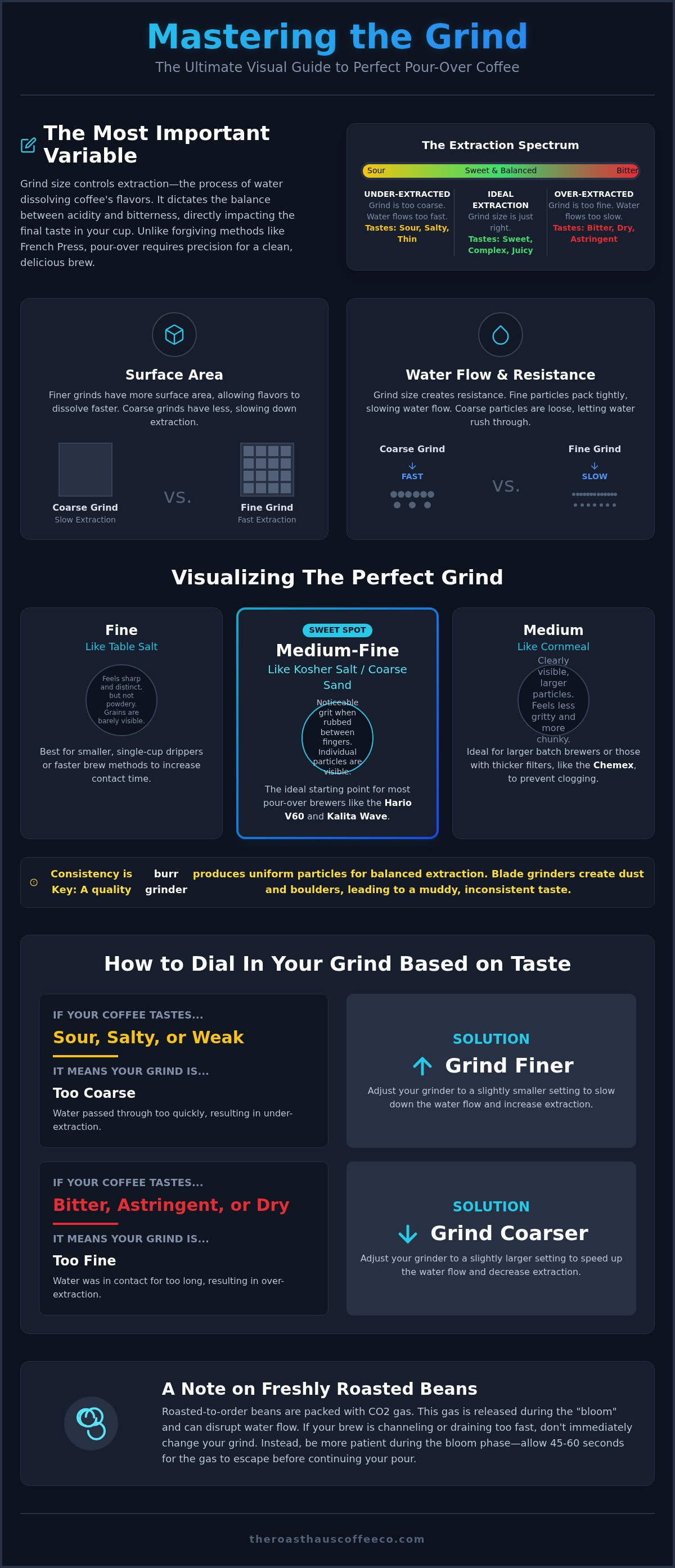
- Under-extraction: This happens when the grind is too coarse. The water moves through the coffee too quickly, leaving behind the sugars. You'll end up with a cup that tastes sour, salty, or unpleasantly acidic.
- Over-extraction: This occurs when the grind is too fine. The water stays in contact with the coffee for too long, pulling out heavy, woody, and bitter flavors. It often leaves a dry or astringent feeling on your tongue.
Surface Area vs. Water Flow
The grind size also acts as a filter for the water flow. Fine grounds pack together closely, creating resistance that slows the water down. If the grind is too fine, the water pools on top of the bed and the filter might even clog. Conversely, coarse grounds allow water to rush through with very little resistance, leading to a weak and watery brew.
Visualizing the Perfect Pour Over Grind: From Sea Salt to Sand
Most home brewers don't own laboratory equipment to measure coffee particles in microns. We use household analogies because they provide a tangible, honest reference for your morning routine. Finding the best grind size for pour over coffee starts with your eyes and your sense of touch. When you rub the grounds between your thumb and forefinger, they should feel gritty like sand, not powdery like flour. This tactile feedback tells you more about your extraction potential than a digital display ever could.
The visual difference between a high-quality burr grind and an uneven blade grind is striking. A burr grinder produces uniform flakes that look consistent across the entire pile. Blade grinders create a chaotic mess of microscopic dust and large chunks. This inconsistency is the enemy of flavor. You can see the difference clearly; a good grind has a matte, uniform appearance, while a poor one looks speckled with different sizes. Achieving that uniformity is the first step toward a repeatable, professional-grade cup at home.
The Pour Over Grind Size Chart
To calibrate your grinder, compare your results to these common kitchen staples. This simple visual check ensures you're in the right ballpark before you even pour the water.
- Fine (Table Salt): This texture is best for small, single-cup drippers or shorter brew times. It feels sharp and distinct but lacks large visible grains.
- Medium-Fine (Kosher Salt): This is the "sweet spot" for the best grind size for pour over coffee in devices like the Hario V60 or Kalita Wave. It looks like coarse sand and has a noticeable grit when rubbed between your fingers.
- Medium (Cornmeal): Ideal for larger batches or brewers with thick filters like the Chemex. The particles are large enough to see individually, similar to the texture of dried cornmeal.
We recommend creating a "calibration jar" for your kitchen. Save a small amount of coffee that produced your favorite brew and keep it in a clear container. This gives you a permanent visual reference to match whenever you switch bean varieties or adjust your grinder settings.
Understanding Grind Distribution
Even if your average particle size looks correct, the distribution of those particles matters. A scientific paper on grind size highlights how extraction kinetics change significantly based on particle diameter. "Fines" are microscopic dust particles that clog the pores of your paper filter. These cause the water to stall and create bitter, over-extracted flavors. "Boulders" are large chunks that water flows around too quickly, leading to sour, watery pockets in your brew.
High-quality coffee grinders are designed to minimize these extremes. When your grind is uniform, every particle extracts at the same rate. This allows the bright acidity of our Ethiopia Limu Organic to shine without being overshadowed by bitterness. To see the difference a precise grind makes in your own kitchen, try these settings with a fresh bag of Kenya AA Supreme.
Matching Your Grind to Your Brewer: V60, Chemex, and Kalita
Different brewers have unique designs that fundamentally change how water moves through the coffee bed. The best grind size for pour over coffee depends heavily on the thickness of your paper filter and the shape of your dripper. A V60 and a Chemex might both be "pour overs," but they require different settings to get the best results from your beans. If you use the same grind for every device, you'll likely end up with inconsistent flavor and frustrating brew times.
Geometry also plays a major role. Conical drippers like the V60 funnel water through the center of the coffee bed, while flat-bottom drippers like the Kalita Wave encourage a more even, horizontal extraction. This difference in water path means you must adjust your grinder to compensate for how much resistance the brewer provides naturally. When you're brewing a larger batch, the water has to travel through a deeper pile of grounds, which increases contact time. To keep your brew from becoming bitter, always click your grinder one or two steps coarser for larger volumes.
Hario V60: The Precision Conical Grind
The V60 features a large exit hole and thin, high-flow filters. Because the water can escape quickly, you must use a "Medium-Fine" grind to create enough resistance. If the grind is too coarse, the water will rush through, leaving your Ethiopia Limu Organic tasting weak and sour. Aim for a total brew time of 2:30 to 3:00 minutes for a standard 300ml pour. Your pouring technique also matters. More agitation from a heavy stream will speed up extraction, so keep your pour steady and circular to maintain consistency.
Chemex: The Coarser Side of Pour Over
Chemex filters are significantly thicker than standard filters. This thick paper removes almost all sediment and oils, creating a very clean cup. However, it also slows down the flow rate. To prevent the brew from stalling or stopping entirely mid-pour, you need a "Medium-Coarse" grind, similar to sea salt. This is essential for large 6-cup or 8-cup batches. If you use a fine grind here, the small particles will migrate to the bottom and clog the filter, leading to a bitter, over-extracted mess that hides the bright notes of our Kenya AA Supreme.
Kalita Wave and Flat-Bottom Drippers
Flat-bottom drippers are more forgiving for home brewers. The three small holes at the bottom regulate the flow rate for you, which helps prevent human error during the pour. This design allows for a standard "Medium" grind, roughly the texture of coarse cornmeal. Because the water pools slightly at the bottom, the extraction is naturally more uniform. You don't need to be as aggressive with your pouring technique as you do with a V60. This stability makes it an excellent choice for a consistent daily cup of our Honduras Morning Splendeur. Mastering these subtle shifts ensures you always have the best grind size for pour over coffee regardless of the device on your counter.
How to Dial In Your Grind Based on Taste
Your taste buds are the ultimate judge of your brewing technique. While timing your brew provides a helpful baseline, the final flavor in the cup tells the real story of your extraction. The golden rule of dialing in is to change only one variable at a time. If you adjust your water temperature, pouring speed, and grind size all at once, you'll never know which change actually improved the flavor. Start by keeping your recipe and technique identical, then move your grinder one notch to see how the taste shifts. Finding the best grind size for pour over coffee is a process of elimination that leads to sweetness.
Don't trust the very first sip you take. Coffee is often too hot for your tongue to perceive complex sugars and acids accurately. Let the cup cool for a minute or two before making a judgment. Many baristas use the "Coffee Compass" method to navigate these flavors. If the coffee feels heavy or muddy, you're heading toward over-extraction. If it feels thin or watery, you're under-extracting. Keeping a simple brew journal helps you track these adjustments. Write down the bean, the grind setting, and a one-word description of the taste. This habit turns a lucky guess into a repeatable skill.
The "If/Then" Troubleshooting Guide
Use this straightforward framework to fix your brew during your next morning session. These adjustments will help you maintain the best grind size for pour over coffee as your beans age or as you switch between different bags.
- If it tastes sour, salty, or thin: Your grind is likely too coarse. The water passed through too quickly to pull out the sugars. Grind one notch finer.
- If it tastes bitter, harsh, or dry: Your grind is probably too fine. The water stayed in contact with the grounds too long. Grind one notch coarser.
- If the water won't drain or stalls: You have too many "fines" clogging the filter. Clean your grinder or move to a significantly coarser setting.
Adjusting for Bean Density and Origin
The origin and altitude of your coffee beans change how they shatter in your grinder. High-altitude beans, such as our Kenya AA Supreme, are much denser than beans grown at lower elevations. These dense beans often require a slightly finer grind to encourage full extraction because their cellular structure is more tightly packed. Conversely, softer beans from lower altitudes can be more brittle. They often shatter into more "fines," which can clog your filter and cause bitterness if you don't adjust by grinding slightly coarser.
Roast levels also play a role. Darker roasts are more porous and soluble, meaning they give up their flavor very easily. If you're brewing a dark roast, you should use a coarser setting to avoid over-extraction. Light roasts are less soluble and need more help from a finer grind to release their vibrant acidity. To experience how these variables come together in a perfect cup, browse our selection of small-batch, roasted-to-order coffee and start your own dialing-in journey today.
Why Freshly Roasted Beans Change Your Grinding Strategy
Freshly roasted coffee is a living product. When you use roasted-to-order coffee, the beans are still packed with carbon dioxide. This gas is a sign of peak freshness, but it also acts as a barrier during the brewing process. As water hits the grounds, the escaping CO2 pushes the water away. This prevents the water from penetrating the coffee particles effectively. This is why the best grind size for pour over coffee isn't a static setting; it's a moving target that depends on how recently the beans left the roaster.
At The Roast Haus Coffee Co., we ship our small-batch roasts from Wyandotte, OK, within 24 hours of roasting. This extreme freshness means you'll see a vigorous "bloom" in your dripper. Because this gas creates physical resistance, fresh coffee often appears to flow slower than stale coffee. You must be patient. A rushed pour will lead to uneven extraction as the water bypasses the gassy grounds. As your beans age over two to four weeks, they naturally lose this gas. You'll likely need to adjust your grinder one notch finer every week to maintain the same extraction level and flavor profile.
Degassing and Flow Rate
The bloom is the most critical stage when working with fresh artisan beans. We recommend a 30 to 45 second bloom period. Use just enough water to saturate the grounds and then wait. This allows the gas to escape so the water can actually do its job. If you notice your how to make coffee routine is resulting in a faster draw-down after two weeks, it's time for a grind tweak. The best grind size for pour over coffee at day three might be too coarse by day twenty-one. Adjusting for this loss of gas ensures your cup remains vibrant rather than becoming weak and hollow as the weeks pass.
The Artisan Roaster Difference
Our small-batch artisan approach allows for higher bean density consistency compared to mass-produced coffee. When beans are roasted in smaller quantities, the heat penetrates each bean more uniformly. This creates a consistent cellular structure throughout the entire batch. This makes the beans more "grindable," meaning they break apart into the uniform flakes your burr grinder is designed to produce. Supporting independent roasters ensures you aren't fighting against brittle, unevenly roasted beans that produce excessive dust and ruin your flow rate.
Finally, consider your environment. Oklahoma's humidity can affect how your beans grind and store. Always keep your coffee in a cool, dry place in an airtight container. High humidity can make the beans slightly more pliable, which sometimes requires a small adjustment toward a coarser setting to prevent the grinder from "smearing" the particles. Our commitment to quality means we provide the freshest possible start. Your job is to listen to the beans and adjust your grind to match their life cycle. This attention to detail is what separates a standard morning cup from a truly artisanal experience.
Master Your Morning Brew
Finding the best grind size for pour over coffee is a skill that pays off every single morning. You now know how to use simple kitchen analogies to calibrate your equipment and how to listen to what the flavor tells you about your extraction. Whether you are using a V60 or a Chemex, the goal remains the same: a balanced, sweet cup that highlights the hard work of the farmers and roasters. Consistency is the foundation of quality, and your grinder is the tool that makes it possible.
The precision of your grind is only half the battle. To truly unlock those complex floral and citrus notes, you need beans that haven't been sitting on a warehouse shelf for months. Since 2014, our family-owned operation in Wyandotte, Oklahoma, has prioritized artisan quality over mass production. We ship every small-batch order within 24 hours of roasting to guarantee peak freshness in your kitchen. Experience the difference of roasted-to-order beans with our Kenya AA Supreme and see how a fresh roast transforms your brewing process.
Trust your taste buds and don't be afraid to make small adjustments as your beans age. With the right beans and a consistent grind, you're well on your way to the best coffee of your life. Happy brewing.
Frequently Asked Questions
Is a medium-fine grind the same for every grinder?
No. Every grinder has a different calibration and burr geometry. A "7" on one machine might be a "12" on another. You should use visual cues like kosher salt or coarse sand rather than relying on a universal number. Testing your specific equipment with our Ethiopia Limu Organic is the best way to find your unique sweet spot. Trust your eyes and your taste buds over a generic dial setting.
Can I use a blade grinder for pour over coffee?
You can, but we don't recommend it. Blade grinders chop beans into uneven shards, creating a mix of dust and large chunks. This inconsistency leads to a cup that is simultaneously bitter and sour. For the best grind size for pour over coffee, a burr grinder is essential. It provides the uniform particle size needed to extract the clean, vibrant notes from our small-batch roasts.
Should I grind my coffee beans right before brewing?
Yes, you should always grind immediately before you brew. Coffee begins to oxidize and lose its aromatic oils within 15 minutes of being ground. Since we ship our beans from Wyandotte within 24 hours of roasting, grinding at the last second ensures you capture that peak freshness. It keeps the volatile compounds in the bean rather than letting them escape into the air before the water hits your grounds.
Why does my pour over take so long to drain?
Slow drainage usually happens because your grind is too fine or your grinder produces too many "fines." These microscopic dust particles migrate to the bottom and clog the paper filter. If your brew stalls, try moving your grinder one or two notches coarser. This opens up the pathways for water to flow. It's a common adjustment needed for dense, high-altitude beans like our Kenya AA Supreme.
How do I know if my grind is too fine?
Your taste buds will provide the clearest evidence. If the coffee tastes unpleasantly bitter, dry, or ashy, your grind is likely too fine. Visually, if the coffee bed looks like thick, flat mud after the water drains, the particles are too small. You want the bed to look like wet sand with a slight dome or flat surface. Adjusting to a coarser setting will bring back sweetness.
Does the type of water I use affect the grind I need?
Water chemistry impacts extraction, but it doesn't usually change your physical grind size requirement. Hard water extracts coffee differently than soft water. However, you should focus on getting your grind size right first to control flow rate and contact time. Once your grind is dialed in for your specific brewer, you can experiment with filtered water to further refine the subtle notes in our Honduras Morning Splendeur.
What is the best grind size for a Chemex vs. a V60?
The Chemex requires a medium-coarse grind, similar to sea salt, to compensate for its very thick paper filter. The V60 works best with a medium-fine grind, resembling table salt or fine sand, because its filters are thinner and the exit hole is larger. Finding the best grind size for pour over coffee means matching the particle size to the specific resistance and geometry of your chosen dripper.
How often should I clean my coffee grinder?
You should give your grinder a quick brush every week and a deep clean once a month. Coffee oils build up on the burrs over time and can go rancid, which ruins the flavor of fresh beans. Since 2014, our family-owned operation has focused on peak quality, and regular maintenance ensures that every cup tastes exactly as intended. Keeping the burrs clean helps maintain the particle consistency required for a perfect cup.

