


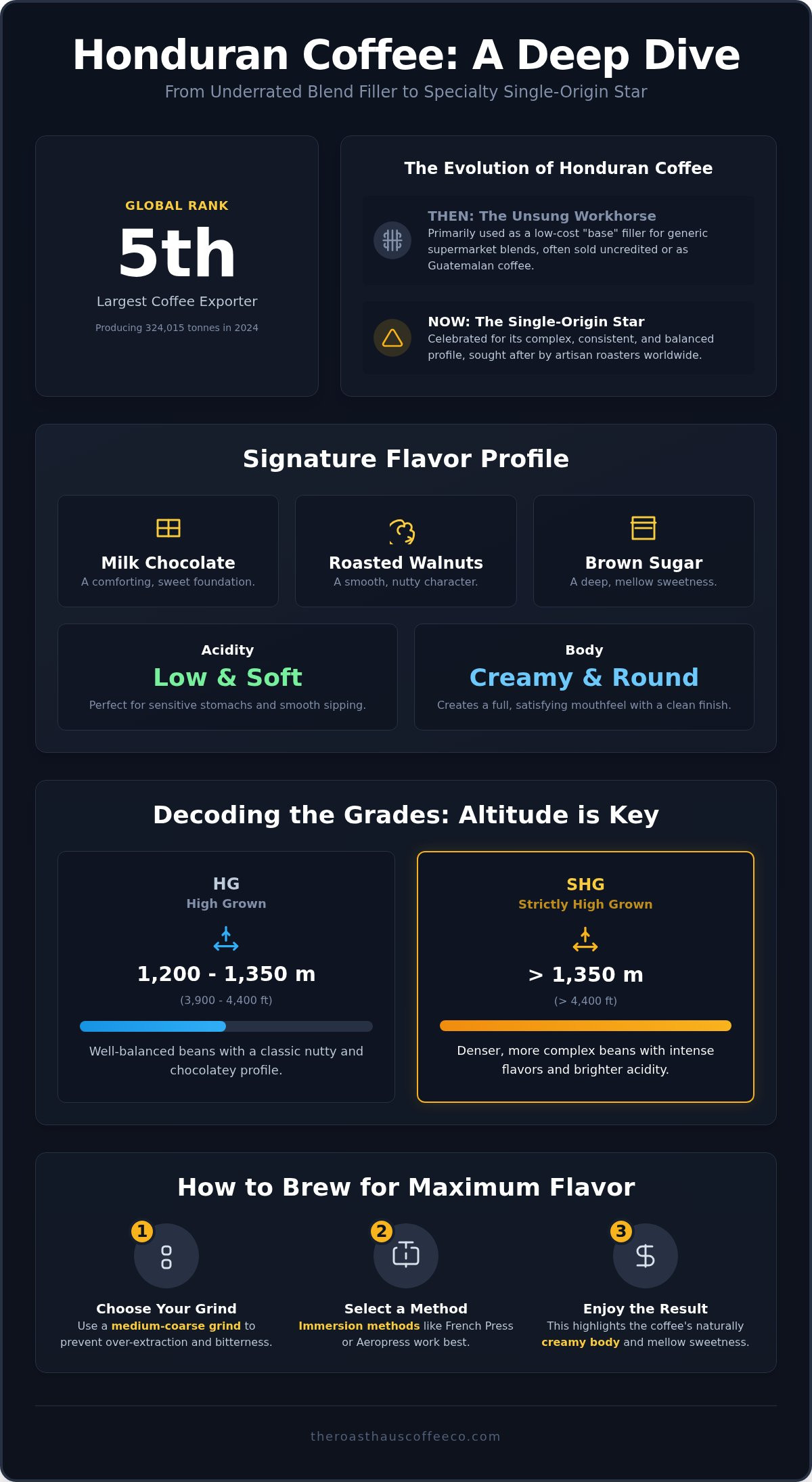
For decades, the coffee industry treated honduran coffee beans as nothing more than a cheap filler for generic supermarket blends. That era is over. Today, Honduras is the fifth largest coffee exporter in the world, producing 324,015 tonnes in 2024 alone. This shift from quantity to quality means you no longer have to settle for stale, over-processed beans that have sat on a grocery store shelf for months. You deserve a cup that reflects the actual craftsmanship of the farm and the care of a dedicated roaster.
It's frustrating to buy a bag covered in technical labels like SHG or HG only to realize the coffee inside tastes flat or bitter. We know you're looking for a reliable, low-acid brew that actually lives up to its aroma. This guide will show you why these beans have become a specialty favorite and how to choose the perfect roast, like our Honduras Morning Splendeur. We'll explore the unique flavor profiles of the region, decode those confusing labels, and share a perfected home brewing recipe so you can master your daily ritual with confidence.
Key Takeaways
- Understand how honduran coffee beans transitioned from a generic blend filler to a world-class single-origin favorite with a balanced, chocolatey profile.
- Identify the signature flavor notes of milk chocolate, brown sugar, and roasted walnuts that define these high-altitude Arabica beans.
- Decode technical labels like SHG and HG to ensure you're buying high-density beans grown at the proper altitude for maximum flavor intensity.
- Master the ideal brewing technique by using a medium-coarse grind and immersion methods to highlight the coffee's naturally creamy body.
- Experience the difference of our "Roasted-to-Order" approach, which ensures your Honduras Morning Splendeur is shipped within 24 hours of roasting.
The Evolution of Honduran Specialty Coffee Beans
Honduran coffee is a high-altitude Arabica bean famous for its balanced, chocolatey profile. For many years, these beans were the hidden workhorses of the coffee world. In the past, the history of coffee production in Honduras was defined by volume rather than variety. Most harvests were used as a "base" for generic supermarket blends, providing body without receiving any credit for flavor. Many farmers even sent their crops across the border to be sold as Guatemalan coffee just to fetch a higher price. That dynamic has changed completely as the country invested in its own identity.
From Blend Filler to Single-Origin Excellence
The transition from a bulk producer to a sought-after single-origin star didn't happen by accident. The introduction of the "Cup of Excellence" competition in the early 2000s forced a radical change in standards. Farmers began to focus on meticulous harvesting and processing to compete on a global stage. Today, honduran coffee beans are a staple for artisan roasters who value complexity and consistency. We prioritize these beans because they offer a reliable, low-acid experience that stands up on its own. You don't need to hide this coffee in a blend; its natural sweetness is the main event.
The Role of Micro-Climates in Honduran Quality
Geography is the secret weapon of the Honduran coffee sector. The diverse landscape creates distinct flavor pockets that vary from valley to valley. Volcanic soil provides essential minerals, while tropical humidity and high altitudes in the central highlands allow the cherries to ripen slowly. This slow maturation increases the density of the bean, which leads to a more concentrated and vibrant flavor in your cup. Improved processing infrastructure in these highland regions has also allowed farmers to experiment with washed and honey processes that were once impossible. The Marcala region stands as a pioneer in organic Honduran coffee, setting the standard for sustainable practices in the country.
Small-batch roasters are now prioritizing honduran coffee beans over more famous neighbors like Costa Rica or Colombia. The quality-to-price ratio is exceptional. In 2024, Honduras produced 324,015 tonnes of coffee, ranking as the 5th largest exporter globally. This massive output includes incredible micro-lots from independent family farms that we are proud to support. By choosing these beans, you are supporting a fulfillment model that values the craftsman over the corporation. It's an honest product that delivers sensory excellence in every brew.
Defining the Flavor Profile of Honduras Coffee
The first thing you'll notice about honduran coffee beans is their incredible balance. Unlike some origins that hit you with sharp, citrusy acidity, coffee from this region offers a "soft" acidity. This makes it a perfect choice if you have a sensitive stomach or simply prefer a smoother morning cup. The texture is typically round and creamy, leaving a clean finish on the palate that doesn't linger with bitterness.
When you brew these beans, the primary tasting notes center on a comforting trio of milk chocolate, roasted walnuts, and brown sugar sweetness. The aroma is equally inviting. You'll often detect subtle hints of vanilla and hazelnut, with occasional flashes of tropical fruit in higher-altitude lots. This combination creates a sensory profile that feels grounded and honest, much like the farmers who produce it.
What to Expect in Every Cup
The "nutty-sweet" balance is the hallmark of the country's best exports. Most farmers use wet processing, also known as the washing process, to remove the fruit from the bean before drying. This method clarifies the flavor profile, ensuring that the chocolate and nut notes remain crisp and distinct. According to World Coffee Research on Honduran coffee, the development of specific varieties has helped stabilize these flavor characteristics across different micro-climates.
If you compare this to the vibrant, fruit-forward brightness of Kenyan coffee, you'll find that Honduras is much more approachable for daily drinking. While a Kenyan bean might surprise you with intense acidity, honduran coffee beans provide a reliable, mellow sweetness that pairs perfectly with breakfast. For a taste of this balanced profile, our Honduras Morning Splendeur is an excellent starting point for any coffee lover.
How Roast Levels Influence Honduran Beans
Roast level plays a critical role in how these flavors land in your mug. A medium roast is excellent for preserving the delicate stone fruit and citrus undertones that often hide behind the sweetness. It keeps the bean's natural character intact while developing enough sugars to keep the cup balanced.
If you prefer a darker profile, these beans handle heat exceptionally well. A dark roast pushes the flavor toward deep cocoa and heavily toasted nuts, minimizing acidity almost entirely. We've found that a medium-dark roast is the true "sweet spot." It provides the rich, syrupy body of a dark roast while keeping the brown sugar sweetness front and center. This balance ensures you get the most out of every small batch we roast in Wyandotte.
Understanding the Grading System: SHG vs. HG Coffee
When you look at a bag of specialty coffee, the labels can feel like a secret code. Understanding the grading system is the best way to ensure you're getting the quality you pay for. In Honduras, the two most important acronyms you'll see are SHG and HG. These aren't just marketing terms; they describe the elevation where the coffee was grown and the physical density of the bean itself.
Strictly High Grown (SHG) coffee is harvested at altitudes above 1,350 meters. High Grown (HG) coffee is found slightly lower, between 1,200 and 1,350 meters. This distinction is critical because altitude directly impacts how honduran coffee beans develop. Higher elevations offer cooler temperatures, which forces the coffee cherry to ripen at a slower pace than it would in a warmer, lower climate.
This slow maturation process is a matter of science. It allows the bean to develop a much higher density and a greater concentration of natural sugars. For the home brewer, density is a major factor in flavor. Denser beans can withstand higher temperatures during the roasting process without scorching. This resilience allows us to develop those deep chocolate and brown sugar notes mentioned in our section on Honduran coffee flavor profiles without introducing smoky or bitter overtones. Higher density essentially creates a "tougher" bean that holds onto its flavor integrity throughout the roast.
Why Altitude is the Ultimate Quality Indicator
Altitude is more than just a number; it's a predictor of complexity. In the cooler, high-altitude climates of the Honduran highlands, the slow maturation creates a bean that is hard and compact. This hardness correlates with a more vibrant and complex acidity in your cup. If you want to dive deeper into how elevation affects your morning brew, check out our guide on choosing the best coffee beans for your specific palate.
European Preparation (EP) and Sorting
You might also see the letters "EP" on a label. This stands for European Preparation. It means the beans have undergone a rigorous hand-sorting process to remove defects like broken beans, hulls, or small stones. For a small-batch roaster, EP-graded beans are essential. We don't want a single defective bean ruining the consistency of a roast. Rigorous sorting ensures that every bean in your bag of honduran coffee beans behaves the same way in the roaster and in your coffee maker. This level of integrity is what separates an honest, artisanal product from a mass-produced grocery store blend.
How to Brew Honduran Beans for Maximum Flavor
Brewing the perfect cup starts with understanding the physical nature of the bean. As we discussed, high-altitude honduran coffee beans are exceptionally dense. This density means they require precise extraction to release their deep, chocolatey sugars without becoming bitter. If you follow a few basic principles, you can replicate the quality of a professional cupping in your own kitchen.
First, always start with freshly roasted beans. Coffee begins to lose its vibrant aroma almost immediately after roasting. We recommend brewing your beans within two weeks of their roast date to experience the full spectrum of flavor. Second, choose a medium-coarse grind if you are using immersion methods. This size allows the water to penetrate the dense bean structure effectively while highlighting the creamy body. Third, target a water temperature between 195°F and 205°F. If your water is boiling, you risk over-extracting the beans and creating a harsh, burnt taste. Finally, use a 1:16 coffee-to-water ratio. This is the "golden ratio" for a balanced, full-bodied result that isn't too thin or too intense.
The French Press Method: Highlighting the Body
The French Press is arguably the best tool for honduran coffee beans because it captures the natural oils that create a heavy, chocolatey richness. Since these beans are known for their creamy texture, an immersion method allows that "mouthfeel" to shine. Add your medium-coarse grounds, pour in your heated water, and let it steep for exactly four minutes. This timing ensures you get the brown sugar sweetness without pulling out dry, woody notes. For a detailed walkthrough, check our perfect French Press recipe.
Pour Over Techniques for Clarity
If you prefer a cup that emphasizes the subtle vanilla and hazelnut notes, a pour-over method like the V60 or Chemex is the way to go. Paper filters remove some of the heavier oils, resulting in a "clean" cup that lets the delicate fruit undertones emerge. Consistency is vital here. Using a high-quality coffee grinder ensures your particles are uniform, which prevents some grounds from over-extracting while others under-extract. This precision is what allows the complexity of a single-origin bean to truly stand out.
Whether you choose the richness of a press or the clarity of a pour-over, the quality of the raw product is what matters most. You can buy our Honduras Morning Splendeur to put these brewing techniques to the test with beans roasted just 24 hours before they ship.
The Roast Haus Difference: Freshly Roasted Honduran Coffee
The primary differentiator for our brand is our fulfillment model. Most coffee companies roast large quantities and let them sit in a warehouse or on a grocery shelf for weeks. We don't believe in that approach. Our "Roasted-to-Order" philosophy means your honduran coffee beans are not touched by heat until the moment you place your order. This ensures the integrity of the product remains intact from our roaster to your doorstep.
We operate as a family-owned and operated business in Wyandotte, Oklahoma, and have been perfecting our craft since 2014. We focus on small-batch production because it allows us to monitor every variable in the roasting process. This level of craftsmanship is impossible for large, industrial producers to replicate. When you choose our signature Honduras Morning Splendeur, you're getting a product that has been handled with care by a team that genuinely wants you to have the best possible experience.
Why 24-Hour Freshness Matters for Honduras Beans
Freshness is not just a buzzword; it's a chemical reality. Volatile aromatics like vanilla and hazelnut begin to degrade the moment roasting is complete. By the time a bag reaches a supermarket shelf, these delicate notes have often vanished entirely. We solve this problem with our 24-hour guarantee. We ship every order within one day of roasting to lock in the flavor profile we worked so hard to develop. Our roasting process is specifically designed to highlight the specific sugars found in SHG Honduran beans. By shipping immediately, we ensure those sugars stay sweet and vibrant rather than turning flat and stale.
Support Small Business with Every Sip
Choosing small-batch coffee is about more than just a better cup. It's a commitment to supporting independent enterprises and artisan values. Every bag of Honduras Morning Splendeur represents hours of dedicated work from our family to yours. We're proud of our identity as an independent, personal venture. We don't hide behind corporate labels or impersonal service. We stand behind every roast and are always accessible to our customers.
Supporting a small roastery in Oklahoma means you're prioritizing quality over convenience. You're choosing a bespoke fulfillment experience that treats every order as a priority. Experience the difference that honest craftsmanship makes in your morning routine. Shop Honduras Morning Splendeur today and see why freshness is our ultimate mantra.
Elevate Your Morning Ritual with Freshly Roasted Honduras Coffee
You now understand why honduran coffee beans have earned their place as a specialty favorite. From the high-altitude SHG grading to the balanced notes of milk chocolate and roasted walnuts, these beans offer a sensory experience that generic blends simply cannot match. You have the tools to brew a perfect cup using immersion or pour-over methods, but the final ingredient is always freshness.
At The Roast Haus Coffee Co., we take our role as craftsmen seriously. We are family-owned and operated in Wyandotte, Oklahoma, focusing on quality over volume. Your coffee is roasted to order and shipped within 24 hours to ensure you receive it at the absolute peak of its flavor. Don't settle for stale beans that have lost their aromatic complexity. Support an independent business that prioritizes integrity in every small batch. We look forward to helping you master your daily brew.
Experience the peak of freshness; Order your Honduras Morning Splendeur today!
Frequently Asked Questions
Are Honduran coffee beans good for espresso?
Yes. Their natural sweetness and creamy body make them excellent for espresso. The milk chocolate and walnut notes create a rich, thick crema that holds up well in lattes. Because they have soft acidity, they don't produce the sour shots sometimes found with brighter African origins. We recommend a medium-dark roast to maximize the syrupy texture and deep cocoa finish that espresso drinkers love.
Is Honduran coffee low acid?
Honduran coffee is generally considered a low-acid or soft-acid option compared to other high-elevation origins. The flavor profile leans toward brown sugar and cocoa rather than sharp citrus or malic acidity. This makes it much easier on the stomach for many daily drinkers. High-altitude SHG beans still provide some complexity, but the overall experience is smooth, mellow, and consistent across different brewing methods.
What is the difference between SHG and HG coffee?
The difference is defined by the elevation where the coffee cherries were grown. SHG stands for Strictly High Grown, meaning the beans were harvested above 1,350 meters. HG stands for High Grown, which refers to altitudes between 1,200 and 1,350 meters. Higher altitudes result in cooler temperatures and slower maturation. This creates denser beans with more concentrated sugars and a significantly more refined flavor profile.
How should I store my Honduran coffee beans to keep them fresh?
Store your beans in an airtight container in a cool, dark place like a pantry. Avoid the refrigerator or freezer, as moisture can damage the delicate oils. Since we ship our honduran coffee beans within 24 hours of roasting, keeping them away from direct sunlight and oxygen is the best way to preserve those volatile vanilla and hazelnut aromatics for at least two weeks.
What does 'Fair Trade' mean for Honduran coffee farmers?
Fair Trade certification ensures that farmers receive a minimum price for their harvest regardless of global market volatility. It also provides a social premium used for community projects like schools or healthcare. While we focus on artisanal quality, supporting these standards helps independent farmers in regions like Marcala maintain sustainable operations. This investment allows them to improve their processing infrastructure and continue producing world-class specialty lots.
Does dark roast Honduran coffee have more caffeine than light roast?
No. Caffeine content remains relatively stable during the roasting process. Dark roasts are less dense because the beans expand and lose moisture. If you measure your coffee by volume using a scoop, you might actually get less caffeine in a dark roast. If you measure by weight using a scale, the caffeine levels are nearly identical. The dark roast simply emphasizes deep cocoa flavors over acidity.
What is the best way to brew Honduras Morning Splendeur?
We recommend using a French Press to fully capture the creamy body and chocolatey sweetness of this single-origin coffee. Use a medium-coarse grind and a 1:16 coffee-to-water ratio with water heated to approximately 200°F. Let the coffee steep for exactly four minutes before pressing. This immersion method highlights the natural oils and the smooth, nutty finish that defines our signature Honduras Morning Splendeur roast.
Can I get a subscription for Honduran coffee beans?
Yes. We offer a monthly subscription for our honduran coffee beans and other single-origin favorites through our online storefront. This recurring model ensures you never run out of freshly roasted coffee from our Wyandotte, Oklahoma roastery. You can manage your preferences and frequency through a customer portal. Every subscription order is roasted to order and shipped within 24 hours to guarantee peak freshness.

