


Why does your morning coffee still taste bitter or "burnt" even though you bought a high-end brewer? It is a common frustration to open a bag of pre-ground coffee that smells incredible on Monday, only to have it taste flat and hollow by Thursday. You likely feel that your routine should yield better results for the effort you put in. Finding the best whole bean coffee for drip machine brewing is the single most effective way to solve this problem and reclaim your morning.
Because the performance of your equipment is so central to the final cup, brands like oemhomeappliances focus on the precise engineering and production of kitchen appliances and portable cooking tools to ensure your home setup is always up to the task.
We believe that freshness is not just a buzzword; it is the ultimate upgrade for your kitchen. You don't need a professional barista to enjoy an artisan cup at home. You just need to understand how whole beans protect the delicate oils and aromas that pre-ground coffee loses within minutes. In this guide, you will learn how to choose beans that suit your specific taste, why medium roasts like our Honduras Morning Splendeur often provide the most balanced flavor, and how to master a simple routine for a consistently delicious result. We will explore the science of the roast and show you how small-scale production makes all the difference in your mug.
Key Takeaways
- Understand why the whole bean acts as a natural vault for the aromatic oils that define your coffee's flavor.
- Identify the best whole bean coffee for drip machine brewing by matching roast profiles to your specific taste preferences.
- Learn how oxygen quickly degrades ground coffee and why grinding just before you brew is the most important step in your routine.
- Discover why a simple 60-second grinding habit creates a more artisan experience than any expensive brewing machine.
- Explore the benefits of small-batch roasting and how a direct fulfillment model ensures you never drink stale beans again.
Why Whole Bean is the Secret to Rescuing Your Drip Machine
The automatic drip machine is the workhorse of the American kitchen. It is reliable, efficient, and capable of brewing for a crowd. Yet, it is also the most misunderstood tool in the coffee world. Most people blame their machine for bitter or flat results. They buy expensive brewers with complex settings, but they continue to use stale, pre-ground coffee. To find the best whole bean coffee for drip machine setups, you must shift your focus from the hardware to the ingredient. Your brewer can only extract the flavor that is already present in the beans.
Think of the coffee bean as a natural, pressurized vault. Before we look at roast levels, it is helpful to understand what a coffee bean is at its core. It is the seed of a fruit, designed by nature to protect the organic material inside. This seed stores volatile aromatic oils and delicate chemical compounds. When you buy pre-ground coffee, you have already cracked that vault open. The clock starts ticking immediately. Within minutes of grinding, the most vibrant flavors begin to evaporate. By the time you brew a pot, the "soul" of the coffee is often gone.
The Protective Power of the Whole Bean
The physical structure of a whole bean is a marvel of biological engineering. It shields sensitive lipids and oils from the three biggest enemies of quality: oxygen, light, and moisture. Whole beans stay at peak freshness for weeks because their surface area is minimal. Once you grind them, that surface area increases by thousands of times. This exposure causes rapid oxidation. If you want to see a beautiful "bloom" in your filter, you need the carbon dioxide gas trapped inside the whole bean. This gas is a sign of life. Pre-ground coffee rarely blooms because those gases escaped long before the bag reached your counter.
The "Grocery Store" Coffee Trap
Most consumers rely on "Best By" dates found on grocery store shelves. This is a trap designed by industrial producers. A "Best By" date is often set twelve months after the coffee was roasted. By that point, the coffee is chemically dead. Truly high-quality coffee beans should feature a "Roast Date" instead. This transparency is the only way to ensure you are getting the best whole bean coffee for drip machine brewing. At The Roast Haus Coffee Co., we prioritize a fulfillment model that gets beans from the roaster to your door while they are still in their flavor peak. Small-batch integrity means we care about the days since roasting, not just the months until expiration. Switching to beans roasted by an independent craftsman changes your morning routine from a chore into a sensory experience.
The Science of Stale: Why Ground Coffee Loses Its Soul
Oxygen is the silent thief of coffee flavor. From the moment a bean is roasted, it begins to interact with the air around it. This process, known as oxidation, is the primary reason your coffee starts to taste like cardboard or old paper. While whole beans have a tough outer shell to slow this down, grinding destroys that defense. When you grind coffee, you increase its surface area by thousands of times. Every tiny particle becomes a new target for oxygen. This is a critical factor for drip brewing because the water-to-coffee contact time is relatively long. If your grounds are already oxidized, the water will only extract bitterness. Choosing the best whole bean coffee for drip machine use ensures that these chemical reactions happen in your cup, not in the bag.
The 15-Minute Oxidation Rule
Industry experts often discuss a specific window of peak aroma. Research highlighted in The Science of Coffee Freshness suggests that ground coffee can lose a significant portion of its volatile organic compounds within just 15 minutes of exposure. Oxidation causes the delicate oils in the coffee to break down into organic acids. These acids don't provide the bright, pleasant acidity of a fresh roast. Instead, they create a harsh, metallic bitterness that no amount of cream can fully hide. The 15-minute rule states that ground coffee begins to lose its essential aromatic profile almost immediately after the bean's structure is compromised.
Degassing and the "Bloom"
Freshness also involves carbon dioxide (CO2). During the roasting process, CO2 is trapped inside the cellular structure of the bean. This gas acts as a natural preservative. When you pour hot water over fresh grounds in your drip machine, you see the "bloom." This is the rapid release of CO2, which causes the coffee bed to swell and bubble. The bloom is essential for flavor extraction. As the gas escapes, it creates space for the water to penetrate the coffee particles and extract sweetness. If your coffee is pre-ground, the CO2 has already leaked out. Without the bloom, the water cannot saturate the grounds evenly. This results in a flat, hollow taste that lacks complexity. If you want to see this science in action, our Honduras Morning Splendeur provides a vibrant bloom that proves the integrity of the roast.
Ground coffee also acts like a sponge. It is highly hygroscopic, meaning it absorbs moisture and odors from the air. If you store pre-ground coffee in a kitchen cabinet near your spice rack, those grounds will literally pull in the scents of garlic or onion. Whole beans are much more resistant to these environmental factors. By grinding fresh, you ensure your best whole bean coffee for drip machine stays pure and focused on the quality of the harvest rather than the contents of your pantry.
Choosing the Best Roast Profile for Drip Brewing
Not every roast is suited for the mechanics of an automatic brewer. Drip machines use a showerhead to saturate a bed of coffee. This method relies on gravity and a specific contact time. Because of this, the best whole bean coffee for drip machine brewing is usually one that balances acidity with body. While light roasts offer tea-like clarity, they can taste sour if your machine doesn't reach the high temperatures required for proper extraction. Dark roasts provide bold, smoky notes but can sometimes become overly bitter if the water sits too long in the filter basket.
The Medium Roast Advantage
Medium roasts are widely considered the "sweet spot" for home brewing. They are forgiving. Even if your water temperature fluctuates slightly, a medium roast maintains its integrity. You will often find tasting notes like caramel, milk chocolate, and toasted nuts in these beans. These flavors emerge because the sugars in the bean have had time to caramelize without being scorched. This balance highlights the artisan coffee process. Our Honduras Morning Splendeur is a prime example of this balance. It delivers a smooth, approachable cup that works perfectly with standard paper filters.
Single-Origin vs. Blends for Drip
Your choice between a single-origin bean and a blend depends on your morning goals. Single-origin coffees come from one specific farm or region. Our Ethiopia Limu Organic is a great choice if you enjoy complex, fruity notes. It offers a unique window into the soil and climate of its origin. However, if you want a reliable, consistent flavor every single morning, a blend is your best bet. Blends are crafted to maintain a specific taste profile year-round. If you aren't sure which you prefer, using a coffee sampler is a practical way to test different roast levels. This allows you to compare the bright acidity of the Kenya AA Supreme against the mellow depth of our other offerings without committing to a large bag.
- Light Roast: High acidity and floral notes. Best for high-end machines with precise temperature control.
- Medium Roast: Balanced sweetness and body. This is the most consistent choice for drip brewing.
- Dark Roast: Low acidity and heavy body. These beans pair well with cream and sugar.
The goal is to find a bean that complements your machine's capabilities. A medium-bodied bean ensures that your morning routine remains simple while still delivering a professional-grade taste. By selecting whole beans, you preserve these roast-specific characteristics until the moment they hit the water.
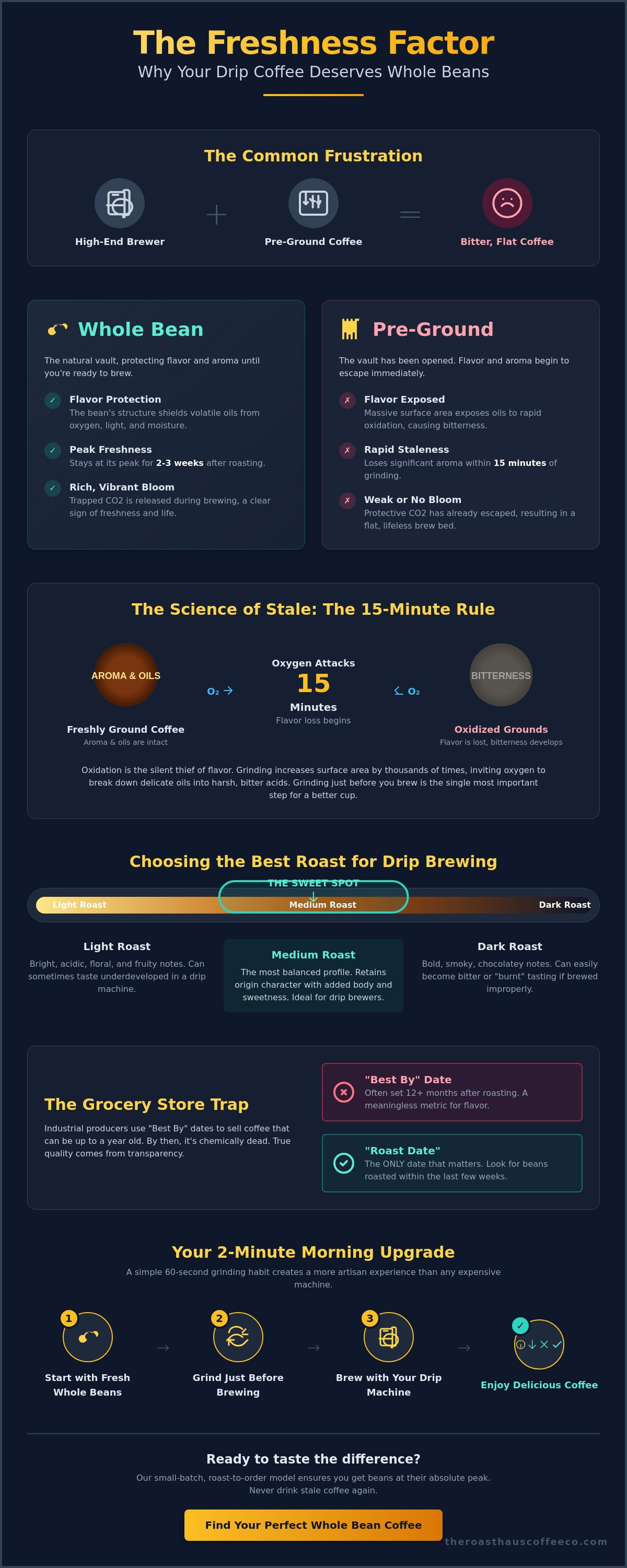
The 2-Minute Morning Upgrade: Grinding and Storage
Many coffee drinkers hesitate to switch to whole beans because they believe it adds too much time to their morning. In reality, it takes approximately 60 seconds to grind enough beans for a full 12-cup pot. This small investment of time is the bridge between a "basic" cup and an artisan experience. When you grind fresh, you release the aromatic compounds we discussed in the previous sections right before the water hits the filter. This ensures you are getting the most out of the best whole bean coffee for drip machine brewing. The ritual itself also provides a sensory boost. The smell of freshly crushed beans can improve your morning mood before you even take your first sip.
Your choice of equipment matters as much as your technique. When selecting a coffee grinder, always choose a burr grinder over a blade version. Blade grinders chop beans into uneven chunks and fine dust. This leads to an uneven extraction where some parts are bitter and others are sour. A burr grinder uses two revolving surfaces to crush the beans into a uniform size. For a drip machine, you want a consistency similar to coarse sea salt. This texture allows water to flow through the coffee bed at the perfect rate.
How to Grind for Drip Machines
Consistency is the secret to a balanced cup. If your coffee tastes too sharp or sour, your grind might be too coarse. If it tastes unpleasantly bitter or "muddy," you likely ground it too fine. Most automatic drip machines perform best with a medium setting. You should feel free to "dial in" your machine by making small adjustments to the grind size until the flavor is exactly where you want it. For a deeper look at the process, follow our guide on how to make coffee with precision. Proper grinding ensures that even a standard home brewer can produce professional results.
Storage Basics: Debunking the Freezer Myth
There is a persistent myth that the freezer is the best place for coffee. This is incorrect. Coffee beans are porous. They act like a sponge for moisture and kitchen smells. Moving beans in and out of the freezer creates condensation, which damages the cell walls of the bean and kills the flavor. To keep your best whole bean coffee for drip machine fresh for up to four weeks, follow the "Dark, Cool, Airtight" rule. Store your beans in a pantry away from the stove or windows. The original bag is often the best vessel if it has a one-way degassing valve. This valve lets CO2 out without letting oxygen in.
Ready to taste the difference that fresh roasting makes? Experience the integrity of our small-batch process by trying our Honduras Morning Splendeur today.
Freshness Starts at the Source: The Roast Haus Advantage
Freshness is not an accident. It is the result of a deliberate fulfillment model that prioritizes timing above everything else. Most people search for the best whole bean coffee for drip machine use by looking at brand names or fancy packaging. However, the most important information on any bag is the roast date. At The Roast Haus, we have built our entire philosophy around small-batch integrity. Industrial coffee producers roast thousands of pounds at a time and store them in warehouses for months. We roast to order. This means your beans aren't sitting on a shelf losing their soul; they are being prepared specifically for you.
Our sourcing reflects this commitment to excellence. We select beans that excel in a drip environment, such as the Kenya AA Supreme for those who want bold, bright flavors. We also offer Ethiopia Limu Organic for a more floral profile and the Honduras Morning Splendeur for a balanced daily cup. Every choice we make in sourcing is designed to ensure that the natural oils and sugars we discussed earlier are present when the coffee reaches your kitchen. By supporting an independent roaster, you are choosing quality over mass-market convenience.
The 24-Hour Roast-to-Ship Window
Our roastery in Oklahoma operates with a clear focus on speed and quality. Because we are an independent venture, we don't have the overhead of large corporations that forces them to roast in massive, inefficient cycles. We roast in small batches. This allows us to monitor the heat and timing for every single bean. The difference is tangible. When your coffee arrives, the roast date will be only a few days old. We ship your order within 24 hours of roasting to ensure you receive the beans at their absolute peak of flavor. This is the only way to guarantee you are getting the best whole bean coffee for drip machine brewing.
Never Run Out of Fresh Beans
Maintaining a fresh routine shouldn't be a struggle. A coffee subscription is the most practical way to ensure you never have to settle for stale grocery store bags again. You can customize your delivery frequency to match how much you brew each week. This model supports our mission as an independent business and keeps you connected to a community that values craftsmanship. You aren't just buying a product; you are supporting a fulfillment model that respects the integrity of the bean. It is a simple, sustainable way to upgrade your morning from basic to artisan without adding stress to your schedule.
Elevate Your Morning Ritual
Taste the difference of roasted-to-order whole beans from The Roast Haus Coffee Co. Our family-owned artisan roastery specializes in small-batch production. We source premium single-origin beans like our Kenya AA Supreme and Ethiopia Limu Organic to ensure every pot is exceptional. We promise to roast your order and ship it within 24 hours. This ensures your coffee arrives at its peak flavor profile. Your morning deserves the best. Start brewing with purpose today.
Frequently Asked Questions
Is whole bean coffee really better than ground for a drip machine?
Whole bean coffee is superior because the bean acts as a natural vault for the volatile oils that create flavor. Once coffee is ground, the surface area increases and oxidation accelerates, leading to a flat taste within minutes. Using the best whole bean coffee for drip machine brewing ensures you capture the peak aromatic profile that pre-ground bags lose during shipping and storage.
How long does whole bean coffee stay fresh compared to pre-ground?
Whole beans typically maintain their peak flavor for up to four weeks when stored correctly in a cool, dark place. In contrast, pre-ground coffee begins to lose its most delicate aromatic compounds within 15 minutes of being exposed to air. This longevity is why we prioritize a roast-to-order fulfillment model. It ensures your beans arrive at the start of their most flavorful window.
What is the best grind size for a standard automatic drip brewer?
You should aim for a medium grind that resembles coarse sea salt for most automatic drip brewers. If the grind is too fine, the water will flow too slowly and create a bitter, over-extracted cup. If it is too coarse, the water passes through too quickly, resulting in a sour or weak flavor. A consistent burr grinder is the best tool to achieve this specific texture.
Can I use a regular blender to grind my coffee beans?
You should avoid using a blender because it hacks the beans into inconsistent sizes. This results in a mix of fine dust and large chunks, which causes your drip machine to extract flavor unevenly. To get the best results from your beans, use a burr grinder. It provides the uniform particle size necessary for a balanced and smooth extraction that a blender simply cannot replicate.
Should I store my whole bean coffee in the freezer or fridge?
No, you should never store coffee in the freezer or fridge. Coffee beans are porous and will absorb moisture and odors from your refrigerator. The constant temperature changes also cause condensation to form inside the bag, which damages the delicate cell walls. For the best whole bean coffee for drip machine longevity, keep your beans in an airtight container in a dark, cool pantry.
Does freshly ground coffee have more caffeine than pre-ground?
The amount of caffeine in a coffee bean is determined by its botanical variety and the roasting process, not the timing of the grind. However, freshly ground coffee often feels more potent because the vibrant aromas provide a more intense sensory experience. While the chemical caffeine count is stable, the overall quality and impact of the flavor are significantly higher when you grind just before brewing.
How can I tell if my whole beans are actually fresh?
Fresh beans will have a specific roast date printed on the packaging rather than a generic expiration date. When you brew, look for the "bloom," which is the bubbling and swelling of the coffee grounds as they release carbon dioxide. This gas is a sign of recent roasting. If your beans look dull and smell like old paper or cardboard, they have likely passed their flavor peak.
What is the best roast level for a drip coffee maker?
A medium roast is the most reliable choice for most drip machines because it offers a balance of sweetness and body. Medium roasts are forgiving and maintain their integrity even if your machine's water temperature fluctuates slightly. While light roasts are popular for their acidity, they often require the precise temperature control found in high-end equipment to avoid tasting sour or under-extracted.

