


What if the reason your morning cup feels thin and weak isn't the quality of your beans, but the hidden math behind your water? It's incredibly frustrating to invest in a premium bag like our Kenya AA Supreme only to end up with a mug that lacks any real character. You are likely searching for how to make coffee taste less watery because you're tired of wasting expensive specialty coffee on a disappointing routine. We understand the frustration of following conflicting online advice while your coffee continues to lack that bold punch that stands up to milk.
We agree that a cup of coffee should be the highlight of your day, not a thin, translucent letdown. This guide will show you the exact adjustments to your ratio, grind size, and water quality needed to transform weak brews into a bold, full-bodied experience. You'll learn why the Specialty Coffee Association recommends a 1:18 ratio as a starting point and how moving toward a 1:16 ratio can create a thicker, syrupy mouthfeel. We'll walk through the practical steps to master your technique so you can finally brew with the confidence of a seasoned craftsman.
Key Takeaways
- Learn how to make coffee taste less watery by shifting from imprecise scoops to exact weight measurements for a consistent brew foundation.
- Identify why a finer grind size solves the under-extraction issues that leave your morning cup tasting thin and sour.
- Master the ideal water temperature range to ensure you are extracting the bold flavors and oils your artisan beans have to offer.
- Apply targeted techniques for drip and immersion brewing to ensure every ground is fully saturated and properly steeped for maximum body.
- Understand why fresh, small-batch roasts retain the essential lipids and gases that create a thick, syrupy mouthfeel.
Mastering the Golden Ratio: The Foundation of Bold Coffee
The most common reason for weak coffee is simply using too much water. Your brew ratio is the single most important factor in determining the strength and mouthfeel of your drink. If you want to know how to make coffee taste less watery, you must stop thinking in terms of "scoops" and start thinking in terms of weight. Coffee beans are organic products with varying densities. For example, a scoop of a dense bean like our Ethiopia Limu Organic might weigh significantly more than a scoop of a larger, less dense bean. Using a kitchen scale ensures that you are actually using the exact amount of coffee required to balance the water volume every single time.
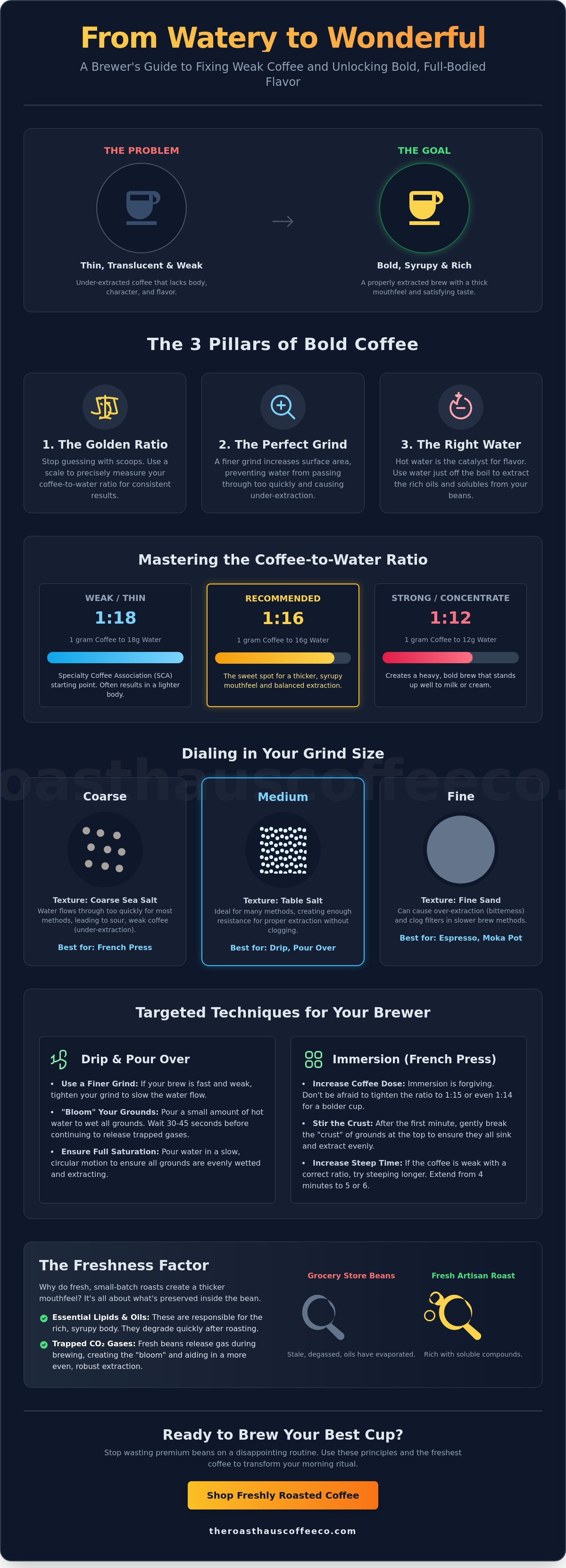
The specialty coffee industry often points to a "Golden Ratio" of 1:15 to 1:17 as the ideal starting point. This means for every 1 gram of coffee, you use 15 to 17 grams of water. If you find this still tastes a bit thin, you can tighten the ratio to suit your preference. A 1:12 ratio creates a heavy, bold concentrate that highlights the natural oils and sugars in the bean. This is particularly effective for those who enjoy adding milk or cream and want the coffee flavor to remain prominent. Understanding these key variables in coffee preparation allows you to manipulate the final result with artisan precision.
Why Your Current Ratio Is Failing You
Many home brewers try to stretch a small amount of coffee to fill a large carafe. This mistake leads to immediate over-dilution. When you run too much water through a small bed of grounds, you extract bitter, woody notes while thinning out the desirable oils that create a rich mouthfeel. It's a common myth that more water results in more caffeine. In reality, you're just washing the grounds out until the liquid becomes translucent and flavorless. If you want a larger pot of coffee, you must increase the weight of the coffee grounds proportionally to the water you add.
The Math-Free Way to Measure
If you aren't ready to use a scale, you can use a basic conversion to improve your results today. Aim for two level tablespoons of ground coffee for every six ounces of water. This is a rough approximation, but it's a much better starting point than guessing. For those who want to master their morning routine, we highly recommend a simple digital kitchen scale. It eliminates the guesswork and helps you replicate your best brews every single day without fail. You can find more details on refining your specific brewing technique in our ultimate guide to crafting the perfect cup at home. Consistent measuring is the first step toward a cup that is bold, earnest, and deeply satisfying.
Grind Size and Extraction: Why Coarse Isn’t Always Better
If your brew ratio is correct but the cup still lacks body, your grind size is likely the culprit. Grind size determines the surface area available for the water to work with during the brewing process. Think of it this way: water flows through a jar of large pebbles much faster than a jar of fine sand. When the particles are too large, the water cannot penetrate deep enough to pull out the essential oils and sugars. Under-extraction is the scientific reason for watery, sour tastes; it occurs when water passes through the grounds too quickly to pull out the necessary solids. Understanding how to make coffee taste less watery often comes down to creating the right amount of resistance in your filter.
Visualizing textures is helpful for the home brewer. A French Press requires a grind like coarse sea salt. A standard drip machine or pour over needs something closer to table salt. If you're using something that feels like coarse sand for a drip machine, you're inviting a watery result. While the effects of brewing temperature on extraction are significant, the physical size of the grind is your primary lever for controlling mouthfeel and strength.
Matching Grind to Your Brew Method
Each brewing tool requires a specific resistance to work correctly. French press needs a coarse grind because the grounds steep in water for several minutes. Pour over requires a medium-fine grind to create a controlled flow rate. If the grind is too coarse for your specific method, you risk "channeling." This is where water finds the path of least resistance and bypasses the coffee flavor entirely, leaving you with a weak, translucent liquid. You can learn more about choosing the right equipment in the ultimate guide to coffee grinders.
Signs Your Grind Is Too Coarse
Your palate will tell you the truth about your grind. If the coffee tastes sour, lacks a lingering finish, or has a thin mouthfeel, you've under-extracted the beans. Watch the water as it brews. If it rushes through the filter in a steady stream rather than a controlled drip, the particles are too large to hold the water back. Use the "One Click Finer" rule. Adjust your grinder one setting finer and brew again. This small change often provides the resistance needed to pull out the rich, syrupy notes found in our Honduras Morning Splendeur. This patient adjustment is the mark of a true craftsman who cares about the integrity of their morning cup.
Water Quality and Temperature: The Catalyst for Body
Since your brew is approximately 98% water, the quality of your source is just as important as the beans themselves. If you are struggling with how to make coffee taste less watery, you might be overlooking the solvent. Water acts as a vehicle for flavor. Poor water quality leads to poor extraction, regardless of whether you're using a premium Ethiopia Limu Organic or a standard blend. You should avoid using distilled water for brewing, as it lacks the essential minerals required to chemically bond with and "grab" the flavor compounds from your beans. Without these minerals, the water remains "empty" and fails to pull the necessary body from the grounds.
Temperature is the other half of this equation. Many people believe boiling water is the standard, but 212°F can actually scorch the delicate oils in the coffee. The sweet spot for extraction is between 195°F and 205°F. If your water is cooler than this, it simply won't have enough energy to break down the coffee's cellular structure. This results in a cup that tastes like "acidic water" rather than a rich, artisan beverage. Precision in temperature ensures that you are pulling out the full spectrum of flavor rather than just the surface-level acidity.
The Impact of Temperature on Oils
Heat is the catalyst that releases the lipids and oils that provide a thick mouthfeel. When water is too cold, it only extracts the most soluble acids, leaving the heavier, syrupy compounds behind. Many entry-level drip machines never reach the 195°F threshold, which is why their results often feel thin and uninspired. To combat this, try pre-heating your brewer or carafe with hot water before you start the cycle. This simple step prevents the equipment from stealing heat from the brewing water, keeping the temperature stable for a more robust extraction.
Filtered vs. Tap: A Quick Test
Tap water often contains chlorine and other treatments that mask the subtle, floral notes of high-quality beans. These chemicals create a flat profile that can make even a strong brew feel thin. Magnesium and calcium are actually beneficial in small amounts because they help pull out the earthy and bold flavors during the brewing process. If you want to see an immediate difference, use a basic charcoal water filter. This removes the harsh chemical taste without stripping away the minerals that give your coffee its necessary weight and character. We want you to taste the craft in every sip, and that starts with the water in your kettle.
Step-by-Step Fixes for Every Brewing Method
Fixing a weak cup requires a look at how your specific equipment handles the beans. You've already mastered the ratio and grind, but the way water interacts with those grounds can still make or break the body of your brew. Learning how to make coffee taste less watery involves more than just adding more grounds; it requires adjusting your technique to match your hardware. Whether you use a simple drip machine or a manual pour over, small mechanical adjustments can lead to a much thicker, more satisfying result.
For those using a standard drip machine, the first step is to inspect the shower head. If mineral deposits clog the holes, water only hits the center of the coffee bed. This leaves "dry spots" in the filter, meaning a large portion of your coffee is never actually brewed. If you prefer a manual pour over, try a slower pour rate. Increasing the contact time between the water and the coffee allows for a deeper extraction of the oils. If you use an Aeropress, switch to the inverted method. By brewing with the device upside down, you ensure the coffee is fully immersed in water until the moment you plunge, preventing any premature leakage that thins out the flavor.
The French Press "Deep Steep"
A common mistake with the French Press is rushing the process. While four minutes is the standard, we recommend a five-minute steep for a syrupy Kenya AA Supreme brew. During the first minute, a "crust" of grounds forms at the top. You must break this crust with a gentle stir to ensure every particle is fully submerged. Unlike drip methods that use paper filters, the metal mesh of a French Press allows all the natural oils to pass into your cup. These oils provide the heavy mouthfeel that makes a brew feel substantial rather than thin.
Troubleshooting the Drip Basket
If your machine seems to finish the cycle too quickly, it might be "short-cycling." This happens when water rushes through the basket without properly saturating the grounds. You can fix this with the "Stir" technique. Gently stir the slurry during the first thirty seconds of the brew cycle to break up any clumps. A clean machine also produces more vibrant coffee. Residual oils from old brews can go rancid and interfere with the extraction process, leaving you with a cup that feels lackluster. If you want to experience the true potential of your morning routine, explore our All Day Sampler to find the perfect profile for your favorite brewing method.
The Freshness Factor: Why Artisan Roasts Beat Grocery Store Beans
You can master the ratio and the water temperature, but you cannot fix a bean that has already lost its biological integrity. Freshness is the final variable that dictates the body of your brew. During the roasting process, coffee beans develop carbon dioxide. This gas is released during the brewing "bloom," creating a physical barrier that slows down the water and allows for a deeper, more robust extraction. If you want to know how to make coffee taste less watery, you must use beans that still have this gas trapped inside. Stale coffee tastes thin because its aromatic oils have evaporated, which causes the water to pass through the grounds without picking up the necessary weight or complexity.
Grocery store coffee often sits in warehouses or on shelves for months before it reaches your kitchen. Over time, the lipids that provide a creamy mouthfeel oxidize and break down. This is why mass-produced bags often yield a cup that feels like translucent water regardless of your technique. At The Roast Haus Coffee Co., we solve this by roasting in small quantities and shipping within 24 hours of production. This specific fulfillment model ensures that the oils and gases remain intact until the moment the beans hit your grinder.
Small Batch vs. Mass Produced
Artisan roasting focuses on protecting the delicate cellular structure of the coffee bean. High-volume industrial roasters often use extreme heat that damages these cells, leading to a flat and uninspired profile. Our small-batch method ensures that every roast retains the oils needed for a syrupy texture. You will notice a significant difference in mouthfeel when comparing a generic blend to our Kenya AA Supreme. To understand the science behind this process, read our post on what roasted-to-order coffee actually means.
The Roast Haus Coffee Co. Commitment
Our family-owned operation in Wyandotte, Oklahoma, is built on the values of independent business and artisanal quality. We take pride in our small-scale production because it allows for a level of precision that large corporations cannot match. We are passionate about helping you achieve the best possible experience with every brew we provide. Experience the difference with our Kenya AA Supreme and taste what true, honest freshness brings to your morning mug.
Master Your Morning Brew
You now have the technical tools to eliminate thin, disappointing coffee from your daily routine. By moving from imprecise scoops to exact weight measurements and adjusting your grind for better resistance, you have mastered the most critical steps in how to make coffee taste less watery. Remember that even the best technique cannot save a stale bean that has lost its essential oils. True body comes from the biological integrity of a fresh roast that still carries its natural gases and lipids.
At The Roast Haus Coffee Co., we have been dedicated to this level of craftsmanship since 2014. As a family-owned roastery in Wyandotte, Oklahoma, we use small-batch precision to ensure maximum oil retention in every bean. Every order is roasted-to-order and shipped within 24 hours to guarantee you receive the boldest flavor possible. It is time to treat your morning routine with the respect it deserves and enjoy a cup that truly stands up to milk.
Stop drinking watery coffee, order our small-batch Kenya AA Supreme today!
We are confident that these adjustments will lead to the most syrupy and satisfying cup you have ever brewed at home. Happy brewing.
Frequently Asked Questions
Can I just use more coffee grounds to make it taste less watery?
Yes, increasing the amount of grounds is the most direct way to improve strength. Most brewers find success by moving from a standard 1:18 ratio to a tighter 1:15 or 1:16 ratio. This ensures there are more soluble solids available for the water to extract during the cycle. However, you must also check your grind size. If the grounds are too coarse, adding more won't fix the thin mouthfeel because the water will still rush through too quickly.
Why does my coffee taste like water even though it is dark?
A dark color doesn't always equal a bold body. If your coffee looks dark but feels thin, you're likely dealing with stale beans or poor extraction. Freshly roasted beans contain lipids and gases that create a syrupy texture. When beans sit on grocery store shelves for months, these oils evaporate. This is why people often ask how to make coffee taste less watery even when using dark roasts that appear oily on the surface.
Does the type of water filter I use affect the body of my coffee?
Yes, your filter choice matters for more than just removing odors. A charcoal filter removes chlorine while leaving behind minerals like magnesium. These minerals are essential because they help pull the bold flavors and oils out of the grounds. Avoid using distilled water. It lacks the minerals needed for proper extraction, which often results in a cup that tastes flat and lacks any real physical weight on the tongue.
How long should I steep my coffee to avoid a thin taste?
For immersion methods like the French Press, you should steep for a full four to five minutes. The heaviest oils and sugars are among the last compounds to be extracted. If you plunge too soon, you're only getting the surface-level acidity. For drip coffee, you don't control the time directly; instead, you must use a finer grind to slow the water down. This increases contact time and builds the body you're looking for.
Is my coffee maker broken if the coffee comes out watery?
It is more likely a maintenance issue than a broken machine. Check if your shower head is distributing water evenly across the entire coffee bed. If the water only hits the center, you're leaving a lot of flavor in the dry grounds. Also, many home brewers don't reach the required 195°F for proper extraction. If the water is too cool, it can't melt the coffee's oils, leading to a lackluster and watery result.
Why do light roasts sometimes feel more "watery" than dark roasts?
Light roasts are denser and have a tighter cellular structure than dark roasts. This makes them harder for water to penetrate. If your light roast feels thin, it's often under-extracted. You can fix this by using a finer grind and hotter water, ideally around 205°F. This extra energy helps break down the bean and releases the complex, floral oils that give light roasts their unique character and weight.
What is the best coffee-to-water ratio for a bold cup?
We recommend a 1:15 ratio for a consistently bold cup. This provides enough coffee solids to create a rich mouthfeel without becoming overly bitter. Using a scale is a key step in how to make coffee taste less watery because it ensures your ratio is exact every time. Scoops are inconsistent because different beans have different densities, which can lead to a watery cup one day and a bitter one the next.
Can I re-brew coffee grounds to make the coffee stronger?
No, you should never re-brew used grounds. The first brew cycle already pulled out the best oils and flavors. A second pass only extracts bitter, woody compounds and harsh tannins that will ruin your cup. To get a stronger brew, simply use a fresh dose of high-quality beans and a tighter water ratio. Respecting the integrity of the bean means only brewing it once to capture its peak flavor profile.

