


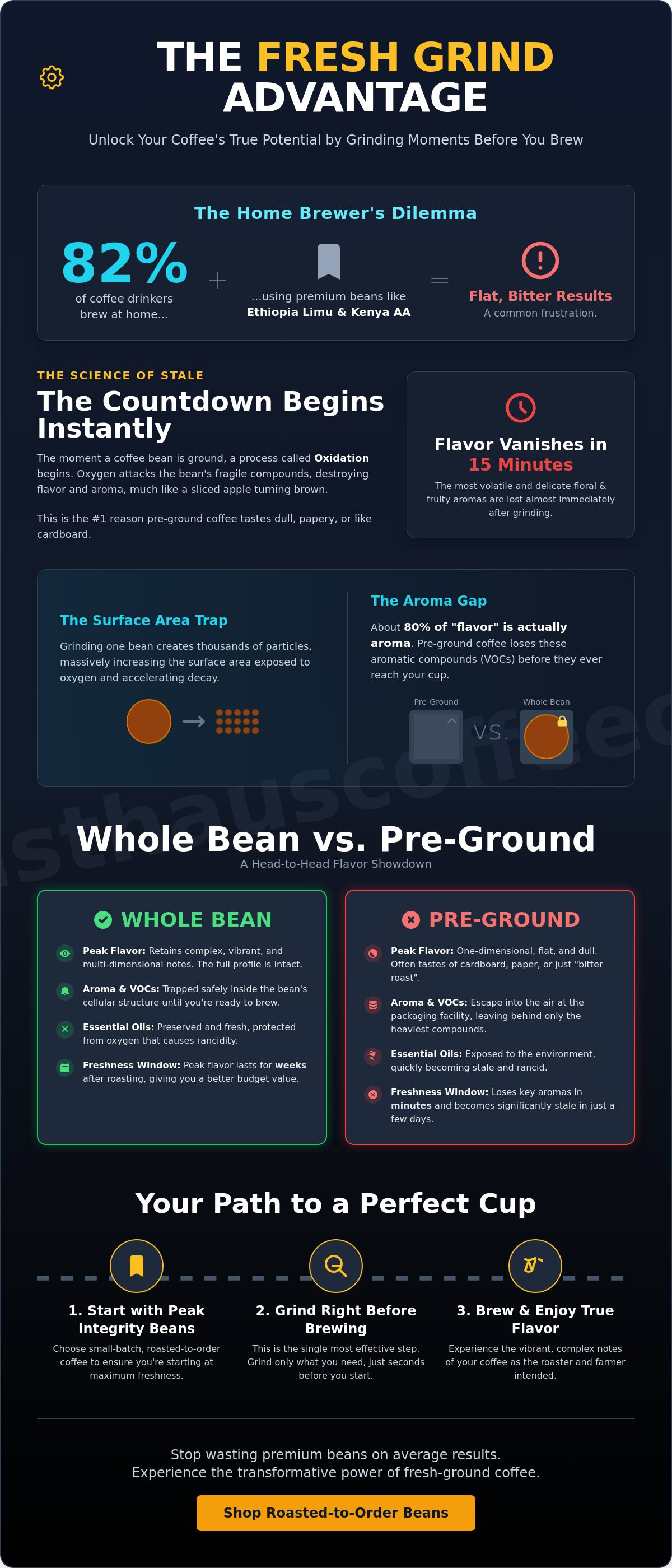
Recent data shows that 82% of coffee drinkers prepare their daily cup at home, yet many still settle for a brew that tastes flat or bitter. You might spend money on a premium bag of Ethiopia Limu Organic only to find the flavor doesn't live up to the craftsman quality you expected. It's a common frustration to feel like you're wasting high-quality beans on an average result. Learning why fresh ground coffee is better is the most important step you can take to fix your morning routine and enjoy the full profile of your roast.
We believe that you deserve a cup of coffee that reflects the hard work put into the harvest. This article will show you why grinding your own beans is the single most effective way to transform your coffee from average to artisan-quality. We'll explain the science of oxidation and how grind size impacts the flavor of your Kenya AA Supreme or Honduras Morning Splendeur. You'll gain the clarity you need to stop the confusion over equipment and start brewing with confidence.
Key Takeaways
- Stop flavor loss by understanding how oxidation and increased surface area destroy bean character within minutes of grinding.
- Discover the "Aroma Gap" and why preserving essential oils is the secret to achieving artisan-quality coffee at home.
- Learn why fresh ground coffee is better for your budget by extending the peak flavor life of your beans from days to weeks.
- Fix thin or watery results by identifying common equipment pitfalls that prevent a consistent and professional extraction.
- Understand how a roasted-to-order fulfillment model ensures you receive small-batch beans at their absolute peak of integrity.
The Science of Stale: Why Coffee Starts Dying the Moment It's Ground
Think about a fresh apple. When you slice it and leave it on the counter, the flesh quickly turns brown and the texture becomes soft. Coffee is no different. The moment you break the bean's structure, you start a countdown to staleness. This chemical reality is the main reason why fresh ground coffee is better than anything you can buy pre-packaged at a grocery store. Whole beans act as a natural protective vault for the flavors inside. Once that vault is cracked, the environment begins to reclaim the quality we worked so hard to roast into the bean.
The primary enemy of your morning cup is oxidation. This process begins the instant oxygen touches the internal compounds of the bean. Research suggests that the most volatile and delicate aromas vanish within just 15 minutes of grinding. If you are using pre-ground coffee that has sat in a bag for weeks, those vibrant floral or fruity notes are already gone. You aren't just losing flavor; you're losing the soul of the coffee. It's the difference between a live performance and a fuzzy, third-generation recording.
What is Coffee Oxidation?
Oxidation is a simple chemical reaction where oxygen molecules break down the organic compounds, lipids, and amino acids within the bean. This degradation is what creates that dull, "cardboard" or "papery" taste often associated with cheap, old coffee. When you buy high-quality coffee beans, you're paying for specific flavor profiles like the bright acidity of our Kenya AA Supreme. Oxidation mutes these characteristics. Factors like high humidity and direct sunlight accelerate this decay, turning a premium product into something flat and uninspiring in a matter of days.
The Surface Area Multiplier
The "Surface Area Trap" explains why ground coffee fails so much faster than whole beans. When you grind a single bean, you turn it into thousands of tiny particles. This increases the total surface area exposed to the air by thousands of times. Because of this, fine grinds used for espresso oxidize significantly faster than the coarse grinds used for a French press. This exposure is a critical part of the brewing process, but it's a disaster for long-term storage.
Degassing is the natural release of carbon dioxide from the bean that carries essential flavor oils into your water during extraction. When coffee is pre-ground, this gas escapes almost instantly. Without that CO2 "shield," oxygen moves in even faster to finish the job. If you want to experience the true integrity of a small-batch roast, you have to grind right before you brew. It's the only way to keep the science of staleness at bay and ensure your Ethiopia Limu Organic tastes exactly as the farmer intended.
Flavor Chemistry: Essential Oils, CO2, and the Aroma Gap
Smell isn't just a bonus. It is the foundation of your experience. Science shows that approximately 80% of what we perceive as flavor is actually aroma. When you understand the intricate coffee flavor chemistry involved, you realize that most of what we call "taste" happens in the nose, not on the tongue. This aroma gap is a primary reason why fresh ground coffee is better for anyone seeking an artisan experience. Once beans are ground, the aromatic compounds that provide character begin to dissipate into the air rather than into your cup.
Essential oils are the literal lifeblood of the coffee bean. These oils carry the unique flavor markers of the region where the coffee was grown. In a whole bean, these oils are tucked away safely. In a pre-ground bag, they are exposed to the environment. Over time, these oils don't just disappear; they become rancid. This chemical shift is why old coffee tastes stale or "off" rather than clean and vibrant. If you want to experience the true profile of your beans, you must keep these oils trapped inside the bean until the very last moment.
The Role of Volatile Organic Compounds (VOCs)
Volatile Organic Compounds, or VOCs, are the elements responsible for the fruity, floral, and nutty notes in your brew. They are called "volatile" because they evaporate easily at room temperature. When you grind a batch of Ethiopia Limu Organic, these compounds are released in a sudden burst. Pre-ground coffee often lacks these delicate notes, leaving behind only the heavy, one-dimensional flavors of "burnt" or "bitter" roast. Fresh grinding preserves these VOCs, ensuring they end up in your carafe instead of floating away in the warehouse where the coffee was packaged.
The Protective Power of Carbon Dioxide
During the roasting process, carbon dioxide (CO2) builds up inside the beans. This gas acts as a natural protective shield that keeps oxygen out. When you open a bag of freshly roasted whole beans, you might hear a faint "hiss" as the gas escapes. Grocery store bags are often silent because that protective gas is long gone. This CO2 is also responsible for the "bloom" you see when hot water first hits your grounds. Those rising bubbles are the visual proof of a better cup. The gas carries flavor oils directly to your taste buds, creating a depth of flavor that pre-ground coffee simply cannot match. To see this science in action, try brewing a fresh batch of our Kenya AA Supreme and watch the bloom for yourself.
Whole Bean vs. Pre-Ground: A Performance Comparison
The "Diner Coffee" effect is a real problem for home brewers. You might buy a bag of premium Ethiopia Limu Organic, but if it was ground weeks ago, it will taste exactly like generic, low-grade coffee. The distinct notes of citrus or jasmine disappear. You're left with a flat, bitter cup. This loss of origin character is a primary reason why fresh ground coffee is better for anyone who values quality. When you grind at home, you unlock the specific profile you paid for. If you don't, you're essentially paying specialty prices for a commodity experience.
Buying whole beans also improves your cost-to-value ratio. Many people hesitate to buy whole beans because of the extra step, but it actually reduces waste. When you buy pre-ground coffee, you're racing against a clock that's already halfway finished. You might end up throwing away the last third of the bag because it tastes like paper. Whole beans allow you to enjoy every gram at its peak, ensuring you get the full value of your investment.
The Shelf Life Reality Check
Whole beans stay at their peak flavor for four to six weeks when stored in a sealed, cool environment. In contrast, pre-ground coffee begins a rapid decline within 24 to 48 hours of opening the bag. The "best by" dates you see on grocery store shelves are often misleading. Those dates refer to food safety and shelf stability, not flavor integrity. A bag of coffee can be "safe" to drink for a year while being completely devoid of taste. To get the most out of our All Day Sampler, you need the protection that only a whole bean shell provides.
Customization: The Hidden Benefit of Whole Beans
One bag of beans can produce many different results. Pre-ground coffee is usually a medium "one size fits none" grind. This limits you. If you want to use a French Press, you need a coarse grind to avoid a muddy cup. If you prefer a pour-over, you need something finer. Having whole beans gives you total control over how to make coffee that fits your specific brewing equipment.
Consistency is the secret to a professional-grade cup. Science shows that grind size and water temperature are critical variables that impact reproducibility in your brew. When you grind your own beans, you can adjust these variables to suit your palate. If your cup tastes too sour, you grind a little finer next time. If it's too bitter, you go coarser. This level of precision is impossible with a pre-ground bag, which leaves you stuck with whatever the factory decided was "standard."
Mastering the Home Grind: Avoiding Pitfalls and 'Watery' Brews
Many beginners make the switch to whole beans and feel immediate disappointment. They expect a bold, artisan cup but end up with something thin and tea-like. This leads to a common question: if I'm doing everything right, why is my coffee watery? The answer usually lies in the mechanics of the grind rather than the beans themselves. We've already shown why fresh ground coffee is better for preserving oils and gases, but those elements only reach your cup if the extraction is handled correctly.
Blade vs. Burr: Why the Tool Matters
The most common pitfall is using a blade grinder. These machines don't actually grind; they chop. This creates an inconsistent mess of "boulders and dust." The tiny dust particles over-extract and become bitter. Meanwhile, the large boulders under-extract and contribute nothing but watery waste. A burr grinder uses two revolving abrasive surfaces to crush beans into a uniform size. This ensures every particle extracts at the same rate, resulting in a balanced cup of Honduras Morning Splendeur. We recommend starting with a manual or entry-level electric burr grinder to see an immediate difference in quality. You can learn more about choosing the right equipment in our guide to coffee grinders.
Troubleshooting Thin or Weak Coffee
If your coffee feels weak, you likely need to grind finer. Many people use a coarse setting intended for a French Press in a standard drip machine. This allows water to pass through the grounds too quickly. To fix a "sour" or thin taste, tighten your grind to increase the surface area and slow down the water flow. If your coffee is unpleasantly bitter, your grind is likely too fine. Water temperature also matters. If your water is too cool, it won't pull the flavors out of your fresh grounds, regardless of how well you've ground them.
Precision is key. Measuring by "scoops" or volume is unreliable because bean density varies between roasts. A scoop of our Decaf Swiss Water Process might weigh differently than a scoop of Ethiopia Limu Organic. Use a digital scale to measure by weight in grams. A standard starting ratio is 1 gram of coffee for every 16 or 17 grams of water. If you want a bolder experience, try a 1:15 ratio. If you're ready to put this into practice, pick up our All Day Sampler and find the perfect setting for your palate.
The Roast Haus Philosophy: Roasted-to-Order for Peak Integrity
The journey to a perfect cup begins long before you turn on your grinder. While we've discussed why fresh ground coffee is better for preserving volatile aromas, that freshness depends entirely on the state of the bean when it reaches your kitchen. Even the most skillful grinding can't bring back flavor that has already vanished in a corporate warehouse. We believe the roast date is just as critical as the grind date. Our philosophy centers on the idea that coffee is a fresh agricultural product, not a non-perishable commodity.
This commitment to agricultural integrity is a value shared by many food-focused initiatives; for instance, you can visit Hammer Ernte to see how they empower people to grow their own fresh vegetables on leased farmland.
Our fulfillment model is our ultimate differentiator. We don't keep inventory sitting on shelves for weeks or months. Instead, we focus on a direct connection between the roaster and the brewer. This ensures the integrity of the product remains intact from the moment the beans leave the cooling tray until they hit your mailbox. It's a level of service that large, impersonal corporations simply cannot provide.
From Our Haus to Yours: The 24-Hour Promise
We operate our family roastery in Wyandotte, Oklahoma. Our process is straightforward and earnest. We don't roast your beans until you place your order. Once the roast is complete, we ship within 24 hours. This 24-hour promise acts as your insurance against staleness. When you open a bag of our Kenya AA Supreme or Ethiopia Limu Organic, you'll smell the difference immediately. The beans are still packed with the protective CO2 and essential oils needed for a vibrant brew. You won't find this level of timing at a grocery store.
Supporting Small-Batch Craftsmanship
Small-batch roasting allows for a level of attention that mass production ignores. We monitor every temperature change and air-flow adjustment to ensure consistency in every bag. This is the heart of independent business values. We prioritize sensory excellence over high-volume distribution. Our sourcing is transparent, and our methods are grounded in a passion for the craft. We want you to have the best possible experience every single morning.
While we focus on the nuances of small-batch roasting, other sectors of the food industry utilize specialized technology like HummusMaster to bring professional-grade precision to large-scale production without sacrificing quality.
You deserve a coffee routine that reflects the hard work of the farmers and the roaster. Start your journey toward a better cup with a coffee subscription to guarantee you always have fresh beans on hand. If you aren't sure where to start, try our All Day Sampler. It's the easiest way to experience the difference that small-batch, roasted-to-order fulfillment makes in your daily brew.
Elevate Your Morning Ritual
You now understand the chemistry that defines a truly great cup. Grinding just before you brew is the only way to stop oxidation and keep those delicate flavor oils from vanishing. By choosing whole beans, you protect the carbon dioxide shield that creates a vibrant bloom and a clean, artisan finish. This simple change in your routine is the most effective way to see firsthand why fresh ground coffee is better than any mass-produced alternative.
At The Roast Haus, we take this science seriously. We are a family-owned and operated roastery based in Wyandotte, Oklahoma. Every bag we produce is small-batch and artisan-quality. We don't let beans sit on shelves; we ship within 24 hours of roasting to ensure you receive your coffee at the peak of its integrity. You've learned the science; now it's time to taste the results. Experience the difference of roasted-to-order beans: Shop The Roast Haus Sampler today. Your morning coffee is about to become the best part of your day.
Frequently Asked Questions
Is fresh ground coffee really worth the extra effort in the morning?
Yes, taking the extra sixty seconds to grind your beans is the most effective way to improve your brew. It preserves the delicate oils and aromas that define specialty coffee. While pre-ground coffee is convenient, it cannot match the artisan quality of a cup made from beans opened just seconds before brewing. This small change in your routine ensures you aren't wasting the potential of high-quality roasts.
How long does coffee stay fresh after it has been ground?
Coffee begins to lose its peak aromatic complexity within fifteen minutes of grinding. While the grounds remain safe to use for weeks, the volatile compounds that provide flavor dissipate almost immediately upon contact with oxygen. To experience why fresh ground coffee is better, you should only grind the exact amount you plan to brew right before you start your kettle or machine.
Why does my freshly ground coffee taste weaker than store-bought pre-ground?
This usually happens because your home grind is too coarse for your specific brewing equipment. Pre-ground coffee is often processed to a very fine, uniform size to ensure a bold extraction in standard machines. If your cup tastes thin or watery, try a finer setting on your burr grinder. This increases the surface area and allows the water to pull more flavor from the beans during the extraction process.
Can I use a blender if I don't have a coffee grinder?
You can use a blender as a temporary solution, but it will not produce a professional result. Blenders use high-speed blades that chop the beans into inconsistent sizes. This creates "boulders and dust," where the small particles over-extract and the large chunks under-extract. For a balanced cup of Ethiopia Limu Organic, a dedicated burr grinder is a much better investment for your kitchen.
What is the best way to store whole bean coffee to keep it fresh?
Keep your whole beans in an airtight, opaque container in a cool and dark location. Avoid storing your coffee in the refrigerator or freezer. The moisture and fluctuating temperatures in those environments can damage the bean structure and introduce unwanted odors. Proper storage ensures your Kenya AA Supreme stays at peak integrity for four to six weeks after the roast date.
Does freshly ground coffee have more caffeine than pre-ground?
No, the timing of the grind does not change the chemical caffeine content of the bean. Caffeine levels are determined by the coffee variety and the roasting process itself. However, because fresh grounds retain more essential oils and aromatic compounds, the sensory experience is much more intense. Many drinkers find that this increased flavor profile makes the coffee feel more potent and satisfying.
How do I know what grind size to use for my coffee maker?
Your grind size should match the amount of time the water stays in contact with the grounds. For a French Press, use a coarse grind that looks like sea salt. For a standard drip machine or a pour-over, a medium-fine grind similar to table salt is best. Understanding these settings is a key part of why fresh ground coffee is better for customizing your daily experience.
What is the 'bloom' in coffee and why does it only happen with fresh grounds?
The bloom is the rapid release of carbon dioxide gas that occurs when hot water first hits the grounds. This gas acts as a protective shield for the flavor oils inside the bean. Pre-ground coffee loses this gas shortly after it is processed at the factory. Seeing those bubbles rise is the visual proof that your coffee is fresh and still contains its full range of flavor.
