


Imagine opening a bag of coffee that was roasted specifically for you by a family who knows every farmer they work with. Most people settle for stale beans from a grocery store shelf that have been sitting in a distribution center for months. You likely feel like just another number to a massive corporation that hides its supply chain behind vague, corporate labels. You deserve better than a bitter, anonymous cup. Choosing coffee that supports family businesses isn't just a feel-good gesture; it's a strategic move for superior freshness and total supply chain integrity.
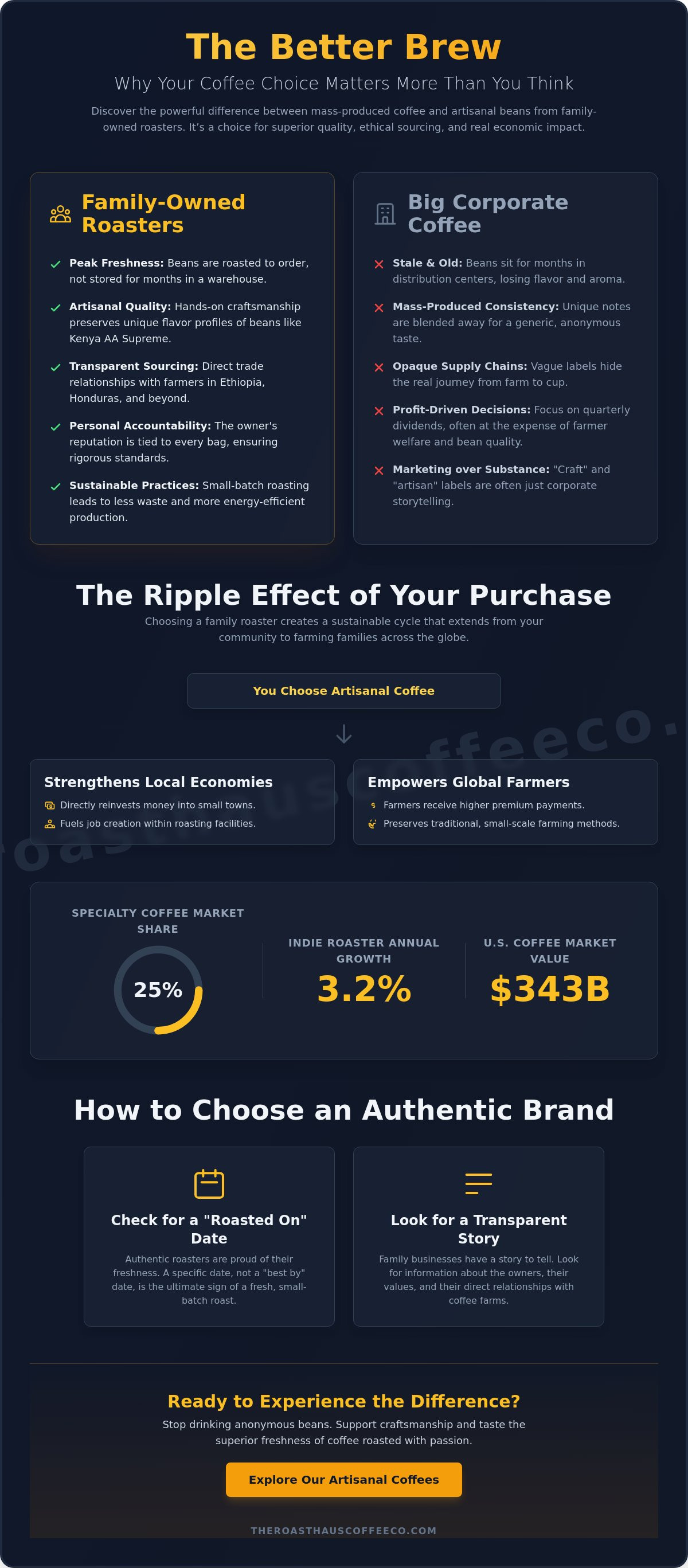
When you switch to independent roasters, you get a level of craftsmanship that big brands simply can't replicate. This article explains how your purchase directly fuels small-town economies and rewards the hard work of global farmers through transparent sourcing. You'll see why the "American Dream" is alive in the specialty coffee world, which now holds a 25% share of the U.S. market. We'll explore the tangible benefits of small-scale production, from the sensory excellence of a Kenya AA Supreme to the clean finish of a Decaf Swiss Water Process. It's time to stop drinking anonymous beans and start feeling a real connection to the people behind your brew.
Key Takeaways
- Shift your daily habits toward "intentional consumption" to ensure your coffee budget directly benefits global farmers through direct trade relationships.
- Learn to verify the authenticity of coffee that supports family businesses by checking for "Roasted On" dates and transparent ownership stories.
- Compare the superior freshness of small-batch, roast-to-order fulfillment against the stale, warehouse-stored beans typical of big-box retailers.
- Find out how a husband-and-wife team maintains rigorous quality standards through every step of the artisanal roasting process.
- Discover the tangible economic impact of supporting independent entrepreneurs who prioritize craftsmanship over corporate profit margins.
The Growing Movement Toward Coffee That Supports Family Businesses
Coffee that supports family businesses refers to beans sourced and roasted by independent, non-corporate entities. These are ventures where the owners are often the ones operating the roaster, tasting the batches, and packing the bags. In 2026, we are seeing a massive shift toward intentional consumption. Coffee drinkers are increasingly tired of anonymous, mass-produced products that prioritize volume over value. They want to support local artisans who care about the craft. This "flight to quality" is a response to the stale, warehouse-stored beans that dominate grocery store shelves.
A corporate brand might put a "craft" label on a bag, but that's usually just marketing storytelling. A family roastery is fundamentally different. These businesses prioritize long-term relationships with farmers and customers over meeting quarterly dividends for shareholders. They focus on the integrity of the product. This commitment ensures that every bag, from a vibrant Kenya AA Supreme to a smooth Decaf Swiss Water Process, meets a standard that big corporations simply cannot replicate at scale.
Why Independence Matters in the Coffee Industry
Independence gives a roaster the autonomy to make decisions based on quality rather than cost-cutting. They don't have to buy the cheapest beans available just to satisfy a board of directors. Instead, they can focus on direct trade and high ethical standards. This allows them to source specialty lots like Ethiopia Limu Organic that offer unique flavor profiles. Independent roasters preserve these distinct characteristics instead of blending them away for the sake of mass-market consistency.
The history of coffeehouses shows us that these spaces have always been centers for community and social exchange. Today, that community starts with the roaster. By choosing coffee that supports family businesses, you are choosing a product handled by people who value craftsmanship. These roasters have the flexibility to prioritize sensory excellence and nutritional integrity, ensuring you get the best possible experience in every cup.
The Economic Ripple Effect of Your Morning Cup
When you buy from a family-run business, your money stays in the local community. For a roastery based in a small town like Wyandotte, Oklahoma, this revenue supports local families and provides stable employment. Independent coffee shops and roasters are currently growing at a rate of 3.2% annually, proving that consumers value this personal connection. This economic stability helps small-town economies thrive in a market valued at $343 billion.
The impact travels all the way back to the origin countries. Family roasters often work with small-scale farms in regions like Honduras and Ethiopia. By paying fair prices for a Honduras Morning Splendeur, the roaster helps those farming families maintain their own land and traditions. This creates a sustainable cycle of support that includes:
- Direct reinvestment into local small-town infrastructure.
- Higher premiums paid to farmers for specialty-grade beans.
- Job creation within independent roasting facilities.
- Preservation of traditional, small-scale farming methods.
The Tangible Impact of Choosing a Family-Owned Coffee Roastery
Choosing coffee that supports family businesses creates a level of accountability that corporate giants cannot match. When a husband-and-wife team runs the roastery, their personal reputation is tied to every bag of beans. They don't answer to a board of directors or distant shareholders. They answer to you. This hands-on approach ensures that quality control happens at the cooling tray, not in a remote corporate laboratory. Smaller operations also naturally practice better environmental stewardship. Roasting in small batches leads to less waste and allows for more sustainable, energy-efficient production cycles that respect the land.
Accountability is the ultimate differentiator. If the owner's name is on the bag, the standards are higher. There is no hiding behind a generic corporate logo. Every batch of Honduras Morning Splendeur is a reflection of the roaster's commitment to excellence. By choosing coffee that supports family businesses, you ensure your morning routine contributes to a sustainable future for independent makers and their families.
From Farm to Family: Sourcing with Integrity
The journey of a great cup begins with sourcing high quality coffee beans directly from the people who grow them. Family-owned roasters often seek out "hidden gems" in regions like Kenya and Ethiopia that larger buyers overlook because they lack mass-market scalability. This isn't just about flavor. It's about global economic impact. In Colombia alone, there are more than half a million producers operating small family businesses. Small roasters establish direct trade relationships that often pay prices well above Fair Trade minimums. This transparency means you know exactly where your Ethiopia Limu Organic came from and who benefited from the sale.
Small-Batch Roasting: The Secret to Consistency
Precision is the hallmark of an artisan craftsman. While industrial roasters might process 500 lbs of beans at once, family roasteries typically work with 10 to 20 lbs. This small-scale approach allows the roaster to adjust for daily variables like humidity and bean density with extreme accuracy. It's a meticulous, step-by-step process that requires constant attention. Small batches allow for hitting exact flavor notes without the risk of scorching the beans, which is common in mass production. Roasting to order ensures the product doesn't sit in a warehouse for months before reaching your door. If you are ready to taste the difference of fresh beans, you can explore our current roast offerings. Every bag is tasted and verified by the owners to ensure it meets our strict integrity standards.
Family-Owned Roasters vs. Big Coffee: A Quality and Ethics Comparison
Choosing coffee that supports family businesses means choosing a different set of priorities. Big Coffee focuses on efficiency and mass-market appeal. Independent roasters focus on the integrity of the bean. Corporate brands often use marketing departments to manufacture a sense of "craft" through expensive ad campaigns. In contrast, family roasters rely on their reputation. You don't get a corporate chatbot when you have a question. You get a real person who knows the profile of every roast, from the bright notes of a Kenya AA Supreme to the rich finish of an Ethiopia Limu Organic.
Flexibility is another major advantage of the small-scale model. Large corporations need standardized products to fit their massive supply chains. Family businesses can pivot quickly to offer personalized experiences. This includes curated options like The All Day Sampler, which allows you to explore different origins without committing to a single large bag. These personal touches reflect a commitment to the customer that big-box brands cannot match.
The Freshness Gap: Roasted-to-Order Explained
The timeline of your coffee determines its flavor. Big Coffee is often roasted in massive quantities and stored in warehouses for 3 to 6 months before it reaches a grocery store shelf. By the time you buy it, the oils have turned and the flavor is flat. At The Roast Haus, we roast your coffee within 24 hours of fulfillment. This ensures you receive the beans at their absolute peak.
Science backs up this need for speed. Freshly roasted coffee undergoes CO2 degassing, a process where carbon dioxide is released from the beans. This degassing is essential for developing the full flavor profile. After a few weeks, the beans begin to oxidize. The "Roasted On" date is the most important metric you can find on a bag. If a bag only has a "Best By" date, it is likely months old. Buying fresh is the only way to experience the true sensory excellence of the craft.
Values-Based Business Models
How to Spot Authentic Family-Run Coffee Brands in 2026
Identifying authentic coffee that supports family businesses requires a critical eye. Many corporate entities now use "craft" labels to mimic the look of independent roasters. To find the real thing, start with the "About Us" page. An authentic family business will feature real names and photos of the owners. If the website only shows stock photos of generic coffee fields or uses vague corporate jargon, it's likely a subsidiary of a larger corporation. Families who take pride in their work want you to see the faces behind the roaster.
Look at the bag for a "Roasted On" date. This is the most reliable marker of an artisan operation. Big-box brands use "Best By" dates to hide the fact that their beans have sat in warehouses for months. A family-owned roastery typically roasts to order, ensuring you receive the product at its flavor peak. You should also check their social media. Authentic brands often share behind-the-scenes content of the actual roasting process. They show the cooling trays, the bagging, and the daily work that goes into every batch of Kenya AA Supreme or Ethiopia Limu Organic.
Customer reviews provide another layer of proof. Look for mentions of personal service and consistency. When you buy from a family, you aren't just a transaction. You're a member of their community. If reviewers mention speaking directly to the owners or receiving personalized recommendations, you've found a genuine independent venture.
Red Flags of 'Corporate Craft' Brands
Corporate mimics use specific tricks to gain your trust. Watch for these warning signs:
- Vague sourcing: Phrases like "sourced globally" or "the world's finest beans" without naming specific countries or farms.
- Hidden ownership: No mention of who actually owns or operates the company.
- Lack of batch numbers: Packaging that lacks specific roast dates or batch identifiers.
Questions to Ask Your Local Roaster
Don't be afraid to engage with a roaster directly. Ask about their roasting schedule. A dedicated craftsman roasts daily or specifically when an order is placed. Ask where they source their coffee beans. They should be able to tell you the specific regions and the farmers they support. Finally, ask how they impact their local community. Family businesses are usually involved in local events and support other small-scale entrepreneurs. If you are ready to support a real family operation, browse our selection of fresh-roasted artisan coffee today.
The Roast Haus Coffee Co.: A Family Legacy in Every Small Batch
The Roast Haus Coffee Co. is the result of a passion that started in a family kitchen back in 2014. What began as a personal hobby has grown into a dedicated commercial artisan operation in Wyandotte, Oklahoma. We are a husband-and-wife team. We don't have a corporate board or a marketing department. We have a roaster, a commitment to quality, and a desire to serve our customers the best beans possible. By choosing our beans, you are investing in coffee that supports family businesses and the independent values we stand for.
Our fulfillment model is built on one core principle: timing is everything. We don't roast beans to sit in a bin. Every bag is roasted to order. We ship your coffee within 24 hours of roasting. This ensures that when you open a bag of Ethiopia Limu Organic, you are getting the absolute peak of flavor. Personal accountability is baked into our process. If our name is on the package, we make sure the quality inside is unmatched.
Artisan Coffee with an Oklahoma Heart
We chose to build our business in Wyandotte because we believe in the strength of our local community. Staying here allows us to maintain a grounded, honest approach to our craft. Our small-batch process is the key to our consistency. We roast in tiny quantities to ensure the integrity of high-quality origins like our Kenya AA Supreme. This meticulous attention to detail is something a mass-market producer cannot offer. It requires a step-by-step focus on every cooling tray and every roast profile.
Every order is handled directly by our family. We pack the bags, print the labels, and verify the roast quality ourselves. This personal touch ensures that the sensory excellence we promise is delivered to your door every time. We are proud to be an independent venture that prioritizes craftsmanship over corporate expansion. When you buy from us, you're getting advice and products from trusted local experts who genuinely care about your experience.
Joining the Roast Haus Family
Supporting an independent roaster should be simple. We've designed our offerings to fit your daily routine without any extra hassle. Our coffee subscription makes it effortless to keep fresh beans in your pantry. You choose your favorite roasts, and we handle the rest. It's the easiest way to ensure you never have to settle for stale grocery store coffee again.
If you aren't sure where to start, our sampler packs are the perfect solution. The All Day Sampler allows you to taste the variety of our origins, from the bright notes of East Africa to the balanced body of Central American beans like our Honduras Morning Splendeur. You can also represent the independent spirit with our branded tees and drinkware. Start your day with a brew that matters. Choose coffee that supports family businesses and taste the difference that integrity makes. Shop our small-batch collection today.
Upgrade Your Morning with a Brew That Matters
Your morning cup is more than just a routine. It's a choice between corporate volume and artisan integrity. Choosing coffee that supports family businesses ensures your daily habit fuels local economies and rewards the craftsmanship of independent farmers. You move away from stale, warehouse-stored beans and toward a product defined by transparency and sensory excellence. The personal accountability of a family-run roastery ensures a level of quality control that big corporations simply can't match.
At The Roast Haus Coffee Co., we've been dedicated to small-batch artisan quality since 2014. We are family-owned and operated in Wyandotte, Oklahoma. Our commitment is simple: every bag is roasted to order and shipped within 24 hours. This guarantees you receive your beans at their absolute peak of flavor. Stop settling for anonymous, mass-produced coffee that lacks a story. Shop our family-roasted, small-batch coffee beans today and experience the difference that personal dedication makes. Let's make your daily brew something worth celebrating.
Frequently Asked Questions
Is coffee from family businesses always more expensive than grocery store brands?
You pay for quality and freshness rather than mass-market volume when choosing independent roasters. While grocery store coffee prices reached record highs in 2026, the value of artisan beans comes from their superior flavor and ethical sourcing. Family businesses prioritize the integrity of the product over corporate dividends. This means you get a higher grade of bean that hasn't lost its flavor sitting in a warehouse for months.
How do I know if a coffee brand is truly family-owned?
Authentic brands provide transparency through a clear "About Us" page featuring real names and photos of the owners. Look for specific details about their roasting facility and sourcing practices. Choosing coffee that supports family businesses requires looking past corporate "craft" labels. If a brand cannot name its owners or show you the actual roasting process, it is likely a subsidiary of a larger corporation.
Does family-owned coffee taste better than corporate coffee?
Small-batch roasting allows for much higher quality control and sensory excellence. Corporate coffee is often roasted in 500 lb batches and blended to achieve a generic consistency. Family roasters focus on preserving the unique flavor profiles of specific origins. This results in a cleaner, more vibrant cup that highlights the natural characteristics of the beans rather than a burnt, uniform taste.
What does 'roasted-to-order' mean for my coffee's flavor?
Roasted-to-order means your beans are processed only after you place your order. This is the ultimate differentiator for flavor because coffee begins to oxidize and lose its complexity shortly after roasting. By shipping within 24 hours of the roast, we ensure the delicate oils and aromatics are at their peak when they reach your kitchen. You get a cup that is full-bodied and aromatic instead of flat and bitter.
Can I get a coffee subscription from a small family business?
Most independent roasters offer flexible subscriptions to make supporting their craft effortless. You can set a schedule to receive fresh bags of Ethiopia Limu Organic or Honduras Morning Splendeur directly to your door. These services provide the convenience of a big brand while maintaining the personal connection of a local expert. It is a simple way to ensure you never run out of high-quality, fresh-roasted beans.
How does supporting a local roaster help coffee farmers abroad?
Supporting coffee that supports family businesses often means your money goes toward direct trade relationships. Independent roasters frequently pay premiums well above Fair Trade prices to secure the best beans. This direct support helps small family farms in countries like Kenya and Ethiopia invest in better equipment and sustainable practices. Your purchase creates a cycle of economic stability that benefits farming families across the globe.
Why is the 'Roasted On' date so important on a coffee bag?
The "Roasted On" date is the only way to verify the actual freshness of your coffee. Corporate brands use "Best By" dates to hide how long their product has been sitting on a shelf. Coffee is a perishable food item that peaks in flavor within the first few weeks after roasting. Knowing the exact date of production allows you to brew your coffee when the flavor profile is most vibrant and complex.
Do family-owned roasters offer decaf options?
Artisan roasters provide high-quality decaf options like the Decaf Swiss Water Process. This method uses only water, temperature, and time to remove caffeine without the use of harsh chemicals. It preserves the nutritional integrity and flavor of the original bean. You can enjoy a rich, flavorful cup of decaf that meets the same strict craftsmanship standards as any caffeinated specialty roast.

