


Most home baristas dump 25% of their premium, small-batch beans directly down the drain during the first seven days of a new roast. It’s a frustrating waste of artisan quality. You’ve likely felt the sting of a sour "sink shot" or felt overwhelmed by conflicting online advice regarding ratios and brew times. We believe that dialing in espresso at home shouldn’t feel like a guessing game. You deserve a consistent morning routine that honors the craft and freshness put into every roasted-to-order bag.
This guide provides a practical, taste-first workflow designed to help you master espresso extraction on any machine. We’ll show you how to diagnose flavor issues using your own palate rather than just staring at a timer. By the end of this article, you’ll have a repeatable four-step system to achieve cafe-quality results. You’ll stop wasting expensive beans and start enjoying the peak freshness and rich flavor potential in every single cup.
Key Takeaways
- Understand why "dialing in" is a mandatory skill for unlocking the full flavor potential of fresh, artisan coffee beans.
- Master the relationship between dose and yield to simplify the process of dialing in espresso at home on any machine.
- Learn a precise, step-by-step preparation routine that eliminates common errors like channeling and inconsistent measurements.
- Develop your palate to distinguish between under-extracted and over-extracted shots to troubleshoot flavor issues by taste.
- Discover how to maintain a perfect extraction as your coffee ages and environmental factors like humidity impact your grinder.
What Does "Dialing In" Espresso Actually Mean?
Dialing in is the technical process of adjusting your brewing variables to find the perfect balance of flavor. It involves changing your grind size, the amount of coffee used, and the total water output to reach a delicious result. While it might sound complicated, it's the most important skill for anyone dialing in espresso at home. You aren't just making coffee; you're calibrating your equipment to the unique physical properties of a specific roast.
A "set it and forget it" approach fails with artisan coffee because small-batch beans are dynamic. Unlike stale grocery store coffee that sits on a shelf for 180 days, fresh beans change daily. Bean density plays a massive role here. A light roast bean is dense and hard, requiring a finer grind to allow water to penetrate the cell structure. A dark roast is more porous and brittle, offering less water resistance. If you don't adjust for these physical differences, your espresso will either gush out too fast or choke the machine entirely.
The Role of Freshness and Roast Date
Roasted to order coffee requires a different strategy than commodity beans. When we ship coffee the same day it's roasted, it's packed with flavor but also contains high levels of carbon dioxide. Degassing is the release of CO2 that can cause bubbly shots if the coffee is too fresh. For the best results, wait 5 to 10 days after the roast date before you start the dialing-in process. This 5-day minimum ensures the gas won't interfere with water contact, leading to a much smoother extraction and better crema quality.
The Goal: Balancing the Extraction Spectrum
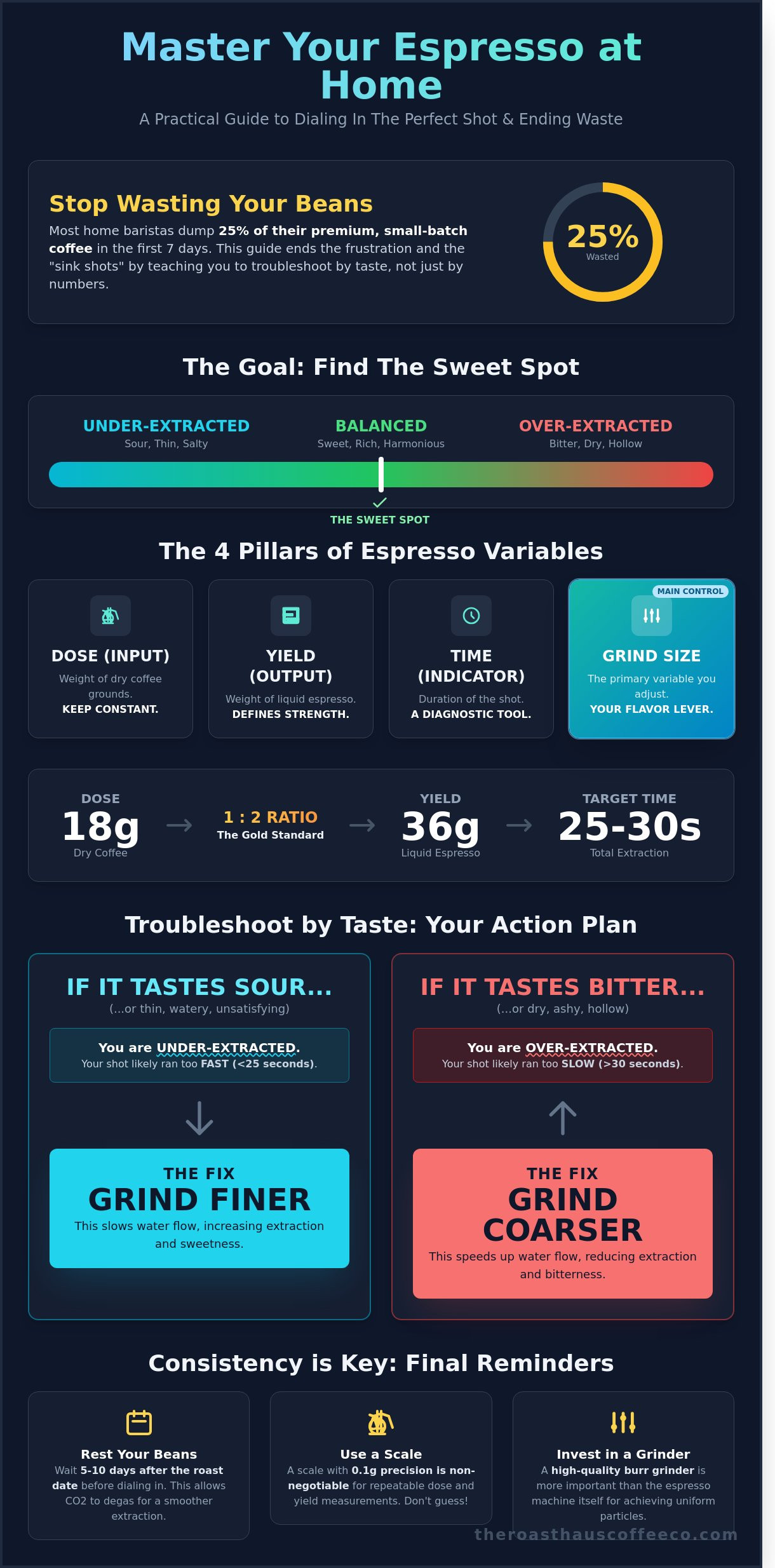
The objective is to land in the "Sweet Spot" of the extraction spectrum. If your grind is too coarse, the water rushes through, resulting in an under-extracted shot that tastes sour and thin. If the grind is too fine, the water stays in contact with the grounds too long. This causes over-extraction, which tastes bitter and leaves a dry feeling on your tongue. Finding the balance where sweetness and acidity harmonize is the ultimate goal. For a deeper look at the fundamentals of this drink, read our What Is Espresso? guide to build your foundation.
The Four Pillars of Espresso Variables
Consistency is the only way to master dialing in espresso at home. To get a repeatable, delicious result, you have to understand the four variables that dictate flavor. We treat these as a set of controls. If you change everything at once, you'll never know what actually fixed the shot. These pillars include:
- Dose: This is the weight of dry coffee grounds you put into your portafilter. We keep this constant to simplify the process.
- Yield: This is the total weight of the liquid espresso in your cup. It defines the concentration and balance of the shot.
- Time: The number of seconds the pump runs. It acts as your primary indicator of whether your grind size is correct.
- Grind Size: This is your main lever. You will adjust the texture of the grounds to speed up or slow down the water flow.
When you start with freshly roasted artisan beans, these variables become much easier to manage because the coffee reacts predictably to heat and pressure.
Setting Your Baseline Dose and Yield
Most modern home espresso baskets are designed for a double shot, which typically starts at 18 grams of dry coffee. You should stick to this number religiously while you're learning. We use a 1:2 ratio as the gold standard for traditional espresso. This means if you put 18 grams of coffee in, you want 36 grams of liquid espresso out. You must use a digital scale that measures to 0.1 grams for every single shot. Guessing by volume is inaccurate because the crema can vary based on the roast date.
Grind Size: Your Primary Flavor Lever
Grind size determines how much surface area the water touches. Finer grounds create more resistance, slowing the water down and increasing extraction. Coarser grounds let water pass through quickly. When you're dialing in espresso at home, your goal is a texture that feels like a cross between powdered sugar and fine table salt. It should clump slightly when pinched but still feel gritty. A high-quality coffee grinder is the most important tool in your kitchen. It's more critical than the espresso machine itself because it produces uniform particles. Inconsistent particles lead to "channeling," where water finds easy paths through the puck, resulting in a shot that is both sour and bitter at the same time.
The Step-by-Step Dialing-In Routine
Precision is the only way to achieve a perfect extraction. Start by wiping your portafilter basket with a dry microfiber cloth until it is completely clean. Any leftover moisture or old grounds will cause channeling, which ruins the flavor of our small-batch beans. Accuracy is your best tool when dialing in espresso at home. Use a digital scale to weigh your coffee dose to within 0.1 grams. If your recipe calls for 18.0 grams, ensure it hits that mark exactly. Small deviations in weight lead to massive changes in pressure and flow.
- Execute Puck Prep: Use a WDT tool or a distributor to break up clumps. An even coffee bed prevents the high-pressure water from finding weak spots in the puck.
- Synchronize Timing: Start your timer and the pump at the same time. This provides a consistent data point for every shot you pull.
- Hit Your Yield: Watch the scale under your cup. Stop the shot the moment you hit your target weight, usually 36 grams for a standard double shot.
- Change One Variable: Only adjust your grind or your dose. Never change both at once. If you do, you won't know which adjustment fixed the flavor.
The First Shot: Finding the Ballpark
Choose a middle-of-the-road grind setting to see how the water reacts. If the espresso gushes out in under 15 seconds, the grind is too coarse and needs to be finer. If the machine chokes and only produces a few dark drips, the grind is too fine. Remember that most home grinders retain 2 to 5 grams of coffee in the chute. This means your first shot often contains stale grounds from your last session. Purge a small amount of coffee first to ensure you are tasting the peak freshness of our roasted to order beans.
The Three-Shot Method to Perfection
Shot one focuses on the flow rate. You want to see 36 grams of espresso in roughly 25 to 30 seconds. If you hit that window, you are in the ballpark. Use shot two to fine-tune the balance between acidity and sweetness. If the coffee tastes sour or salty, grind one notch finer to increase extraction. If it tastes dry or bitter, go one notch coarser. Shot three is the final polish. You might keep the grind the same but pull the shot 2 grams longer to find the perfect sweet spot. This routine locks in a recipe that honors the artisan quality of the roast.
Troubleshooting by Taste: Fixed Your Shot
Your palate is the most important tool when dialing in espresso at home. You need to distinguish between a "bright" acidity that tastes like a crisp apple and a "sour" bite that makes you pucker like a lemon. Under-extracted coffee often feels thin or even salty on the tongue. Over-extracted shots leave a dry, ashy sensation in the back of your mouth, similar to drinking over-steeped black tea. These flavors tell you exactly how to adjust your grinder or your recipe.
The Salami Shot is a practical exercise for anyone dialing in espresso at home for the first time. Place three cups in a row. Pull your shot and switch cups every 10 seconds. The first cup will be thick, salty, and intensely sour. The second cup contains the sweetness and balance. The third cup is thin, watery, and bitter. Tasting these stages separately helps you identify which phase of the extraction is dominating your final cup.
If your shot tastes both sour and bitter, you likely have channeling. This occurs when water finds a weak point in the coffee puck and rushes through a small hole. Roughly 15% of your coffee grounds might be over-extracted while the rest remains under-extracted. This creates a confusing, muddy flavor profile that ruins the artisan quality of your beans. Focus on even tamping and better puck preparation to fix this issue.
Fixing Sour, Thin, or Salty Shots (Under-Extraction)
Sourness means the water didn't stay in contact with the coffee long enough to pull out the sugars. If your 18-gram dose finishes in 20 seconds, your grind is too coarse. Grind finer to slow the water flow and increase contact time. You can also increase your yield. Moving from a 1:2 ratio to a 1:2.2 ratio, such as 36 grams out to 40 grams out, gives the water more time to extract sweetness from the grounds.
Fixing Bitter, Dry, or Harsh Shots (Over-Extraction)
Bitterness occurs when you've dissolved heavy, harsh organic compounds. This usually happens when the grind is too fine or the water is too hot. If your shot takes 40 seconds to finish, grind coarser to speed up the flow. If your machine allows for temperature control, lower the brew temperature by 2 degrees. This reduces the extraction of those harsh, ashy flavors that mask the natural profile of the bean.
Consistency: Keeping the "Dial" Locked In
Dialing in espresso at home is a continuous process rather than a one-time task. Coffee beans are organic materials that change every single day. As a bag of beans ages, it loses carbon dioxide and internal moisture. This loss of pressure means the beans offer less resistance to water over time. You'll likely notice that a shot which flowed perfectly on Monday runs 5 seconds too fast by Friday. To compensate, you must adjust your grinder slightly finer as the weeks progress.
Environmental factors also shift your results. A 15 percent increase in kitchen humidity can cause coffee grounds to clump or swell, which slows down the flow of water. Similarly, temperature changes affect how grinder burrs expand and contract. Using freshly roasted coffee beans from Oklahoma makes these adjustments much easier to manage. Fresh beans have a predictable degassing curve and consistent density. Stale beans from a grocery store shelf have often sat for 180 days or more, losing the structural integrity needed to create a stable puck. This leads to erratic shots that are impossible to track.
The best way to stay consistent is to use a simple shot log. Record three specific variables for every session:
- Dose: The exact weight of dry grounds (e.g., 18.0 grams).
- Yield: The weight of the liquid espresso in the cup (e.g., 36.0 grams).
- Time: How many seconds the pump ran (e.g., 27 seconds).
The Importance of Puck Prep Consistency
Uneven tamping ruins even the most precise grind setting. If your tamp is slanted, water follows the path of least resistance, which causes side-channeling and a hollow, sour taste. Use the vertical tamp rule: keep your elbow high and your forearm perpendicular to the portafilter to ensure the puck is perfectly level. Puck prep is the foundation that allows your grind adjustments to be meaningful.
Maintaining Your Gear for Better Flavor
Dirty equipment produces bitter flavors that no amount of dialing in can fix. Coffee oils turn rancid quickly when exposed to heat. Backflush your group head with a dedicated cleaner every 25 to 30 shots to remove buildup. You should also purge your grinder for 2 seconds whenever you change the setting. Most home grinders retain 1.0 to 2.0 grams of coffee in the chute. If you don't purge, your next shot will be a mix of two different grind sizes, giving you inaccurate results.
Subscribe to The Roast Haus for a steady supply of beans that make dialing in a joy, not a chore.
Master Your Morning Shot
Mastering the art of dialing in espresso at home comes down to controlling your variables. You've learned how to balance dose, yield, and time to hit that 25 to 30 second extraction window. By making one small adjustment at a time, you eliminate the guesswork and find the peak flavor potential of every bean. Consistency is your best tool for better coffee; once you lock in your grind size, your shots will taste professional every single day.
Great espresso starts with the bean. At The Roast Haus Coffee Co., we are a family-owned artisan roastery based in Oklahoma. We focus on small-batch quality because we believe freshness is non-negotiable. Every bag is Roasted To Order and shipped within 24 hours of roasting to ensure you receive your coffee at its absolute peak. Don't settle for grocery store beans that have been oxidizing on a shelf for 90 days or more. Shop our Roasted-to-Order Espresso Selection and taste the difference that 100% fresh beans make in your portafilter. Your journey to the perfect shot is just beginning, so keep practicing and enjoy every sip of your progress.
Frequently Asked Questions
Why does my espresso taste sour even though it took 30 seconds to pull?
Your espresso tastes sour because the water temperature is too low or the water is channeling through the coffee puck. Even if you hit a 30 second window, channeling prevents the water from extracting flavors evenly across the grounds. Check your group head temperature to ensure it reaches 200 degrees Fahrenheit. If your temperature is correct, use a distribution tool to ensure the coffee bed is level before tamping.
How often do I need to dial in my espresso machine?
You should perform the process of dialing in espresso at home every time you open a new bag or every 48 hours as the beans age. Coffee beans lose CO2 as they sit, which changes how they resist water flow. A 1 percent change in room humidity can also shift your shot time by 3 seconds. Consistency is vital for maintaining the flavor profile of our roasted to order beans.
Can I dial in espresso without a coffee scale?
No, you cannot accurately master dialing in espresso at home without a digital scale that measures to 0.1 grams. Volume is an unreliable metric because the crema on a fresh roast can occupy 40 percent of the glass while containing very little liquid. Using a scale ensures you hit your 1:2 ratio every time. This precision is the only way to replicate a professional shot in your own kitchen.
Does the type of water I use affect dialing in espresso?
Water quality impacts your results because coffee is 98 percent water. Ideal brewing water contains 150 parts per million of total dissolved solids. If your water is too soft, the espresso will taste sharp and acidic. If it is too hard, you will lose the delicate floral notes. Use filtered water or a specific mineral packet to keep your equipment safe and your flavors clean.
Should I change the dose or the grind size first?
You should always change your grind size first while keeping your dose locked at a specific weight like 18 grams. Changing two variables at once makes it impossible to know which adjustment fixed the flavor. Start with your target dose and only move the grinder collar one notch at a time. This methodical approach is the fastest way to achieve the perfect flow rate without wasting your fresh coffee.
What is the "Golden Rule" for espresso brew time?
The Golden Rule states that a standard double shot should take 25 to 30 seconds to produce twice the weight of the dry grounds. If you start with 18 grams of coffee, you want 36 grams of liquid espresso in that timeframe. While this is a starting point, some light roasts taste better at 35 seconds. Use this 5 second window as your baseline before you begin fine tuning.
Why does my first shot of the morning always taste different than the second?
Your first shot tastes different because your machine hasn't reached thermal equilibrium and the grinder contains 5 grams of stale coffee from the day before. Metal components in the group head need 20 minutes to heat up fully. Always purge your grinder with 5 grams of fresh beans and pull a sink shot to warm the portafilter. This ensures your actual drink uses only the freshest grounds.

