


You are likely wasting up to 30% of the flavor potential in your specialty beans simply by guessing the best grind size for pour over. It's a common frustration for home brewers who invest in our small-batch, roasted-to-order coffee only to face inconsistent results. You know that the difference between a sour cup and a perfect one is often just a few clicks on your grinder, yet terms like medium-coarse remain confusing and imprecise. We believe that every bag of artisan coffee deserves a perfect extraction.
We created this master guide for 2026 to help you unlock the rich flavors in every bean without the guesswork. You'll learn the exact settings for your specific device and gain a simple framework to troubleshoot a bad cup in under 60 seconds. We're moving past vague descriptions to give you a set and forget understanding of extraction. This ensures every bag of coffee we ship delivers its peak aroma and taste directly to your kitchen.
Key Takeaways
- Understand how grind size acts as a speed limit for water flow to ensure a balanced, artisan-quality extraction every time.
- Learn to identify the best grind size for pour over through simple tactile testing to achieve a consistent medium-coarse texture.
- Adjust your grinder settings based on your specific device to account for the unique filter thicknesses and shapes of the V60, Chemex, and Kalita.
- Master the "one variable" rule to troubleshoot your brew by taste and eliminate hollow or under-extracted flavors.
- Discover why roasted-to-order coffee behaves differently during the bloom and how to manage degassing for peak flavor potential.
Why Grind Size is the Secret to Pour Over Success
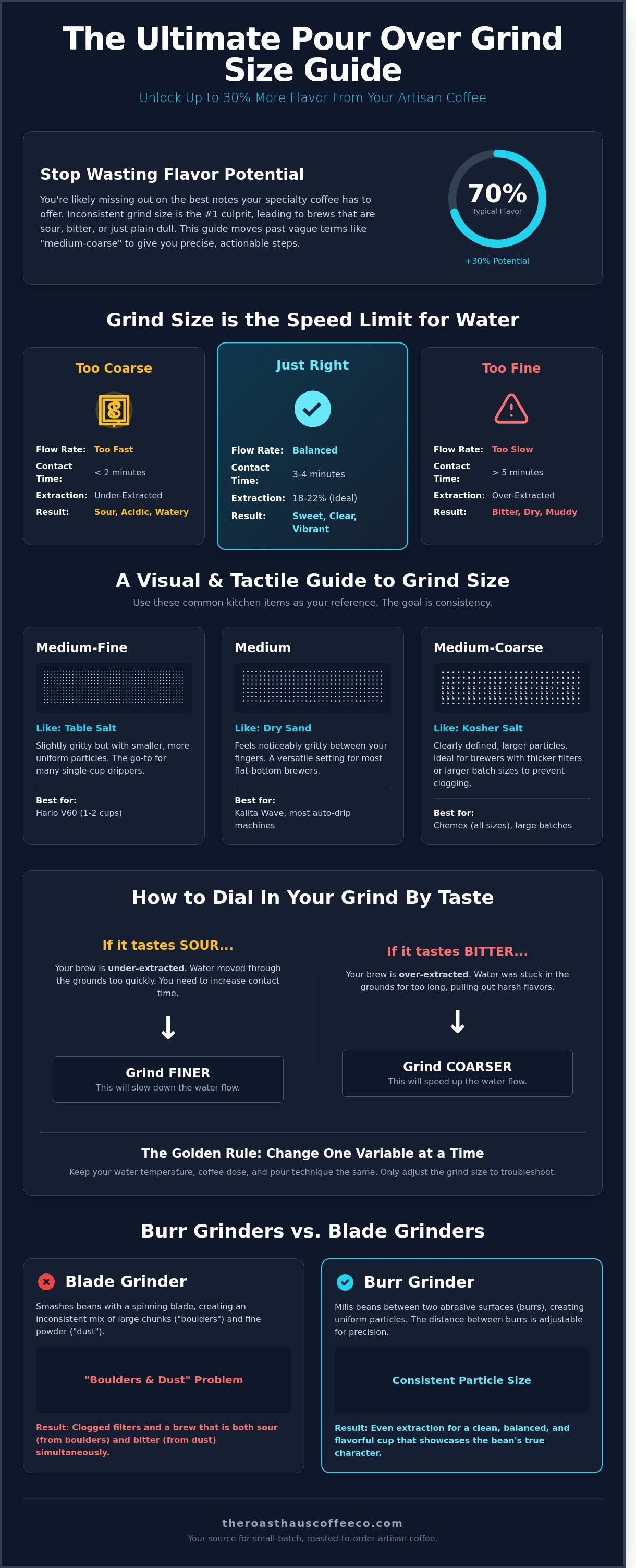
Finding the best grind size for pour over is the most important step you can take to improve your morning cup. At Roast Haus Coffee Co., we focus on roasting our beans to order so you get peak freshness, but even our best artisan roasts can taste dull if the grind size is wrong. Grind size acts as the primary speed limit for water moving through the coffee bed. If the particles are too large, water rushes through without picking up enough flavor. If they are too small, the water stalls, leading to a cup that tastes burnt or muddy.
The science behind this comes down to surface area. Smaller particles increase the total surface area exposed to water, which accelerates the extraction of oils, acids, and sugars. In the world of drip coffee and manual brewing, precision is everything. Unlike a French Press where the coffee sits in water for minutes, or espresso which uses high pressure, pour over relies on gravity. This makes it more sensitive to grind adjustments. A change as small as 100 microns can be the difference between a flat cup and one that showcases the vibrant notes of a fresh small-batch roast.
Understanding Extraction: Sour vs. Bitter
Extraction is the process of pulling flavor out of the bean. Professional baristas aim for a specific sweet spot, typically an extraction yield between 18% and 22% of the coffee's total weight. If your grind is too coarse, you end up with under-extracted coffee. This results in a thin, watery body and a sharp, sour acidity that lacks sweetness. Conversely, grinding too fine leads to over-extraction. This pulls out heavy, dry, and ashy flavors that mask the natural character of the bean. We want you to taste the specific profile of our family-owned roasts, not just the bitterness of a stalled brew.
The Role of Contact Time in Manual Brewing
Gravity works with your grind size to control the brew window. For most pour over drippers, the industry standard for a balanced brew is between 3 and 4 minutes. If your water drains in 2 minutes, the grind is too coarse for the best grind size for pour over results. If it takes 5 minutes, you need to coarsen your settings. Contact time is the duration water spends interacting with coffee solids. Controlling this interaction ensures you hit the peak flavor potential of our fresh-roasted beans without the grit or bitterness found in poorly prepared coffee.
- Coarse Grinds: Fast flow, low extraction, sour taste.
- Medium Grinds: Balanced flow, 18-22% yield, sweet and clear flavor.
- Fine Grinds: Slow flow, high extraction, bitter and dry finish.
Visualizing the Best Grind Size for Pour Over
Finding the best grind size for pour over isn't just about following a number on a dial. Every grinder is calibrated differently. You must use your eyes and fingers to judge the results before you ever pour water. High-quality coffee beans deserve a precise surface area to release their flavor properly. If the grounds are too big, the water rushes through without picking up the oils. If they're too small, the water gets stuck and the coffee tastes like ash.
Rub a small amount of grounds between your thumb and forefinger. It should feel gritty, like a dry exfoliating scrub. Consistency is the most important factor here. If you see massive chunks mixed with fine powder, your brew will taste both sour and bitter at the same time. This happens because coffee extraction occurs at different rates for different particle sizes. Smaller particles over-extract quickly, while larger chunks stay under-extracted. A 2024 analysis of brewing dynamics showed that even a 15% variance in particle size can noticeably muddy the flavor profile of a light roast.
The Kitchen Analogy: Salt, Sand, and Sugar
- Medium-Fine: This looks like standard table salt. It's the go-to setting for a single-cup V60 brew using 15 to 22 grams of coffee.
- Medium: This feels like dry beach sand. It serves as the "all-rounder" setting for most flat-bottom drippers like the Kalita Wave.
- Medium-Coarse: This resembles Kosher salt or rough cornmeal. It's ideal for a 6-cup or 8-cup Chemex. The thicker paper filters on a Chemex require this larger size to prevent the water from stalling during the final three minutes of the brew.
Why Blade Grinders Fail at Pour Over
Blade grinders don't actually grind coffee; they smash it. They create a "boulder and dust" problem that ruins the clarity of your cup. The dust, or "fines," clogs the pores of your paper filter. This causes the water to sit on top of the grounds for too long, leading to a bitter, over-extracted mess. A quality burr grinder ensures every particle is roughly the same size. For a deeper look at the equipment that makes this possible, see The Ultimate Guide to Coffee Grinders.
Fines are the enemy of a clean pour over. When your filter clogs, the draw-down time can increase by over 80 seconds, which pulls harsh tannins out of the bean. Our family-owned business focuses on small-batch roasting to ensure every bean arrives at your door at peak freshness, making them easier to grind consistently. You can shop our fresh-roasted collections to start your morning with better clarity and honest flavor.
Device-Specific Settings: V60, Chemex, and Kalita
The brewer you choose dictates the best grind size for pour over coffee because of two main factors: geometry and filter density. A conical brewer concentrates water through a deep bed of grounds, while a flat-bottom brewer spreads water across a wider surface area. These physical differences mean you cannot use a "one size fits all" setting for every device in your kitchen. If you switch from a paper filter to a metal mesh filter, you must coarsen your grind by at least 2 notches on a professional burr grinder. Metal filters have larger pores that allow more sediment through, so a coarser grind prevents a gritty, muddy mouthfeel.
Batch size also forces a change in your settings. When you move from a 300ml single cup to a 600ml double batch, the water stays in contact with the coffee for a longer period. To keep your total brew time under 4 minutes, you should coarsen your grind. This adjustment prevents the bottom layer of coffee from over-extracting while the rest of the water finishes draining.
The Hario V60: Precision and Speed
The V60 features a 60 degree angle and large exit hole that allows for rapid drainage. Because the water moves so quickly, you need a finer "medium" grind, similar to the texture of table salt. This increased surface area ensures the water extracts enough flavor during its short trip through the brewer. If your total draw down time is less than 2 minutes and 30 seconds for a standard 15 gram dose, your grind is likely too coarse. You can master these variables by following our ultimate guide to crafting the perfect cup.
The Chemex: Handling the Heavy Filter
Chemex filters are 20% to 30% thicker than standard coffee filters. This heavy paper removes almost all oils and fine particles, resulting in a very clean cup. However, this density also slows water flow significantly. To prevent the brew from stalling during the final 20% of the pour, you must use a medium-coarse setting. Aim for a texture like coarse sea salt. This prevents the "muddy" bed that traps water and leads to the bitter, dry flavors associated with over-extraction.
The Kalita Wave: Consistency through Flat Bottoms
The Kalita Wave uses a flat-bottom design with three small exit holes. These holes create a built-in restriction that regulates flow, making it more forgiving than the V60. A consistent medium grind is the sweet spot for this brewer. It provides enough resistance to develop sweetness without clogging the small drainage points. This stability makes it the ideal choice for highlighting the vibrant, wine-like acidity found in our Kenya AA Supreme. If your Kalita brew tastes sour or thin, tighten the grind by 1 notch to increase extraction time.
How to 'Dial In' Your Grind by Taste
Finding the best grind size for pour over is a process of elimination. You must follow the 'One Variable at a Time' rule to achieve professional results at home. If your coffee doesn't taste right, only change your grind setting for the next brew. Changing your water temperature and your grind size simultaneously makes it impossible to identify which adjustment actually improved the flavor. We recommend keeping a simple brew log on your counter. Data from a 2023 industry survey suggests that home brewers who track their variables see a 40% increase in cup consistency within the first 30 days.
Under-extraction happens when water passes through the coffee too quickly. This results in a 'hollow' or thin taste that lacks the natural sweetness of a well-roasted bean. It might even taste unpleasantly sour or salty. If your coffee lacks body, your grind is likely too coarse. Over-extraction is the opposite. This occurs when the water stays in contact with the coffee for too long, pulling out bitter tannins. You'll recognize this by an astringent finish that feels like sandpaper on your tongue. It's a dry sensation that lingers long after the sip is gone.
The Troubleshooting Flowchart
Use your palate as your primary compass. If the cup tastes sour or sharp, grind finer for your next session. This slows the water flow and extracts more sweetness. If the cup tastes bitter or smoky, grind coarser. You should only adjust water temperature if you're already within the 3.0 to 4.0 minute total brew time range but still want more clarity. Keep your water between 195°F and 205°F for our small-batch roasts to ensure you don't scald the delicate oils.
The 'Muddy Bed' Indicator
The appearance of your spent grounds provides immediate visual feedback. A perfect bed is flat and slightly sparkling, resembling wet beach sand. If the bed looks like thick mud or sludge, your grind is too fine. This often leads to 'channeling,' where water carves a single path through the coffee instead of saturating it evenly. Look for small holes or craters in the grounds after the water has drained. These indicate that the water bypassed the flavor, leaving you with a cup that is simultaneously sour and bitter. Finding the best grind size for pour over ensures the water moves through the entire coffee bed at a uniform pace.
Experience the flavor potential of beans that haven't sat on a shelf for months. Shop our Roasted To Order coffee beans and taste the difference of peak freshness.
Freshness and Grind: The Roast Haus Advantage
Freshness isn't just a marketing buzzword; it's a physical variable in your extraction process. When you use roasted-to-order beans, they behave differently in your grinder than stale, mass-produced options found on grocery shelves. Roast Haus beans arrive at your door with their internal cellular structure intact and their natural oils preserved. This high level of quality requires a specific approach to find the best grind size for pour over success.
Our small-batch artisan roasting process ensures more consistent bean density across every bag. We monitor heat transfer precisely so that every bean reaches the same level of development. This consistency means you won't deal with "fines" or "boulders" caused by unevenly roasted, brittle beans. You get a uniform grind that leads to a clean, transparent cup of coffee every single morning.
The Impact of Freshness on Extraction
Ultra-fresh beans are packed with carbon dioxide. When hot water hits these grounds, the CO2 escapes rapidly, creating a vigorous bloom. This gas can actually push water away, preventing it from saturating the coffee particles. If your beans were roasted within the last 48 hours, you'll often need to use a slightly coarser grind to allow the water to pass through this gas barrier. The Roast Haus commitment is simple: we ship your coffee within 24 hours of roasting so you can experience this peak freshness.
- 1 Week Post-Roast: This is the sweet spot for most brewers. Beans are stable and degassing is controlled. Use your standard medium-fine setting.
- 4 Weeks Post-Roast: The coffee has lost significant gas and moisture. You'll need to grind roughly 5% to 8% finer to prevent the water from rushing through the now-porous grounds too quickly.
Matching Roast Level to Grind Size
The physical density of the bean changes based on the time it spends in our roaster. Light roasts are dense, heavy, and organic. They require a finer grind and higher water temperatures to unlock their complex acidity and sweetness. Dark roasts stay in the roaster longer, making them more porous and brittle. They shatter easily in a grinder and extract very quickly. To avoid a bitter or ashy taste with dark roasts, you should always move your grinder to a coarser setting.
If you're still learning how to dial in the best grind size for pour over, practicing with different roast profiles is the fastest way to sharpen your skills. Our The All Day Sampler provides a range of roasts to help you see these physical differences firsthand. We're a family-owned business that values the craft of the roast above all else. When you choose Roast Haus, you're getting honest advice and the freshest beans available for your home brewing setup.
Master Your Morning Brew Today
Finding the best grind size for pour over isn't just about following a chart; it's about how the water moves through your specific brewer. A V60 performs best with a medium-fine texture like table salt, while a Chemex requires a coarser, sea salt consistency. If your coffee tastes too bitter, coarsen the grind by one notch. If it's sour, go finer. Since 2014, our family-owned shop has helped thousands of home brewers perfect these variables. We roast every small batch in Wyandotte, OK, to ensure you start with the highest quality beans possible. Our process focuses on the artisan details that large corporations often ignore.
We ship every order within 24 hours of roasting because stale beans won't hold a consistent grind or release the right gasses during the bloom. You've learned the mechanics, so now it's time to taste the difference that peak freshness makes. Experience the Peak of Freshness; Shop Our Roasted-to-Order Beans Now. Your journey to a better cup starts with the right beans and the right technique. You've got this.
Frequently Asked Questions
Is a medium or coarse grind better for pour over?
A medium-coarse grind is the best grind size for pour over because it allows water to flow at a steady, controlled rate. If you use a grind that looks like sea salt, you'll achieve the 3 to 4 minute brew time required for a balanced cup. Coarse grinds are better suited for immersion methods like French press, where the coffee sits in water for 4 minutes or longer.
What happens if the grind is too fine for pour over?
If your grind is too fine, the water cannot pass through the coffee bed quickly enough, which causes over-extraction. This results in a bitter, dry taste that masks the natural sweetness of our small-batch beans. A fine grind also clogs the paper filter, often extending the brew time to 6 minutes or more. This extra contact time ruins the flavor profile of the artisan roast.
Can I use pre-ground coffee for a pour over brewer?
You can use pre-ground coffee, but you'll lose the peak freshness and flavor potential we aim for at Roast Haus. Since coffee loses 60% of its volatile aromas within 15 minutes of being ground, whole bean is always superior. For the best grind size for pour over, we suggest grinding your roasted to order beans immediately before you start your kettle to ensure maximum quality.
Why does my pour over take so long to drain?
Your pour over is likely draining slowly because your grind size is too small or your grinder is producing too many "fines." These tiny dust-like particles settle at the bottom of the filter and block the flow of water. If your total brew time for a 12-ounce cup exceeds 4 minutes, try coarsening your grind by 2 clicks on a burr grinder to speed up the flow.
Does grind size affect caffeine content in my coffee?
Yes, a finer grind size increases the total surface area, which allows the water to extract more caffeine from the beans. Research from 2020 indicates that a fine grind can yield up to 15% more caffeine than a coarse grind when using the same amount of water. However, grinding too fine for a pour over will make the coffee taste unpleasantly bitter and metallic.
Should I change my grind size for a light roast vs a dark roast?
You should definitely adjust your settings because light roasts are denser and harder to extract than dark roasts. We recommend grinding light roasts about 10% finer to help the water pull out the complex acids and sugars. Dark roasts are more porous and brittle, so a slightly coarser setting prevents them from tasting burnt or ashy during the brewing process.
How do I know if my coffee is under-extracted or over-extracted?
Your taste buds are the best tool for identifying extraction levels. Under-extracted coffee tastes sour, thin, or salty because the water didn't have enough time to pull out the sugars. Over-extracted coffee tastes bitter and leaves a dry sensation on your tongue. Aiming for a 1.3% TDS (Total Dissolved Solids) ensures you've hit the sweet spot for a perfect cup of coffee.
What is the best coffee-to-water ratio for a pour over?
The standard ratio is 1:16, which means 1 part coffee to 16 parts water. For a standard 320ml mug, use exactly 20 grams of coffee. This ratio provides the ideal balance of strength and clarity, allowing the artisan notes of our family-owned roast to shine through without being diluted. Using a scale ensures you maintain this consistency for every single brew you make.

