


Why does your espresso taste like a bright lemon one morning and burnt rubber the next, even though you haven't touched the grinder dial? It's a common frustration for home baristas who find themselves wasting bags of premium Ethiopia Limu on "sink shots." You've likely felt the sting of pouring expensive, small-batch beans down the drain because the flow was too fast or the flavor was painfully sour. Finding the perfect espresso grind size isn't a one-time setting; it's a dynamic skill that changes as your beans age.
We believe that artisan-quality coffee should be accessible at your own kitchen counter. This guide will help you master the relationship between particle size and flavor extraction so you can achieve cafe-quality crema every time. You'll learn a repeatable process for dialing in your shots, whether you're working with high-altitude Kenya AA Supreme or a smooth organic roast. We'll explore how to read your shot's behavior and make the precise adjustments needed for a balanced, full-bodied espresso. By the end, you'll stop guessing and start brewing with the confidence of a seasoned craftsman.
Key Takeaways
- Learn how water finds the path of least resistance and how to use particle diameter to control extraction speed.
- Identify the ideal espresso grind size for your setup by using tactile comparisons to common kitchen staples like table salt and sugar.
- Establish a repeatable "dialing in" ritual that focuses on changing one variable at a time to fix sour or bitter flavor profiles.
- Understand why high-altitude beans and different roast levels, such as our Honduras Morning Splendeur, require specific adjustments to your grinder.
- Discover how the Roast Haus small-batch, roasted-to-order model provides the peak freshness needed for superior crema and body.
Understanding Espresso Grind Size and Why It Matters
Espresso is a unique brewing method because it relies on force. When we talk about espresso grind size, we are describing the specific diameter of coffee particles needed to withstand intense water pressure. Unlike other methods where gravity does the work, espresso requires the coffee itself to act as a barrier. This creates a high-stakes environment where every micron matters to the final flavor.
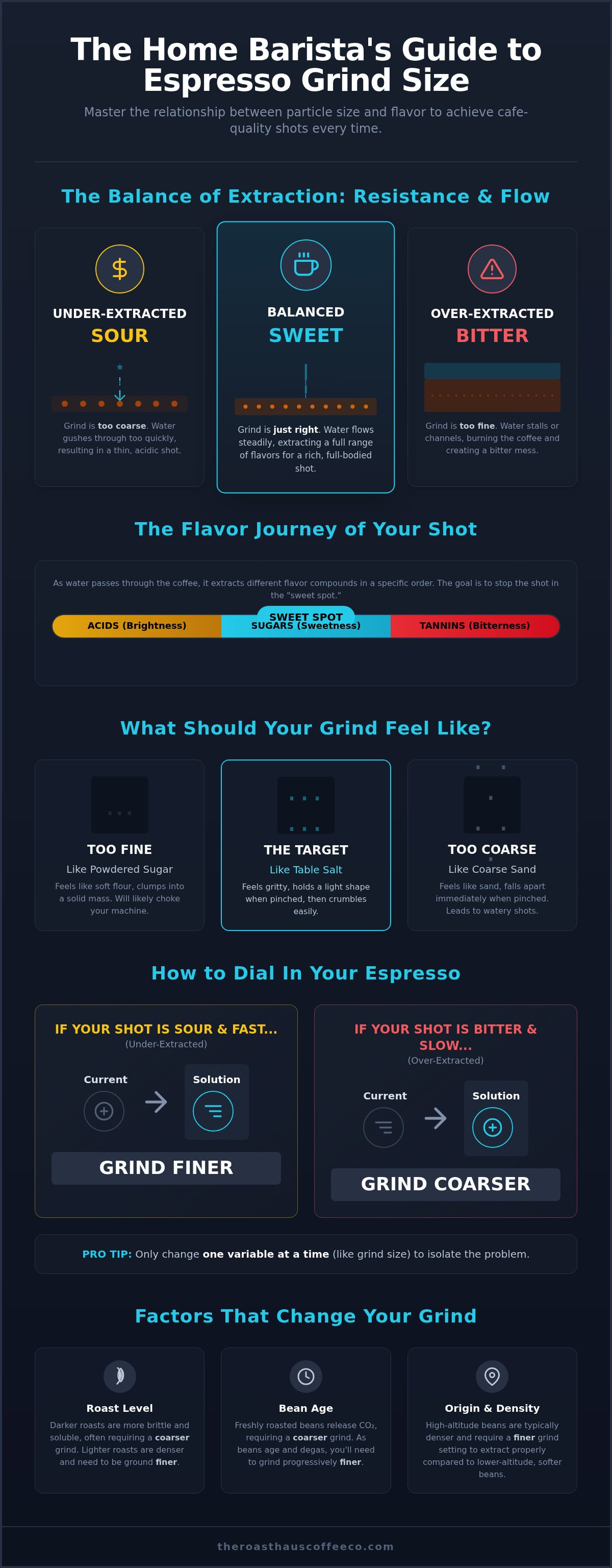
The core of this process is the "Resistance and Flow" principle. Water is lazy; it always finds the path of least resistance. If your grind is too loose, the water gushes through the gaps, resulting in a thin, sour liquid. If the particles are too packed, the water stalls, burning the coffee and creating a bitter mess.
Espresso grind is fine-textured coffee, similar to table salt, that creates 9 bars of resistance.
Achieving this balance is what separates a professional shot from a "sink shot." As an independent roaster, we see how much effort goes into the beans before they reach your kitchen. Respecting that craftsmanship means understanding the physics of the brew so you can enjoy the full potential of every roast.
The Science of Surface Area
When you grind a whole bean, you expose its internal structure. Smaller particles mean more surface area for hot water to touch. This increased contact allows the water to pull out oils, acids, and sugars quickly. There is a specific sweet spot where these elements balance perfectly.
- Acids: Extracted first, providing brightness and fruit notes.
- Sugars: Extracted next, providing sweetness and the necessary balance.
- Tannins: Extracted last; these cause bitterness if the grind is too fine.
You also have to consider "fines." These microscopic particles can muddy the clarity of your shot, but they also contribute to the heavy body and mouthfeel we love. Managing these tiny particles is why a high-quality burr grinder is essential for consistent results.
The Role of Pressure in Espresso
Pressure is the defining characteristic of espresso. This is why you need a significantly tighter grind than you would use for French press coffee. In an espresso machine, the coffee puck serves two roles at once: it is the filter that holds back the grounds and the valve that regulates the flow of water.
Imagine the 9-bar pressure environment inside your portafilter; that is roughly 130 pounds of pressure per square inch. Without a precise espresso grind size, the water would simply blast through the coffee without extracting anything meaningful. By mastering this resistance, you control the timing of the extraction, ensuring every drop contributes to a rich, artisan-quality experience.
The Espresso Grind Spectrum: Fine to Extra Fine
Many home baristas make the mistake of thinking espresso is a single, fixed setting on their equipment. In reality, "espresso" represents a specific range on your coffee grinder. Dialing in your espresso grind size is about finding the exact point within that range that suits your specific bean and machine. Because we roast in small batches to ensure uniform quality, you'll find that our beans respond predictably to even the smallest adjustments.
A simple way to test your progress without pulling a shot is the "Pinch Test." Take a small amount of dry grounds between your thumb and forefinger and press firmly. If the coffee feels like soft flour and stays in a solid, compressed clump, it's likely too fine. If it feels like coarse sand and falls apart immediately, it's too coarse. You want the grounds to feel gritty, like high-quality table salt, and hold a light shape before crumbling.
You might also notice small clumps forming as the coffee leaves the chute. While some clumping is a natural result of the oils found in fresh-roasted beans, excessive clumping can lead to "channeling." This is where water blasts through a weak spot in the puck. If you see large, hard clumps, your grind might be slightly too fine, or static is building up in your grinder's internal path.
Tactile Benchmarks for Home Baristas
To master your espresso grind size, you need to recognize how it compares to other brewing methods. Use these kitchen staples as a mental map for your texture:
- Powdered Sugar (Turkish Coffee): This is an extremely fine, dust-like texture. It's too fine for almost all espresso machines and will likely choke your pump.
- Table Salt (Standard Espresso): This is your target. You should feel a distinct grit, but the particles are small enough to provide the necessary resistance for a 25 to 30-second extraction.
- Granulated Sugar (Moka Pot): This is slightly too coarse for a standard espresso machine. The water will move through the puck too fast, leaving you with a sour, thin shot.
Visual Indicators of the Correct Grind
Before you even lock the portafilter into your machine, take a look at the mound of coffee. A high-quality artisan grind should look uniform in color and texture. You may see tiny flecks of "chaff," which is the paper-like silver skin of the bean. This is normal, especially in high-altitude beans like our Ethiopia Limu Organic, and won't hurt your flavor as long as the particle size remains consistent.
Consistency is the hallmark of a great shot. If you see a mix of large chunks and fine dust, your grinder isn't producing a uniform result. This creates an uneven extraction where some parts of the puck are over-brewed and others are under-brewed. For the best results, start with fresh beans from The Roast Haus Coffee Co. to ensure the natural oils and structure of the bean are intact when they hit your burrs.
How to Dial In Your Espresso: A Step-by-Step Process
Dialing in your machine is the craftsman's daily ritual. It's the moment you align your equipment with the unique character of the bean. To get this right, you must change only one variable at a time. If you adjust your dose and your grind simultaneously, you'll never know which change improved the shot. We recommend keeping your dose constant and using your espresso grind size as the primary lever for flavor control.
Start with a clean setup and a reliable scale. Pulling a great shot is easier when you have a variety of profiles to test. You can use The All Day Sampler to practice dialing in different origins. Each bean behaves slightly differently in the basket, and practicing with a variety of roasts helps you develop a feel for the grinder.
The 1:2 Ratio Framework
A 1:2 ratio is the best starting point for modern espresso. This means if you put 18 grams of ground coffee into your portafilter, you should aim for 36 grams of liquid espresso in your cup. Timing is the thermometer for your grind accuracy. Start your timer the moment you engage the pump and watch the flow carefully.
- Aim for 36 grams of output in 25 to 30 seconds.
- If your shot finishes in under 20 seconds, your espresso grind size is too coarse.
- If the machine struggles and takes over 40 seconds, your grind is too fine.
- Adjust your grinder in small increments until you hit that 30-second window.
Troubleshooting: Sour vs. Bitter
Use your taste buds to finalize the setting. A sour shot often tastes sharp, like lemon or salt. This happens when the water moves too fast, leading to under-extraction. It means the water didn't have enough time to pull the sugars out of the bean. In this case, make your grind finer to slow the water down and increase resistance.
A bitter shot tastes like ash or dry tobacco. This happens when the water stays in contact with the grounds for too long, causing over-extraction. If your shot is bitter or tastes burnt, coarsen your grind slightly. Your goal is the sweet spot where the natural character of the bean shines through without any harshness. This balance is the hallmark of an artisan brew.
Variables That Change Your Grind: Roast, Age, and Origin
Your espresso machine doesn't know what kind of coffee you're using. It only knows how much resistance the puck provides. This is why you can't use a "set and forget" approach for your espresso grind size. Even a small change in the weather can throw off your shot. In Wyandotte, Oklahoma, we see this often; a humid morning might require a slightly coarser setting than a dry afternoon because moisture makes the grounds clump together more tightly.
The "Freshness Factor" is the most overlooked variable in home brewing. Our roasted-to-order model means you receive beans at peak degassing. Within the first 48 hours, CO2 escaping from the beans creates a layer of "artificial resistance." This gas pushes back against the water, making the shot flow slower than an older, stale bean would. As the coffee ages over a week or two, you'll need to move your grinder finer to compensate for the loss of this internal pressure.
Grinding for Roast Levels
Roast level dictates the physical structure of the bean. Dark roasts, like our Honduras Morning Splendeur, have been roasted longer. This makes the bean more brittle and porous. Because the cell structure is broken down, water can penetrate and extract flavor very quickly. To prevent a bitter, over-extracted mess, you should use a coarser grind for dark roasts.
Light roasts are the opposite. They are dense and elastic because they haven't been exposed to high heat for as long. They resist water, so you must use a finer espresso grind size to expose more surface area and slow the flow. Medium roasts represent the balanced middle ground for most specialty coffee. They offer a forgiving window for dialing in and generally require fewer daily adjustments.
The Impact of Bean Density and Altitude
Altitude changes how a coffee bean grows. High-altitude beans, such as our Kenya AA Supreme, grow slower and become much denser than beans grown at lower elevations. When these dense beans hit your grinder blades, they shatter into very specific particle shapes. This hardness requires a high-quality grinder and precise adjustments to get the extraction right. A dense bean often needs a slightly finer touch than a softer, low-altitude bean.
Freshness also preserves the natural moisture content of the bean. Stale beans from a grocery store shelf have lost their internal oils and moisture, leading to a "shattering" effect that creates too many microscopic fines. By using beans that are shipped within 24 hours of roasting, you ensure the bean structure is intact. This gives you a more uniform particle size and a much cleaner cup. Experience the difference that peak freshness makes by ordering a bag of fresh-roasted beans from The Roast Haus Coffee Co. today.
Mastering Freshness with The Roast Haus Coffee Co.
Mastering your espresso grind size is only half the battle. You can have the most expensive grinder in the world, but if your beans are stale, you'll never achieve the rich crema and complex body of an artisan shot. At The Roast Haus Coffee Co., we operate on a simple, honest principle: freshness starts with the roast date. Our roasted-to-order philosophy ensures that your coffee is packed and shipped within 24 hours of leaving the drum. This means you receive your beans within that critical 24 to 48-hour window when they are most expressive.
Receiving beans this fresh gives you a distinct advantage. The natural CO2 levels are at their peak, providing the resistance needed to build a stable puck. This results in a thick, mahogany crema that industrial coffee simply can't replicate. If you're ever passing through Wyandotte, OK, we invite you to stop by our roasting facility. We love sharing artisan advice and helping our neighbors dial in their home setups to get the most out of every bag.
Small-Batch Quality Control
Consistency is the enemy of mass production. Large-scale roasters often mix different lots of beans, leading to uneven density. When these beans hit your grinder, they produce a wide range of particle sizes that make it impossible to find a stable espresso grind size. We focus on small-batch production to ensure uniform quality across the entire bag. Every bean has been roasted with the same level of care, meaning they will shatter and extract predictably in your machine.
Our hands-on approach also allows us to remove defects that could damage your grinder's burrs. In industrial settings, small rocks or debris often make it into the final package. As a family-owned business, we take pride in the integrity of our product. We ensure that only the highest quality beans reach your kitchen, protecting your equipment and your palate.
Starting Your Espresso Journey
If you're just beginning to learn the nuances of extraction, we recommend starting with a dense, high-altitude bean like our Kenya AA Supreme. Its hardness makes it a great teacher for precision grinding. For those who prefer a more floral and bright profile, our Ethiopia Limu Organic is an excellent choice. If you want to explore the full spectrum of flavor, The All Day Sampler provides a variety of profiles that will help you practice making grind adjustments across different origins.
The best way to maintain your skills is through repetition. A monthly coffee subscription ensures you never run out of fresh beans, allowing you to keep your grinder calibrated without interruption. You'll develop a rhythm that turns the technical chore of dialing in into a rewarding morning ritual. Shop our fresh-roasted beans and start dialing in today.
Elevate Your Home Brewing Today
Mastering the technical side of coffee is a journey that pays off in every sip. You now understand that finding the right espresso grind size is about more than just turning a dial. It's a dynamic response to the bean's density, roast level, and the time since it left the roaster. By following a consistent dialing-in process and focusing on one variable at a time, you can stop wasting expensive beans and start enjoying artisan-quality results.
True quality starts with the state of your coffee. As a family-owned roastery in Wyandotte, OK, we focus on small-batch quality to ensure your coffee behaves predictably in your grinder. We ship all our orders within 24 hours of roasting so you receive your beans at peak freshness. This commitment to craftsmanship makes it easier for you to achieve the perfect balance of sweetness and body right at your kitchen counter.
Ready to transform your morning ritual? Master your espresso with our Roasted-to-Order beans and experience the difference that true freshness makes. We're here to support your passion for great coffee.
Frequently Asked Questions
Why does my espresso grind size need to change every day?
Your espresso grind size changes because coffee beans are organic and reactive. As they age, they lose carbon dioxide, which reduces the internal resistance during extraction. Environmental shifts, such as a spike in Oklahoma humidity, also affect how the grounds clump together. You must make small adjustments to your grinder daily to compensate for these physical changes and maintain a consistent 30-second pour.
Can I use a blade grinder for espresso grind size?
No, blade grinders are unsuitable for espresso because they produce inconsistent particle sizes. A blade grinder chops the beans into a mix of large chunks and fine dust. This causes "channeling," where water blasts through the gaps and leaves you with a sour, thin shot. For the pressurized environment of an espresso machine, a high-quality burr grinder is required to achieve a uniform espresso grind size.
What happens if my espresso grind is too fine?
If your grind is too fine, the water cannot easily pass through the coffee puck. This often "chokes" the machine, resulting in a very slow drip or no flow at all. Because the water stays in contact with the grounds for too long, it extracts harsh tannins. This leads to a bitter, burnt flavor profile and a dry aftertaste that lingers unpleasantly on the palate.
How much coffee should I use for a double shot of espresso?
A standard double shot typically requires 18 grams of dry coffee grounds. We recommend using a digital scale to ensure accuracy, as even a half-gram difference can change the resistance of the puck. Following a 1:2 ratio, those 18 grams of coffee should produce roughly 36 grams of liquid espresso. Keeping your dose consistent allows you to focus entirely on adjusting your grind size for flavor.
Does a darker roast need a finer or coarser grind for espresso?
Darker roasts, like our Honduras Morning Splendeur, require a coarser grind. These beans have been roasted longer, making them more brittle and porous than light roasts. They give up their soluble compounds very quickly when they hit hot water. If you grind them as fine as a light roast, you will likely over-extract the coffee, resulting in a heavy, bitter taste.
Is "espresso grind" the same as "fine grind" on grocery store bags?
No, grocery store "fine grind" is rarely precise enough for a true espresso machine. Most pre-ground bags are designed for pressurized portafilters or Moka pots, which are more forgiving. True espresso requires a specific espresso grind size tailored to your specific machine and the freshness of the beans. Using generic "fine" coffee often leads to fast, sour shots because the particles are too large to provide resistance.
How do I know if my espresso shot is under-extracted?
Under-extraction is easy to identify through taste and visual cues. The shot will taste sharp, sour, or salty, and the body will feel thin and watery. Visually, the espresso will gush out of the portafilter too quickly, often finishing in under 20 seconds. This happens because the water didn't have enough time to pull out the sugars and oils needed for a balanced cup.
Can I use pre-ground coffee for an espresso machine?
We don't recommend using pre-ground coffee for espresso. Coffee begins to oxidize and lose its aromatic oils within minutes of being ground. Because espresso relies on the gas and oils within the bean to create resistance and crema, pre-ground coffee usually produces a flat, crema-less shot. For the best experience, grind our fresh-roasted Ethiopia Limu Organic just seconds before you brew.

