


What if the sharp, tongue-curling bitterness in your morning cup isn't actually the taste of coffee? It's a common mistake to think that a harsh bite is just how coffee is supposed to taste. You might spend your hard-earned money on high-quality beans only to end up with a brew that feels like a chore to drink. We want to help you fix that by showing you how to brew coffee that's not bitter using simple, professional techniques at home.
We understand your frustration because we believe coffee should be a highlight of your day, not something you mask with cream and sugar. In this guide, you'll learn how to adjust your brewing variables and selection process to eliminate unpleasant flavors. We'll show you how over-extraction and stale beans are the real culprits behind a bad cup. We'll also explore how small-batch, roasted-to-order beans like our Kenya AA Supreme or Ethiopia Limu Organic provide a naturally sweet foundation. You're about to gain the confidence to control your brew and finally enjoy the smooth, artisanal experience you deserve.
Key Takeaways
- Bitterness is a symptom of over-extraction, not a sign of coffee strength. Learn how to stop pulling harsh compounds from your grounds to reveal natural sweetness.
- Master the relationship between grind size and water temperature. These simple brewing adjustments are the key to how to brew coffee that's not bitter.
- Freshness is the ultimate differentiator for flavor. Using small-batch beans roasted-to-order prevents the rancid oils and oxidation common in stale, store-bought coffee.
- Use our 5-step checklist to troubleshoot a bad brew instantly. Learn why lowering your water temperature or coarsening your grind can transform your morning routine.
- Choose bean origins known for natural sweetness, such as Kenya AA Supreme. High-altitude beans provide a bright, balanced profile that naturally resists bitterness.
Understanding Bitterness: Why Your Coffee Tastes Like Ash
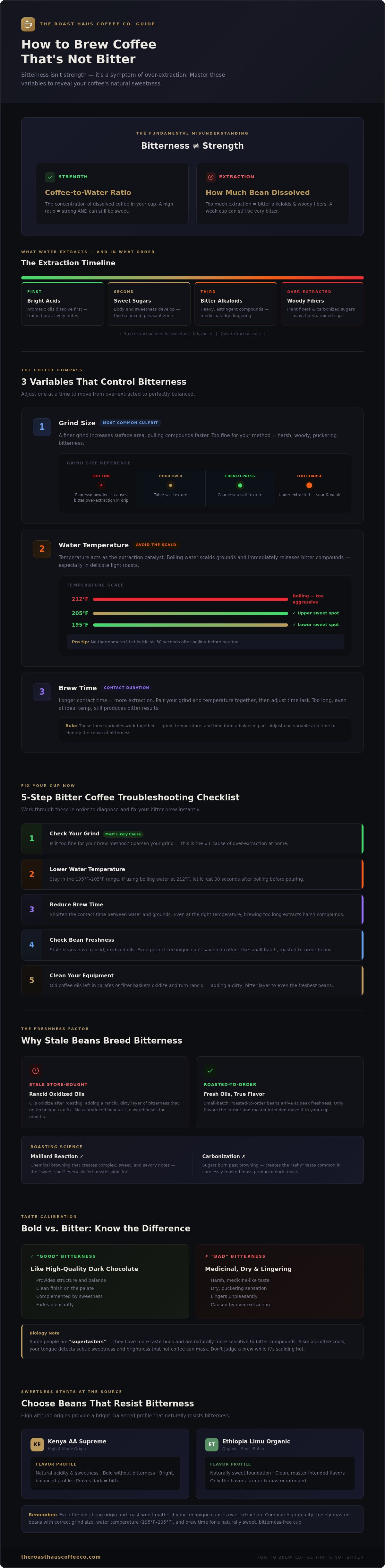
Bitterness is often misunderstood as a sign of coffee strength. In reality, it is usually a symptom of over-extraction. When you brew, water acts as a solvent to pull organic compounds from the ground beans. The bright acids and aromatic oils dissolve first, followed by the sweet sugars. If the brewing process continues too long, the water begins to pull out heavy, astringent plant fibers and bitter alkaloids. Learning how to brew coffee that's not bitter starts with stopping the extraction process at exactly the right moment.
The roasting process also determines the baseline for these flavors. We focus on the Maillard reaction, which is the chemical browning that creates complex, sweet, and savory notes. If a roaster isn't careful, the beans can move past browning into carbonization. This is where the sugars actually burn, creating the "ashy" taste common in mass-produced dark roasts. Our small-batch artisan process ensures we hit the sweet spot where acidity, sweetness, and bitterness are perfectly balanced before the beans turn harsh.
It is vital to distinguish between strength and extraction. Strength, or concentration, refers to the ratio of coffee to water in your cup. Extraction, or yield, refers to how much of the coffee bean you actually dissolved. According to coffee extraction science, you can have a very strong cup that is sweet and balanced, or a weak, watery cup that is incredibly bitter because it was over-extracted.
The Difference Between Bold and Bitter
Many drinkers confuse a dark roast's intensity with bitterness. "Good" bitterness is like high-quality dark chocolate; it provides structure and balance. "Bad" bitterness is medicinal, dry, and lingers unpleasantly on the tongue. Extraction is the process of water dissolving coffee solids. If you find your coffee tastes like medicine, you've likely extracted too many solids. We roast our Kenya AA Supreme to highlight natural acidity and sweetness, proving that a bold profile doesn't have to be a bitter one.
The Role of Your Taste Buds
Your biology and your environment change how you perceive flavor. Some people are "supertasters" who have more taste buds and are naturally more sensitive to bitter compounds. Temperature also plays a major role. As your coffee cools, your tongue becomes better at detecting the subtle sweetness and bright notes that might be hidden when the drink is very hot. If you drink your coffee while it is too hot to handle, you might only perceive the harshest notes.
Keep your equipment spotless to avoid "stale" bitterness. Old coffee oils left in a carafe or filter basket will oxidize and turn rancid quickly. These oils add a dirty, bitter layer to even the freshest beans. Using clean gear and fresh-roasted beans like our Ethiopia Limu Organic ensures that the only flavors you taste are the ones the farmer and roaster intended.
The Three Variables of Extraction: Grind, Temperature, and Time
Mastering your home brew is about controlling three simple variables. If you want to know how to brew coffee that's not bitter, you must view your grind, temperature, and time as a balancing act. Think of these as points on a Coffee Compass. If your cup tastes like ash or medicine, you are in the over-extracted zone. To move toward the sweet spot, you need to adjust one variable at a time until the flavors align. It is a logical process that rewards patience and consistency.
Grind Size: The Most Common Culprit
Grind size is the gatekeeper of flavor. A finer grind increases the total surface area of the coffee, which allows water to extract compounds very quickly. If your grind is too fine for your brew method, the water will pull out those harsh, woody fibers that cause a dry, puckering sensation. For example, a French press needs a coarse, sea-salt texture, while a pour over requires something closer to table salt. You can learn more about choosing the right tools in The Ultimate Guide to Coffee Grinders. Matching the grind to your specific equipment is the first step in avoiding a ruined cup.
Water Temperature: Avoiding the Scald
Water temperature acts as the catalyst for extraction. We recommend a range between 195°F and 205°F for most brewing methods. Using boiling water at 212°F is too aggressive; it can scald the grounds and immediately release bitter compounds, especially in delicate light roasts. If you don't have a thermometer, let your kettle sit for 30 seconds after it finishes boiling before you start pouring. This simple pause allows the temperature to drop into the ideal range, protecting the sweet, nuanced oils inside the bean.
Brew Time: When to Stop the Clock
Contact time is the final piece of the puzzle. The longer water stays in contact with the grounds, the more it extracts. If your coffee is consistently bitter, try shortening your brew time by 30 seconds. In drip machines, be aware of channelling. This happens when water finds a path of least resistance through the grounds, over-extracting that specific area while leaving the rest dry. Ensuring an even bed of coffee helps prevent these localized pockets of bitterness. Adjusting these three variables is the most effective way to learn how to brew coffee that's not bitter every single morning. Starting your journey with a naturally sweet bean like our Kenya AA Supreme makes it much easier to find that perfect balance.
The Freshness Factor: Why Stale Beans Breed Bitterness
No matter how much you study how to brew coffee that's not bitter, you cannot fix stale beans. Coffee is a perishable agricultural product. Once the roasting process ends, the clock starts ticking on flavor. Oxidation is the primary enemy here. When oxygen interacts with the delicate oils inside the bean, it turns them rancid. This chemical reaction replaces sweet, aromatic notes with a sharp, metallic bitterness that no brewing technique can hide. Freshness isn't just a preference; it is a requirement for a smooth cup.
Many coffee drinkers fall into the "Grocery Store Trap." Large commercial roasters prioritize shelf life and logistics over sensory quality. They often use "Best-by" dates that are set 12 months into the future. By the time you pull those beans off the shelf, the oils have likely already oxidized. Always look for a specific "Roasted-on" date. If a bag doesn't have one, the roaster is hiding the age of the product. We ship our beans within 24 hours of roasting to ensure you receive them at their peak of sweetness.
Darker roasts are especially vulnerable to this degradation. The intense heat of a dark roast pushes oils to the surface of the bean. These visible oils are exposed directly to the air, which causes them to reach their "bitter peak" much faster than lighter roasts. If you enjoy a bold profile, freshness is even more critical to avoid that "burnt rubber" taste that comes from old surface oils.
Artisan Roasting vs. Mass Production
Small-batch roasting allows for a level of precision that mass production simply cannot match. In a small roaster, we can monitor the temperature and airflow to ensure every bean is roasted evenly. Mass-produced coffee often contains a mix of scorched and under-roasted beans, leading to an inconsistent and bitter brew. Choosing a roasted-to-order model is the ultimate guarantee of flavor integrity. To learn more about how different origins impact your flavor profile, read Coffee Beans: The Ultimate Beginner's Guide.
Storing Your Beans to Preserve Sweetness
Proper storage is about protecting your investment from four enemies: light, heat, moisture, and air. While clear glass jars look nice on a counter, they expose your beans to light and heat, which accelerate spoilage. The original valve bag is actually the best storage tool. It features a one-way valve that lets carbon dioxide escape while blocking oxygen from getting in. Keep your bag in a cool, dark cupboard. Don't put your coffee in the freezer. The moisture from condensation will damage the bean's structure and create the very bitterness you're trying to avoid.
The 5-Step Troubleshooting Checklist for a Smoother Brew
If your morning cup still has an unpleasant bite, use this systematic checklist to identify the problem. Fixing a bad brew is about making small, intentional changes rather than guessing. Follow these steps to learn how to brew coffee that's not bitter while maintaining the strength you enjoy.
- Step 1: Coarsen your grind size. If your coffee tastes like ash, your grounds are likely too small. Move your grinder one or two notches toward a coarser setting to slow down the extraction.
- Step 2: Lower your water temperature. If you are using boiling water, you are likely scalding the grounds. Try 200°F to pull out sweetness instead of harshness.
- Step 3: Fix your ratio. Use a scale to ensure you aren't over-extracting a small amount of coffee with too much water. Try a ratio of 1:16 or 1:17.
- Step 4: Filter your water. Chlorine and heavy minerals in tap water can amplify bitter notes. A simple carbon filter can clean up your flavor profile.
- Step 5: Use a tiny pinch of salt. This is the Reddit favorite for neutralizing bitter receptors. A few grains can save a cup that is already brewed.
Dialing In Your Ratio
Many people think using less coffee will make the brew "weaker" and less bitter. The opposite is often true. When you use too little coffee, the water quickly dissolves all the good flavors and then starts attacking the bitter plant fibers. This leads to a thin, watery, yet incredibly bitter cup. We recommend a "Golden Ratio" of 1:16 (one part coffee to 16 parts water). You can find more detailed instructions in How to Make Coffee: The Ultimate Guide. Tweak these numbers slightly until you find the balance that suits your palate.
The Salt Trick: Science or Myth?
The "salt trick" works because sodium ions suppress the tongue's ability to detect bitterness. This is an excellent emergency hack if you are stuck with office coffee or a batch of stale beans. However, it is a mask, not a cure. You only need a few grains; literally three or four crystals are enough to neutralize the bite without making the coffee taste salty. While this works in a pinch, the best long-term solution is to start with a high-quality, fresh-roasted bean. If you want to stop guessing and start enjoying your mornings, buy a bag of our small-batch Ethiopia Limu Organic and use this checklist to dial in your perfect cup.
Choosing the Right Beans: Sweetness Starts at the Source
Even the best technique can't save a poor-quality bean. If you're struggling with how to brew coffee that's not bitter, you must look at your starting material. High-altitude beans, like our Kenya AA Supreme, grow more slowly in cooler temperatures. This slower maturation leads to a denser bean with a higher concentration of natural sugars and organic acids. These acids aren't sour; they are the bright, sparkling notes that provide a necessary balance to the brew. Without them, coffee tastes flat, heavy, and one-dimensionally bitter.
For those who prefer a clean and light profile, the Ethiopia Limu Organic is an excellent choice. It offers a bright taste that avoids the "burnt" notes often found in mass-market dark roasts. If you need to cut out caffeine, our Decaf Swiss Water Process is a game-changer. Unlike chemical decaffeination methods that can leave a metallic, bitter aftertaste, the Swiss Water Process uses only water, temperature, and time. This keeps the flavor oils intact while removing the caffeine. If you aren't sure which profile you prefer, The All Day Sampler allows you to explore different origins and find your personal threshold for bitterness.
Single-Origin Sweetness
African origins like Kenya and Ethiopia are world-renowned for fruit-forward sweetness. These beans naturally resist the "ashy" profile common in lower-altitude crops. If you want something more traditional but still smooth, the Honduras Morning Splendeur provides a balanced, low-bitter experience that is perfect for your first cup of the day. Because we roast-to-order, these delicate fruit and chocolate notes are preserved. You won't find the rancid, bitter oils that develop when coffee sits in a warehouse for months. Our process ensures you receive the beans at their absolute peak of flavor integrity.
The Roast Haus Commitment
We are a family-owned and operated artisan roastery based in Wyandotte, Oklahoma. Since 2014, we've focused on a simple philosophy: quality over quantity. We don't operate a cafe or manage a massive industrial factory. Instead, we focus on a small-batch artisan process that ensures consistency. When you order from us, we roast your beans and ship them within 24 hours. This commitment to timing is the most effective way to learn how to brew coffee that's not bitter. You deserve a cup that reflects the hard work of the farmers and the care of the roaster. Shop our freshly roasted-to-order coffee beans and taste the difference that craftsmanship makes.
Take Control of Your Coffee Experience
You now have the tools to transform your morning routine from a bitter chore into a highlight of your day. Remember that bitterness isn't a required trait of coffee; it's a symptom of variables you can control. By adjusting your grind size, lowering your water temperature, and prioritizing roast-to-order freshness, you've mastered how to brew coffee that's not bitter. These simple changes unlock the natural sweetness and complex fruit notes that mass-produced beans often hide.
At The Roast Haus, we've spent years perfecting our small-batch artisan process in Wyandotte, Oklahoma. As a family-owned business, we believe quality starts with timing. We roast every order and ship it within 24 hours to ensure you never have to deal with oxidized, stale oils again. Whether you choose our bright Ethiopia Limu Organic or the bold Kenya AA Supreme, you're getting the best our craftsmanship can offer. Stop settling for bitter coffee; order your freshly roasted-to-order beans from The Roast Haus today! We're excited for you to taste what real coffee is supposed to be.
Common Questions About Brewing Better Coffee
Why does my French press coffee always taste bitter?
Your French press coffee is likely bitter because the grounds are too fine or have sat in the water too long. A French press requires a coarse, sea-salt texture to prevent over-extraction during the four-minute steep. If you leave the brewed coffee in the carafe after plunging, the remaining sediment continues to release harsh compounds. Decant your coffee immediately into a mug or thermal carafe to stop the brewing process and preserve the smooth flavors.
Can I make bitter coffee taste better after it's brewed?
You can improve a bitter cup after brewing by adding a tiny pinch of salt or a splash of cream. Sodium ions physically block your tongue's bitter receptors, which helps the sweetness of the bean shine through. While this is a helpful emergency fix for a bad cup, the best solution is learning how to brew coffee that's not bitter from the start. Focus on using fresh beans and correct water temperatures to avoid needing these masks.
Does a darker roast always mean more bitterness?
A darker roast does not always mean more bitterness, but it does require more care during brewing. Darker beans are more porous and extract faster than light roasts, so you should use slightly cooler water or a coarser grind. Bitterness in dark roasts often comes from carbonization or oxidation of surface oils. When you use fresh, small-batch dark roasts, you should taste rich chocolate and toasted notes rather than a harsh, ashy bite.
How much salt should I add to bitter coffee?
You should only add a very small pinch of salt, literally three or four grains, to a standard mug of coffee. The goal is not to make the drink taste salty but to utilize sodium to neutralize bitter compounds on your palate. If you can taste the salt, you have added too much. This trick works best on coffee that was over-extracted or made with stale, mass-produced beans that have lost their natural sweetness and aromatic oils.
Is it the coffee maker or the beans making my coffee bitter?
Bitterness is usually caused by the state of the beans or your technique rather than the coffee maker itself. Stale, store-bought beans are often bitter before you even start brewing. However, a dirty machine with old oil buildup will also ruin your cup. Ensure you are using roasted-to-order beans like our Ethiopia Limu Organic and keep your equipment spotless. If your machine's water temperature is too high, it will pull harsh flavors out of even high-quality beans.
Does water quality affect the bitterness of my coffee?
Water quality plays a significant role in the final flavor of your brew. Tap water often contains chlorine and heavy minerals that can enhance or mimic bitter tastes. Since coffee is 98% water, using a simple carbon filter can make a massive difference in clarity. Clean, filtered water allows the natural sugars in high-altitude beans to come forward, making it much easier to understand how to brew coffee that's not bitter every morning.
What is the best coffee-to-water ratio to avoid bitterness?
The best starting point to avoid bitterness is a 1:16 or 1:17 coffee-to-water ratio. Many people mistakenly use less coffee to try and make a "weaker" brew, but this actually leads to over-extraction as the water dissolves the bitter plant fibers. Using a consistent ratio ensures the water only pulls out the desirable sugars and acids. We recommend using a digital scale to measure your grounds and water for the most consistent, sweet results.
How do I know if my coffee beans are stale?
You can identify stale beans by checking for a "Roasted-on" date rather than a "Best-by" date. If the beans have no aroma when you open the bag or if they look excessively dull and dry, they are likely past their prime. Fresh beans will release a vibrant, pleasant scent and may have a slight sheen. Because we ship our small-batch beans within 24 hours of roasting, you can be confident you are receiving them at peak freshness.

