


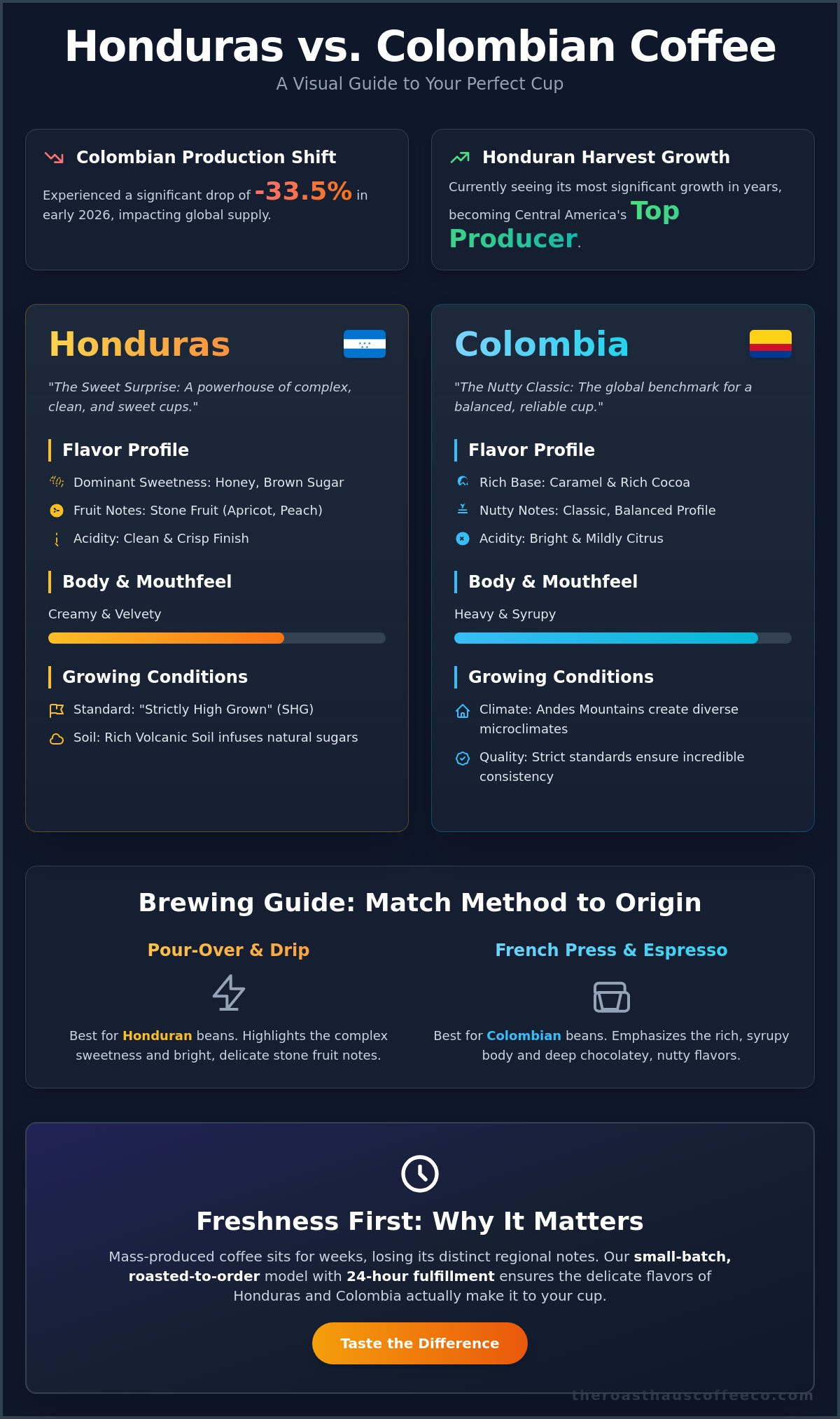
While Colombian coffee production plummeted by 33.5 percent in early 2026, Honduras is currently seeing its most significant harvest growth in years. This shift is changing the game for anyone weighing the honduras coffee vs colombian debate at the kitchen counter. If you have ever felt frustrated by spending money on premium beans only to end up with a cup that tastes stale or confusingly bitter, you are not alone. It is difficult to choose the right origin when big-box retailers hide the truth behind vague labels and old roast dates.
You deserve to know exactly what is in your mug and why it tastes the way it does. We promise to help you identify which origin suits your specific palate and brewing style so you can buy with total confidence. We will compare the bright sweetness of Honduran beans, like our Honduras Morning Splendeur, against the classic balance of Colombian crops. You will also learn why our small-batch, roasted-to-order model is the only way to ensure these distinct regional notes actually make it to your kitchen before they fade.
Key Takeaways
- Contrast the classic, nutty balance of Colombian beans with the distinct tropical sweetness found in Honduran varieties.
- Navigate the honduras coffee vs colombian choice by matching specific origins to your preferred brewing method, such as French Press or pour-over.
- Learn how "Strictly High Grown" standards and volcanic soil conditions impact the final flavor and acidity in your cup.
- Understand why small-batch roasting and our 24-hour fulfillment mantra are necessary to keep delicate tasting notes from disappearing.
- Gain the confidence to buy single-origin beans that match your taste instead of settling for stale, mass-produced options.
Honduras Coffee vs Colombian: The Battle of the Americas
Both Honduras and Colombia occupy a vital space in the global "Coffee Belt." This equatorial zone provides the high altitudes and nutrient-dense soil required for premium Arabica beans to thrive. For most home brewers, the choice between honduras coffee vs colombian beans is the most frequent decision they face. These two origins are staples in the specialty market because they offer distinct, approachable flavor profiles that appeal to a wide range of palates. While Colombia has long held the title of the world's most recognizable coffee producer, Honduras has quietly become the top producer in Central America. It is now a favorite for those seeking intense sweetness and complex fruit notes.
Home brewers often gravitate toward these regions because they are reliable. You can find them in almost any specialty shop, but the quality varies wildly depending on how they are handled. Big-box retailers often stock these origins in bulk, leading to a stale product that loses its regional character. To truly understand the difference between these two giants, you have to look at their history and the specific environments where they grow.
The Colombian Legacy: Consistency and Balance
Colombia's reputation is built on a foundation of incredible consistency. The vast mountain ranges of the Andes create unique microclimates, allowing the country to produce high-quality beans throughout the year. Most drinkers consider Colombian coffee the benchmark for a "classic" cup. It is prized for its medium body and bright, citrusy acidity. This level of quality is maintained by the National Federation of Coffee Growers. This organization has played a massive role in the history of Colombian coffee by setting strict export standards and supporting millions of small-scale farmers. When you buy Colombian beans, you expect a balanced, reliable cup that works well with almost any brewing method. It is the safe, dependable choice for a reason.
The Honduran Rise: Sweetness and Quality
Honduras was once overlooked as a source for high-volume commodity coffee, but that has changed. The country has pivoted toward small-batch, specialty lots that emphasize quality over quantity. Today, Honduras is the largest producer in Central America. Modern roasters are increasingly drawn to Honduran beans because they often possess a deeper, honey-like sweetness compared to their South American neighbors. This shift is why we feature our Honduras Morning Splendeur. It represents the new era of Honduran coffee. In this region, careful processing and high-altitude farming create a profile that is both complex and incredibly smooth. Honduras is no longer a "hidden gem" for industry insiders; it is a powerhouse that offers some of the cleanest and sweetest cups in the world.
Comparing Flavor Profiles: Nutty Classics vs. Tropical Sweetness
Choosing between honduras coffee vs colombian beans often comes down to your preference for body and finish. Colombian coffee is famous for its heavy, syrupy body. It feels substantial and coating on the tongue. Honduran coffee offers a different experience with a creamy, velvety mouthfeel. While both origins are celebrated for clean acidity, they express it differently. Clean acidity refers to a bright, crisp sensation that refreshes the palate and then disappears quickly. It doesn't linger or turn sour.
The International Coffee Organization monitors these global trends, noting how these specific sensory traits drive demand for specialty Arabica. Understanding these nuances helps you avoid the frustration of buying beans that don't match your expectations. When you know what to look for, you can stop guessing and start enjoying your morning cup.
Colombian Tasting Notes: What to Expect
Colombian beans are the gold standard for a balanced cup. You'll typically find deep notes of caramel and rich cocoa paired with mild citrus undertones. This mellow characteristic makes it an ideal all-day drinker. It doesn't overwhelm the senses with too much intensity. One major benefit of Colombian coffee is its roast integrity. Whether you prefer a medium or dark roast, the bean's core flavors remain intact. It provides a reliable, chocolatey base that stands up well to milk or cream.
Honduran Tasting Notes: The Sweet Surprise
Honduran coffee is often much sweeter than its South American neighbor. The volcanic soil in regions like Copán infuses the beans with natural sugars. This results in profiles of honey and brown sugar. You'll also notice stone fruit notes, like apricot or peach, which create a bright and complex finish. Our Honduras Morning Splendeur is a perfect example of this profile. It showcases that signature tropical sweetness and clean finish that modern specialty roasters love. It is a vibrant choice for anyone who finds traditional roasts too flat.
If you want to explore these differences side-by-side, picking up The All Day Sampler allows you to taste how regional soil and processing change every sip.
Growing Conditions: Altitude, Soil, and Processing
While flavor notes tell you what you're tasting, the growing conditions tell you why those flavors exist. The comparison of honduras coffee vs colombian starts with the geography. Colombian beans thrive in the diverse volcanic soil of the Andes, which provides a rich mineral base for balanced growth. In contrast, the mountain ranges of Copán in Honduras offer high-altitude terrain that produces intense sweetness. These environmental factors are not just trivia. They dictate how the bean develops its chemical structure and how we must roast it to reach its full potential.
A comprehensive study on coffee industry competitiveness highlights how these environmental factors and local infrastructure shape the global standing of both nations. For the home brewer, this means understanding that a bean from a high-altitude farm in Honduras will behave differently in your grinder than a bean from a lower-elevation Colombian estate. Altitude directly impacts bean density. Higher elevations lead to slower maturation of the coffee cherry. This slow growth allows the plant to concentrate more sugars and acids into the seed.
High Altitude and Bean Density
You will often see the labels SHG (Strictly High Grown) or HG (High Grown) on specialty bags. SHG specifically refers to coffee grown at altitudes above 1,350 meters. This classification is vital for Honduran quality because it ensures the beans are dense and hard. High bean density is a hallmark of premium coffee. It requires more precise heat management during the roasting process. We adjust our roasting curves specifically for these dense, high-altitude beans. If you apply heat too quickly, the outside burns while the inside remains grassy. If you go too slowly, you bake away the delicate sugars. Our goal is to find the exact balance that preserves the bean's structural integrity.
The Importance of the Washed Process
Most premium beans from both regions undergo the "washed" process. In this method, the fruit pulp is removed from the bean before it is dried. This is the opposite of the "natural" process where the fruit stays on. We prefer washed beans because they highlight the terroir, or the flavor of the origin itself. It results in a cleaner, more consistent cup. Commodity-level coffee often lacks this artisan-level care during processing. Large-scale operations might rush the fermentation or drying stages to increase volume. We focus on small-batch lots where the washing and drying are handled with precision. This ensures that when you brew a cup of our Honduras Morning Splendeur, you are tasting the mountain air and volcanic soil, not processing defects.
Brewing Guide: Matching Your Method to the Origin
Choosing between honduras coffee vs colombian beans means more than just picking a flavor profile. It means matching the bean to your brewing equipment. If you use the wrong method, you waste the potential of these premium beans. Every origin reacts differently to water temperature and extraction time. You also need to ensure your equipment is up to the task. Freshness starts with the grind, so use high-quality coffee grinders to unlock the volatile oils we have worked so hard to preserve.
A blade grinder will shatter the beans and cause uneven extraction. A burr grinder is necessary for the consistency required by specialty coffee. When you have the right grind, you can begin to explore how different brewers interact with the density of these high-altitude beans. Colombian and Honduran coffees are versatile, but they each have a "sweet spot" where their unique traits truly stand out.
Best Methods for Colombian Beans
Colombian beans are the ultimate choice for a classic French Press. The immersion brewing process enhances the nutty, chocolatey body that defines this region. It creates a heavy, satisfying mouthfeel that standard drip machines often miss. These beans are also perfect for cold brew. Their mellow acidity works well for long steeps, resulting in a smooth concentrate that never tastes sour or metallic. For specific recipes and ratios, follow our detailed guide on how to make coffee at home.
Best Methods for Honduran Beans
The bright acidity of Honduras shines in a Pour Over setup. Using a V60 or Chemex highlights the delicate floral and fruit notes we discussed in the previous section. The paper filter traps sediment and allows the tropical sweetness of our Honduras Morning Splendeur to remain clear and vibrant. If you prefer a faster brew, try the AeroPress. This method allows you to experiment with concentrated sweetness by adjusting your pressure and steep time. A medium grind is essential here. It preserves the bean's clarity without introducing the bitterness that comes from over-extraction.
For espresso lovers, the choice depends on your goal. Colombian beans provide a thick, reliable crema and a traditional chocolate base. Honduran beans offer a more complex, fruit-forward shot with a sweet zing. No matter which you choose, the result is only as good as the roast. We ship our beans within 24 hours of roasting because we know that even the best brewing method cannot fix stale coffee. If you want to experience the full spectrum of these two giants, grab The All Day Sampler and start your own home tasting today.
Freshness First: Why Roasted-to-Order Wins Every Time
You can analyze the honduras coffee vs colombian differences all day, but the debate is pointless if the beans are stale. Coffee flavor is derived from volatile oils that begin to dissipate the moment the roasting process ends. Most big-box retailers sell coffee that has sat in a warehouse or on a shelf for months. By the time you buy it, the delicate stone fruit notes of a Honduran bean or the caramel balance of a Colombian one have faded into a generic, bitter taste. You aren't tasting the origin; you're tasting the age.
We operate on a strict 24-hour rule. This is our mantra and the core of our fulfillment model. We ship your beans within a day of roasting to ensure you receive them at their absolute peak chemical state. Industrial production focuses on high-volume shelf stability, which often requires over-roasting to mask old beans. We take the opposite approach. Our small-batch craftsmanship allows us to manage the specific density of high-altitude beans like our Honduras Morning Splendeur. This ensures the natural sugars developed in the volcanic soil are preserved and delivered fresh to your door.
The Problem with Grocery Store Origins
Grocery stores rely on "Best By" dates, which are often set for a year after the coffee was packaged. This is a misleading metric for anyone who cares about quality. In reality, even the highest-grade Colombian bean will taste like cardboard after three months of sitting in a bag. You lose the "clean acidity" and the "mellow" characteristics that make these regions famous. When you support independent roasters, you get transparency. You'll see a "Roasted On" date, giving you the power to know exactly how fresh your morning cup is. There is no substitute for timing.
Finding Your Perfect Match with a Sampler
We created The All Day Sampler to help you end the origin debate in your own kitchen. It allows you to conduct a "cupping" at home, which is the professional standard for comparing different beans side-by-side. Cupping involves smelling the dry grounds, then the wet crust after adding water, and finally slurping the coffee to spray it across your palate. This technique reveals the subtle stone fruit and honey notes of our Honduras Morning Splendeur compared to the nutty balance of other origins. It is the most effective way to identify your favorite without guessing. If you want to keep your pantry stocked with these fresh rotations, consider joining our coffee subscription. It is the best way to ensure you never have to settle for stale, industrial beans again.
Upgrade Your Morning Brew
You have seen how Colombian beans provide a reliable, nutty balance for your French Press. You have also learned how the volcanic soil of Honduras creates the tropical sweetness found in specialty lots. The winner in the honduras coffee vs colombian debate depends on your specific palate, but the quality always depends on the roast date. Since 2014, our family-owned operation in Wyandotte, Oklahoma, has focused on small-batch artisan craftsmanship. We don't believe in shelf-stable bags that lose their character. Instead, we roast to order and ship within 24 hours. This ensures the vibrant oils of these high-altitude beans reach your kitchen at their absolute peak.
Stop settling for stale, industrial coffee that tastes like cardboard. You deserve to experience the complex fruit notes and honey sweetness that these regions are famous for. Taste the difference of fresh-roasted Honduras Morning Splendeur today. We are proud of our identity as an independent venture and we are ready to help you find your next favorite roast. Start your journey toward a better cup of coffee right now.
Frequently Asked Questions
Is Honduran coffee stronger than Colombian coffee?
Strength is determined by your brewing ratio rather than the origin of the bean. However, Honduran coffee often feels more intense because of its vibrant, fruit-forward sweetness. Colombian coffee is known for its heavy body and balanced chocolate notes, which some drinkers perceive as a "stronger" mouthfeel. If you want a punchy, complex cup, you might prefer the flavor intensity of a Honduran roast.
Which coffee is better for people with sensitive stomachs?
Colombian coffee is generally the better choice for people with sensitive stomachs. It features a more mellow, lower acidity profile compared to the bright and crisp acidity found in Honduran beans. This smoother characteristic is gentler on the digestive system. You can also choose a darker roast level for either origin to further reduce the acid content and make your morning cup more comfortable.
Does Honduran coffee have more caffeine than Colombian?
There is no measurable difference in caffeine content between these two Arabica origins. Caffeine levels depend on the species of the bean and the altitude where it grew, not the country of origin. Since both regions focus on high-altitude Arabica plants, the caffeine remains consistent across both. Your brewing method and the amount of coffee grounds you use will have a much larger impact on your caffeine intake.
What is the best roast level for Honduran coffee beans?
A medium roast is the ideal level for Honduran beans because it preserves their natural honey and stone fruit notes. Light roasts can sometimes be too acidic for the average palate, while dark roasts often mask the delicate sweetness that makes this origin special. We roast our Honduras Morning Splendeur to a precise medium level. This develops the natural sugars without burning away the unique regional character.
Why is Colombian coffee so much more famous than other origins?
Colombian coffee is famous because of decades of successful marketing and strict export standards. The National Federation of Coffee Growers built a global reputation for consistency that few other nations could match. This historical head start is why the honduras coffee vs colombian debate is so common today. While Colombia had the early marketing advantage, Honduras has recently become a top competitor by focusing on high-quality specialty lots.
Can I use Honduran coffee beans for espresso?
You can certainly use Honduran beans for espresso to create a vibrant, fruit-forward shot. While many people enjoy the traditional chocolate base of a Colombian espresso, Honduran beans offer a sweet zing that stands out in milk-based drinks. The natural brown sugar notes in the bean pair perfectly with steamed milk. Just ensure you use a high-quality burr grinder to handle the density of these high-altitude beans.
How long do these beans stay fresh after the roast date?
Whole bean coffee stays at its peak flavor for about two to three weeks after the roast date. The volatile oils that define the honduras coffee vs colombian experience begin to evaporate as soon as the beans leave the roaster. This is why we ship our beans within 24 hours of roasting. To keep them fresh at home, store them in an airtight container in a cool, dark place away from direct sunlight.

