


Freshness isn't a date on a calendar; it's a chemical window of peak aromatic performance that closes faster than you think. You've likely felt the frustration of spending money on a premium bag of Kenya AA Supreme only to have it taste flat and woody just a week later. It's common to feel confused by the difference between "best by" and "roasted on" labels when you just want a vibrant morning cup. You want to respect the craft that goes into small-scale roasting by enjoying the coffee at its absolute best.
This guide explains exactly how long do roasted coffee beans last so you never waste another ounce of high-quality coffee. We'll identify the specific four to twenty-one day "sweet spot" for brewing after roasting. You'll also learn the truth about freezing your beans and the specific storage techniques that actually protect delicate oils from oxygen and light. From understanding degassing to spotting stale beans, you're about to master the science of coffee integrity and ensure every cup lives up to its potential.
Key Takeaways
- Learn the critical difference between a safety "expiration" date and the chemical window where flavor actually peaks.
- Understand exactly how long do roasted coffee beans last before oxidation turns your premium brew flat and woody.
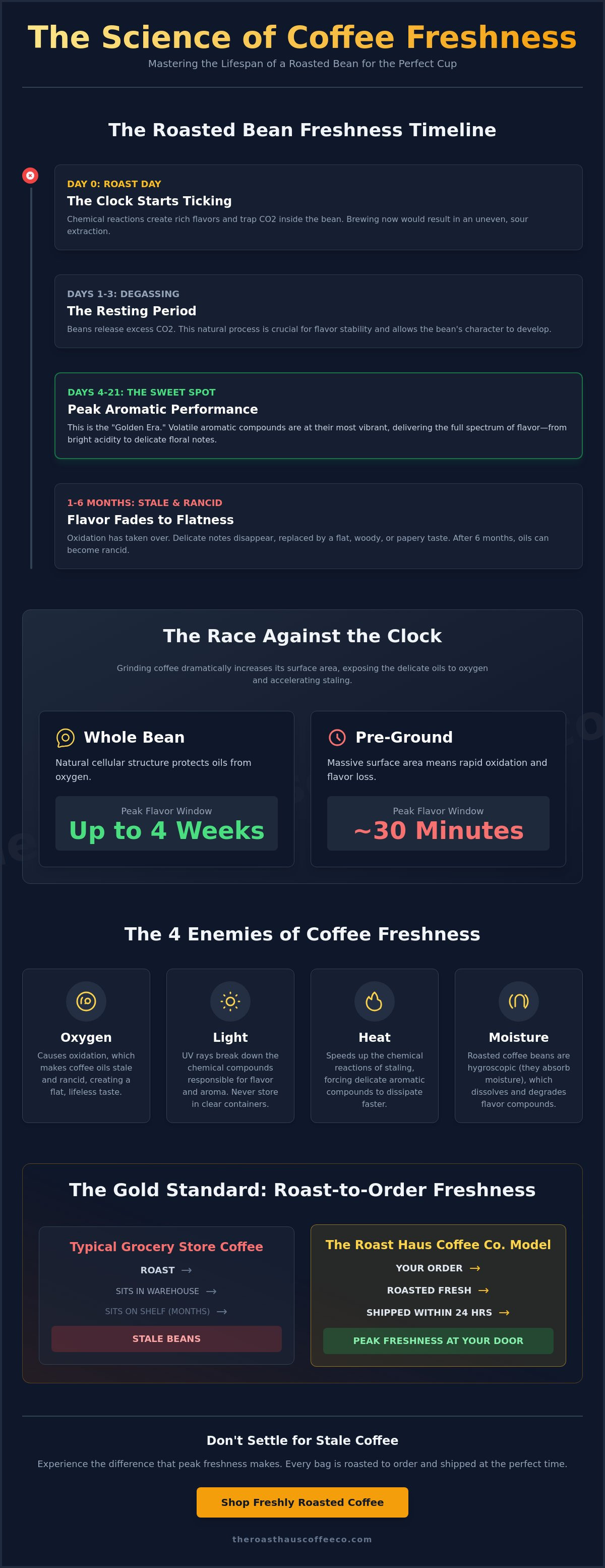
- Find out why pre-ground coffee has a 30-minute race against the clock compared to the month-long life of whole beans.
- Identify the four environmental enemies that ruin your coffee and learn the best ways to protect your investment.
- Discover how the roast-to-order model at The Roast Haus Coffee Co. eliminates the stale shelf problem by shipping beans within 24 hours of roasting.
The Lifespan of a Roasted Bean: Peak Flavor vs. Shelf Life
Roasted coffee is a living product that begins to change the moment it leaves the cooling tray. Unlike milk or meat, coffee doesn't rot or grow mold in a way that makes it dangerous to consume under normal conditions. Instead, it undergoes a steady decline in aromatic integrity. When people ask how long do roasted coffee beans last, they are usually asking about the window of peak flavor rather than a safety expiration date. You won't get sick from drinking an old bag of beans, but you will definitely notice a lack of character in your cup.
Freshness is about the presence of volatile aromatics. These are the delicate compounds that give our Kenya AA Supreme its bright acidity and our Ethiopia Limu Organic its floral notes. As soon as the roasting process ends, these compounds begin to escape. Within two to four weeks, the most vibrant flavors start to dim. To maintain the highest quality, you must prioritize the "Roast Date" over any "Best By" label. A roast date tells you exactly when the clock started ticking, while a best by date is often an arbitrary safety marker set months or even a year into the future.
Understanding the chemistry of your beans helps you time your purchases. While the beans are technically shelf-stable for a long time, their sensory profile is fragile. Utilizing proper coffee bean storage methods can slow this decline, but it cannot stop it entirely. You are looking for a chemical window of performance, not a deadline for food safety.
The 2-Week Rule of Thumb
The first 14 days after roasting are widely considered the "golden era" of coffee flavor. This is the artisan standard for true freshness. During this period, the bean settles after the intense heat of the roaster and reaches its full potential. Delicate flavor profiles, such as light floral or citrus notes, are the first to fade. If you brew a bag of Honduras Morning Splendeur three weeks late, it may still taste good, but you'll miss the subtle nuances that make that specific harvest special. Freshness is a race against time.
Does Coffee Actually Expire?
Coffee is safe to drink for a long time, but it eventually becomes chemically "flat." After about six months, the natural oils inside the bean can begin to go rancid, especially if the beans are exposed to oxygen. This results in a woody, papery, or even metallic taste. Grocery store beans often sit on shelves for months before you buy them, which is why they frequently taste bitter or dull. Knowing how long do roasted coffee beans last helps you avoid these stale products. Always look for a clear roast date to ensure you are buying a product that still has its soul intact.
The Science of Staling: Why Degassing and Oxidation Matter
During the roasting process, a complex chemical event called the Maillard reaction occurs. This reaction doesn't just develop the deep brown color and rich flavors of the bean; it also creates a significant amount of carbon dioxide (CO2). This gas becomes trapped within the cellular structure of the coffee bean. While enthusiasts often ask how long do roasted coffee beans last, the answer depends on how well you manage these chemical transitions. The trapped CO2 actually serves as a natural preservative, keeping oxygen at bay while the bean is still sealed.
Freshly roasted beans need time to settle before they reach their peak. This period is known as degassing. If you brew beans immediately after they leave the roaster, the rapid escape of CO2 can interfere with water contact, leading to an uneven extraction that tastes metallic or unpleasantly sour. Most beans require a rest period of three to seven days to reach a balanced state. We prioritize this resting phase to ensure that when you open a bag of our Ethiopia Limu Organic, the flavors are stable and ready for the perfect extraction.
You can verify the presence of this protective gas through the bloom test. When you follow the steps for how to make coffee, the initial pour of hot water should cause the grounds to swell and bubble. These bubbles are the CO2 escaping. If your grounds lie flat and silent, it's a clear sign that the gas has dissipated and the beans have begun to stale. To experience this vibrant freshness for yourself, consider starting with The All Day Sampler to see how different origins react when they are at their peak.
The Role of Carbon Dioxide
Carbon dioxide acts as a protective blanket for the beans while they are inside the bag. High-quality packaging features a one-way valve that allows this gas to escape without letting oxygen in. If you see a coffee bag that looks slightly puffy, it's a good sign that the beans are fresh and active. Following professional advice on How to Store Coffee Beans will help you maintain this internal environment for as long as possible after you take the beans home.
How Oxidation Destroys Flavor
Oxygen is the primary enemy of coffee quality. Once the protective CO2 escapes, oxygen enters the pores of the bean and begins to break down the delicate lipids and aromatic oils. This chemical process is called oxidation. It's the primary cause of the "cardboard" or "flat" taste found in old coffee. Darker roasts tend to stale even faster because their cellular structure is more porous and they often have more oils visible on the surface. Understanding how long do roasted coffee beans last helps you realize that once the seal is broken, the race against oxidation begins in earnest.
Whole Bean vs. Pre-Ground: The Race Against the Clock
The physics of freshness comes down to surface area. When you keep your coffee beans whole, you protect the product's integrity. A whole bean acts as a biological vault. It keeps the oils and gases inside safe from the outside world. Once you crush that bean, the surface area exposed to oxygen increases by thousands of times. This is the "Surface Area Principle." It explains why whole beans maintain their peak profile for about four weeks, while ground coffee degrades in about 30 minutes. Buying whole beans is the most effective way to ensure the money you spend on quality coffee isn't wasted on air.
People often enjoy the smell of freshly ground coffee, but that aroma is actually flavor leaving the beans. Those smells are volatile organic compounds (VOCs) escaping into your kitchen. If the scent is in the air, it's no longer in your cup. When calculating how long do roasted coffee beans last, you must consider this rapid evaporation. Ground coffee is also hygroscopic. It acts like a sponge for moisture and kitchen odors. If you store ground coffee near your spice rack or in a damp cupboard, those external flavors will contaminate your brew. This absorption happens much faster than most people realize, turning a premium product into something dull and uninspired within a single afternoon.
Why Pre-Ground Coffee Stales in Minutes
The flavor loss in pre-ground coffee is almost immediate. As soon as the bean breaks, the protective CO2 discussed in the previous section rushes out. Oxygen moves in to replace it. Within half an hour, the bright acidity of a bean like our Kenya AA Supreme can vanish. We suggest using high-quality coffee grinders at home. Grinding seconds before you brew ensures those aromatics stay where they belong.
Whole Bean: The Natural Protective Shell
A whole bean is nature's perfect packaging. It keeps delicate compounds stable until the moment of extraction. This is why independent roasters focus on whole beans for serious enthusiasts. We want you to taste every bit of the craftsmanship in our Honduras Morning Splendeur. You'll see the difference in the "bloom" when you brew. Fresh-ground beans bubble with life, while pre-ground coffee stays flat. Understanding how long do roasted coffee beans last means recognizing that the shell is your best defense against staleness.
How to Store Coffee Beans to Maximize Their Life
Protecting your investment starts with understanding the environmental factors that degrade quality. To understand how long do roasted coffee beans last in your kitchen, you must identify the four enemies of freshness: air, light, heat, and moisture. Air causes oxidation, light triggers UV degradation, heat speeds up chemical staling, and moisture introduces the risk of mold. Each of these elements works to destroy the aromatics we work so hard to preserve during the roasting process. If you leave your beans exposed to these elements, the vibrant profile of a specialty roast will vanish in days.
Your first line of defense is the packaging. If your coffee arrives in a bag with a one-way valve and a reliable zip seal, keep it there. This bag was engineered to vent CO2 while blocking oxygen. If you prefer a more permanent solution, move the beans to an airtight, opaque canister. Clear glass jars might look nice on a counter, but they allow light to penetrate the beans, which breaks down the delicate oils and ruins the sensory profile. You don't want to sacrifice flavor for the sake of kitchen aesthetics.
Location matters just as much as the container. Store your beans in a cool, dark place. This means keeping them away from the heat of the oven, the top of the refrigerator, or the direct sunlight of a window. In a typical Oklahoma kitchen, humidity and fluctuating temperatures can be major factors. A dedicated pantry shelf or a low cupboard is usually the best spot. Finally, adopt a better buying habit. Only purchase the amount of coffee you can realistically consume within a two to three-week window. This ensures you're always brewing at the peak of flavor rather than trying to save a stale product.
The Great Freezer Debate
Freezing coffee is a common point of confusion for many drinkers. The biggest risk here is condensation. When you take a bag out of the freezer, moisture forms on the cold beans almost instantly. This moisture ruins the flavor and creates a flat, muddy cup. If you have more coffee than you can use and must freeze it for long-term storage, the beans must be vacuum-sealed in small, single-use portions. Never put your coffee in the refrigerator. The fridge is a damp environment, and coffee is naturally porous. It'll act like a sponge and absorb the odors of your leftover food, which will completely mask the subtle notes of a bean like our Decaf Swiss Water Process.
Choosing the Right Container
The container you choose can significantly extend the life of your coffee. Vacuum-sealed canisters are superior to simple airtight jars because they allow you to actively pump out the oxygen. Avoid decorative clear jars at all costs. While they're popular in home design magazines, light is a primary driver of flavor loss and oil degradation. If you want to see the difference that proper storage and fresh roasting make, order a fresh bag of Honduras Morning Splendeur and store it in a cool, dry pantry away from your stove.
Why Roasted-to-Order is the Gold Standard for Freshness
The Roast Haus Coffee Co. promise is straightforward and honest. We roast and ship your order within 24 hours. This specific fulfillment model bypasses the storage issues discussed earlier in this guide, ensuring you receive a product at its absolute sensory peak. To make this even easier, a coffee subscription is the most reliable way to maintain your supply of fresh beans. It automates your deliveries so you never have to settle for old, flat inventory from a local store again. You deserve a product that reflects the true integrity of the roasting craft and the hard work of the farmers who grew it.
Small-Batch vs. Industrial Roasting
Industrial roasters prioritize mass volume and long shelf lives above all else. They frequently use "best by" dates to hide the actual age of their stock. Small-batch roasting is different because it focuses on heat precision and immediate fulfillment. We take pride in the transparency of our process. Every bag of our Ethiopia Limu Organic or Honduras Morning Splendeur includes a hand-written roast date. This allows you to track exactly how long do roasted coffee beans last in your own pantry with total confidence. It is a level of accountability that large, impersonal corporations simply cannot provide to their customers.
This dedication to immediate preparation is a shared value among specialty producers; for example, Royal Bird's Nest specializes in premium, freshly brewed bird's nest desserts to provide a superior experience compared to mass-produced alternatives, echoing the same standards of accountability we apply to our roasting process.
From Our Roaster to Your Door
We operate our independent roastery in Wyandotte, OK, where we handle every order with personal attention and care. Shipping within 24 hours of roasting ensures that the beans arrive at your door during the optimal degassing period. Whether you are across the country or opting for local pickup in Oklahoma, you are getting a product that hasn't been compromised by warehouse temperature swings or long transit times. This direct path from the roaster to your door is the ultimate differentiator in coffee quality and flavor. Experience the difference of roasted-to-order coffee today.
Take Control of Your Coffee Freshness
You now understand that the true answer to how long do roasted coffee beans last isn't found on a grocery store shelf. It's measured in the four short weeks following the roast date. By prioritizing this peak window and using airtight, opaque storage, you protect the volatile aromatics that define a high-quality brew. You've learned that keeping beans whole and avoiding the moisture of the refrigerator are the simplest ways to maintain product integrity. These small changes in your routine will significantly improve the quality of your morning cup.
We believe you shouldn't have to guess about the age of your coffee. At our family-owned Oklahoma roastery, we focus on small-batch artisan quality that puts the customer's experience first. Every bag is shipped within 24 hours of roasting to ensure you receive it at the height of its flavor potential. Shop our freshly roasted-to-order coffee collections and taste the difference that absolute freshness makes. It's time to stop settling for flat, woody coffee and start enjoying the vibrant, complex profiles you deserve. Your journey toward a better brew starts with a roast date you can trust.
Frequently Asked Questions
Can I drink coffee that is 6 months old?
You can safely drink coffee that is 6 months old, but you likely won't enjoy the experience. Coffee doesn't expire in the way milk does; it simply loses its aromatic oils and goes stale. By the six-month mark, the beans will taste flat, woody, or even like cardboard. When considering how long do roasted coffee beans last, you should focus on flavor quality rather than safety.
Is it better to store coffee beans in the freezer or the pantry?
A cool, dark pantry is the best place for daily coffee storage. The pantry protects beans from light and heat without the moisture risks of a freezer. You should only use the freezer for long-term storage if the beans are vacuum-sealed in single-use portions. This prevents the condensation that ruins flavor when you open and close a cold bag repeatedly during your morning routine.
How do I know if my coffee beans have gone stale?
You can identify stale beans by their smell and how they react to hot water. Fresh beans have a strong, pleasant aroma, while stale beans smell dull or like dusty wood. During brewing, look for the "bloom." Fresh coffee releases CO2 and bubbles when it first hits hot water. If your grounds lie flat and silent, the beans have lost their gas and gone stale.
Why does my coffee taste bitter even though the beans are fresh?
Bitterness in fresh coffee usually comes from over-extraction rather than the beans themselves. If your grind is too fine or your water is too hot, you'll pull out harsh flavors even from a premium roast. Check your brewing parameters to ensure you aren't leaving the water in contact with the grounds for too long. Fresh beans like our Kenya AA Supreme require precise brewing to shine.
What is the "one-way valve" on my coffee bag for?
The one-way valve allows carbon dioxide to escape the bag without letting oxygen inside. Freshly roasted beans release a significant amount of gas, which can cause a sealed bag to burst if it isn't vented. By letting the CO2 out and keeping the oxygen out, the valve helps extend how long do roasted coffee beans last by slowing down the oxidation process that causes staleness.
Do dark roasted beans go stale faster than light roasts?
Dark roasted beans generally go stale faster than light roasts. The roasting process for dark coffee is longer and more intense, which makes the cellular structure of the bean more porous. This allows oxygen to penetrate the bean more easily. Additionally, the visible oils on the surface of dark roasts are highly susceptible to oxidation, leading to a rancid or oily taste much sooner.
Can I use a clear glass jar if it is kept inside a dark cupboard?
You can use a clear glass jar if you are certain it will stay in a dark cupboard. However, light is a major enemy of freshness, and even brief exposure every time you open the cupboard can degrade the oils. An opaque, airtight canister is always a safer choice. It provides a permanent barrier against light, ensuring your beans stay protected even if they're left on the counter.
How long does ground coffee stay fresh compared to whole beans?
Ground coffee stays at peak freshness for only about 30 minutes, whereas whole beans can last up to four weeks. Grinding increases the surface area exposed to oxygen by thousands of times, causing the flavor-giving oils to evaporate almost instantly. To get the best value from your purchase, always buy whole beans and grind them immediately before you brew your cup of coffee.

