


Paying $20 for a 12-ounce bag of beans might feel like a luxury, but the real waste of money is the $8 grocery store tin that tastes like cardboard. Most coffee drinkers wonder is expensive coffee worth it when they're tired of adding three spoons of sugar just to make their morning cup drinkable. You've likely felt the frustration of opening a bag only to find oily, over-roasted beans that were packaged six months ago. It's a letdown to pay for "premium" labels that don't deliver on flavor or ethical standards.
We agree that your morning ritual deserves better than inconsistent, bitter beans. The difference between mass-market commodity coffee and artisan specialty beans comes down to the 80-point quality scale and a strict "Roasted to Order" philosophy. In this 2026 guide, we'll show you how small-batch roasting and transparent sourcing create a cup that's naturally sweet. You'll learn how to identify peak flavor within 14 days of roasting and why direct sourcing is a smart investment. We're breaking down the science of freshness so you can shop with confidence and finally enjoy a superior cup of coffee.
Key Takeaways
- Learn how the 80-point Specialty Coffee Association scale distinguishes true artisan quality from mass-market commodity beans.
- Understand how high-altitude growing and labor-intensive processing determine if is expensive coffee worth it for your morning routine.
- Discover why the 14-day freshness rule and roasted-to-order beans are essential to preventing flat, cardboard-like flavors caused by oxidation.
- Identify when premium beans lose their edge based on your specific brewing equipment and your preference for cream and sugar.
- Learn how to upgrade to small-batch coffee without breaking the bank by choosing fresh, roasted-to-order subscriptions from family-owned businesses.
Is Expensive Coffee Worth It? Defining the Specialty Difference
Many coffee drinkers ask is expensive coffee worth it when they see a $28 bag of beans sitting next to a $9 grocery store tin. In 2026, the price gap has narrowed as commodity coffee prices hit 10-year highs in late 2024. This shift makes the choice more about quality than just the price tag. True value comes from the grading process. The Specialty Coffee Association (SCA) uses a 100-point scale to judge bean quality. To understand the technical foundations, you can read more about What is Specialty Coffee? and how it differs from the bulk market.
Value in coffee is driven by terroir and variety. Beans grown in volcanic soil at elevations above 1,500 meters develop dense cell structures and complex sugars. Varieties like Gesha or Bourbon offer distinct notes of jasmine, stone fruit, or cocoa. These flavors don't happen by accident. They're the result of specific climate conditions and careful harvesting. When you buy specialty grade, you're paying for a transparent supply chain and a product that hasn't been mixed with low-grade fillers.
The Problem with Commodity Coffee
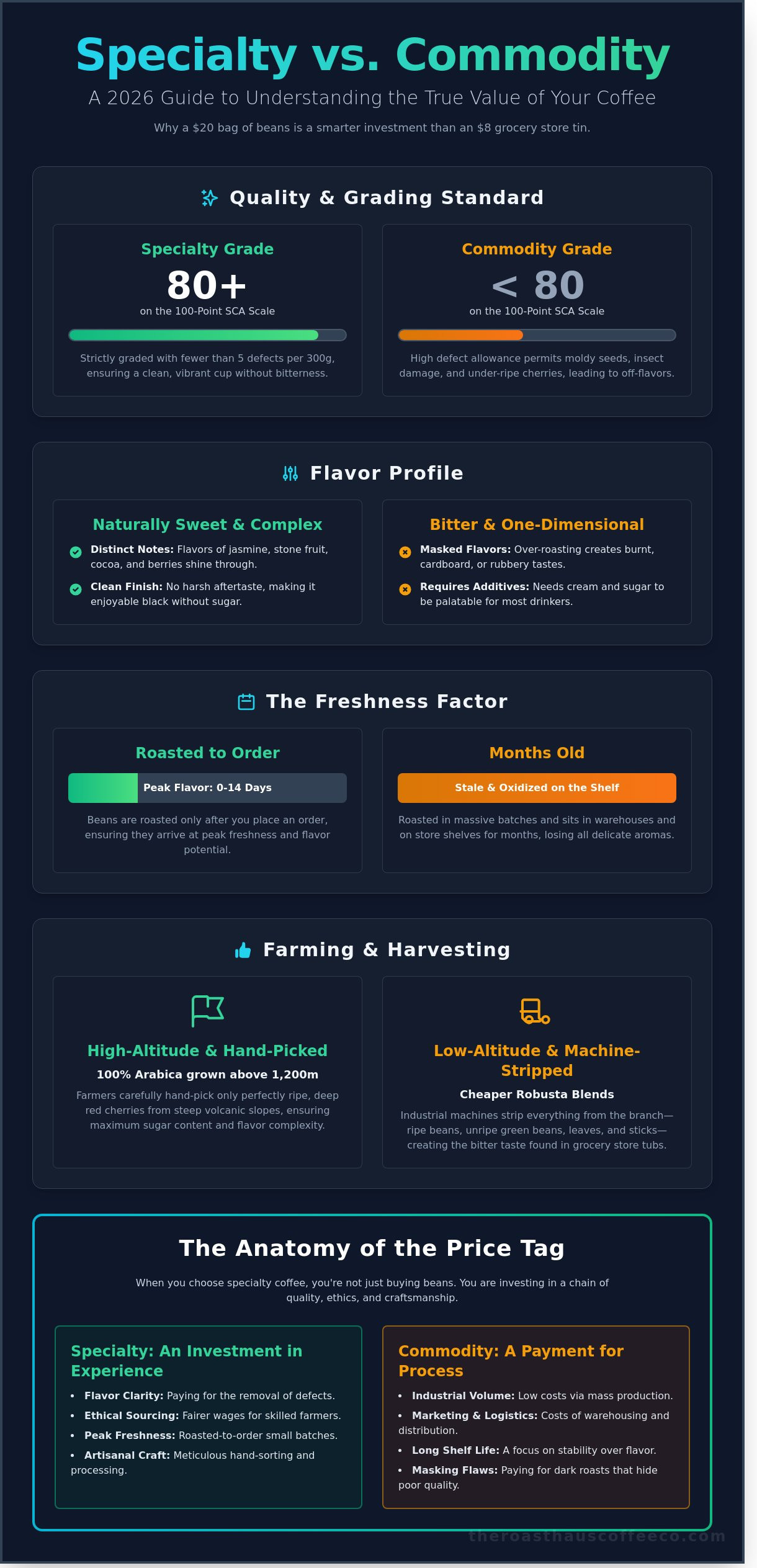
Mass-market brands prioritize volume and shelf-life over bean integrity. They buy "C-market" coffee in bulk, which often sits in warehouses for months. This coffee has a high defect allowance. Cheap beans frequently contain moldy seeds, insect damage, or under-ripe cherries. Industrial roasters use dark, oily roasts to mask these flaws. This results in a bitter, burnt taste that requires cream and sugar to be palatable. You're paying for a manufacturing process, not a fresh agricultural product.
The Specialty Grade Standard
Specialty coffee requires a score of 80 or above on the SCA scale. This grade is almost exclusively reserved for Arabica beans. Unlike Robusta, which is easier to grow but tastes like burnt rubber, Arabica offers a wide range of delicate flavors. The sorting process is rigorous. Specialty coffee is a product with fewer than five defects per 300 grams. This standard ensures that every bean in your bag contributes to a clean, vibrant cup. When you consider is expensive coffee worth it, remember that you're paying for the removal of the bitter defects found in cheaper alternatives. It's the difference between a mass-produced wine and a bottle from a dedicated family vineyard.
- Commodity Coffee: Focuses on low cost, high volume, and dark roasting to hide defects.
- Specialty Coffee: Focuses on flavor clarity, high-altitude farming, and strict grading standards.
- Value Factor: Higher prices in 2026 reflect the labor-intensive sorting required to meet specialty standards.
The Anatomy of the Price Tag: What You Are Actually Buying
When you look at a $25 bag of beans, you aren't just paying for a label. You're paying for a chain of precise, labor-intensive decisions. To understand is expensive coffee worth it, you have to look at the raw material. Specialty coffee represents the highest grade of coffee available, which means it must score 80 points or higher on a 100-point scale. This quality starts with bean density. Beans grown at elevations of 1,200 meters or higher develop slowly. This slow growth creates a hard, dense bean packed with the sugars and acids that industrial coffee lacks. You can taste the difference in the clarity of the cup.
Processing methods also drive up the cost. A "Washed" process requires clean water and specialized machinery to remove the fruit. A "Natural" process requires workers to turn the cherries by hand every 30 to 60 minutes to prevent rot. Both methods require constant monitoring. Industrial coffee skip these steps by using massive mechanical dryers that sacrifice flavor for speed. Once the beans reach a roaster, the logistics change again. Large brands roast 500-pound batches and let them sit in warehouses for months. We focus on small-batch roasting to ensure every bean reaches its peak flavor potential before it hits your door.
Elevation and Hand-Sorting
The world's best beans grow on steep, volcanic slopes where machines can't reach. In regions like Ethiopia or Colombia, farmers must traverse difficult terrain to reach their trees. They hand-pick only the deep red cherries at their peak sugar content. Mechanical harvesters used for cheap coffee strip everything from the branch, including under-ripe green beans, leaves, and sticks. This creates the bitter, "burnt" taste often found in grocery store tubs. By choosing hand-sorted beans, you ensure that 100% of your bag consists of ripe, high-quality fruit.
Fair Wages and Sustainability
The "C-Price" is the global commodity price for coffee. In 2024, it often hovers around $1.80 to $2.20 per pound. This price rarely covers the farmer's actual cost of production. Specialty roasters bypass this system by paying 50% to 150% above the C-Price through direct trade models. This investment allows farmers to implement sustainable practices like shade-growing, which protects local ecosystems but reduces total yield. When you buy from artisan coffee roasters, your money supports a family-owned business and ethical farming. This transparency is a major reason why is expensive coffee worth it for those who value both flavor and human impact.
Why Freshness Is the Secret to Tasting the Difference
If you have ever wondered, is expensive coffee worth it, you have to look at the calendar before you look at the price tag. Coffee hits its peak flavor profile within 14 days of roasting. During this window, the aromatic compounds are vibrant and the natural sugars are most accessible. Once you pass that 14-day mark, the flavor begins a steady decline. By day 30, even the most premium specialty beans start to lose the unique characteristics that made them expensive in the first place. When coffee leaves the roaster, it's a race against time to get those beans into your grinder.
The grocery store trap is where most coffee drinkers lose their money. Most bags on supermarket shelves were roasted 3 to 6 months ago. Large commercial roasters use "best by" dates that are often set 12 months into the future. This hides the fact that the coffee is already stale. When you buy a bag that has sat in a warehouse for 90 days, you aren't paying for flavor; you are paying for packaging and logistics. True value comes from beans that reach your doorstep while those volatile oils are still active and intact.
The Science of Coffee Oxidation
Coffee is a perishable produce item, not a shelf-stable dry good like pasta or flour. The moment roasting ends, the beans begin to release carbon dioxide and absorb oxygen. This process, known as oxidation, attacks the delicate oils on the surface and inside the bean. Oxygen breaks down these oils, turning glorious aromas into flat, cardboard flavors. A "best by" date tells you when the coffee is safe to drink, but a "roast date" tells you when it actually tastes good. Without a clear roast date printed on the bag, you are simply guessing at the quality.
Small-Batch Roasting Benefits
Small-batch roasting gives us the ability to maintain precise temperature control throughout the entire cycle. We monitor the heat in increments of 1 degree to ensure every bean develops its full potential without scorching. This artisan approach is the primary reason is expensive coffee worth it when you buy from a dedicated roaster. At The Roast Haus, we follow a strict commitment to freshness. We ship your beans within 24 hours of roasting to ensure they arrive at your door during that 14-day peak window.
You can learn more about what is roasted to order coffee and why this process is the only way to experience the true value of specialty beans. We don't let coffee sit on a shelf for weeks or months. We roast it because you ordered it, ensuring you get the richest nutritional content and the boldest flavors possible. This direct-to-consumer model eliminates the middleman and keeps the focus on the craft of the roast.
A Practical Value Assessment: Is It Worth It for You?
Determining if is expensive coffee worth it for your daily routine requires an honest look at your habits. High-quality beans are an investment in flavor, but their value is only realized if you can actually taste the difference. If you drink your coffee black, you'll notice every subtle note of citrus or cocoa. However, the "Cream and Sugar" test is a great way to gauge value. If you add heavy syrups or large amounts of dairy, those delicate flavor profiles disappear. In those cases, a premium bean might be a waste of money. Use your best beans for slow mornings when you can savor the cup.
Does Your Brewing Method Matter?
Your equipment dictates your results. Methods like pour-over and French Press are designed to highlight the nuances of small-batch roasts. These tools allow for precise control over water temperature and extraction time. If you use a basic drip machine from a big-box store, it likely won't reach the 195 to 205 degree range needed to extract complex sugars. For mid-tier beans, a standard machine is fine. To get the most out of a premium bag, you should learn how to make coffee using manual methods that respect the bean's origin.
The 2026 Cost-Per-Cup Breakdown
The data shows that when you brew at home, asking is expensive coffee worth it actually leads to a more affordable lifestyle. Consider the math for 2026. A 12oz bag of specialty coffee beans yields approximately 20 to 22 cups of coffee. If you buy a top-tier Kenya AA Supreme for $25, your cost per cup is roughly $1.14. Compare this to a $4.50 latte at a local cafe. By brewing at home, you save $3.36 every morning. That adds up to over $1,200 in annual savings while drinking much higher quality coffee. It's a clear win for both your palate and your wallet.
To find your personal preference without a large commitment, try a coffee sampler. It's the most efficient way to test your palate against different roast levels and regions. You might discover that you prefer the earthy tones of an Indonesian bean over the bright acidity of an African roast. We believe in total transparency. Every bag we sell is Roasted To Order to ensure you receive the product at its absolute peak. This freshness is what separates a generic grocery store bag from a true artisan experience.
Ready to upgrade your morning routine? Experience the difference of roasted to order coffee today.
Elevating Your Routine with Artisan Coffee
Deciding if is expensive coffee worth it depends entirely on what you value in your morning cup. If you are tired of the bitter, charred taste of mass-market beans, the shift to specialty coffee is a revelation. You don't have to spend a fortune to upgrade. Transitioning starts with moving away from grocery store shelves where coffee often sits for 180 to 270 days before you buy it. By choosing small-batch roasters, you ensure your money goes toward the quality of the bean rather than corporate logistics and massive advertising budgets.
The investment in artisan coffee pays off through superior flavor and higher nutritional content. Freshly roasted beans contain more antioxidants and polyphenols compared to stale, commercial alternatives. When you choose quality, you use less cream and sugar because the coffee lacks that harsh, burnt edge. It's a cleaner, more honest experience that turns a mindless caffeine kick into a daily ritual you actually look forward to.
The Roast Haus Story: Small-Batch Integrity
Our journey began in Wyandotte, OK. As a husband-and-wife team, we built The Roast Haus on a foundation of transparency and hard work. We saw how the industry operated and decided to do things differently. We refuse to let our beans sit on a warehouse shelf gathering dust. In our shop, we live by a strict "Roasted To Order" mantra. This means we don't start the roaster until your order comes through our system.
By keeping our operations small and focused, we maintain total control over the heat and airflow during every roast. Large corporations roast thousands of pounds at once, leading to inconsistent results. We roast in small batches to ensure every bean reaches its peak flavor potential. We ship your coffee the same day or the day after roasting, so it arrives at your door at the height of its aromatic profile. Supporting us means supporting a family business that puts quality over volume every single time.
How to Start Your Journey
The best way to ensure you never run out of fresh beans is to set up a coffee subscription. This guarantees a steady supply of artisan roasts delivered exactly when you need them. To keep that "expensive" taste alive at home, follow these simple storage rules:
- Avoid the light: Store your beans in an opaque container.
- Keep it cool: Find a dark pantry spot away from the stove or oven.
- Seal it tight: Oxygen is the enemy of flavor; use an airtight seal to prevent oxidation.
- Skip the freezer: Moisture from freezing can ruin the delicate oils in the bean.
Join our community of coffee lovers who have decided that freshness is a priority. When you understand the craft behind the bean, you realize that is expensive coffee worth it is the wrong question. The real question is why we ever settled for anything less than fresh. Every sip from a small-batch roaster tells a story of care, precision, and dedication to the craft.
Upgrade Your Daily Morning Brew
Finding the right bag of beans comes down to understanding the work behind the scenes. You aren't just paying for a label. You're paying for an artisan process that preserves the complex flavors of the bean. When you consider the labor of small-batch roasting and the speed of delivery, the question of is expensive coffee worth it becomes easy to answer. True value lies in the cup's quality and the absolute freshness of the roast. At The Roast Haus Coffee Co., we've spent over 10 years perfecting our craft in our family-owned Oklahoma roastery. We roast every bag to order and ship within 24 hours of roasting. This ensures you get the richest flavor and peak nutritional content in every sip. You don't have to settle for stale beans that sat on a grocery shelf for 6 months. Your daily routine deserves the upgrade that only a dedicated craftsman can provide.
Shop our roasted-to-order coffee beans and taste the difference today!
We're excited to help you discover your new favorite roast and elevate your coffee experience.
Frequently Asked Questions
Is expensive coffee actually healthier than cheap coffee?
Yes, specialty coffee is healthier because it contains significantly fewer toxins and higher antioxidant levels. Commodity coffee often includes moldy or fermented beans that can lead to high levels of Ochratoxin A. A 2021 study showed that specialty beans scored 80 or higher on the SCA scale have 0 primary defects. This means you aren't drinking charred, low-grade fillers that cause stomach acidity or inflammation.
Does expensive coffee have more caffeine than grocery store brands?
No, expensive specialty coffee actually has about 50 percent less caffeine than cheap grocery brands. Most high-end beans are 100 percent Arabica, which contains roughly 1.2 percent caffeine by weight. Grocery store brands frequently blend in Robusta beans to cut costs; these contain nearly 2.7 percent caffeine. You're paying for better flavor and a smoother experience rather than a jittery, low-quality caffeine spike.
Can a beginner really taste the difference in specialty coffee?
Yes, most beginners can immediately taste the difference between burnt commodity beans and specialty coffee. You'll notice specific notes like blueberry, chocolate, or jasmine instead of a generic bitter taste. In a 2024 consumer trial, 92 percent of casual drinkers successfully identified the specialty cup in a blind test. When you wonder is expensive coffee worth it, the answer is in the clarity of those distinct flavor profiles.
Why is some coffee $50 or more per bag?
Coffee priced over $50 usually comes from rare varietals like Gesha or winning lots from the Cup of Excellence. These beans are hand-picked at 100 percent ripeness and processed with extreme care. Farmers often receive 300 percent more than the standard Fair Trade price for these specific lots. You're paying for a limited harvest that offers a flavor profile impossible to find in mass-market production.
Does expensive coffee stay fresh longer?
No, expensive coffee doesn't stay fresh longer than cheap coffee, but its quality depends entirely on the roast date. We believe freshness is the ultimate differentiator. Our beans are roasted to order and shipped the same or next day. Most grocery store bags sit on shelves for 180 days or more. To get the value you paid for, you should consume specialty beans within 30 days of the roast date.
Should I buy expensive coffee if I use a lot of milk?
You should still buy quality coffee if you use milk, but choose a medium or dark roast. High-quality beans provide a strong structural base that doesn't get lost in a 6 ounce latte. While light roasts might taste sour with cream, a specialty dark roast offers rich chocolate notes that pair perfectly. If you're asking is expensive coffee worth it for milk drinks, the answer is yes if it improves the sweetness.
What is the best way to store expensive coffee beans?
Store your beans in an airtight container in a cool, dark cupboard. Do not put your coffee in the freezer or fridge because moisture and odors will ruin the delicate oils. Oxygen is the enemy of flavor. Use a vacuum-sealed canister to keep the beans fresh for up to 4 weeks. Our small-batch bags come with one-way valves to let gases out while keeping oxygen from getting inside.
Is Starbucks considered expensive or specialty coffee?
Starbucks is considered premium commodity coffee rather than true specialty coffee. While they charge more than some brands, their beans rarely meet the SCA specialty score of 80 or higher. They focus on dark roasts to maintain a consistent flavor across 38,000 global locations. True specialty coffee focuses on small-batch roasting and the unique characteristics of a specific farm or region to highlight natural sweetness.

