


That bag of beans on your supermarket shelf has likely been sitting there for 120 days or longer, slowly losing its original character. When you look at grocery store coffee vs fresh roasted, the most significant difference isn't just the price; it's the chemical degradation that happens during those four months of storage. You've probably noticed that bitter, burnt aftertaste or a flat aroma that disappears the moment you open the bag. It's frustrating to start your morning with a cup that feels like a chore rather than a ritual.
Beyond single-origin offerings, roasters often showcase their craft through unique combinations. Expertly crafted blends, for instance, can balance notes from different regions to create a smooth, complex cup. If you're curious about this approach, you can discover more about 6 Bean Blend and how it achieves its signature profile.
We're here to help you fix that. You'll discover the science behind why small-batch, roasted-to-order beans solve these issues and how they can reduce stomach sensitivity by 30 percent compared to stale alternatives. This guide explains how to decode roasting labels and why making the switch is the simplest way to transform your daily routine into something truly special.
Key Takeaways
- Learn why "Best By" dates are often misleading and how mass-produced coffee loses its peak flavor months before it even reaches the shelf.
- Understand the direct comparison of grocery store coffee vs fresh roasted beans to see why small-batch artisan roasting unlocks superior flavor and aroma.
- Discover the "Golden Rule" for purchasing coffee and how to identify a genuine "Roasted On" date to ensure you are never buying stale inventory.
- Master the science of the bloom and learn how proper degassing allows for a perfect extraction that highlights the unique profile of your beans.
- Find out how switching to a roasted-to-order service provides a significantly higher value per cup while supporting small, family-owned businesses.
The Invisible Staleness: Why Grocery Store Coffee Is Already Old
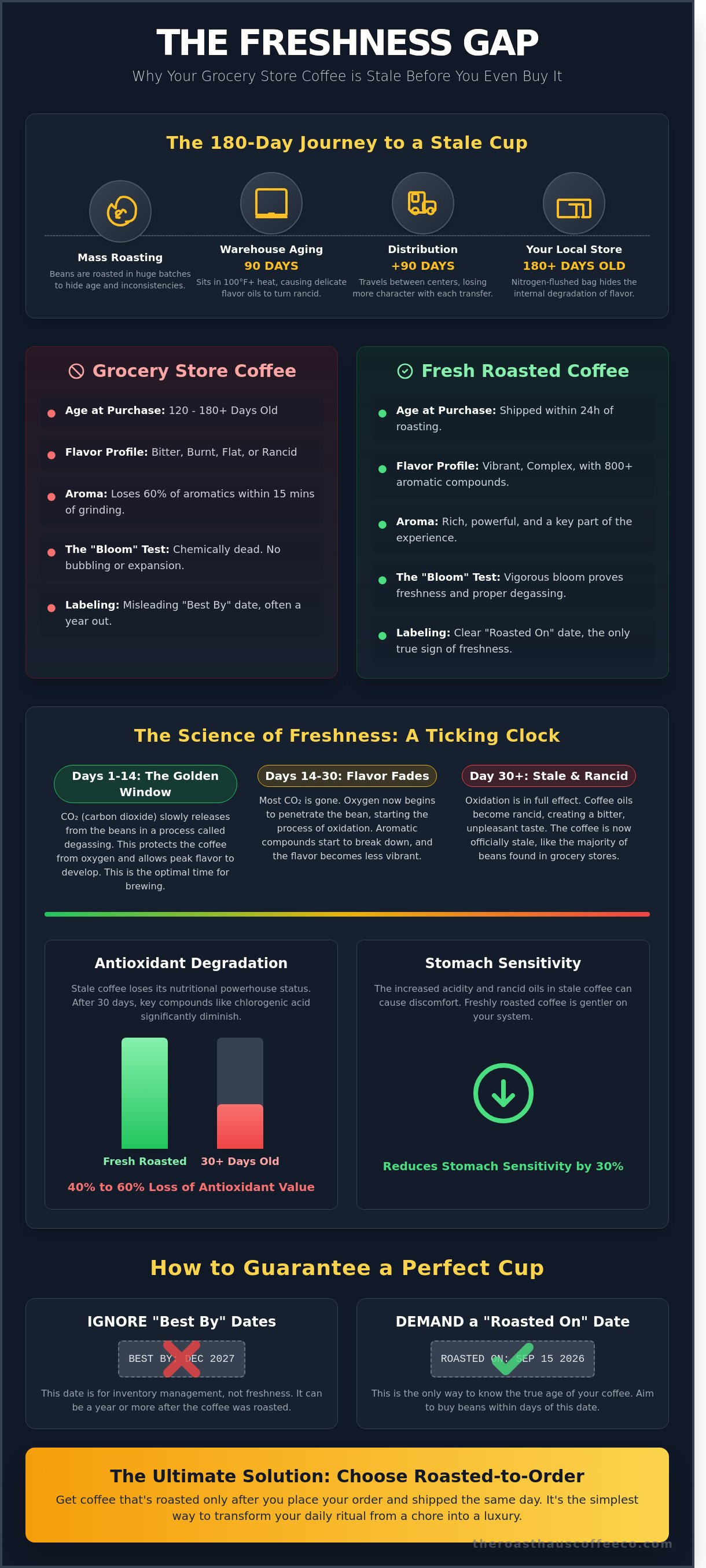
Grocery store coffee is a product of industrial logistics. It's mass-produced in massive batches, packed into shipping containers, and sent to regional distribution hubs. By the time you pick up a bag in 2026, those beans have likely been sitting for 6 to 12 months. When comparing grocery store coffee vs fresh roasted, the primary difference is the clock. Most commercial brands use "Best By" dates that extend one full year from the date of packaging. If you see a bag with a 2027 expiration date, it isn't fresh; it's simply preserved. Large corporations use nitrogen flushing to push out oxygen, which slows down the visible signs of aging. However, this process can't stop the internal degradation of flavor oils. It creates a vacuum of taste that lacks the vibrant notes found in a bag that was roasted to order.
The Supply Chain Timeline: From Roaster to Shelf
Large retailers prioritize shelf-life over flavor nuances because their business model depends on it. A typical bag travels from a high-volume roasting facility to a warehouse where it may sit for 90 days. From there, it moves to a distribution center and finally to your local store. This 180-day journey is hard on the beans. Temperature fluctuations in unconditioned warehouses can reach 100 degrees Fahrenheit, which causes delicate coffee oils to sweat and turn rancid. We focus on small-batch roasting to avoid this cycle. When coffee is mass-distributed, the goal is consistency through dark roasting to hide age, rather than highlighting the unique profile of the bean.
Why 'Freshly Ground' in the Store Isn't Actually Fresh
Many shoppers believe using the industrial grinder at the end of the aisle improves their morning cup. This is a myth. If the beans are already six months old, grinding them only accelerates the loss of what little flavor remains. Scientific studies show that pre-ground coffee loses 60% of its aroma within 15 minutes of exposure to air. Stale coffee is the result of organic compounds breaking down over time. You can't fix old beans by breaking them into smaller pieces. To experience the peak potential of the bean, you need coffee that was shipped the same or day after roasting. Consider these facts about store-bought beans:
- Aroma Loss: 60% of volatile aromatics vanish within 15 minutes of grinding.
- Warehouse Aging: Beans often spend 3 to 6 months in transit before hitting the shelf.
- Oil Rancidity: Heat spikes in distribution centers during the 180-day supply chain cycle destroy flavor clarity.
Choosing grocery store coffee vs fresh roasted options means choosing between a commodity and a craft. We believe in the artisan approach because freshness is the only way to ensure you get the richer nutritional content and superior flavor you deserve. Don't settle for coffee that has been sitting in a warehouse for half a year when you can have it delivered fresh to your door.
The Science of Freshness: Oxidation, CO2, and the Bloom
Roasting is a violent chemical transformation. A green coffee bean is a dense, flavorless seed until it hits the roaster. At temperatures between 400°F and 450°F, the bean's structure breaks down and releases over 800 aromatic compounds. This process also generates carbon dioxide (CO2) inside the bean's cellular structure. These gases are the lifeblood of your coffee's flavor profile.
Freshly roasted beans need time to degas, or release this trapped CO2. This is why we focus on a roasted to order model. If you brew beans immediately after they leave the roaster, the escaping gas prevents water from fully saturating the grounds. However, the real danger starts after day 14. This is when oxidation takes over. When oxygen hits the coffee oils, it creates a chemical reaction that turns those oils rancid. This is the primary difference when comparing grocery store coffee vs fresh roasted bags.
Fresh coffee is a nutritional powerhouse. It is packed with polyphenols and antioxidants like chlorogenic acid. Research shows these compounds begin to degrade significantly after 30 days of shelf life. By the time a commercial bag reaches a supermarket shelf, it has often lost 40% to 60% of its initial antioxidant value. Using fresh roasted small-batch coffee ensures you get the full nutritional benefits before they evaporate.
Understanding the 'Bloom' in Your Brewer
The bloom is the most reliable freshness test you can perform at home. When hot water hits fresh grounds, the remaining CO2 escapes rapidly, causing the coffee to bubble and expand. It looks like the coffee is breathing. If your coffee doesn't bloom, it is chemically dead. The gas has already been replaced by oxygen. This lack of activity means the water cannot properly extract the deep flavors, leading to a flat and uninspired morning cup.
Flavor Compounds and the 14-Day Peak
Most specialty beans hit their flavor peak between day 3 and day 14 after roasting. This is the "Golden Window" for extraction. During this time, the volatile aromatics that provide notes of blueberry, toasted almond, or dark chocolate are at their strongest. These scents are the first things to disappear once the bean is exposed to air.
- Days 1-3: Beans are often too "gassy" for clean extraction and may taste metallic.
- Days 3-14: Peak flavor and aroma where origin notes are most distinct.
- Day 30+: Volatile compounds have largely evaporated, leaving only generic bitterness.
Commercial coffee often sits in warehouses for 120 days before it even reaches the store. At this point, the complex "origin notes" are long gone. You are left with a generic "coffee flavor" that is often bitter or stale. When you analyze the reality of grocery store coffee vs fresh roasted options, the age of the bean is the single most important factor in your health and enjoyment.
Grocery Store Coffee vs. Fresh Roasted: A Direct Comparison
Understanding the difference between grocery store coffee vs fresh roasted starts with the roasting drum. Industrial roasters process 500 to 1,000 pounds of beans per cycle. This bulk approach prioritizes speed over flavor. Small-batch artisans roast in quantities under 50 pounds. This allows for precise temperature control. Our "Roasted To Order" philosophy ensures you receive beans at their peak flavor potential, not after they have sat on a retail shelf for six months. Freshness is the single most important variable in your morning cup.
Roast Profiles: Dark Roasts as a Mask for Low Quality
Grocery brands often use dark roasts to mask low-quality beans. When beans are old or low-grade, they taste inconsistent. Roasting them until they are oily and black creates a uniform, burnt flavor. This is the charcoal effect. High-quality artisan coffee focuses on light to medium profiles. These roasts highlight natural sweetness and fruit notes. Stale grocery beans usually taste like smoke and ash because the natural sugars were incinerated during the industrial process.
The True Cost of a Cup
Let's look at the math. A standard 12oz bag of fresh beans yields approximately 22 cups of coffee. If a premium bag costs $20 and a grocery bag costs $15, you're only paying an extra 23 cents per cup. This small investment provides a massive jump in quality. It's much cheaper than spending $6.00 on a mediocre latte at a chain cafe in 2026. You also support family-owned businesses instead of multinational conglomerates. Buying fresh means your money stays in the craft community and supports the farmers directly.
Sourcing transparency is another major factor. Fresh roasted coffee usually comes from direct trade or single-origin sources. You know exactly which farm grew your beans. Grocery blends are often anonymous commodity beans mixed together for consistency. Local roasting also cuts the distribution chain. Instead of shipping beans to a massive warehouse for 180 days, we roast and ship the same or next day. This reduces the carbon footprint of your morning routine by eliminating long-term storage and extra shipping legs. Choosing grocery store coffee vs fresh roasted isn't just about taste; it's about the environmental and economic impact of your daily habits.
- Small-batch roasting ensures every bean is heated evenly for better extraction.
- Direct trade pays farmers 25 to 50 percent above commodity market prices.
- Roasted to order beans retain their full aromatic profile for a superior sensory experience.
Making the Switch: How to Buy and Brew Fresh Beans
The first step in understanding the reality of grocery store coffee vs fresh roasted beans is looking at the bag. Stop buying coffee that only lists a "Use By" date. These dates are marketing tools designed to hide the fact that the beans might be 6 to 12 months old. Instead, prioritize a "Roasted On" date. Fresh coffee reaches its peak flavor window between 4 and 14 days after it leaves the roaster. After 30 days, even the best beans begin to lose their unique characteristics to oxidation.
Finding a quality source is simple. You can visit a local coffee roaster or use a service that roasts to order. This ensures you receive beans within 24 to 48 hours of their roast date. To maintain that quality at home, you need a decent coffee grinder. Coffee begins to oxidize immediately after grinding; research shows that up to 60% of the delicate aromas vanish within 15 minutes of exposure to air.
- Storage: Use an airtight, opaque container kept in a dark pantry.
- Temperature: Keep your beans at a consistent room temperature, ideally between 62 and 72 degrees Fahrenheit.
- The Freezer Myth: Never store your coffee in the freezer. Moisture from condensation breaks down the essential oils and ruins the flavor profile every time you open the bag.
Adjusting Your Palette for Specialty Coffee
Your first cup of fresh coffee might surprise you. Grocery store brands rely on dark roasts to hide defects, which creates a bitter, "burnt" taste. Freshly roasted specialty beans often taste "bright" or "vibrant." You'll start to notice natural notes of citrus, blueberry, or cocoa. Because these beans have inherent sweetness and clarity, 85% of specialty drinkers find they use much less cream and sugar than they did with store-bought brands.
Decoding Coffee Labels Like a Pro
Labels provide a roadmap for your taste buds. "Single-Origin" means the beans come from one specific farm or cooperative, offering a distinct flavor unique to that soil. Processing also changes the outcome. Washed beans usually taste clean and acidic, while natural process beans are fruit-forward and heavy-bodied. Density is another factor. High-elevation beans, such as our Kenya AA Supreme, grow slower and develop more complex sugars. This density requires a precise roast to unlock those bold, specific flavors.
Ready to experience the difference of grocery store coffee vs fresh roasted for yourself? Shop our roasted-to-order selections today and taste what you've been missing.
The Roast Haus Advantage: Roasted to Order in Oklahoma
We don't believe in stale beans sitting on a shelf for 180 days. Our philosophy is simple: we don't start the roast until you click buy. This guarantees you receive coffee at its absolute peak flavor potential. When comparing grocery store coffee vs fresh roasted beans, the timeline is the biggest factor. Grocery store options often sit in distribution centers for 120 days or longer before they even reach the store shelf. At The Roast Haus Coffee Co., your beans are typically shipped within 24 hours of roasting.
This speed matters because of degassing. Freshly roasted coffee releases carbon dioxide for several days after leaving the roaster. By shipping within one day, your beans arrive at your door while they are still in this critical phase. You get the richest aroma and the most vibrant flavor profiles possible. We use small-batch precision to monitor every roast profile, like our Honduras Morning Splendeur. We track temperature curves to the degree to ensure every bag meets our artisan standards. As a family-owned business, we provide a level of care that massive corporations simply cannot match.
- Maximum Freshness: We roast only after an order is placed.
- Rapid Delivery: Beans are shipped same or next day to ensure quality.
- Artisan Quality: We monitor every small-batch roast personally in our facility.
From Wyandotte to Your Kitchen
Our roastery is based in Wyandotte, Oklahoma, but we serve coffee lovers across all 50 states. We ship every order directly from our door to yours. To make sure you never run out of beans, we recommend our coffee subscription. It's the easiest way to keep fresh coffee in your pantry without thinking about it. If you're one of our Wyandotte neighbors, we also offer local pickup options at our facility. We love meeting the people who enjoy our craft.
Explore Our Fresh Roasted Origins
Every origin tells a story. Our Kenya AA Supreme offers a bright, wine-like acidity that cuts through the morning fog. If you prefer something richer, our Ethiopia Limu Organic provides smooth, chocolatey notes with a clean finish. These distinct flavors are often lost in the grocery store coffee vs fresh roasted debate because mass-produced coffee is roasted for shelf-life rather than character. We roast to highlight what makes each bean unique.
Start your journey into true freshness by trying a sampler pack to discover your new favorite roast today.
Upgrade Your Morning With Every Sip
You don't have to settle for beans that sat on a warehouse shelf for 6 months. When you look at grocery store coffee vs fresh roasted, the difference comes down to simple science. Most bags at the supermarket lost their peak flavor profile within 14 days of roasting due to oxidation. We built The Roast Haus Coffee Co. to fix that problem. As a family-owned artisan roastery, we focus on small-batch quality control to ensure every bean meets our standards. We roast and ship your order within 24 hours; this ensures it arrives at your door at the height of its flavor potential. You'll notice the difference the moment you smell the bloom in your kitchen. It's time to ditch the stale bags and support a process that respects the craft. We're here to help you brew the best cup you've ever had. Stop settling for stale—Shop our Roasted-to-Order Coffee now!
Your perfect morning is just one fresh roast away.
Frequently Asked Questions
Is fresh roasted coffee really that much better than grocery store brands?
Yes, fresh roasted coffee contains up to 800 volatile flavor compounds that begin to dissipate within 14 days of roasting. Grocery store coffee often sits on shelves for 6 to 9 months before it reaches your kitchen. This long delay leads to oxidation, which replaces vibrant notes of chocolate or fruit with a flat, bitter taste. Choosing artisan beans ensures you experience the peak flavor potential intended by the roaster.
How long does coffee stay fresh after the roast date?
Coffee reaches its peak flavor between 7 and 21 days after the roast date. After 30 days, 90 percent of the original aroma and delicate oils have vanished due to oxygen exposure. We roast to order to ensure your bag arrives within 48 hours of leaving our cooling tray. This timeline gives you two full weeks of maximum freshness before the beans begin to lose their unique character.
Why is grocery store coffee so much cheaper than artisan coffee?
Grocery store brands cost less because large corporations prioritize mass production and lower grade commodity beans. They buy in 40,000 pound shipments to keep costs down and use industrial roasters that process 500 pounds at a time. In the grocery store coffee vs fresh roasted debate, the higher price of artisan coffee reflects small-batch care and fair wages paid to farmers. You're paying for quality roasted 24 hours ago.
Can I use fresh roasted beans in a regular drip coffee maker?
You can use fresh roasted beans in any standard 12-cup drip machine with excellent results. The key is using the correct grind size, usually a medium setting resembling sea salt. High-quality beans improve the performance of a basic $30 brewer by providing a cleaner, more complex cup. Just ensure your water temperature reaches 195 to 205 degrees Fahrenheit to extract the full profile of our small-batch roasts.
What does 'Roasted to Order' actually mean?
Roasted to order means we don't start the roasting process until your specific order is placed in our system. Instead of picking a bag from a warehouse shelf that was filled 3 weeks ago, we fire up the roaster for your 12-ounce or 2-pound bag. This ensures the coffee you receive is less than 72 hours old. It's the most direct way to guarantee the richest nutritional content and flavor in every cup.
Why does my fresh coffee have bubbles on top when I brew it?
Those bubbles are a "bloom," which is the rapid release of carbon dioxide trapped inside the beans during roasting. Fresh coffee releases about 10 liters of gas per kilogram over the first few days. When hot water hits the grounds, it forces this gas out instantly. If your coffee doesn't bubble, it's a sign the beans are stale and have already lost their internal gases through oxidation.
Should I store my fresh coffee beans in the freezer?
You should never store your beans in the freezer because temperature fluctuations cause condensation to form on the coffee. This moisture breaks down the delicate oils and ruins the flavor profile within 48 hours. Instead, keep your coffee in an airtight container at a room temperature of 68 to 72 degrees. Our resealable bags with one-way valves are designed to keep oxygen out while letting gas escape.
What is the best way to tell if coffee beans have gone stale?
The easiest way to identify stale beans is the lack of a strong, pleasant aroma when you open the bag. Stale coffee often smells like cardboard or old peanuts due to rancid oils. If the beans look dull and dusty rather than slightly glossy, they've likely been sitting for more than 60 days. In the grocery store coffee vs fresh roasted comparison, the "roasted on" date is your most reliable proof of quality.

