


What if the bright, wine-like flavor you expect from kenya aa coffee beans tastes sour instead? The difference can come down to freshness, brewing, and what “AA” actually means. Kenya AA is prized for lively acidity, a full body, and fruit notes such as black currant and citrus. But a grade label alone can’t promise a great cup.
If you’ve paid more for beans that arrived stale or felt unsure whether AA means better coffee, those concerns make sense. In this guide, you’ll learn how Kenya’s grading system works, what sets Kenyan coffee apart, and how to brew it to bring forward its fruit and floral character without letting the acidity overwhelm the cup.
You’ll also see why roast timing matters. The Roast Haus Coffee Co. makes Kenya AA Supreme in small batches and ships it within 24 hours of roasting. We’ll cover what to look for when buying, how to approach your brew, and how fresh-roasted coffee can help you taste the qualities that make this origin distinctive.
Key Takeaways
- Learn what the AA grade tells you about kenya aa coffee beans, and why bean size alone doesn’t guarantee a great cup.
- Discover the fruit-forward, wine-like character Kenyan coffee is known for, including notes that can guide your tasting.
- See how roast freshness can affect aroma and flavor, and what to look for when buying beans online.
- Explore brewing choices and water temperature that can help bring out Kenyan coffee’s bright, complex notes.
- Find out how Kenya AA Supreme is small-batch roasted to order and shipped within 24 hours of roasting.
What Are Kenya AA Coffee Beans? Defining the Standard
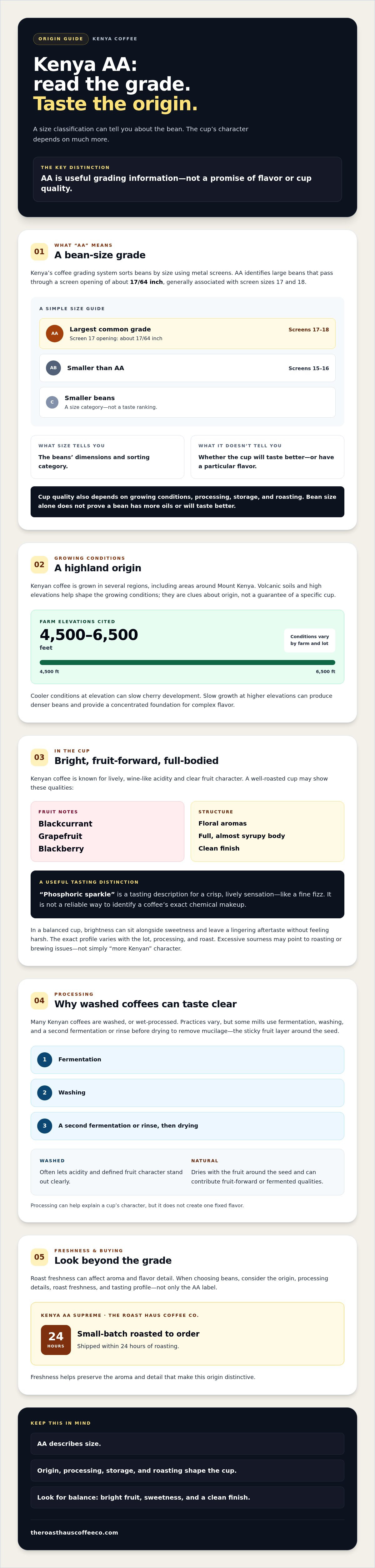
Kenya AA coffee beans are a size classification within Kenya’s coffee grading system, not a guarantee of a particular flavor or a complete measure of quality. “AA” identifies large beans that pass through a screen with holes measuring about 17/64 of an inch. That distinction matters: a size grade tells you about the beans’ dimensions, while the cup’s quality also depends on factors such as growing conditions, processing, storage, and roasting.
Kenyan coffee has earned a reputation as the “Connoisseur’s Cup,” valued for its distinctive character and careful production. For a broader look at the country’s coffee history and industry, see Coffee production in Kenya. Larger beans are sometimes said to hold more essential oils and flavor, but size alone doesn’t prove that a bean contains more oils or will taste better. Think of AA as useful grading information, not a flavor promise.
The Significance of Screen Size 17 and 18
After processing, coffee beans are sorted through metal screens with openings sized to separate beans by width. AA beans are generally associated with screen sizes 17 and 18; the 17/64-inch measurement describes the opening for screen 17. A more uniform lot can roast more evenly because its beans are closer in size, though other factors also affect roast consistency.
AB beans are smaller, typically sorted through screens 15 and 16, while C refers to smaller beans. These are size categories, not a simple ranking of taste. AA is the largest common grade, but it isn’t automatically the best cup. Look beyond the letters to the coffee’s origin, processing details, roast freshness, and tasting profile.
Why High-Altitude Growing Matters
Kenyan coffee is grown in several regions, including areas around Mount Kenya, where volcanic soils and high elevations help shape growing conditions. Coffee farms in the region can sit at elevations of roughly 4,500 to 6,500 feet, though conditions vary by farm and lot. Cooler conditions at elevation can slow cherry development, giving the beans more time to mature.
Slow growth at higher elevations can produce denser beans that retain a concentrated foundation for complex flavor. That’s one reason origin and growing conditions are useful clues when choosing coffee, alongside the AA grade. Size sets a standard for sorting; it doesn’t tell the whole story of what you’ll taste.
The Legendary Flavor Profile of Kenyan Coffee
Kenyan coffee is known for a lively, wine-like acidity and a clear fruit character. In a well-roasted cup, kenya aa coffee beans may bring to mind blackcurrant, grapefruit, and blackberry, with floral aromas and a full, almost syrupy body. The Cabernet comparison describes the wine-like impression, not a flavor match: expect bright fruit and structure rather than grape or wine itself.
Well-processed Kenyan coffee often finishes clean, so its fruit notes remain distinct instead of blending into a muddy aftertaste. The exact profile changes with the lot, processing, and roast. World Coffee Research’s Kenyan coffee research offers useful background on the country’s coffee varieties, including SL28 and SL34. Those varieties are part of Kenya’s coffee story, but a specific lot’s flavor still depends on more than its variety name.
Understanding Phosphoric Acidity
People often use “citric” to describe a familiar lemon-like sharpness, while “phosphoric sparkle” suggests a crisp, lively sensation that can feel more like a fine fizz. These are tasting descriptions, not reliable labels for identifying a coffee’s exact chemical makeup. In a balanced cup, that bright lift can sit alongside sweetness, helping the aftertaste linger without feeling harsh.
This clarity and balance can make Kenyan coffees compelling in specialty tastings. Tasters can pick out distinct fruit, acidity, and finish rather than one note overpowering the rest. A vivid cup should still taste balanced; excessive sourness may point to roast or brewing issues, not simply “more Kenyan” character.
The Role of Wet Processing
Many Kenyan coffees are washed, or wet-processed. In some Kenyan mills, the method includes fermentation, washing, and a second fermentation or rinse before drying. These steps help remove the sticky fruit layer, called mucilage, from the coffee seed. Practices vary, so not every Kenyan lot follows one identical process.
By contrast, natural processing dries the coffee with the fruit still around the seed, which can contribute more fruit-forward or fermented qualities. Washed processing tends to let the bean’s own acidity and defined fruit character stand out more clearly. Processing doesn’t create one fixed flavor, but it helps explain why a washed Kenyan cup can taste so bright and clean.
For a practical taste of this origin, explore Kenya AA Supreme, a small-batch, roasted-to-order single origin from The Roast Haus Coffee Co. Freshness helps preserve the aroma and detail that make a carefully brewed Kenyan cup distinctive.
Freshness vs. Shelf Life: Why Roasted-to-Order is Vital
Kenyan coffee’s lively aroma and layered fruit notes depend on more than origin and roast. After roasting, aromatic compounds gradually fade, especially if beans are exposed to air, heat, light, or moisture. That loss can make a once-vivid cup seem muted. The International Coffee Organization provides context on the global coffee trade, but for your cup, the practical question is simpler: how recently were the beans roasted, and how have they been stored?
Grocery-store coffee can spend an unknown amount of time between roasting, warehousing, and purchase. That doesn’t mean every bag on a shelf is stale, but a roast date gives you a clearer freshness reference than a “best by” date alone. Choose whole beans in a well-sealed bag, check for a roast date, and store them away from air, light, heat, and moisture. For more guidance, read our guide to choosing the best coffee beans.
The Degassing Phase and Peak Flavor
Freshly roasted coffee releases carbon dioxide, a process called degassing. Some brewing methods benefit from allowing beans to rest after roasting, and the ideal rest varies with the roast and brew method. A fixed 24-to-48-hour wait isn’t a universal rule, and shipping quickly doesn’t mean coffee arrives at its exact flavor peak. It does mean the beans leave the roastery soon after roasting, giving you a fresher starting point and control over when to brew.
Oily beans need context, too. Oil on the surface can appear with darker roasts, and may also develop as roasted beans age. It isn’t proof by itself that coffee is stale. Consider the roast date, packaging, aroma, and taste together rather than judging freshness by appearance alone.
Small-Batch Craftsmanship in Oklahoma
The Roast Haus Coffee Co. is a family-owned artisan roastery in Wyandotte, Oklahoma, making Kenya AA Supreme in small batches and shipping it within 24 hours of roasting. Small-batch production keeps the process focused, while roasted-to-order fulfillment reduces the wait between roasting and dispatch. That clear timeline is more useful than a vague promise of “always fresh.”
For kenya aa coffee beans, freshness helps preserve the aromatic detail that makes the cup worth exploring. Choosing a family-owned roaster also supports an independent business built around careful production. Keep the beans sealed, grind them just before brewing, and adjust their resting time to suit your brew method.
How to Brew Kenya AA Beans for Maximum Flavor
The right brew brings out Kenyan coffee’s fruit and sweetness without making its acidity feel sharp. Start with fresh water and a repeatable recipe, then adjust one variable at a time. For a practical overview of home brewing methods, see our guide on how to make coffee at home.
A water temperature of 195°F to 205°F is a useful range for extraction. Start near the middle. If the cup tastes thin or sharply sour, try a slightly finer grind or hotter water. If it tastes bitter or drying, go a little coarser or cooler. Grind size matters because it changes how quickly water extracts flavor from the coffee.
The Pour-Over Method: Highlighting the Brightness
A pour-over with a Hario V60 or Chemex gives you control over water flow and produces a clean cup that can showcase citrus and berry notes. Begin with a coffee-to-water ratio of 1:16 or 1:17. For example, use 20 grams of coffee with 320 to 340 grams of water. Paper filters hold back much of the fine sediment and some oils, giving the brew a lighter, clearer texture.
- Rinse the paper filter and warm the brewer, then discard the rinse water.
- Use a medium grind and add the coffee.
- Pour a small amount of hot water over the grounds, wait briefly, then pour the remaining water steadily in stages.
- Taste the cup. Adjust grind size before changing several parts of the recipe at once.
French Press: A Bold, Syrupy Alternative
Prefer more body? French press immersion keeps more oils and fine particles in the cup, which can emphasize a syrupy texture and berry sweetness. Use a coarse, even grind. A quality coffee grinder helps limit fine particles that can slip through the press filter and make the brew muddy. After steeping, press slowly and pour the coffee promptly rather than leaving it on the grounds.
Both methods can work well with kenya aa coffee beans. Use pour-over to emphasize clarity, or French press for a fuller mouthfeel. Ready to put these brewing tips to work? Explore Kenya AA Supreme, small-batch coffee roasted to order and shipped within 24 hours of roasting.
Experience Kenya AA Supreme from The Roast Haus
Kenya AA Supreme is a single-origin coffee from The Roast Haus Coffee Co., made for drinkers who want to explore the distinctive character of Kenyan coffee. The coffee is roasted to order in small batches, then shipped within 24 hours of roasting. That clear timeline gives you a fresher starting point than a bag with no roast-date context.
The Roast Haus Coffee Co. is a family-owned artisan roastery in Wyandotte, Oklahoma, built around careful production and direct-to-consumer fulfillment. Buying from an independent roaster connects your cup to a small business with a hands-on approach. It also makes the roast timing easier to understand: the coffee is prepared to order, not described with a vague freshness claim.
From Our Oklahoma Roastery to Your Door
Each batch of Kenya AA Supreme is roasted in Wyandotte and shipped within 24 hours of roasting. When comparing coffees, check the product information for details about the specific offering, including its origin and any lot-specific notes. Oklahoma residents can also ask about local pickup in Wyandotte.
If you’re comparing kenya aa coffee beans, look for a clear roast date, origin details, and straightforward information about fulfillment. Those practical details help you make an informed choice and know what to expect from the coffee in your cup.
Keeping Fresh Coffee on Hand
A coffee subscription can be convenient if you want recurring deliveries instead of placing each order separately. The Roast Haus Coffee Co. offers monthly coffee subscriptions, and subscribers can manage preferences and delivery frequency through a customer portal. Review the subscription details and choose a delivery frequency that fits how quickly you use coffee, so you can enjoy the beans while they’re at their best.
For an overview of what to consider, see this guide to coffee subscription services. To keep Kenya AA Supreme in your coffee rotation, explore the available coffee and subscription options from The Roast Haus Coffee Co.
Bring Kenya’s Brightest Cup to Your Brewing Routine
The best kenya aa coffee beans offer more than a grade label. AA describes bean size, while origin, processing, freshness, and brewing all shape what you taste. For a balanced cup, use a consistent grind and adjust your brewing recipe to bring out the coffee’s fruit and brightness without making it taste sharply sour.
Freshness matters, too. The Roast Haus Coffee Co. is family-owned and operated in Wyandotte, Oklahoma, where Kenya AA Supreme is roasted in small batches and shipped within 24 hours of roasting. Choose individual bags or explore recurring coffee deliveries through the subscription option.
Ready to taste this distinctive single origin for yourself? Shop Kenya AA Supreme, roasted to order and shipped within 24 hours. Try it with the brewing method that suits you, make small adjustments, and enjoy discovering the cup’s character.
Frequently Asked Questions
What does the “AA” stand for in Kenya AA coffee?
“AA” is a grade based on bean size, not an abbreviation for a flavor or a guarantee of quality. Kenyan coffee is sorted through screens, and AA beans are among the largest, typically passing through a screen with openings around 17/64 of an inch. The grade can help you understand the beans’ size, but it doesn’t tell you everything about the cup. Origin, processing, freshness, and roasting also matter.
Is Kenya AA coffee high in caffeine?
Not necessarily. The AA grade describes bean size, not caffeine content. The amount of caffeine in your cup depends on factors such as the coffee’s variety, how much coffee you use, the brewing method, and serving size. A larger bean doesn’t automatically mean more caffeine. If caffeine is a concern, check whether the seller provides information about the specific coffee, and adjust your portion or brewing strength to suit your needs.
Should I drink Kenya AA with milk or sugar?
Try it black first if you want to experience its natural character. A well-brewed cup may show bright fruit notes and a clean finish, which milk or sugar can soften or mask. That said, there’s no wrong way to enjoy your coffee. Add a little milk or sweetener if you prefer, then compare it with a black cup. A pour-over can make the fruit notes especially easy to notice.
What is the best roast level for Kenya AA beans?
A light to medium roast is often a good starting point for tasting the origin’s fruit, floral aromas, and lively acidity. A darker roast can bring more roast-forward flavors and make those delicate notes less apparent. There’s no single best level for everyone, though. Try the roast offered by your roaster, brew it consistently, and adjust based on what you enjoy. Roast preference is personal, not determined by the AA grade.
Why is Kenyan coffee more expensive than other origins?
Prices vary by coffee, seller, and harvest, so Kenyan coffee isn’t always more expensive than every other origin. Cost can reflect the particular lot’s quality, sorting and processing, supply, transport, and the roaster’s production and fulfillment methods. The AA label alone doesn’t set a price or guarantee a premium cup. Compare roast dates, origin details, and how the coffee is handled, rather than relying on grade letters alone.
How long do Kenya AA beans stay fresh after roasting?
There isn’t one exact freshness window for every coffee. Flavor changes over time, and storage conditions matter. Keep whole beans in a tightly sealed container away from heat, light, air, and moisture, and grind them just before brewing. Check the roast date so you know when the coffee was roasted. The Roast Haus Coffee Co. ships its small-batch coffee within 24 hours of roasting, giving you a clear freshness starting point.
Can I use Kenya AA beans for espresso?
Yes. Kenya AA beans can be brewed as espresso, though their bright acidity may taste more pronounced in a concentrated shot. Start with your usual espresso recipe, then adjust grind size, dose, or extraction gradually until the cup tastes balanced. A slightly longer extraction may help bring out sweetness, but results depend on the coffee and your setup. The AA grade doesn’t require a special espresso recipe.
Where can I find Kenya AA coffee in Oklahoma?
The Roast Haus Coffee Co. is a family-owned roastery based in Wyandotte, Oklahoma, and offers Kenya AA Supreme through its online storefront. The coffee is roasted to order in small batches and shipped within 24 hours of roasting. Oklahoma residents can ask about local pickup in Wyandotte. Review the current product and pickup details before ordering so you know which option suits you.

