


A higher coffee price doesn’t always mean the supply chain is failing. But the problems with national coffee supply chains can be difficult to identify because climate pressures, trade changes, transport delays, and market conditions often overlap. A short-lived disruption may affect one shipment; a structural risk can leave growers and buyers exposed season after season.
It helps to separate what happened from what it affected. A shipping delay, for example, might change when a particular coffee arrives without changing every product’s price or availability. This article explains how supply-chain pressures interact, how they can reach coffee buyers, and what practical steps can improve planning and transparency. A small roastery offers one view of the chain: The Roast Haus Coffee Co. sources beans from global regions, then ships coffee within 24 hours of roasting. That is a step after green coffee reaches the roastery, not control over the wider chain. Understanding the difference helps buyers make informed choices and businesses communicate clearly.
Key Takeaways
- Understand how the problems with national coffee supply chains connect climate exposure, trade shifts, transport delays, and market pressures.
- Distinguish a temporary disruption from a structural vulnerability by checking its duration, cause, and warning signs.
- Map sourcing origins and dependencies to identify exposure, while recognizing that diversification cannot remove every risk.
- Assess sourcing and sustainability claims by checking their scope, evidence, and date rather than relying on broad promises.
- See where coffee businesses and buyers can support resilience, and where a small roaster’s influence has limits.
Why Problems With National Coffee Supply Chains Affect More Than Coffee Prices
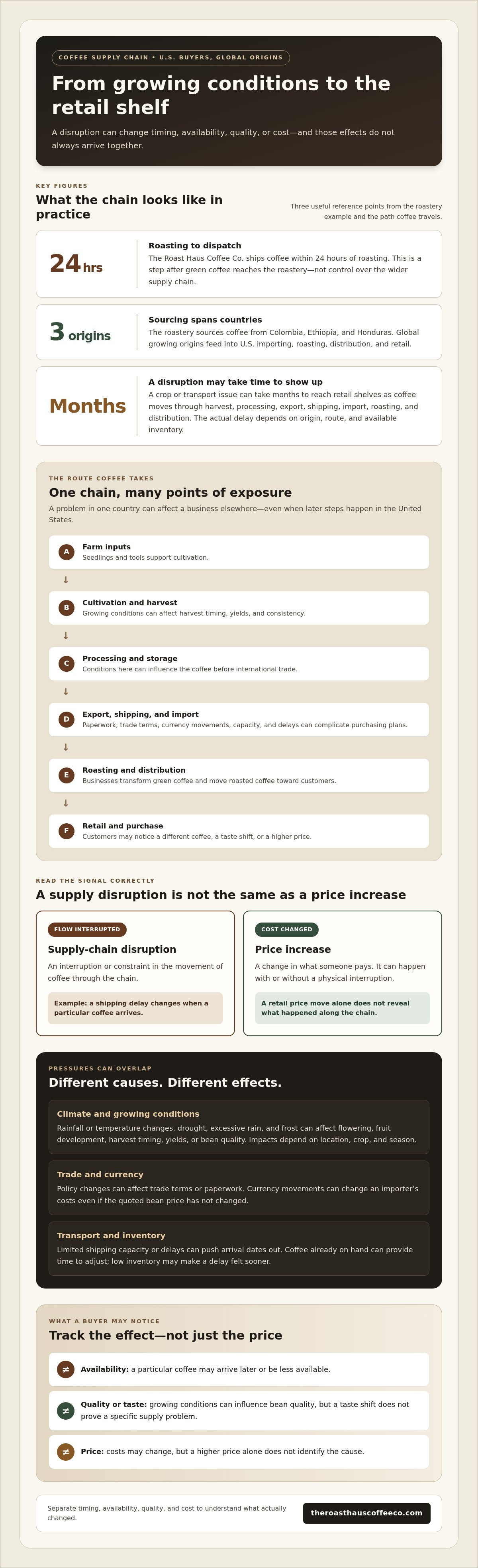
A coffee supply chain starts well before a bag reaches a kitchen. It includes farm inputs such as seedlings and tools, cultivation and harvest, processing and storage, export, import, roasting, distribution, retail, and purchase. A supply-chain disruption is an interruption or constraint in that flow; a price increase is a change in what someone pays, which can happen with or without a physical interruption. The two can be related, but they are not the same problem.
For U.S. buyers, the chain is national in its import, roasting, distribution, and retail stages, but global at its agricultural foundation. Coffee-growing regions are abroad, so U.S. supply depends on crops and transport across borders. The Coffee production overview describes how cultivation, processing, and storage shape coffee before it enters international trade. The Roast Haus Coffee Co. sources coffee from Colombia, Ethiopia, and Honduras. These origins illustrate how beans grown abroad become part of a domestic supply chain.
What makes a coffee supply chain national and global at once?
After coffee is harvested and processed, it moves through export and import channels to U.S. businesses. Importers handle the cross-border step; roasters turn green coffee into roasted beans, while distributors and retailers connect those beans with customers. Each stage adds value, from preparing and roasting the coffee to making it available for purchase. A disruption in one country can affect a business in another, even if later steps happen entirely within the United States.
Why can one disruption have several different effects?
The consequences depend on where and when the problem occurs. A shipping delay can leave a roaster waiting longer for a particular coffee. A smaller harvest may limit how much of an origin is available. Changing growing conditions can influence crop consistency, while higher expenses at an earlier stage can raise costs for businesses farther down the chain. These effects do not always occur together, and a change in the retail price alone does not reveal which one is at work.
Timing matters. A business with inventory or a contract already in place may experience a disruption differently from one buying coffee later. Effects can also vary by crop and origin, the alternatives a buyer can use, and the business’s size and planning capacity. For customers, a supply change might show up as a different coffee on the shelf, a shift in taste, or a higher price. One outcome does not automatically prove another. If you are comparing origins or learning what shapes a bean’s character, the coffee beans beginner’s guide offers a useful primer. Separating availability, quality, and price helps you identify what has actually changed instead of treating every market movement as the same supply-chain problem.
How Climate, Trade, and Logistics Create Coffee Supply-Chain Disruptions
Coffee supply problems rarely have one cause. A difficult growing season can tighten available supply, while shipping delays, currency shifts, policy changes, or low inventories add pressure at different points. These factors can overlap, but they do not affect every origin or buyer in the same way. A price move alone cannot show what happened along the chain.
How climate risk can affect growing regions
Coffee plants depend on suitable growing conditions. Changes in rainfall or temperature can affect flowering and fruit development, while drought, excessive rain, or frost can disrupt harvest timing and yields. Conditions during growth and processing can also influence bean quality. The impact depends on the location, crop, and season, so one unusual weather event is not proof of a permanent climate trend.
The International Coffee Organization’s market reporting tracks production and exports over time. That longer view helps put a single season in context: harvest estimates are forecasts, not guarantees, and growing conditions can change before coffee is ready for export. For buyers, the practical questions are how much a reported shock affected the harvest, which origin or crop it involved, and whether other sources can fill the gap.
How trade, transport, and inventory amplify uncertainty
After harvest, coffee still has to be processed, prepared for export, shipped, imported, and moved through domestic distribution. Policy changes can affect cross-border trade terms or paperwork. Currency movements can change what an importer pays in its own currency, even if the quoted bean price has not changed. Limited shipping capacity or delays can push arrival dates out. These are separate pressures, but together they can make purchasing plans harder.
A disruption can take months to reach retail shelves because coffee moves from harvest and processing through export, shipping, import, roasting, and distribution. The actual delay depends on the origin, route, and available inventory. Coffee is often purchased and planned well before it is sold to a customer, so the effects of a crop or transport issue may appear later, not all at once.
Inventory acts as a buffer. A business with coffee already on hand may have time to adjust; one with little stock may feel a delay sooner. Contracts and purchasing schedules matter too. A buyer committed to a particular origin may have different options from one able to adjust sourcing. None of these factors guarantees a retail price increase. A disruption may first affect timing, selection, or business planning, and its eventual price effect depends on the wider market.
For a grounded example of the later steps, The Roast Haus Coffee Co. roasts coffee in Wyandotte, Oklahoma, and ships it within 24 hours of roasting. This fulfillment happens after green coffee has reached the roastery; it does not control growing conditions, trade policy, or international transport. Explore coffee from a family-owned roastery to see one small business’s place in the wider chain.
Which National Coffee Supply-Chain Risks Are Structural, and Which Are Temporary?
Not every disruption signals a lasting weakness. A time-limited event can interrupt a shipment or harvest, while a structural risk remains after that event passes. A structural vulnerability is a persistent feature of the system, such as reliance on climate-sensitive growing regions or limited sourcing flexibility; a temporary disruption is a dated interruption affecting a specific origin, product, or stage. The distinction matters: one calls for long-term planning, while the other calls for a response to a particular event.
What makes a supply-chain vulnerability structural?
Structural exposure tends to persist across seasons. Coffee production depends on growing conditions in producing regions, so climate sensitivity is built into the chain rather than limited to one bad harvest. The International Coffee Organization’s reporting by origin and crop year helps show how production and exports vary over time. Persistent dependence on a small number of origins, few practical substitutes, or long replenishment times can add further exposure, though the degree varies by buyer and sourcing strategy.
Keep the scale clear. An industry-wide risk does not prove that a particular roaster relies on one origin or faces a specific shortage. Company-level conclusions require company-level evidence.
| Risk type | Warning signs | How to interpret it |
|---|---|---|
| Structural exposure | Repeated dependence on climate-sensitive origins, few substitutes, or recurring planning constraints | Consider it a lasting vulnerability; one calm season does not remove it. |
| Temporary shock | A dated harvest delay, policy change, or transport interruption affecting a defined origin or route | Check the date, location, product, and supply-chain stage before judging its reach. |
| Unclear or mixed signal | A broad price headline without details about cause, timing, or affected coffee | Do not assume it proves a shortage or an impact on every buyer. |
How to read a short-term shock without overgeneralizing
Start with four checks: when the event happened, which origin it affected, what coffee or shipment was involved, and where in the chain it occurred. Then separate the reported event from its demonstrated effects. A port delay may affect a particular route; it does not automatically establish that every importer, roaster, or customer experienced a shortage or paid more.
This discipline is especially useful with market headlines. A reported price movement is evidence of a market movement, not proof of the same change in every retail bag. Look for dated updates and clear attribution, and avoid treating one crop year as a permanent pattern. The coffee subscription services guide can help readers think about recurring purchase planning. A regular buying schedule may help a customer plan personal orders, but it does not change how much coffee is grown or remove upstream supply risk.
Practical Ways Coffee Businesses and Buyers Can Support Supply-Chain Resilience
Resilience starts with knowing where exposure sits, not assuming every risk can be avoided. Businesses can improve planning and communication, while customers can look for clear, specific information. These steps will not solve the problems with national coffee supply chains on their own, but they can support better decisions when conditions change.
What should a business track before disruption occurs?
Use records the business already maintains to build a practical picture of its dependencies. Keep the information current, and be clear about what the records can and cannot show.
- Map origins and suppliers. Record the known origin of each coffee, the supplier involved, and any key dependencies. Identify whether several coffees rely on the same origin, route, or supplier. A broader mix may create options, but it does not eliminate shared risks or guarantee replacement supply.
- Track timing and inventory. Note purchasing schedules, expected arrival windows, stock on hand, and how a delay could affect planned orders. Use actual supplier and inventory records rather than treating one lead time as universal.
- Review alternatives and their limits. Consider what adjustments are practical if a shipment is late or a coffee is unavailable. A substitute may differ in taste, availability, or timing. Explain those trade-offs instead of promising continuity the business cannot control.
- Date and qualify claims. Tie updates about harvests, shipments, or sourcing to a reliable, dated source. Separate confirmed information from estimates, and revise customer-facing statements when circumstances change.
Clear communication matters. If an order is affected, explain what is known, which coffee or shipment is involved, and whether the issue appears temporary or ongoing. Do not turn one delay into a claim about the whole market, or describe a recurring constraint as a brief hiccup.
How can consumers assess sourcing and sustainability claims?
Look for a named origin and a clear explanation of what a sourcing or sustainability statement covers. A company’s commitment is useful context, but it is not the same as an independently verified certification or a measured farm-level outcome. Check whether a claim describes an intention, a process, or a result, and whether it has a date or defined scope.
Customers can compare available sourcing details, ask informed questions, and choose businesses whose explanations are clear. Those choices can support transparency and independent businesses, but one purchase cannot guarantee farmer income, environmental benefits, or a more resilient system. Individual action has limits. Honest information helps everyone understand those limits.
The Roast Haus Coffee Co. is a family-owned roastery that sources beans from global regions and states a mission of supporting sustainable farming and local farmers. Explore coffee from The Roast Haus and consider the sourcing information available as part of your buying decision.
What a Small Roaster Can, and Cannot, Change in the Coffee Supply Chain
A small roaster is one link in a much longer chain, but it enters after many upstream decisions and risks have already shaped the coffee. Farms grow and harvest the crop. Processors prepare the beans, and transporters move them toward export and import. Once green coffee arrives, a roaster manages roasting, fulfillment, and communication with customers. Understanding that boundary helps set honest expectations about what a business can influence.
Where an independent roaster fits in the chain
The Roast Haus Coffee Co. is a family-owned roastery in Wyandotte, Oklahoma. It sources coffee from global regions including Ethiopia, Colombia, and Honduras. These are examples of the company’s origins, not a picture of every roaster’s sourcing. Once green coffee reaches the roastery, the work shifts to roasting and preparing orders. The Roast Haus follows a roasted-to-order model and ships coffee within 24 hours of roasting.
That fulfillment approach applies to downstream stages. It does not give a roaster control over farm conditions, harvest outcomes, international freight, trade policy, or the amount of coffee available at origin. Nor does it mean every upstream delay can be prevented. A clear picture of those limits makes it easier to distinguish care in roasting and fulfillment from claims about parts of the chain a roaster does not manage.
How transparency supports more informed choices
Plain-language information can help customers understand the journey. An origin description identifies where a coffee comes from. A process description explains what happened to the beans at a stated stage. Clear information about roasting and shipping shows what the roaster does after green coffee arrives. Specific explanations make it easier to understand what a claim covers and where its boundaries lie.
Transparency is not the same as control. A roaster can share sourcing information and explain its own practices, but that alone cannot prevent shortages, stabilize market prices, or establish a particular farm-level result. If a business expresses support for sustainable farming and local farmers, read that as a statement of purpose unless it is accompanied by specific evidence of outcomes. Customers can value the commitment while still looking carefully at what is documented.
This distinction matters across the problems with national coffee supply chains. Resilience depends on many people and stages, from growing and transport to domestic roasting and delivery. A small roaster can focus on the parts it handles: make careful roasting decisions, communicate plainly, and fulfill orders in a defined way. Customers can use clear sourcing and process information to make choices with a better understanding of what they are buying.
Explore coffee roasted to order by The Roast Haus and learn more about the coffee available from this family-owned roastery.
Choose Coffee With a Clearer View of Its Journey
Resilience is not a promise that coffee will always be available or unaffected by change. It means understanding where decisions are made, being honest about what is known, and improving the information people use to plan. That perspective keeps the problems with national coffee supply chains in view without turning every delay or price shift into the same story.
For your next purchase, look for a roaster that explains its part of the process plainly. Clear information will not solve risks at origin or on the way to the roastery, but it can help you make an informed choice and support businesses that value openness and craft.
The Roast Haus Coffee Co. is a family-owned roastery in Wyandotte, Oklahoma, sourcing coffee from Ethiopia, Colombia, and Honduras. Its coffee ships within 24 hours of roasting. Explore coffee roasted to order by The Roast Haus and choose a coffee for your next cup.
Frequently Asked Questions
What are the biggest problems with national coffee supply chains?
The biggest problems with national coffee supply chains include crop uncertainty, transport delays, trade changes, currency movements, and limited flexibility when a particular origin becomes harder to source. Their effects vary. A delay may disrupt a roasting schedule without changing retail prices, while a broader supply constraint could affect selection and costs over time. To understand a specific concern, look for which origin, shipment, or business stage is affected.
Why does the United States rely on coffee from other countries?
The United States relies on imports because coffee grows best in tropical conditions, while domestic production is limited compared with the coffee Americans consume. Coffee sold in the country therefore depends on crops grown in other nations and the systems that move beans to U.S. buyers. Importers and roasters can be exposed to overseas harvest and transport conditions, even when their own operations are domestic.
How does climate change affect the coffee supply chain?
Climate change can affect the conditions coffee plants need, including temperature and rainfall patterns. Shifts in those conditions can influence flowering, crop development, harvest timing, and pressure from pests or disease. Growers may face greater uncertainty about when and how much coffee they can harvest. The effect is not identical in every region, and a single poor season should not be treated as proof of a long-term trend.
Can supply-chain problems make coffee more expensive?
Yes, supply constraints can contribute to higher prices, but the effect is not automatic or immediate. The result depends on the scale of the disruption, purchasing agreements, existing stocks, and how costs move between suppliers, importers, roasters, and retailers. For example, a delayed shipment might first lead a shop to adjust its coffee selection rather than change prices. A market price report also does not establish what every customer pays.
What happens if coffee shipments are delayed?
A delayed shipment can leave an importer or roaster waiting for a specific coffee, disrupting stock planning or an expected product schedule. A business may use available inventory, adjust its offerings, or tell customers that an item is delayed. The practical effect depends on how much stock is available and whether a suitable alternative exists. For customers, checking a seller’s current product updates is more useful than assuming every coffee is affected.
Can small coffee roasters help make supply chains more resilient?
Small roasters can contribute by sharing clear origin information, planning carefully, maintaining open communication, and considering sourcing options where practical. They can also help customers understand when a change affects a particular coffee rather than the whole market. Their influence has limits: roasters do not control farm conditions, international transport, or trade policy. Resilience depends on cooperation across the chain, not on any one business or buyer.

