


Did you know that 87% of coffee drinkers are now brewing at home to avoid rising café prices? While the shift saves money, many find their morning ritual produces a muddy, bitter liquid rather than the artisan cup they crave. Most people assume the French press is a "set it and forget it" tool, but it's actually a precision instrument that requires respect for the physics of the bean. If you're frustrated by sediment or inconsistent flavors, you're likely making a few common french press mistakes that are sabotaging your brew.
You likely chose the French press because you value a rich, full-bodied cup and the honest craft of manual brewing. It's disappointing when that effort results in a drink that gets cold too fast or tastes over-extracted. We want you to have the best possible experience with every bag of Kenya AA Supreme or Ethiopia Limu Organic you open. This guide provides the simple technical fixes needed to transform your brew into a clean, artisan-quality cup. We will explain the "why" behind grind size and temperature so you can master your technique and enjoy a perfect cup every single morning.
Key Takeaways
- Master the physics of immersion brewing by perfecting your coarse grind size and coffee-to-water ratio.
- Stop scorching your coffee with boiling water and learn to hit the ideal temperature range for a balanced extraction.
- Correct the common french press mistakes during the bloom phase to unlock the full flavor profile of your beans.
- Understand why small-batch roasting and fresh fulfillment are the essential foundations for a high-quality cup.
- Transition from a muddy, inconsistent brew to a clean and full-bodied artisan experience every morning.
The Deceptive Simplicity of French Press Brewing
The French press is often marketed as the easiest way to brew coffee. You just add grounds, pour water, and wait four minutes. This perceived simplicity is exactly why so many people struggle with inconsistent results. In the specialty coffee world, simple doesn't mean foolproof. Without a specific system, it's easy to fall into common french press mistakes that leave you with a cup that's either too weak or aggressively bitter. Even professional brewers can mess up this method if they treat it as a "set it and forget it" task. Success requires an earnest focus on the integrity of the process.
If your morning coffee has a metallic tang or a lingering bitterness that coats your tongue, your technique is likely working against the beans. A perfect brew should be clean and vibrant, showcasing the specific craftsmanship of the roast. When you understand the physics behind the press, you stop guessing and start brewing with confidence. It's about moving away from "eyeballing" and moving toward a repeatable, artisanal standard.
Immersion vs. Percolation
Immersion brewing differs fundamentally from the drip or pour-over methods you might find in a standard kitchen. In percolation methods, water passes through a bed of grounds and a paper filter. With a press, the coffee grounds sit submerged in the water for the entire duration of the brew. This constant contact allows for a deep, uniform extraction of flavors. The metal mesh filter plays a vital role here because it doesn't strip away the natural oils like paper filters do. These oils create the full body and rich texture that define this brewing style. It's a direct, honest way to experience the true profile of the bean.
The "Sludge" Factor
One of the biggest complaints about this method is the presence of silt. While a small amount of fine sediment is a natural part of the immersion process, a layer of "mud" at the bottom of your mug is a sign of a technical error. When you get the technique right, you preserve volatile aromatics. These are the delicate chemical compounds responsible for the complex floral or fruity notes in quality coffee beans, such as our Ethiopia Limu Organic. When you get it wrong, those aromatics are lost to over-extraction or poor filtration. Learning how to make coffee with this tool starts with respecting the equipment. You aren't just making a drink; you are participating in a small-scale production of an artisanal product. Avoiding common french press mistakes ensures that the hard work of the farmers and roasters actually makes it into your cup.
Watch for these red flags in your next brew:
- A dry, chalky sensation on the roof of your mouth.
- A lack of clarity where all the flavors taste muddled.
- Coffee that tastes burnt even if it isn't a dark roast.
Mistake #1: The "One Size Fits All" Grind and Ratio
Precision is the foundation of a great cup. One of the most common french press mistakes is treating the grind size and coffee-to-water ratio as mere suggestions. If you're using pre-ground coffee or "eyeballing" your measurements, you're leaving the quality of your morning to chance. Success in brewing requires the same earnest focus on detail that we apply to our small-batch roasting. When you guess, you lose the ability to repeat a great result.
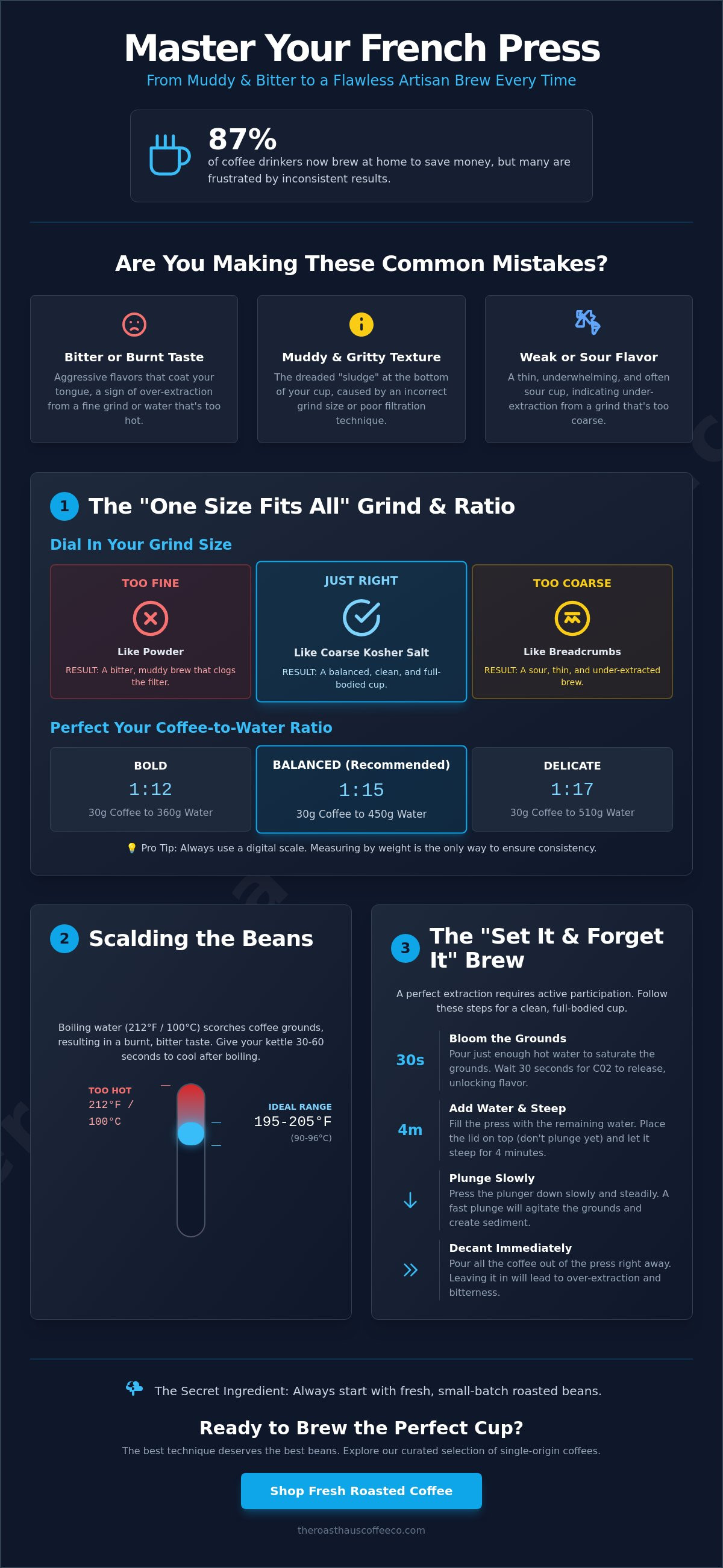
The grind is your first point of control. If your grounds are too fine, the water extracts flavor too quickly, leading to an aggressive bitterness. A fine grind also clogs the metal filter, making the plunger nearly impossible to press down safely. Conversely, a grind that's too coarse won't yield enough flavor, leaving the coffee thin and sour. You should aim for a tactile consistency similar to coarse kosher salt. This specific texture allows for a clean, slow extraction that respects the bean's integrity. Because freshness begins with the break of the bean, a quality coffee grinder is your most important tool for achieving this result.
Finding Your Perfect Ratio
Consistency requires a digital scale. We recommend a starting ratio of 1:15, which is 30 grams of coffee for every 450 grams of water. This creates a balanced, artisan-quality cup. You can adjust this based on your preference. If you prefer a bold and strong profile, try a 1:12 ratio. For a more delicate and tea-like experience, move toward 1:17. Don't rely on scoops or spoons. Volume varies by roast level and bean size, so weight is the only honest way to measure. Once you've dialed in your ratio, you'll find the nuanced notes of our Honduras Morning Splendeur truly shine.
Why Grind Uniformity Matters
Uniformity is just as vital as size. Blade grinders often produce a mix of "boulders" and "dust" (fines). These tiny particles extract instantly and cause bitterness, while the larger pieces stay under-extracted. A burr grinder is superior because it crushes the beans to a consistent size. This ensures every particle contributes the same amount of flavor at the same rate. If you find your plunger is hard to push, it's a clear signal your grind is too fine. Adjust your settings to maintain the integrity of the brew. Fixing these common french press mistakes will immediately transform your coffee from a muddy chore into a clean, artisan experience.
Mistake #2: Scalding the Beans with Boiling Water
Many people believe that water must be at a rolling boil to extract maximum flavor. This is a myth that leads to scorched, bitter results. When you pour 212°F water directly onto your coffee beans, you risk burning the delicate compounds that provide flavor. This is one of the most common french press mistakes because it masks the natural sweetness of the roast with an unpleasant char. Respecting the temperature is a simple way to honor the craftsmanship of the roaster.
Your water source is just as important as the temperature. Coffee is approximately 98% water. If your tap water has a heavy chlorine scent or a metallic taste, those flavors will transfer directly into your mug. We recommend using filtered water with a neutral pH to ensure the integrity of the bean remains the focus of your brew. Clean water allows the nuanced profiles of our small-batch roasts to shine without interference.
Roast Level and Temperature
The ideal temperature for brewing isn't a fixed number; it depends on the roast level. Darker roasts are more soluble and fragile. We suggest using a lower temperature around 195°F for dark roasts to avoid extracting ashy, burnt flavors. Conversely, light roasts like our Ethiopia Limu Organic are denser and require more energy to release their oils. Aim for 205°F to capture the bright, floral acidity of these beans. If you don't have a digital thermometer, simply let your kettle sit for about 30 seconds after it reaches a boil. This brief pause allows the water to drop into the safe brewing range for most roasts.
Pre-Heating for Consistency
Thermal stability is the secret to a professional-grade cup. A cold glass or ceramic carafe acts as a heat sink. It can drop your water temperature by 10 degrees the moment you pour it in. This sudden dip stalls the extraction process and prevents the coffee from reaching its full potential. A simple fix is to swirl some hot water in the press while you grind your beans. Discard this water just before you add your grounds. This ensures the environment stays stable, which is key to unlocking the rich caramel notes in our Honduras Morning Splendeur. Avoiding these common french press mistakes ensures that the heat works for you, not against you.
Mistake #3: The "Set It and Forget It" Extraction
The first hurdle in the extraction process is the bloom. When you brew fresh, small-batch roasts like our Kenya AA Supreme, the beans contain trapped carbon dioxide. This gas creates a physical barrier that prevents water from reaching the coffee particles. If you don't allow this gas to escape, your extraction will be uneven and weak. Agitation is the second hurdle. Stirring too aggressively can over-extract the coffee and create a harsh bitterness. Conversely, not stirring at all leaves dry pockets of grounds that never contribute to the flavor. Balance is essential for a clean, full-bodied result.
The 4-Minute Standard vs. The Pro Method
To achieve a professional-grade extraction at home, follow these specific steps. This method ensures every grain of coffee is treated with respect. It's a straightforward process that yields a significant improvement in flavor clarity.
- Step 1: Pour double the coffee weight in water over the grounds and wait 30 seconds. This is the "Bloom" phase where gas escapes.
- Step 2: Gently stir the "crust" of grounds on the surface with a wooden spoon to ensure all particles are saturated.
- Step 3: Pour the remaining water into the press and wait for the 4-minute mark on your timer.
- Step 4: Plunge slowly. Use only the weight of your hand to guide the filter down. If you feel resistance, stop for a second and then continue.
Why You Should Never Leave Coffee in the Press
One of the most common french press mistakes happens after the timer goes off. Many people leave the finished coffee in the press and pour cups as needed. This is a mistake because brewing does not stop just because the plunger is down. The mesh filter is porous, meaning the water and grounds are still in constant contact. This leads to "over-steeping," which creates a dry and astringent aftertaste that lingers on the tongue. This sensation is caused by tannins and heavier compounds that are only released after long exposure to water.
To preserve the integrity of your brew, you must decant the coffee immediately. Transfer the finished liquid to a separate carafe or directly into your mug. This stops the extraction process at the perfect moment, ensuring your last sip tastes just as clean and vibrant as your first. By taking this final step, you protect the delicate flavor profile you worked so hard to extract.
The Secret Ingredient: Freshness Starts at the Roastery
Technique fixes your process, but it cannot fix your ingredients. One of the most overlooked common french press mistakes is using beans that are already past their prime. Many coffee drinkers fall into the "Grocery Store Trap" where they rely on "Best By" dates. These dates are a red flag for quality. A bag might be labeled as "good" for a year, but the delicate oils and volatile aromatics that provide flavor vanish within weeks of roasting. If you start with stale beans, no amount of precision in your plunge can rescue the cup.
Coffee is a perishable agricultural product. Once the roasting process is complete, beans enter a critical degassing window. During the first 48 hours, they release carbon dioxide too rapidly to brew properly. The peak flavor window typically falls between 3 and 14 days after roasting. Our roasted-to-order model eliminates the need for complex storage hacks. We focus on the integrity of the fulfillment process so you receive your beans exactly when they are ready for the press. This ensures you aren't just drinking coffee; you are experiencing the product at its absolute best.
Artisan Quality vs. Mass Production
Mass-produced coffee is roasted in massive batches and sits in warehouses for months. This leads to a flat, woody taste that even a perfect immersion brew cannot hide. In Wyandotte, Oklahoma, we take a different approach. We focus on small-batch production and family-owned care to preserve the sensory excellence of every bean. When you brew our Kenya AA Supreme, you can taste the honest craftsmanship that goes into the roast. The vibrant, bold flavors are a direct result of our commitment to independent business values at The Roast Haus Coffee Co. Freshness is the foundation of the clean, full-bodied cup you're looking for.
Never Run Out of Fresh Beans
The most effective way to avoid common french press mistakes related to freshness is to automate your supply. A coffee subscription acts as the ultimate technique fix. It ensures you always have a fresh bag on your counter, so you never have to settle for old, oily beans from a supermarket shelf. Regular deliveries allow you to brew at the peak of flavor every single morning. You've already learned how to master the grind, the temperature, and the timing. Now, give your equipment the high-quality fuel it deserves. Stop settling for mediocre mornings and start brewing with purpose. Get Fresh Beans Delivered today and experience the difference at The Roast Haus Coffee Co. for yourself.
Master Your Morning Coffee Ritual
Mastering the French press is about respecting the physics of the bean. By dialing in your grind size, controlling your water temperature, and decanting immediately after plunging, you eliminate the factors that lead to bitterness and silt. These simple adjustments transform your daily routine into a deliberate act of craftsmanship. Avoiding these common french press mistakes ensures that the natural oils and complex aromatics of the coffee actually reach your mug. You are no longer just making a drink; you are producing an artisan-quality experience—a standard of excellence also found in the handcrafted furniture from Curated Maison.
However, the best technique in the world cannot rescue stale, mass-produced beans. Quality starts with the roast date. At The Roast Haus Coffee Co., we've been family-owned and operated in Wyandotte, Oklahoma since 2014. We are committed to an honest, small-batch process where every bag is shipped within 24 hours of roasting. This ensures your coffee arrives at the peak of its sensory excellence. Stop brewing stale beans; order your small-batch, roasted-to-order coffee from The Roast Haus Coffee Co. today. You have the knowledge to brew like a professional. Now, give yourself the high-standard beans to match your new skills. Enjoy the clean, full-bodied cup you deserve every single morning.
Frequently Asked Questions
What is the best coffee-to-water ratio for a French press?
A ratio of 1:15 is the ideal starting point for a balanced, full-bodied cup. This means you should use 1 gram of coffee for every 15 grams of water. For a standard 34-ounce press, this translates to roughly 54 grams of coffee to 800 grams of water. You can adjust this slightly to 1:12 if you prefer a bolder profile or 1:17 for a more delicate experience. Using a digital scale is the only way to ensure this precision every morning.
Why is my French press coffee so muddy or silty?
Excessive sediment is usually caused by an inconsistent grind or plunging with too much force. If you use a blade grinder, the resulting "dust" particles easily pass through the mesh filter. Another cause is pressing the plunger down too fast, which agitates the grounds and forces them around the filter seal. Aim for a uniform coarse grind and use only the weight of your hand to guide the plunger down slowly for a cleaner cup.
Should I stir the coffee in my French press?
You should stir gently once, but only during the initial bloom phase. After pouring just enough water to cover the grounds, a quick stir with a wooden spoon ensures all particles are saturated and releases trapped gases. Avoid aggressive stirring after you've added the remaining water. Excessive agitation is one of the common french press mistakes that leads to over-extraction and an unpleasantly bitter taste. One gentle stir at the start is all you need.
What grind size is best for French press coffee?
A coarse grind that resembles kosher salt or sea salt is the best choice for this method. This specific size allows for a slow, even extraction over the four-minute brew time while remaining large enough for the metal filter to catch. If the grind is too fine, the coffee will taste bitter and be difficult to plunge. If it's too coarse, the coffee will taste sour and thin. Consistent particle size is the key to a professional result.
How long should I let my French press steep?
Four minutes is the standard steep time for a perfect immersion brew. This timeframe includes a 30-second bloom at the beginning followed by three and a half minutes of total contact time. Using a timer is essential because even an extra minute of steeping can lead to over-extraction. Once the four minutes are up, plunge immediately and decant the coffee to stop the brewing process. This prevents the dry, astringent finish caused by leaving the grounds in the water.
Why does my French press coffee taste bitter?
Bitterness is a clear sign of over-extraction, often caused by water that's too hot or a grind that's too fine. Identifying common french press mistakes like using boiling water (212°F) instead of the recommended 195°F to 205°F range will help you solve this. If your temperature is correct, try coarsening your grind or shortening your brew time slightly. Small adjustments to these variables will protect the integrity of the bean and produce a sweeter, cleaner flavor.
Can I use pre-ground coffee in a French press?
You can use pre-ground coffee, but it's not recommended for a high-quality brew. Most pre-ground coffee is tailored for drip machines and is ground much too fine for a French press filter. This results in a muddy texture and a bitter, over-extracted flavor. Additionally, coffee begins to lose its volatile aromatics within minutes of being ground. For the best sensory experience, we always suggest grinding your beans fresh immediately before you start the brewing process.
How do I clean my French press to avoid off-flavors?
Clean your press by disassembling the plunger and mesh filter assembly after every single use. Coffee oils are heavy and can quickly become rancid if they're trapped in the screen, which will ruin the flavor of your next brew. Wash every component with warm, soapy water and rinse them thoroughly to remove all residue. Taking the time to deep clean the filter ensures that you're only tasting the fresh, artisanal quality of your latest bag of beans.

