


Grinding your coffee is the ignition switch for staleness. Once you break the surface of a roasted bean, the clock starts ticking faster than you might think. Most coffee drinkers have felt that sharp disappointment when a bag that smelled amazing on Monday tastes like flat, bitter cardboard by Thursday. It's a common struggle that leads many to question the real difference between whole bean vs ground coffee. You shouldn't have to settle for a dull cup just because you're in a hurry or worried about the cost of new equipment.
This guide reveals the science of coffee freshness so you can stop wasting money on beans that go flat. You'll learn why the physical structure of a whole bean acts like a natural vault for delicate flavor oils and how oxygen begins to steal those aromas the moment the grind happens. We'll help you decide which option fits your daily routine and budget without any unnecessary snobbery. Whether you're brewing our Ethiopia Limu Organic or a bold morning roast, understanding these basics ensures every sip is as vibrant as possible. We'll explore the impact of oxidation, the reality of grinder costs, and why our 24 hour shipping model changes the rules for both whole and ground options.
Key Takeaways
- Learn how whole beans act as a natural vault to protect delicate flavor oils from oxygen and moisture.
- Understand the science of whole bean vs ground coffee so you don't end up with a flat, bitter cup.
- Gain total control over your brewing methods by learning to adjust your grind size for any machine.
- Save time by debunking the myth that grinding at home is a slow or difficult process.
- Follow a simple plan to upgrade your morning routine with small-batch, roasted-to-order beans like Ethiopia Limu Organic.
The Science of Freshness: Why Whole Beans are Flavor Vaults
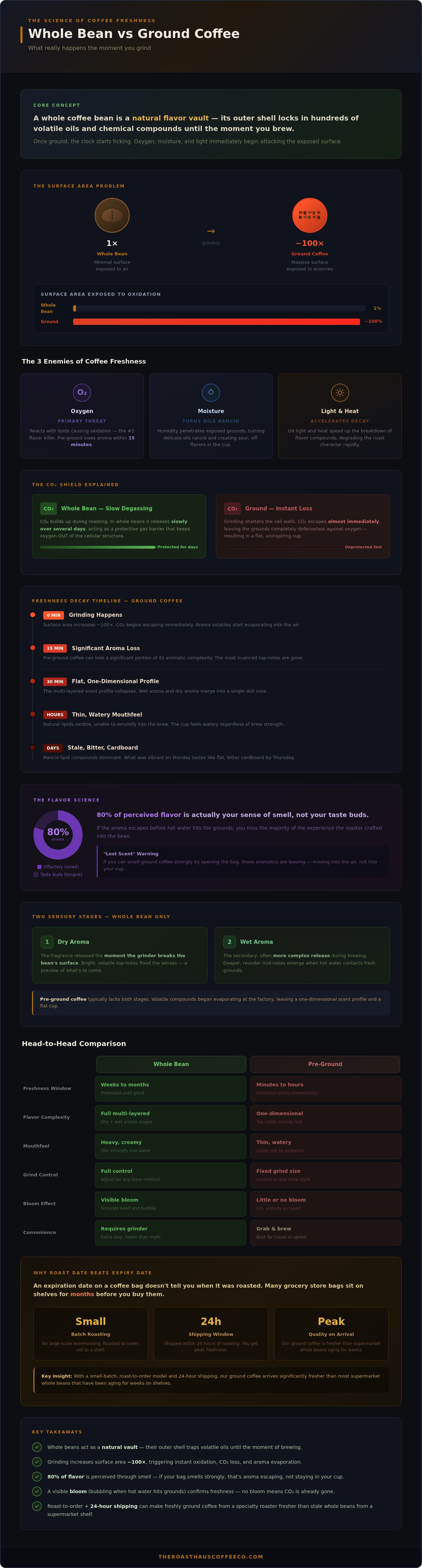
Coffee beans are sophisticated biological containers. They hold hundreds of chemical compounds and delicate oils that create the complex flavor profile you enjoy every morning. When you keep the bean whole, its outer shell acts as a natural vault. This structure keeps those volatile oils trapped inside until the moment you decide to brew. Your decision in the whole bean vs ground coffee debate is essentially a choice about how well you want to protect that craftsmanship.
Physics explains why ground coffee fades so quickly. When you grind a single bean, you break it into hundreds of tiny particles. This process increases the total surface area exposed to the environment by roughly 100 times. This massive increase in surface area gives the three main enemies of coffee, oxygen, light, and moisture, more room to attack. Moisture can cause the oils to turn rancid, while light and heat accelerate the breakdown of flavor. Whole beans minimize this exposure, keeping the interior of the bean safe from the elements.
Freshly roasted coffee also needs to manage its gas content. During roasting, carbon dioxide (CO2) builds up inside the bean. This gas serves as a protective barrier that helps prevent oxygen from entering the cellular structure. Whole beans release this gas slowly over several days, which is known as degassing. Ground coffee loses its CO2 almost immediately. Without that protective gas, the coffee is left defenseless against the air, leading to a flat and uninspiring cup.
Oxidation: The Silent Flavor Killer
Oxidation is the primary reason coffee loses its punch. In the context of coffee science, oxidation is the chemical process where oxygen reacts with the lipids in the bean, causing them to degrade and produce stale-tasting compounds. This reaction happens with incredible speed. Pre-ground coffee can lose a significant portion of its aromatic complexity within just 15 minutes of grinding. If you want to experience the true depth of the roast, you have to control this window of oxidation.
The Role of the Roast Date
An expiration date on a coffee bag is often a distraction. It doesn't tell you when the coffee was actually roasted. Many grocery store bags sit on shelves for months, losing their character long before you buy them. We take a different approach at The Roast Haus by focusing on the roast date as the ultimate mark of quality. We roast in small batches and ship within 24 hours. This ensures you receive a product at its peak, making our ground coffee significantly fresher than supermarket whole beans that have been aging for weeks.
Flavor, Aroma, and the "Bloom": A Sensory Comparison
Your tongue only does part of the work when you take a sip of coffee. Scientific research indicates that roughly 80% of what we perceive as flavor is actually rooted in our sense of smell. This olfactory connection is why the whole bean vs ground coffee choice is so vital to your morning. If the aroma escapes before the water hits the grounds, you're missing the majority of the experience we worked so hard to roast into the bean.
Preparing whole beans offers two distinct sensory stages: the dry aroma and the wet aroma. The dry aroma is the fragrance released the moment the grinder breaks the bean's surface. The wet aroma is the secondary, often more complex release that happens during the brewing process. Pre-ground coffee typically lacks this multi-layered depth. Those volatile compounds began evaporating the moment they were processed at a factory, leaving you with a one-dimensional scent profile.
Texture also plays a significant role in how you enjoy your cup. Fresh coffee beans contain natural lipids and oils that contribute to a heavy, creamy mouthfeel. When you grind just before brewing, these oils remain intact and emulsify into your water. Older grounds often lose these lipids to oxidation. This results in a brew that feels thin or watery on the palate, regardless of how much coffee you use.
Why Pre-Ground Coffee Smells Better Than It Tastes
Opening a new bag of ground coffee smells wonderful, but that scent is actually a warning. This is the "lost scent" theory. If you can smell the coffee intensely just by opening the bag, those aromatics are leaving the grounds. They are moving into the air instead of staying inside the coffee particles. By the time you pour your water, the most complex flavors have already vanished. Freshly grinding ensures those scents are trapped in the water where they belong.
The Visual Test: Identifying Freshness
You can visually verify freshness through the "bloom." When hot water hits fresh grounds, they should swell, rise, and produce small bubbles. This is the visible release of gasses trapped inside the bean structure. A healthy, active bloom is a hallmark of quality and craftsmanship. If your grounds stay flat and motionless during the pour, the coffee is likely stale. This visual feedback is unmistakable when brewing a vibrant roast like our Kenya AA Supreme. If you want to see this science in your own kitchen, start with a bag of freshly roasted beans and watch the difference a fresh grind makes.
Versatility and Control: The Tactical Advantage of Whole Beans
Buying a bag of pre-ground coffee locks you into one specific way of brewing. Most commercial grounds are processed with a universal medium setting. This works fine for a standard drip machine, but it fails when you want to experiment with other methods. The real tactical advantage in the whole bean vs ground coffee debate is the freedom to choose your equipment on any given day. With whole beans, a single bag of our artisan roast can serve as the base for a rich espresso, a clean pour-over, or a heavy French Press.
Control over grind size is also your best tool for troubleshooting flavor. If your coffee tastes unpleasantly sharp or sour, it is likely under-extracted. You can fix this by grinding finer next time to increase the surface area and slow the water flow. If the cup is harsh and bitter, it is over-extracted. Grinding coarser will reduce the surface area and balance the flavor. This level of precision is impossible with pre-ground coffee, where you are stuck with whatever the factory decided was best for the average consumer.
You also save money by reducing waste. When you buy pre-ground, the clock starts ticking on the entire bag immediately. If you don't drink it fast enough, the last third of the bag usually ends up tasting like cardboard and gets thrown away. With whole beans, you only grind exactly what you need for that specific moment. This keeps the rest of your supply protected in its whole state, ensuring the final cup from the bag is as fresh as the first.
Matching the Grind to Your Brewing Method
Successful brewing depends on the relationship between particle size and contact time with water. You must adjust your grind to match your specific tool:
- Coarse for French Press: These large particles resemble sea salt. They are ideal for the four-minute steep time of a French Press, allowing for a full-bodied flavor without becoming muddy.
- Fine for Espresso: This grind should feel like powdered sugar. It creates the resistance needed for high-pressure machines to extract oils and sugars in under 30 seconds.
- Medium for Pour-Over: A texture like table salt works best here. It allows water to flow through the grounds at a steady pace for a balanced, clear cup.
The Investment: Choosing a Coffee Grinder
You don't need industrial equipment to start grinding at home. However, the type of grinder you choose matters more than the price tag. A burr grinder is superior to a blade grinder because it crushes the beans into uniform pieces rather than chopping them into uneven shards. Consistency ensures that every particle extracts at the same rate. For a deep dive into your options, check out The Ultimate Guide to Coffee Grinders. If you're on a budget, a manual hand grinder is a great way to bridge the gap and start experiencing the benefits of fresh-ground coffee.
Convenience vs. Quality: Addressing the Morning Rush
The most common argument in the whole bean vs ground coffee debate is that grinding takes too much time. Some online forums suggest it adds five to ten minutes to your morning routine. This is simply not true. Most high-quality electric burr grinders can process enough coffee for a full pot in less than 30 seconds. When you consider the massive jump in quality, that half-minute is the best investment you can make for your day. It is a small price to pay for a cup that actually tastes like the origin intended.
There is also a mental benefit to the ritual of grinding. The sound and the immediate release of aromatics signal to your brain that it's time to wake up. It is a moment of quiet craftsmanship before the chaos of the workday begins. However, we understand that life requires flexibility. Pre-ground coffee is a practical choice for camping trips, office environments, or travel where a grinder isn't accessible. If you must use pre-ground, store it in an airtight container in a cool, dark place. Never keep it in the freezer, as moisture and odors will quickly ruin the delicate flavor profile.
Optimizing Your Morning Routine
You can streamline your process without sacrificing integrity. Many electric burr grinders feature dose timers that grind the exact amount you need with one touch. If you're truly pressed for time, grinding your beans the night before is an acceptable compromise. While not as ideal as grinding immediately before brewing, it's still superior to buying stale coffee from a supermarket shelf. Learning how to make coffee properly starts with these small, manageable adjustments to your daily workflow.
The Truth About Shelf Life
Freshness is a ticking clock. Whole beans generally maintain their peak flavor for four to six weeks if stored correctly. Ground coffee begins to fade significantly after just one or two weeks. You'll know your coffee has gone stale if it develops a flat, woody taste or lacks its characteristic aroma. To keep this simple, follow the Rule of 15: green beans last 15 months, roasted whole beans last 15 days for peak freshness, and ground coffee lasts 15 minutes before major flavor loss occurs.
If you want the best experience regardless of your equipment, order our roasted-to-order coffee and experience the difference that 24-hour fulfillment makes for your morning cup.
Making the Switch: How to Transition to Whole Bean Coffee
Moving away from pre-ground coffee is the single biggest upgrade you can make to your kitchen routine. It's a shift from seeing coffee as a generic caffeine delivery system to respecting it as a seasonal product. When evaluating whole bean vs ground coffee, the transition is simpler than many people assume. You don't need a massive budget or a chemistry degree to start enjoying better flavors. You just need to change your approach to sourcing and preparation.
- Step 1: Buy better beans. Start with a high-quality single-origin like Ethiopia Limu Organic. Its citrus and floral notes are delicate and disappear quickly in pre-ground form.
- Step 2: Get a burr grinder. Consistency is everything. Even a basic manual grinder will outperform a high-end blade model by providing a uniform particle size.
- Step 3: Master one method. Don't try to learn espresso and pour-over at the same time. Pick one tool, like a French Press, and learn how changing your grind size impacts the final taste.
- Step 4: Automate your freshness. A "Roasted-to-Order" service ensures you always have beans within their peak window.
Why Small-Batch Roasting Matters
The Roast Haus philosophy is built on small-batch production. We roast in Wyandotte, Oklahoma, focusing on quality control that large corporations can't match. In the whole bean vs ground coffee debate, our model offers a unique advantage. Because we ship within 24 hours of roasting, your coffee arrives in a state of peak integrity. This supports local craftsmanship and ensures you aren't paying for beans that have been degassing on a warehouse floor for months. Every bag is a commitment to artisanal quality and family-owned transparency.
The Roast Haus Coffee Subscription
Consistency is the key to a better morning. Our subscription service allows you to customize your delivery frequency so you never run out of fresh supplies. You can rotate through different origins like our Kenya AA Supreme or Honduras Morning Splendeur to develop your palate. This variety helps you understand the nuances of different growing regions and roasting profiles. Start your fresh coffee journey with a Roast Haus subscription today and experience the difference that small-batch dedication makes in every cup.
Take Control of Your Morning Brew
Choosing between whole bean vs ground coffee is about more than just convenience. It is a decision to prioritize the chemistry of your cup. You now understand how the bean structure acts as a flavor vault and why the bloom is a visual indicator of quality. By grinding your own beans, you gain the tactical advantage of matching your grind to your favorite brewing method. This simple shift ensures you don't have to settle for a flat or bitter experience ever again.
At The Roast Haus Coffee Co., we believe you deserve to taste the full potential of every roast. Since 2014, our family-owned operation has focused on small-batch craftsmanship in Wyandotte, OK. We roast to order and ship within 24 hours to guarantee peak freshness reaches your door. Whether you're brewing a vibrant single-origin or a smooth morning blend, our process respects the integrity of the product. Shop our freshly roasted-to-order whole bean coffee and experience the difference that true freshness makes. Your best cup of coffee is only a 30-second grind away.
Frequently Asked Questions
Is whole bean coffee more expensive than ground coffee?
Whole bean coffee is typically priced the same as ground coffee by specialty roasters. The price reflects the quality of the green beans and the roasting process. You don't pay a premium for whole beans; you simply receive them in their most protected state. When comparing whole bean vs ground coffee, the cost usually stays identical at the point of sale. This allows you to control freshness at home without increasing your budget.
Does grinding your own coffee actually save money in the long run?
Grinding at home saves money by significantly reducing product waste. When you buy pre-ground coffee, the entire bag begins to go stale the moment it is opened. This often leads to throwing away the last few ounces because the flavor has turned flat or woody. Whole beans act as a natural vault, keeping the coffee fresh until you are ready to brew. This ensures every gram you buy ends up in your cup.
Can I use a blender if I don’t have a coffee grinder?
You can use a blender in an emergency, but we don't recommend it for daily use. Blenders use high-speed blades that chop beans into uneven shards rather than crushing them uniformly. This inconsistency leads to poor extraction, where some particles are over-extracted and bitter while others are under-extracted and sour. For a consistent cup that respects the bean, a burr grinder is a much better tool for your kitchen.
How should I store whole bean coffee to keep it fresh?
The best way to store your beans is in an airtight container kept in a cool, dark place like a pantry. Avoid storing coffee in the freezer or refrigerator. These environments introduce moisture and odors that can seep into the beans. Condensation is a major enemy of coffee freshness. Keeping your beans at a stable room temperature in a sealed jar is the most effective way to preserve their integrity.
Does ground coffee lose caffeine faster than whole bean coffee?
Caffeine is a very stable molecule and does not evaporate like flavor oils do. In the whole bean vs ground coffee debate, the caffeine content stays the same even as the flavor fades. While your cup might taste stale or flat after a few weeks, it will still provide the same energy boost. You lose the complex aromas and sensory experience long before you lose any of the caffeine.
Is there a difference in health benefits between whole bean and ground?
Freshness plays a role in the preservation of antioxidants and polyphenols. While the basic nutritional profile is the same, ground coffee oxidizes much faster than whole beans. This chemical breakdown can reduce the potency of some beneficial compounds over time. Choosing whole beans and grinding them just before brewing ensures you are getting the most intact biological profile possible from the plant. It's a choice for quality and integrity.
What is the best grind size for a standard drip coffee maker?
A medium grind that resembles the texture of table salt is ideal for most standard drip coffee makers. If the grind is too coarse, the water will flow through too quickly and result in a weak, sour cup. If it's too fine, the water may clog the filter or over-extract the grounds, leading to a harsh, bitter taste. Finding this balance is key to a consistent morning routine.
Can I buy whole beans and have them ground at a local shop?
Most local coffee shops will grind whole beans for you upon request. While this is better than buying grocery store coffee that was ground months ago, it still starts the oxidation process immediately. If you have your beans ground at a shop, try to use them within seven days. This helps you maintain as much of the original flavor and aroma as possible before the grounds begin to go stale.

