


The secret to cafe-quality coffee at home isn't found in a complex machine. It is actually found in the narrow window between roasting and shipping. You might feel overwhelmed by the endless variety of gadgets or worried that getting started with home brewing coffee will take too much of your valuable morning time. It is frustrating to deal with inconsistent flavors when you just want a reliable, delicious cup to start your day.
We believe that high-quality coffee should be accessible and straightforward. You don't need to spend hundreds of dollars on smart technology to notice a massive difference in your mug. By focusing on the freshness of your beans, such as a bright Ethiopia Limu Organic or a bold Kenya AA Supreme, you can create a professional experience in your own kitchen. This guide will teach you how to master simple techniques and choose the right gear for a better morning ritual.
We'll walk through the essential equipment that fits your budget, the importance of grind size, and how to pick beans that suit your palate. You will gain the confidence to ditch the expensive cafe lines and enjoy a superior cup of coffee every single day.
Key Takeaways
- Understand why the timing of your roast is more critical than the price of your machine for achieving cafe-quality flavor.
- Identify the four essential tools required for getting started with home brewing coffee, focusing on consistency rather than complexity.
- Learn to distinguish between immersion and percolation methods to find the specific body and clarity that matches your personal taste.
- Master the 1:16 golden ratio and the degassing bloom to ensure every cup you brew is repeatable and balanced.
- Explore how small-batch, roasted-to-order beans from independent craftsmen provide the honest foundation your morning ritual deserves.
The Foundation of Home Brewing: Why Freshness Trumps Gear
Home brewing is the art of extracting flavor from roasted seeds using water. It's a simple process, but it requires a solid foundation. Many people think they need a thousand-dollar espresso machine to get a good cup. This isn't true. When you're getting started with home brewing coffee, the most important factor is the freshness of your beans. If your coffee was roasted six months ago and sat on a grocery store shelf, no amount of expensive gear will save the flavor.
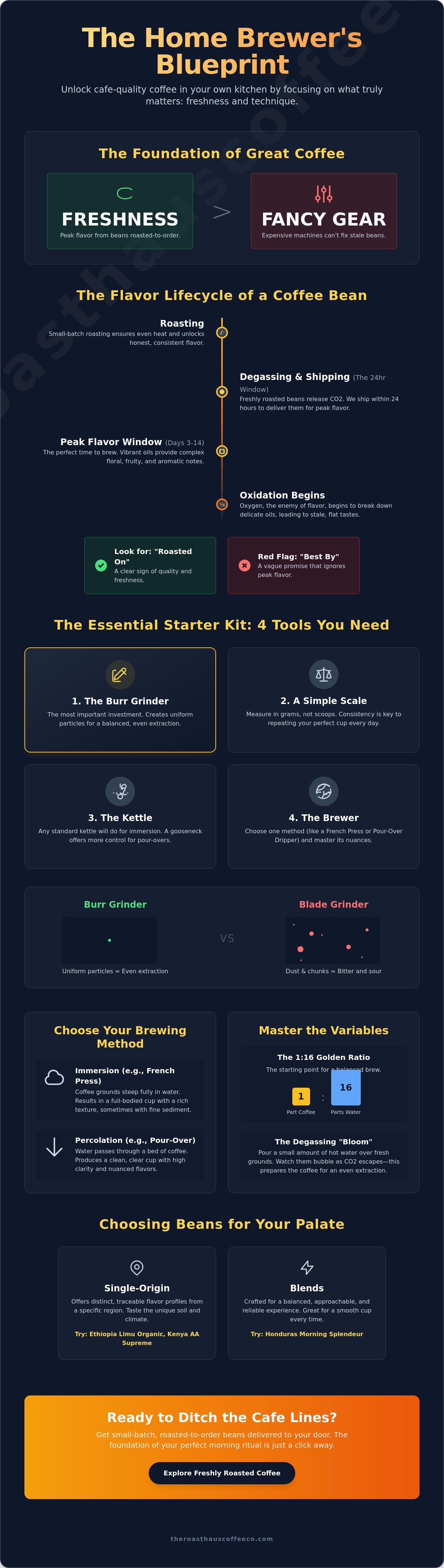
Freshly roasted coffee needs a short period to release carbon dioxide, a process known as degassing. Once this window passes, the coffee begins to oxidize. Oxygen is the enemy of flavor. It turns vibrant oils into stale, flat tastes. Most commercial coffee brands prioritize shelf life over sensory excellence, which is why their products often taste bitter or woody. We believe in a different standard. Our 24-hour roasting-to-shipping model is the ultimate flavor cheat code. It ensures you receive the beans exactly when they're at their peak. This freshness makes even the most basic coffee preparation methods taste professional.
Understanding the Roast Date
Always look for a "Roasted On" date on your bag. A "Best By" date is a red flag. It's a vague promise of safety, not a guarantee of quality. Coffee oils are delicate and volatile. When they oxidize, they lose the aromatics that provide floral or fruity notes. We focus on small-batch roasting because it allows for precise heat control. Every bean in a small lot receives the same attention, ensuring a consistent and honest flavor that large-scale industrial roasters simply can't match.
Single-Origin vs. Blends for Beginners
Beginners often find success starting with single-origin beans. Options like our Kenya AA Supreme or Ethiopia Limu Organic offer distinct, traceable flavor profiles. You can actually taste the specific soil and climate of the region. If you prefer a more balanced, approachable experience, a blend like our Honduras Morning Splendeur is a great choice for all-day drinking. These blends are crafted to provide a reliable, smooth cup every time you brew. Choosing between these options is a big step in your journey. You can find more detail in our guide on Coffee Beans: The Ultimate Beginner's Guide to Choosing the Best.
The Essential Starter Kit: 4 Tools You Actually Need
Getting started with home brewing coffee doesn't require a massive budget or a dedicated counter for expensive chrome machinery. You can achieve excellent results with a few purposeful choices. While some online forums might tell you that a high-end setup is the only way forward, we believe in practical craftsmanship. You need tools that provide consistency, not just status. Focus on these four essentials to build a repeatable morning ritual.
- The Burr Grinder: This is the heart of your kit. It ensures every particle of coffee is the same size, which is the only way to achieve an even extraction.
- A Simple Scale: Consistency is the enemy of "eyeballing it." Measuring your coffee and water in grams instead of scoops allows you to repeat a great cup every single morning.
- The Kettle: You don't need a fancy gooseneck kettle for your first brew. While they offer better control for pour-overs, any standard kettle that can boil water is sufficient for immersion methods like the French Press.
- The Brewer: Select one reliable vessel, like a simple glass dripper or a sturdy press, and master it. Learning the nuances of one method is better than owning five brewers you don't understand.
Why the Grinder is Your Most Important Investment
Blade grinders work like a blender, creating both fine dust and large chunks. This leads to a cup that is simultaneously bitter and sour. A burr grinder uses two revolving abrasive surfaces to create a specific, uniform grind size. This uniformity is where the science of coffee brewing truly starts. When your grind is consistent, you control the flavor. If you want to understand the mechanics of how this affects your cup, read The Ultimate Guide to Coffee Grinders: Why Freshness Starts with the Grind.
The Role of Water Quality
Your coffee is 98% water. If your tap water has a strong chemical taste, it will mask the delicate notes in beans like our Ethiopia Limu Organic. Use a simple charcoal filter to remove impurities. Temperature is also vital. Aim for a range between 195°F and 205°F to extract the right flavors without scorching the grounds. If you don't have a thermometer, let your kettle sit for about 30 seconds after it reaches a full boil. This naturally drops the temperature into the ideal range for getting started with home brewing coffee.
Choosing Your First Method: French Press vs. Pour Over
Choosing a brewing method is a personal decision based on how you like your coffee to feel on your tongue. When you are getting started with home brewing coffee, you will likely choose between two main styles: immersion and percolation. Immersion methods keep the water and grounds together for the entire brew time, while percolation involves water passing through a bed of coffee. Both can produce cafe-quality results if you follow the National Coffee Association's brewing essentials regarding time and temperature. Your goal is to find a method that fits your morning rhythm and your flavor preferences.
The French Press: For the Bold Coffee Lover
The French Press is arguably the most forgiving tool for anyone getting started with home brewing coffee. It relies on a coarse grind and a metal mesh filter. Unlike paper, this metal filter allows the coffee's natural oils to remain in the final cup. This creates a heavy, textured body and a bold flavor that many coffee lovers crave. It is a fantastic method for beans that have a natural sweetness, such as our Honduras Morning Splendeur. The workflow is straightforward. You add your coffee, pour your water, and let it sit for exactly four minutes. After a slow plunge, you have a rich, honest cup of coffee that feels substantial and satisfying.
The Pour Over: For the Flavor Explorer
The Pour Over is for the person who wants to explore the subtle nuances of a specific bean. This method uses a paper filter to remove sediment and certain oils, resulting in a crisp finish and high clarity. It's the best way to experience the bright, floral notes of a single-origin bean like our Ethiopia Limu Organic. There is a meditative quality to the hand-pouring process. It forces you to slow down and focus on the bloom and the steady stream of water. While it has a steeper learning curve than the French Press, the ability to taste the distinct characteristics of the roast makes the effort worthwhile. It turns your morning caffeine fix into a deliberate, rewarding ritual.
For those who need versatility, the AeroPress is a compact and nearly indestructible option. It is a favorite for travelers because it can brew anything from a concentrated shot to a standard cup using a hybrid of pressure and immersion. If you prefer the ease of an automatic drip machine, you can still get great results. Just ensure you choose a machine that maintains a consistent temperature. No matter which vessel you choose, the integrity of the bean remains the most important factor. Start with fresh, small-batch coffee and you will see an immediate improvement in your daily cup.
Mastering the Variables: Ratios and Technique
The variables of brewing are where your skill as a craftsman begins to show. Once you have your fresh beans and basic tools, you need a plan. Getting started with home brewing coffee is often confusing because people use vague measurements like scoops or spoonfuls. We use ratios instead. A ratio ensures that no matter how much coffee you want to make, the strength and integrity of the flavor remain consistent.
The 1:16 Golden Ratio is the standard starting point for most home brewers. This means for every 1 gram of coffee, you use 16 grams of water. For a standard 10 ounce mug, you would use approximately 20 grams of coffee and 320 grams of water. This balance ensures the water has enough surface area to pull the right flavors without becoming too diluted or too intense. It is a simple mathematical foundation that removes the guesswork from your morning.
The 4-Step Brewing Process
Consistency is built through a repeatable technique. Follow these steps to ensure your morning cup is exactly what you expect.
- Step 1: Weighing and Grinding. Start with fresh Roast Haus beans. Weigh them out to your 1:16 ratio and grind them just before you brew to preserve the aromatics.
- Step 2: The Bloom. Pour a small amount of water, about twice the weight of the coffee, over the grounds. Wait 30 seconds. You will see bubbles forming on the surface. This is the coffee releasing carbon dioxide, which allows the water to penetrate the grounds more effectively.
- Step 3: The Main Pour. Add the remaining water in steady, circular motions. Keep the grounds saturated but do not flood the brewer. Focus on a gentle, consistent stream.
- Step 4: The Draw Down. Let the water filter through completely. When it is finished, you should see a flat bed of grounds. This indicates an even extraction across the entire surface.
Troubleshooting Your Brew
Extraction is the process of dissolving coffee solids into water. If your coffee tastes sour or salty, it is likely under-extracted. This happens when the water hasn't pulled enough flavor out, usually because your grind was too coarse or your brew time was too short. If the coffee tastes unpleasantly bitter or dry, it is over-extracted. This is caused by a grind that is too fine or water that is too hot.
Adjust one variable at a time. If your cup is sour, grind a little finer next time. If it is bitter, go coarser. Mastering these small adjustments is the difference between a good cup and a great one. To start with the best foundation for your practice, pick up The All Day Sampler and test your technique with four distinct roast profiles.
Starting Your Journey with The Roast Haus Coffee Co.
Everything you've learned about gear, technique, and ratios relies on one single factor: the integrity of the coffee bean. Getting started with home brewing coffee is a rewarding experience, but it only works if you start with ingredients that have been handled with care. We don't believe in the industrial model of mass-produced coffee that sits in warehouses for months. Instead, we offer a direct path from our roaster to your kitchen counter.
Our roasted-to-order model is the foundation of our entire philosophy. When you place an order, we roast those specific beans in small batches. This ensures you receive your coffee within its peak flavor window. We promise to ship within 24 hours of roasting, so the degassing process happens while the package is on its way to you. This level of freshness is the ultimate differentiator for any home barista who wants to notice a real difference in their morning mug.
Artisan Quality, Family Values
The Roast Haus Coffee Co. is a husband-and-wife venture rooted in Wyandotte, Oklahoma. We are passionate about independent business values and the craftsmanship required to produce a perfect roast. We take pride in our identity as a personal, small-scale operation. For our neighbors in Oklahoma, we even offer a local pickup option in Wyandotte, allowing you to bypass shipping and connect directly with the people roasting your coffee. This personal touch is what sets independent roasters apart from large, impersonal corporations. We want you to have the best possible experience, and that starts with a transparent process you can trust.
Choosing Your First Bag
If you're unsure where to begin, we recommend starting with a profile that matches your preferred body and clarity. Our Honduras Morning Splendeur is an excellent choice for a smooth, approachable start to your day. For those who want a more complex and fruity punch, our Kenya AA Supreme offers a bold experience that highlights the unique characteristics of African origins. If you want to explore multiple flavors at once, our All Day Sampler provides four distinct 8oz bags, giving you the perfect variety to test your new brewing skills and find your favorite roast.
Consistency is the key to a great morning ritual. To ensure you never run out of fresh beans, consider a recurring subscription. It's the most convenient way to maintain a high-standard coffee experience without having to remember to reorder. You can learn more about how these programs work by reading A Guide to the Best Coffee Subscription Services in 2026. We're here to support your journey, providing the honest advice and quality product you need to brew cafe-quality coffee every single day.
Take Control of Your Daily Cup
You now have the foundation to transform your kitchen into a high-quality coffee bar. Remember that the secret isn't a complex machine; it's the integrity of the bean and the precision of your technique. By prioritizing a roasted-to-order timeline and mastering the 1:16 ratio, you ensure every mug is balanced and full of flavor. Getting started with home brewing coffee is a journey of small, honest adjustments that lead to a superior sensory experience. You don't need to be a professional barista to enjoy a professional cup.
We are a family-owned roastery in Wyandotte, Oklahoma, dedicated to small-batch artisan quality. We promise to roast your beans and ship them within 24 hours, giving you the freshness you deserve. You can taste the difference that direct, personal care makes in every sip. Supporting independent business means getting a product that hasn't sat on a shelf for months. Start your brewing journey with our All Day Sampler and explore the distinct profiles of our best roasts. Your path to a better morning ritual starts here. We're proud to be a part of your coffee journey and can't wait to hear about your progress.
Frequently Asked Questions
Is home brewing coffee cheaper than going to a cafe?
Home brewing is significantly more cost-effective than visiting a cafe every morning. While a single latte can cost over $5.00, a high-quality bag of our small-batch beans provides dozens of servings for a much lower cost per cup. Even after you invest in a basic starter kit, you'll likely see a full return on your investment within the first few months of getting started with home brewing coffee.
Do I really need a coffee scale to get started?
You need a scale if you want a repeatable and consistent cup of coffee. Measuring by volume with scoops is unreliable because different beans have different densities and sizes. Using a simple digital scale allows you to follow the 1:16 golden ratio precisely. This ensures that your morning ritual produces the same excellent flavor every single day without any frustrating guesswork or wasted beans.
What is the best coffee bean for a beginner?
A balanced medium roast like our Honduras Morning Splendeur is the best starting point for most beginners. It offers a smooth and approachable flavor profile that is forgiving during the learning process. If you want to explore more distinct notes immediately, our Ethiopia Limu Organic provides a bright and floral experience. This clearly demonstrates the benefits of choosing single-origin quality over generic grocery store blends.
How long do roasted coffee beans stay fresh?
Roasted coffee beans stay at their peak freshness for about two to four weeks after the roast date. Once the initial degassing period ends, oxidation begins to dull the delicate aromatics and oils. We ship our beans within 24 hours of roasting to ensure they arrive at your door with the maximum amount of flavor. Keeping your beans in a sealed, opaque container will help maintain their integrity.
Can I use a regular blade grinder for specialty coffee?
You can use a blade grinder, but it will produce an inconsistent grind that leads to poor extraction. Blade grinders chop beans into uneven sizes, which results in a cup that tastes both bitter and sour at the same time. For anyone getting started with home brewing coffee, investing in a burr grinder is the single best way to improve the clarity and balance of your daily brew.
What is the difference between a light and dark roast?
Light roasts preserve more of the bean's original floral and fruity characteristics, while dark roasts emphasize the flavors created by the roasting process itself. A light roast often has a higher acidity and a tea-like body. A dark roast offers a heavier mouthfeel with notes of chocolate or smoke. Both styles have merit, but choosing depends on whether you prefer brightness or a bold, traditional taste.
How do I know if my water is the right temperature?
The ideal temperature for brewing is between 195°F and 205°F. If you don't own a digital thermometer, bring your kettle to a full boil and then let it sit off the heat for 30 seconds. This short pause naturally brings the water down into the perfect range. It allows you to extract the necessary oils and flavors without scorching the grounds and creating an unpleasantly burnt taste.
What is a "bloom" in coffee brewing?
The bloom is the rapid release of carbon dioxide that occurs when hot water first touches freshly roasted grounds. This process causes the coffee to bubble and expand, which is a clear sign of bean freshness. Allowing the coffee to bloom for 30 seconds ensures that the gas doesn't block the water from penetrating the grounds. This step is essential for achieving a full and even extraction of flavor.
