


Most coffee subscriptions are selling you convenience. What they're actually delivering is disappointment, in the form of beans roasted weeks ago, sitting in a warehouse, slowly going stale before they ever reach your cup. If you've ever opened a freshly arrived bag and wondered why it tastes flat, now you know why.
You already know there's a better cup out there. You've tasted it at a small roastery, or maybe at a friend's house, and you've been chasing that experience ever since. For anyone searching for a genuine coffee subscription Oklahoma can be proud of, the problem isn't a lack of options. It's that most clubs prioritize volume and variety over the one thing that actually matters: freshness.
This guide cuts through the noise. You'll learn exactly what separates a truly great coffee of the month club from the rest, how to spot single-origin quality before you commit, and what a flexible, transparent subscription actually looks like. By the end, you'll know how to find a club that ships within 24 hours of roasting, keeps its process honest, and fits your brewing life without the headaches.
Key Takeaways
- A great coffee of the month club is defined by its roasting model, not its variety — learn the four quality markers that separate roast-to-order freshness from warehouse convenience.
- For anyone evaluating a coffee subscription Oklahoma has to offer, roasting transparency and sourcing integrity are the two non-negotiables worth checking before you commit.
- Small-batch production consistently outperforms mass-market volume when it comes to what actually ends up in your cup — find out exactly why more choices don't equal better coffee.
- Your flavor preferences should drive your first subscription pick — discover how to match your palate to the right roast, including bold, high-acid single-origin profiles.
- A family-owned roastery shipping within 24 hours of roasting is a different kind of coffee subscription — learn what that model looks like and how to join one.
What is a Coffee of the Month Club and Why Should You Join One?
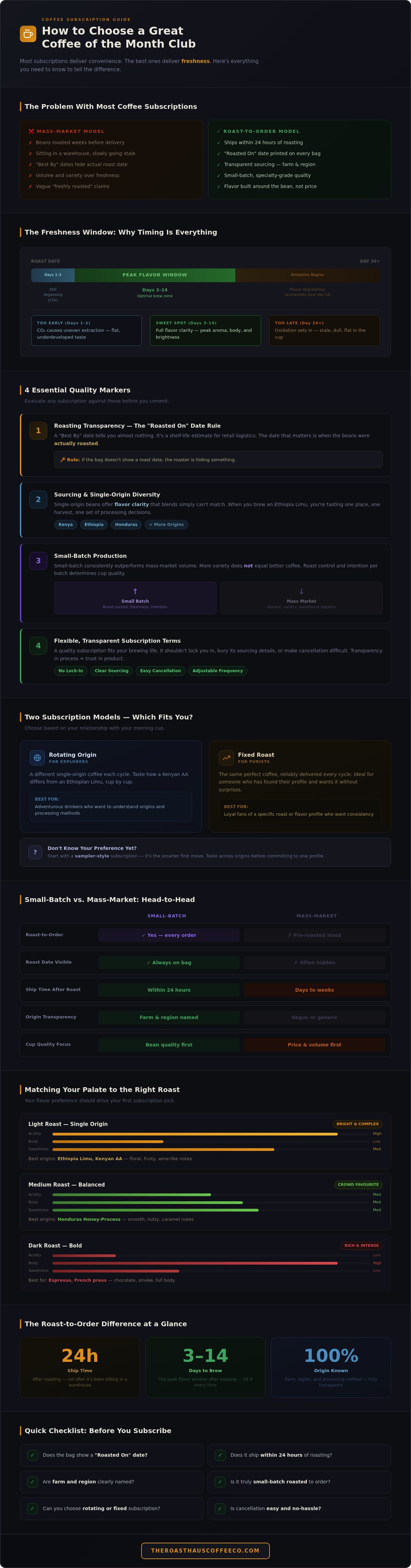
A coffee of the month club is a curated subscription service that delivers freshly roasted beans to your door on a recurring schedule, weekly, biweekly, or monthly, based on your preference. It's not just a convenience play. Done right, it's a direct line to specialty-grade coffee sourced from specific farms and regions, roasted in small batches, and shipped before the flavor has any chance to fade.
The distinction between commodity coffee and specialty subscription models matters more than most people realize. Commodity coffee is built around price and volume. Specialty subscriptions are built around the bean itself: its origin, its processing method, its roast profile, and critically, how quickly it reaches you after roasting. That shift in philosophy changes everything about what ends up in your cup.
For home brewers who want to explore beyond the grocery store shelf, a subscription removes the guesswork. You can taste a washed Ethiopian natural one month and a Honduran honey-process the next, without researching importers or hunting down specialty retailers. Regions like Kenya, Honduras, and Ethiopia each produce beans with genuinely distinct flavor characteristics, and a well-curated club brings those differences to your kitchen on autopilot.
The Evolution of Coffee Subscriptions in 2026
Technology has quietly leveled the playing field between small independent roasters and national brands. A family-owned roastery in a small Oklahoma town can now reach customers across the country with the same logistical efficiency as a large operation, while still roasting to order. That's a significant shift. The result is that transparency has become a real competitive differentiator: roasters who publish their sourcing origins and roast dates are winning customers who've grown skeptical of vague "freshly roasted" claims on mass-market bags. Freshness has replaced convenience as the primary reason people join a subscription, because convenience alone doesn't explain why your coffee tastes flat.
Discovery vs. Consistency: Which Club Type Do You Need?
Two distinct subscription models have emerged, and choosing between them comes down to your relationship with your morning cup.
- Rotating Origin clubs send a different single-origin coffee each cycle. These are built for adventurous drinkers who want to understand how a Kenyan AA differs from an Ethiopian Limu, cup by cup.
- Fixed Roast subscriptions deliver the same coffee repeatedly, ideal for someone who's found their perfect profile and wants it reliably, without surprises.
Your coffee beans choice shapes your long-term satisfaction more than any other variable. If you don't know your preference yet, a sampler-style entry point is the smarter first move. When evaluating any coffee subscription Oklahoma has available, ask whether the club actually supports both paths, or just defaults to rotating variety because it's easier to market.
How to Evaluate a Coffee Subscription: 4 Essential Quality Markers
Most people pick a subscription based on price or packaging. That's the wrong starting point. The quality of what's in your cup comes down to four specific markers, and once you know them, you can't unsee them. Use these as your filter before you commit to any recurring order.
Roasting Transparency: The 'Roasted On' Date Rule
A "Best By" date tells you almost nothing useful. It's a shelf-life estimate designed around retail logistics, not flavor. In the artisan world, it's a red flag because it obscures the one date that actually matters: when the beans were roasted.
Peak flavor in freshly roasted coffee typically falls within a 3 to 14-day window after the roast date. Before day three, beans are still degassing, which is the process by which carbon dioxide trapped during roasting slowly releases from the bean. Brew too early and that CO2 creates uneven extraction. Wait too long and oxidation takes over. A roaster who prints the roast date on every bag is giving you the information you need to hit that window precisely. One who doesn't is hiding something.
Sourcing and Single-Origin Diversity
Single-origin beans offer something blends simply can't: flavor clarity. When you brew an Ethiopia Limu, you're tasting one place, one harvest, one set of processing decisions. That specificity is how you actually learn what you like. Mystery blends flatten those distinctions into a generic "smooth" or "bold" that tells you nothing about origin character.
Small-batch roasting amplifies this advantage. Industrial roasters work in volumes that prioritize consistency across thousands of pounds. Small-batch roasters dial in each origin individually, adjusting roast curves to match the bean's density and moisture. The difference shows up immediately in the cup.
Shipping Speed and Customization Flexibility
Two final markers separate serious subscriptions from convenient ones. First, count the days between roast and delivery. A roastery shipping within 24 hours of roasting is operating at a fundamentally different standard than one fulfilling weekly warehouse batches. Second, check whether you can pause, skip, or adjust your grind size without a phone call. Rigid subscriptions create friction; flexible ones fit your actual life.
For anyone evaluating a coffee subscription Oklahoma has to offer, these four markers work as a practical checklist. Any roaster worth your recurring business should be able to answer all four questions clearly and without hesitation. If they can't, that's your answer. You can explore how a roast-to-order model handles all four at The Roast Haus Coffee Co., where the roast date is never a mystery.
Small-Batch vs. Mass-Market: Why Freshness Trumps Variety
More options don't make better coffee. That's the core misconception driving most people toward the wrong subscription. Large clubs compete on catalog size because it's easy to market. Forty origins, twelve roast levels, a new limited release every week. What that breadth actually requires is a logistics model built around storage, not freshness. And storage is where flavor goes to die.
The Problem with Warehouse Coffee
Large aggregator subscriptions typically roast in bulk, then hold pre-roasted inventory in fulfillment centers until an order triggers a shipment. The timeline from roast to your door can stretch to 30, 45, even 60 days. By that point, the volatile aromatic compounds responsible for brightness, complexity, and origin character have largely dissipated through oxidation. What you're brewing is technically coffee. It's just a diminished version of what it could have been.
The loss isn't subtle. Freshly roasted beans carry compounds like aldehydes and ketones that contribute floral, fruity, and caramel notes. These degrade quickly once exposed to oxygen over time. After 30 days in a warehouse bag, those notes are gone regardless of the bag's one-way valve. And here's the part most people miss: no amount of grinder quality recovers what oxidation has already destroyed. As this guide to coffee grinders explains, grinding precision matters enormously, but it can only unlock what's still present in the bean. Stale beans ground perfectly still produce a flat cup.
The 24-Hour Roast-to-Ship Guarantee
Shipping within 24 hours of roasting isn't a marketing line. It's a logistical commitment that fundamentally restructures how a roastery operates. It means roasting only what's ordered, not what's projected. It means no warehouse buffer, no pre-built inventory, no rounding up batches for efficiency. Every order triggers the roast.
The Roast Haus Coffee Co. operates exactly this way from Wyandotte, Oklahoma. That's not a limitation. It's the point. A family-owned operation at that scale can maintain direct accountability over every batch in a way that a national distributor simply can't. When the same people sourcing the beans are also roasting them and packing the order, quality control isn't a department. It's personal.
For anyone evaluating a coffee subscription Oklahoma has to offer, the 24-hour model means your beans arrive at the beginning of their peak flavor window, not the end of it. You're not compensating for lost time. You're starting exactly where you should be.
Small-batch roasting also allows for something industrial volume prevents: precision heat control dialed to each specific origin. A dense Kenyan AA needs a different roast curve than a lighter Ethiopian natural process. Mass-market roasters standardize those curves for throughput. Small-batch roasters adjust them for the bean. That difference is measurable in the cup, and it's the reason variety without freshness is just noise.
Customizing Your Experience: From Single-Origin to Signature Samplers
Knowing freshness matters is only half the equation. The other half is knowing what you actually want in your cup. Flavor preference is personal, and the right starting point depends entirely on how you like your coffee to feel, not just taste. Bright and complex? Rich and smooth? Somewhere in between? Your answer shapes everything that follows.
Understanding Flavor Profiles: Fruity, Nutty, and Bold
Origin is the single biggest driver of natural flavor character. Ethiopian beans, for example, tend toward bright, fruit-forward complexity, think blueberry, jasmine, and citrus peel. Mexican and Central American origins lean nuttier and more chocolatey, with lower acidity and a rounder body that many drinkers find immediately approachable. These aren't roasting decisions. They're geography.
Brewing method amplifies this. A French press, which uses full immersion and no paper filter, pulls more oils from the bean and produces a heavier, richer body. That method pairs naturally with a medium or dark roast. If you want to understand exactly how to dial in that process, this guide to making coffee at home walks through the variables worth controlling. Pairing the right roast level to your preferred brew method isn't overthinking it; it's just getting the most out of what's in the bag.
For those avoiding caffeine, the Swiss Water Process decaf is worth understanding. It uses water, not chemical solvents, to remove caffeine while preserving the bean's original flavor compounds. The Roast Haus Coffee Co. offers a Decaf Swiss Water Process option for exactly this reason. Clean extraction, no chemical residue, and the same roast-to-order freshness applied to every other offering.
If you love bold, high-acid profiles with real complexity, the Kenya AA Supreme is the clearest expression of what single-origin coffee can do. It's not subtle. For a gentler entry point, the Honduras Morning Splendeur delivers a balanced, smooth cup that works well across multiple brewing methods without demanding much adjustment.
Not sure where you land yet? Start with the All Day Sampler. It's the most practical first move for any new member of a coffee subscription Oklahoma roastery can offer, because it removes the guesswork entirely. You taste across profiles, identify what resonates, and then commit with real information rather than a guess.
Managing Your Subscription: Flexibility is Key
The best subscriptions bend around your life, not the other way around. Consumption changes. Travel happens. A club that locks you into a rigid cadence isn't a service; it's an obligation. Look for a portal where you can adjust delivery frequency, skip a cycle, or update your grind preference without contacting support. That level of control is also what makes a coffee subscription a genuinely useful gift. You're not giving someone a one-time box. You're giving them a recurring, customizable experience they can shape themselves.
Explore the full lineup at The Roast Haus Coffee Co. and find the roast that matches how you actually drink your coffee.
Join The Roast Haus Coffee of the Month Club
Everything covered in this guide points to the same conclusion: freshness isn't a feature. It's the foundation. A coffee subscription built around roast-to-order production, transparent sourcing, and genuine flexibility isn't a luxury option. It's simply the standard that every subscription should meet, and most don't.
The Roast Haus Coffee Co. was built around one operating principle: roast only what's ordered, then ship it within 24 hours. No warehouse buffer. No pre-built inventory sitting under fluorescent lights. Every bag leaves Wyandotte at the beginning of its peak flavor window, not the tail end of it. That's not a slogan. It's a daily operational commitment that shapes every decision the roastery makes.
For anyone still weighing which coffee subscription Oklahoma has to offer is worth their recurring order, the answer comes down to accountability. Who's actually responsible for what ends up in your cup? At The Roast Haus, that answer is specific and personal.
From Our Haus to Yours: The Wyandotte Connection
The Roast Haus Coffee Co. started in 2014 as a kitchen hobby. What began between a husband and wife has grown into a commercial roastery without losing the thing that made it worth growing in the first place: the personal stake in every batch. Artisan roasting, as The Roast Haus practices it, means every variable from heat curve to ship date is controlled by the same people who care whether your cup is exceptional. Oklahoma craftsmanship isn't a regional talking point here. It's the actual mechanism behind the quality.
Start Your Discovery Today
If you're not sure where to begin, start with the All Day Sampler. It's the lowest-risk, highest-return entry point available. You'll taste across profiles, from the bold, complex brightness of the Kenya AA Supreme to the smooth, approachable balance of the Honduras Morning Splendeur, and you'll know exactly what to order next based on what your palate actually responds to. That's real information. It's more useful than any quiz or algorithm.
Once you're in, the subscription bends around your life. Adjust your frequency, skip a cycle, or update your grind preference without friction. The flexibility is built in because a good subscription should feel like a service, not a commitment you need to escape.
Your next great cup is already roasted to order and waiting to ship. Join the Roast Haus Coffee of the Month Club and taste what peak freshness actually means.
Your Best Cup Is One Order Away
The difference between a forgettable subscription and a genuinely great one comes down to three things: when the beans were roasted, how carefully they were sourced, and whether the model bends around your life. Every section of this guide points back to those same fundamentals.
For anyone still comparing which coffee subscription Oklahoma is worth committing to, the practical filter is simple. Ask when the beans were roasted. Ask who's accountable for the answer. A family-owned roastery that's been perfecting small-batch production since 2014, shipping within 24 hours of every roast, answers both questions without hesitation.
You don't need to guess your way into a great cup. Start with the All Day Sampler, taste what peak freshness actually delivers, and let your palate make the call from there.
Experience Peak Freshness: Join Our Coffee of the Month Club and taste the difference that roasted-to-order really makes. Your next great morning starts here.
Frequently Asked Questions
What is a coffee of the month club?
A coffee of the month club is a recurring subscription that delivers freshly roasted beans to your door on a schedule you choose, typically weekly, biweekly, or monthly. It's a direct line to specialty-grade coffee sourced from specific farms and regions, without the need to hunt down specialty retailers yourself. The best clubs roast to order, meaning your beans are roasted specifically for your shipment rather than pulled from pre-built inventory.
How often will I receive my coffee deliveries?
Delivery frequency depends on the club you join and how much coffee you actually drink. Most subscriptions offer weekly, biweekly, or monthly options. The right cadence is personal. A household brewing one or two cups daily has different needs than someone running a home espresso setup all morning. Choose a club that lets you adjust that frequency without jumping through hoops, because your consumption will shift over time.
Can I choose between whole bean and ground coffee in a subscription?
Most quality subscriptions offer both whole bean and pre-ground options, with grind settings matched to your brewing method, whether that's drip, French press, pour-over, or espresso. Whole bean is always the better choice if you have a grinder at home, since grinding just before brewing preserves the volatile aromatic compounds that give coffee its brightness and complexity. Pre-ground starts oxidizing the moment it's cut, which accelerates flavor loss.
What makes 'roasted-to-order' coffee better than store-bought?
Store-bought coffee is roasted in bulk, packaged, shipped to a distributor, then shelved. By the time it reaches your cart, weeks or months have passed since the roast date. Roasted-to-order means the beans are roasted specifically because you placed an order, then shipped within 24 hours. You receive coffee at the start of its peak flavor window, not the end. That's a fundamentally different product, and the difference is immediately noticeable in the cup.
Is it easy to cancel or pause my coffee of the month club membership?
It should be. A well-designed subscription lets you pause, skip, or cancel directly through your account portal without contacting customer support. If a club makes cancellation difficult or buries the option, that's a deliberate friction point, not an oversight. Before committing to any coffee subscription Oklahoma has to offer, check that the account management tools are straightforward and that you're not locked into a rigid billing cycle you can't adjust.
What is the best way to store my monthly coffee delivery for freshness?
Store your beans in an airtight container, away from direct light, heat, and moisture. A cool, dark cabinet works well for most households. Avoid the refrigerator; the temperature cycling and ambient moisture do more harm than good. Don't freeze beans unless you're storing a large quantity long-term and can seal them in airtight portions. With roasted-to-order beans arriving fresh, your main job is simply keeping oxygen away from them between uses.
Do you offer decaf options in your coffee club?
Yes. The Roast Haus Coffee Co. offers a Decaf Swiss Water Process option, which removes caffeine using water rather than chemical solvents. That distinction matters because the Swiss Water Process preserves the bean's original flavor compounds instead of stripping them out alongside the caffeine. The same roast-to-order freshness standard applies to every decaf order. You're not getting a compromise product; you're getting the same small-batch quality with the caffeine removed cleanly.
How do I know where my coffee beans are sourced from?
A transparent roastery tells you exactly where each bean comes from, down to the country and region. At The Roast Haus Coffee Co., every offering is tied to a specific origin: Kenya AA Supreme, Ethiopia Limu Organic, Honduras Morning Splendeur. That's not marketing language; it's sourcing accountability. For anyone evaluating a coffee subscription Oklahoma roastery can offer, origin transparency is one of the clearest signals that a roaster is working with genuine specialty-grade beans and not obscuring the supply chain behind a blend name.

