


If your beans were roasted more than a few weeks ago, even the most expensive burr grinder in the world won't save your morning cup. You've likely experienced the frustration of grinding fresh only to be met with a thin, bitter, or unpleasantly sour taste. It's confusing to navigate the endless labels and industry jargon, especially when "premium" bags from the grocery store often turn out to be stale. Finding the best coffee beans for home grinding isn't just about the label; it's about the timing and the integrity of the roast.
We understand that you want a reliable source for beans that actually live up to the hype. This guide will show you how to select high-quality beans that unlock the full potential of your home grinder for a consistent, cafe-quality experience. With specialty coffee consumption reaching record levels in 2026, knowing exactly what is in your hopper is more important than ever. We'll explore how different roast levels affect your specific brew method and look at five exceptional options, including our small-batch Kenya AA Supreme and Ethiopia Limu Organic. These selections are shipped within 24 hours of roasting to ensure you get the sensory excellence you deserve every morning.
Key Takeaways
- Learn why the roast date is the only metric that matters for preserving the aromatic oils that make fresh grinding worthwhile.
- Discover how to identify the best coffee beans for home grinding by matching bean density to your specific grinder type.
- Understand the differences between single-origin beans and blends to help you choose between unique flavor profiles or brewing consistency.
- Master the roast level roadmap to select beans like our Honduras Morning Splendeur that provide a forgiving "sweet spot" for most home setups.
- See how small-batch production and 24-hour shipping windows protect the delicate flavors often lost in industrial warehouse storage.
Why the Best Coffee Beans for Home Grinding Must Be Fresh
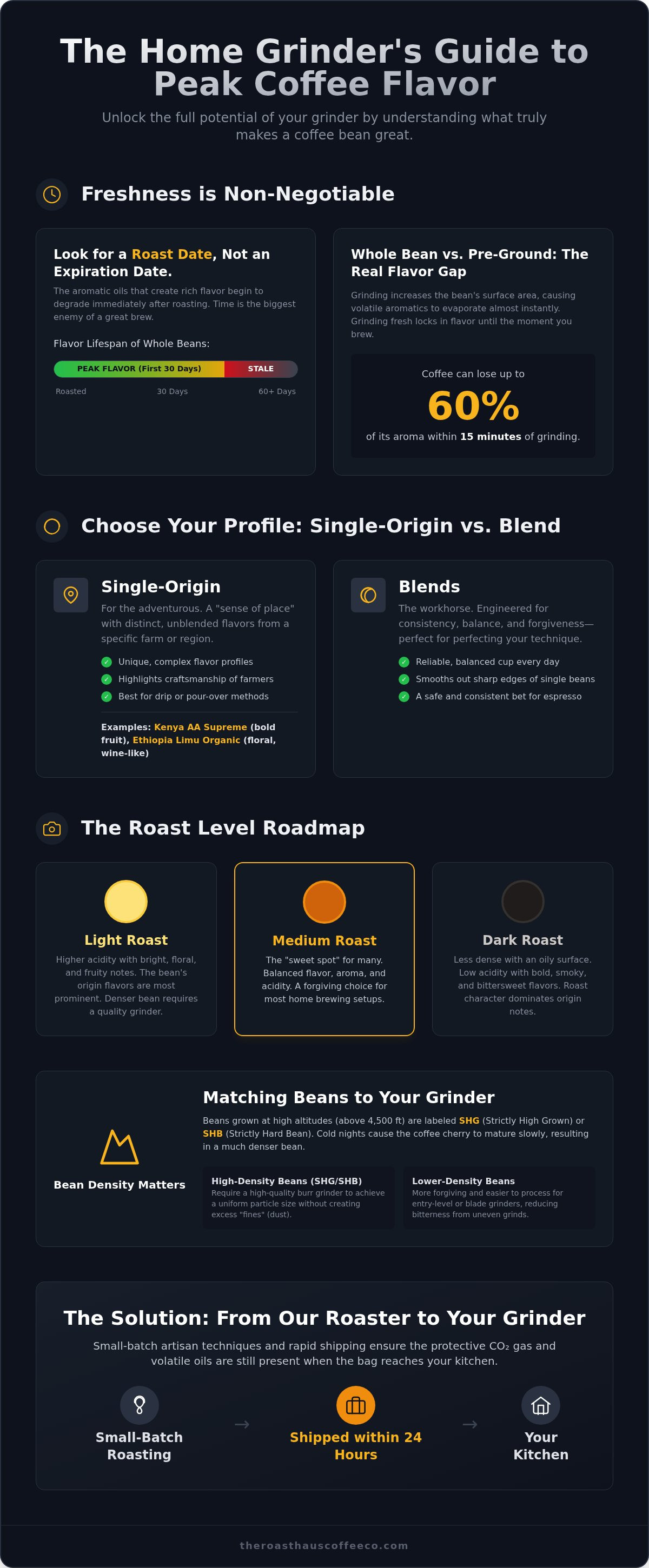
Grinding at home is a commitment to quality. It requires an investment in equipment and a few extra minutes each morning. If you start with stale beans, you are simply wasting your time. The Coffee bean is a complex organic seed that begins to change the moment it leaves the heat of the roaster. Oxidation starts immediately. Whole beans can hold their peak character for about thirty days, but ground coffee loses its magic in less than an hour. Finding the best coffee beans for home grinding means looking for a roast date, not an expiration date.
Most grocery store bags are a trap. They feature "Best By" dates that are months in the future. These dates relate to shelf stability, not the vibrant flavors you want. Once you grind a bean, the oxidation rate increases tenfold. You cannot recover lost flavor with a high-end grinder if the bean is already flat. A roasted-to-order approach is the only way to ensure your morning routine produces a superior cup. At Roast Haus, we ship within 24 hours of roasting because we know that time is the biggest enemy of a great brew.
The Science of Freshness: Volatile Oils and Aromatics
Fresh coffee contains carbon dioxide that was trapped during the roasting process. This CO2 acts as a natural shield, preventing oxygen from reaching the lipids and oils that provide a rich, cafe-style mouthfeel. Degassing is the steady release of these gases from the roasted bean over time, and it is a critical window for flavor development. If you grind too late, the shield is gone and the oils have turned rancid. We focus on small-batch artisan techniques to ensure this protective gas is still present when the bag reaches your kitchen.
Whole Bean vs. Pre-Ground: The Real Flavor Gap
Pre-ground coffee is convenient, but it comes at a steep cost to quality. Studies in the industry show that coffee can lose up to 60% of its aroma within 15 minutes of grinding. The reason is simple physics. Grinding breaks the bean into thousands of tiny particles, which increases the surface area exposed to the atmosphere. This massive exposure causes the volatile aromatics to evaporate almost instantly. Grinding at home allows you to keep these flavors locked inside the bean until the second you are ready to brew. It also gives you the power to adjust your grind size for precise extraction control, preventing the bitterness found in stale, pre-ground alternatives.
Choosing Between Single-Origin and Blends for Your Grinder
Choosing the best coffee beans for home grinding depends on your goal for the morning. Do you want to explore the unique characteristics of a specific mountain range, or do you want a reliable, balanced cup that tastes the same every day? Single-origin beans represent a single farm or region. They offer a "sense of place" through distinct, unblended flavors. Blends are different. We engineer blends for consistency and forgiveness. They combine various beans to smooth out the sharp edges, making them an excellent choice for those still perfecting their grinding technique.
Altitude is a technical detail that many home brewers overlook. Beans labeled as Strictly High Grown (SHG) or Strictly Hard Bean (SHB) grow at elevations above 4,500 feet. The cold nights and thin air at these heights cause the fruit to mature slowly. This results in a much denser bean. Bean density directly impacts your grind consistency. A very dense bean requires a high-quality burr grinder to achieve a uniform particle size. If your grinder is an entry-level model, you might find that softer, lower-altitude beans are easier to process without creating too many "fines" or dust particles.
The Case for Single-Origin: Exploring Kenya and Ethiopia
Single-origin beans are for the adventurous. They highlight the raw craftsmanship of the farmers. Our Kenya AA Supreme: Bold Flavors From The Roast Haus is a perfect example. It features high acidity and bold fruit notes that demand a precise grind. These beans are best suited for drip or pour-over methods where the nuanced flavors can breathe. Similarly, our Ethiopia Limu Organic offers floral and wine-like qualities. These delicate aromatics are easily lost if the beans are not ground immediately before brewing. If you enjoy discovering new flavor profiles, single origins are the best coffee beans for home grinding.
Why Blends Are the Safe Bet for Espresso Grinding
Blends are the workhorse of the home kitchen. They are particularly valuable for espresso drinkers who need a consistent result every time. Our Honduras Morning Splendeur is designed to create a balanced morning cup with a smooth finish. Blends are helpful because they mask minor grinding errors. If your particle size is slightly inconsistent, the diverse flavor profile of a blend can hide the resulting bitterness. They also help you achieve a thick, stable crema. This is often difficult to do with light-roast single origins. You can browse our full range of small-batch roasted beans to find the right balance for your specific machine.
The Roast Level Roadmap: Light, Medium, or Dark?
Selecting the best coffee beans for home grinding requires understanding how heat changes the bean's physical structure. During the roasting process, heat breaks down the internal fibers of the seed. Light roasted beans are the densest and hardest to process. They preserve the most "origin character," which includes the bright, floral notes found in high-altitude crops. However, this density puts significant strain on your grinder motor. If you use a manual hand grinder, you will notice that light roasts require much more physical effort to crush than darker options.
Medium roasts represent the sweet spot for most home equipment. These beans have spent enough time in the roaster to develop a balanced body without losing their unique acidity. You can identify a fresh, roasted-to-order bean by its appearance. A fresh medium roast should have a satin or matte finish. If the beans look gray or dusty, they have likely sat in a warehouse for months and lost their vitality. When you grind fresh, you should see a vibrant, consistent color across the particles.
Medium Roasts: The Versatile Choice for Home Brewers
Medium roasts provide the most balanced profile for daily drinking. They offer enough structure to stand up to milk while maintaining the crispness of the original bean. Our Honduras Morning Splendeur is a prime example of this versatility. It works well across various grind sizes, from the coarse setting needed for a French Press to the medium-fine texture required for an Aeropress. If you want the best coffee beans for home grinding that won't damage your equipment, medium roasts are the most reliable starting point. You can learn more about perfecting these techniques in our guide on How to Make Coffee: The Ultimate Guide.
The Dark Roast Warning: Oily Beans and Grinder Maintenance
Dark roasts are rich and chocolatey, but they come with a maintenance cost. As beans roast longer, the internal oils are forced to the surface. These oils create a shiny, dark appearance that many people associate with "bold" flavor. However, there is a fine line between a bold roast and a burnt one. If the beans are oily, they can gum up your burr grinder over time. The sticky residue attracts old coffee dust, which can turn rancid and ruin future batches. To prevent clogging, we recommend cleaning your burrs every two weeks if you primarily grind dark roasts. You can also try grinding in smaller batches to keep the heat from the motor from melting the oils further into the mechanism.
Practical Guidance: Matching Beans to Your Grinder Type
The grinder is the bridge between the bean and your cup. You do not need to spend hundreds of dollars on a commercial machine to see an improvement. However, you must match your choice of the best coffee beans for home grinding to the specific tool on your counter. Different grinding mechanisms handle bean density and roast levels in unique ways. If you understand these mechanics, you can avoid common frustrations like bitter "sludge" or uneven extraction.
Blade grinders are common in many kitchens. These machines use a spinning blade to chop beans through impact. Because they lack precision, they are best suited for medium-to-dark roasts. These beans are more brittle and break apart easily. Burr grinders are different. They use two abrasive surfaces to crush the beans to a specific size. A burr grinder is essential if you want to unlock the nuanced, floral flavors of light-roast single origins. These denser, high-altitude beans require the torque and precision that only a burr set can provide. Regardless of your equipment, follow the "Grind Only What You Need" rule. Keep your beans in their airtight bag until the moment you brew to prevent the volatile oils from evaporating in your grinder's hopper.
Grinding for Pour-Over and Drip
For methods like pour-over or standard drip, you want a clean and bright result. We recommend using our Ethiopia Limu Organic or Kenya AA Supreme for these brewers. These beans have the high-altitude density required for a crisp finish. Aim for a "medium-coarse" consistency, which should look like sea salt. Artisan beans hold their structure better during this process, allowing for a more uniform particle size. If you are struggling with your settings, check out The Ultimate Guide to Coffee Grinders for a deeper look at equipment calibration.
Grinding for French Press and Cold Brew
Coarse-grind methods require a bean with a sturdy body. Our Honduras Morning Splendeur excels here because it maintains its balance even with longer immersion times. Many people complain about "sludge" at the bottom of their French Press. This usually happens when you use brittle, stale beans that shatter into fine dust during the grinding process. High-quality, fresh beans are more pliable and resist this shattering. Coarse grinding requires the freshest possible beans because older, drier beans shatter into fine dust that passes right through your filter and ruins the clarity of your brew. To see the difference that 24-hour freshness makes in your coarse-grind brewer, order our All Day Sampler today.
The Roast Haus Solution: From Roaster to Your Grinder in 24 Hours
At Roast Haus, we believe the best coffee beans for home grinding are those that have not spent weeks on a retail shelf. Our family owned roastery in Oklahoma operates on a strict roast to order model. We do not roast a single bean until your order arrives in our system. This ensures you receive your coffee at the peak of its degassing phase, which is when the flavors are most vibrant. Most industrial brands roast in massive batches and store them in distribution centers for months. Our small batch artisan techniques prioritize the integrity of the seed over warehouse efficiency. This commitment to timing is the ultimate differentiator in the quality of your cup.
Large scale industrial roasting is designed for shelf life, not sensory excellence. Those beans are often roasted to a generic profile that survives long term storage in plastic bags. Our Oklahoma based team takes the opposite approach. We monitor each small batch to ensure the unique sugars of the bean are perfectly caramelized. This artisan focus means you get a product that is alive with flavor. When you support an independent business like ours, you are participating in a community that values craftsmanship over corporate shortcuts. We are proud of our identity as a personal venture that genuinely wants you to have the best experience possible every morning.
The All Day Sampler: Find Your Perfect Grind
If you are new to home grinding, starting with a large bag can be a challenge. The All Day Sampler is a curated selection of our best selling whole beans designed to help you experiment. It includes a variety of origins, such as our Mexican, Colombian, and Ethiopian beans. This allows you to feel the physical difference in bean density. You will notice that the harder Ethiopian beans require a different touch on your grinder than the softer Mexican varieties. Using a sampler is the most effective way to calibrate your equipment and find the best coffee beans for home grinding without wasting a full bag of premium coffee.
The Roast-to-Order Subscription Advantage
Consistency is the key to better morning coffee. A subscription ensures you never have to settle for stale grocery store beans again. When you schedule your deliveries, you save time and skip the frustration of finding empty shelves or old roast dates. You also gain peace of mind knowing your beans were roasted just 24 hours before they were shipped. This direct to consumer model eliminates the middleman and keeps the focus on sensory integrity. You can explore how to set up your own schedule in our A Guide to the Best Coffee Subscription Services. By choosing a subscription, you are choosing a high standard experience that respects the effort you put into grinding your own coffee.
Elevate Your Morning Routine with Better Beans
At Roast Haus, we are a family-owned and operated roastery in Wyandotte, OK. We believe in the integrity of our product. This is why every bag is shipped within 24 hours of roasting. This artisan, small-batch approach means you get the freshest possible experience delivered straight to your door. It's time to stop settling for stale, warehouse-stored coffee that lacks character. Shop our Roasted-to-Order Whole Beans and Taste the Difference today. We are excited to help you transform your morning ritual into something truly exceptional.
Frequently Asked Questions
What are the best coffee beans for beginners to grind at home?
Medium roast blends are the ideal starting point for anyone new to home grinding. These beans are less dense than light roasts, which makes them easier for entry-level grinders to process consistently. Our Honduras Morning Splendeur provides a balanced profile that is very forgiving if your grind size isn't perfect yet. It offers a smooth experience that helps you learn the mechanics of your equipment without the frustration of extreme acidity.
How long do whole coffee beans stay fresh after the roast date?
Whole beans remain at their peak flavor for approximately 7 to 30 days after the roast date. During this window, the beans are still releasing carbon dioxide, which protects the delicate oils from oxidation. After 30 days, even the best coffee beans for home grinding will begin to lose their aromatic complexity. This is why we prioritize shipping within 24 hours of roasting to maximize your usable freshness window at home.
Is it actually cheaper to buy whole beans and grind them yourself?
Buying whole beans offers better long-term value rather than a lower shelf price. While the cost per bag is similar to pre-ground specialty coffee, you reduce waste by only grinding what you need for each cup. Pre-ground coffee stales rapidly, often leading you to throw away the bottom of the bag when it loses flavor. Investing in whole beans ensures that every cent you spend results in a high-quality, drinkable cup of coffee.
What coffee beans are best for a burr grinder vs a blade grinder?
Burr grinders are best for dense single-origin beans like our Kenya AA Supreme because they require precise particle uniformity. These machines can handle the hard structure of high-altitude seeds without overheating. Blade grinders are better suited for medium-to-dark roasts. Since these beans are more brittle and shatter easily, the lack of precision in a blade grinder is less noticeable than it would be with a light, acidic roast.
Should I store my coffee beans in the freezer to keep them fresh?
You should not store your coffee beans in the freezer for daily use. Every time you open the container, condensation forms on the cold beans, which introduces moisture and accelerates spoilage. Beans also act as a sponge for freezer odors. The most effective way to preserve your beans is to keep them in an opaque, airtight container at room temperature. Place the container in a dark cupboard away from the stove or direct sunlight.
How many days after roasting should I wait before grinding my beans?
You should wait between 3 and 5 days after the roast date before you begin grinding. This period allows the beans to undergo degassing, which is the release of excess carbon dioxide trapped during roasting. If you grind and brew too early, the gas can interfere with water contact and result in a sour or metallic taste. Our 24-hour shipping model ensures that by the time the beans reach your door, they are perfectly ready for your grinder.
Can I use espresso beans for regular drip coffee if I grind them fresh?
You can absolutely use espresso-labeled beans for drip coffee if you adjust your grind setting. Espresso is a roasting style or a brewing method, not a specific type of bean. To use these beans in a drip machine, simply set your grinder to a medium consistency similar to sea salt. This allows the rich, chocolatey notes typically found in espresso roasts to shine in a larger cup without becoming over-extracted or bitter.
What is the difference between single-origin and blended beans for home grinding?
Single-origin beans come from one specific region and highlight unique flavor characteristics, such as the wine-like notes in our Ethiopia Limu Organic. These are the best coffee beans for home grinding when you want to explore the diversity of coffee. Blends combine beans from different origins to create a specific, repeatable flavor profile. Blends are engineered for balance and consistency, making them a reliable choice for your daily morning routine.
