


Why does most decaf coffee taste like wet cardboard and chemicals? You shouldn't have to choose between a good night's sleep and a cup of coffee that actually tastes like coffee. Most people think decaf is a compromise. They're used to that flat, paper-like flavor and a lingering chemical aftertaste from solvent-based processing. It's frustrating when you want the ritual of a pour-over or the richness of an espresso without the jitters. Finding decaf coffee that actually tastes good is possible when you stop settling for stale, grocery store bags.
The global decaf market is valued at $16.48 billion in 2026. More drinkers now demand premium, chemical-free options that keep the bean's integrity. We'll show you why your current cup tastes flat and how the Swiss Water Process preserves natural flavor profiles. You'll learn how to identify fresh, artisan-roasted beans that rival any caffeinated cup. We'll also explain why buying from independent roasters who respect the process makes a real difference for your daily ritual.
Key Takeaways
- Identify the chemical solvents that ruin flavor and learn how to swap them for cleaner, more flavorful processing methods.
- Discover why the Swiss Water Process is essential for decaf coffee that actually tastes good by preserving the bean's original origin notes.
- Learn how to avoid stale beans by understanding why decaf is more porous and requires stricter freshness standards than regular coffee.
- Master specific brewing adjustments, like coarsening your grind and lowering water temperature, to prevent over-extraction.
- See how artisan-roasting methods treat decaf as a specialty product rather than a secondary concern.
Why Most Decaf Tastes Bad (And How to Fix It)
Most supermarket decaf is a disappointment. It often tastes like wet paper or flat cardboard because big coffee corporations treat it as a secondary product. They use lower-grade beans that didn't make the cut for their caffeinated lines. This "afterthought" mentality is why many people believe decaf is inherently inferior. If you want decaf coffee that actually tastes good, you have to look past the grocery store aisle and understand how the coffee was handled before it even reached the shelf.
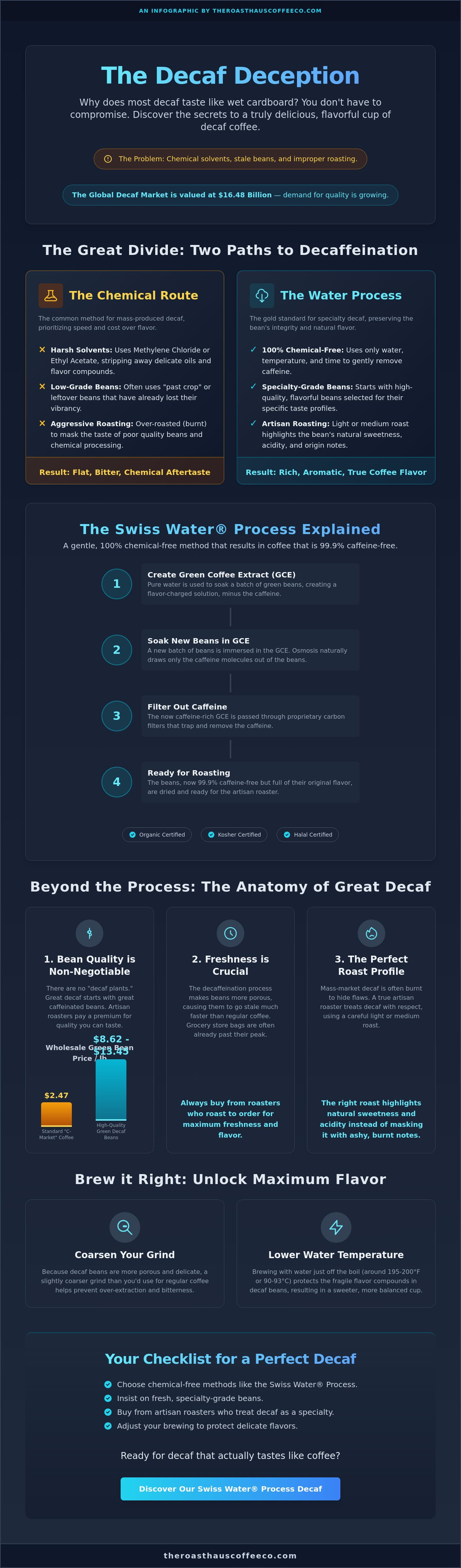
The problem starts with the beans. In April 2026, the average retail price for ground coffee hit $9.72 per pound. Despite these rising costs, mass-market brands often cut corners on the quality of green beans used for decaf. They use leftovers or "past crop" beans that have already lost their vibrant flavor notes. When you start with a stale, low-quality bean, no amount of roasting can bring it back to life. Real flavor comes from specialty-grade beans that are selected for their specific taste profiles, not just their caffeine content.
The Problem with Chemical Solvents
Mass production relies on speed and volume. This industrial approach to the decaffeination process usually involves chemical solvents like Methylene Chloride or Ethyl Acetate. These chemicals are effective at removing caffeine, but they are aggressive. They strip away the essential oils and flavor compounds that give coffee its body and sweetness. This often leaves behind a metallic or bitter aftertaste that lingers on the tongue. Small-batch roasters avoid these harsh methods because they value the integrity of the bean over the speed of the process.
The Misconception of "Decaf Beans"
There is no such thing as a "decaf coffee plant." Every decaf coffee starts as a regular specialty bean. The final flavor depends entirely on the quality of that "input" bean. Many commercial roasters try to hide processing flaws or low-quality beans by over-roasting them. This results in a burnt, ashy flavor that masks the bean's natural character. To find decaf coffee that actually tastes good, you need a roaster who treats decaf with the same respect as a high-end Kenya AA or Ethiopia Limu. They use a light or medium roast to highlight the natural sweetness and acidity rather than burning it away.
Quality comes at a price. Wholesale prices for high-quality green decaf beans in June 2026 range from $8.62 to $13.45 per pound. This is significantly higher than the $2.47 benchmark "C-market" price for standard coffee. Independent roasters pay this premium because they know that craftsmanship starts with the best raw materials. When you choose a roaster that prioritizes quality over volume, you get a cup that rivals any caffeinated coffee in depth and richness.
The Swiss Water Process: The Secret to Chemical-Free Flavor
The Swiss Water Process is the gold standard for anyone seeking decaf coffee that actually tastes good. It isn't just a marketing term. It is a specific, chemical-free method that relies on the laws of physics to remove caffeine while leaving flavor behind. While traditional methods use harsh solvents, this process uses only water, temperature, and time. It results in a bean that is 99.9% caffeine-free but still retains the complex profile of a standard specialty cup. You get the rich body and aroma you expect without the chemical aftertaste that ruins most decaf experiences.
How Swiss Water Decaffeination Works
The process begins with Green Coffee Extract (GCE). This is water that has been saturated with all the natural flavor solids found in green coffee, but with the caffeine removed. When new green beans are soaked in this GCE, the caffeine migrates out of the beans through osmosis. Because the water is already "flavor-charged," the flavor solids stay inside the bean. The caffeine is then trapped by specialized carbon filters. As of June 2026, the Swiss Water Process maintains Organic, Kosher, and Halal certifications. This ensures the process is environmentally friendly and clean from start to finish.
Preserving Origin Characteristics
Artisan roasters prefer this method because it allows the "terroir" of the coffee to shine. If you are drinking a high-quality bean from Ethiopia or Honduras, you want to taste the specific floral or chocolate notes of that region. Other methods, like the Mountain Water Process, are similar but often lack the same level of flavor saturation during the extraction phase. Swiss Water decaffeination is the preferred choice for small-batch roasting because it protects the delicate sugars and acids that define a specialty bean's character. It's the only way to ensure the final product doesn't just taste like "decaf," but tastes like excellent coffee.
If you are tired of flat, uninspired cups, our Decaf Swiss Water Process beans offer a rich, full-bodied experience that stands up to any brewing method. We treat these beans with the same precision as our caffeinated offerings because we believe decaf drinkers deserve a superior product.
Freshness: The Missing Ingredient in Your Decaf Journey
Freshness is the silent killer of great flavor. This is especially true when you are searching for decaf coffee that actually tastes good. Most people pick up a bag from a grocery store shelf and wonder why the brew tastes like dust or wet paper. The answer is usually the calendar. Decaf beans are physically different from regular beans. Because they have undergone a decaffeination process, their cellular structure is more open and porous. This makes them highly susceptible to oxidation, which is the process that turns fresh oils rancid and flat.
The "Grocery Store Trap" is real. Big brands use "Best By" dates that are often set a year into the future. These dates are about food safety, not flavor integrity. By the time that bag reaches your kitchen, the delicate aromatic compounds are long gone. To get a rich cup, you need to see a "Roasted On" date that is measured in days, not months. We roast our beans in small batches and ship them within 24 hours. This ensures you receive the product at its absolute peak.
The Decaf Oxidation Timeline
The decaffeination process expands the bean's cell structure. This expansion means oxygen can penetrate the bean more easily. Industry experts generally agree that decaf coffee loses its peak flavor profile roughly 20% to 30% faster than caffeinated beans. If a standard coffee stays fresh for four weeks, your decaf might only have a three-week window of excellence. This accelerated timeline is why "roasted-to-order" isn't just a luxury; it's a requirement for quality. Once the beans are roasted, the clock starts ticking faster than you might realize.
Small-Batch Roasting vs. Mass Production
Mass production relies on high heat and massive volumes, which often results in uneven roasts. Decaf beans are delicate. They tend to darken faster and more unpredictably than regular beans. An artisan roaster uses small-batch methods to maintain precise temperature control. This allows us to develop the natural sugars within the bean without scorching the exterior. This careful development is what creates that chocolatey, smooth finish people crave. For a deeper look at how to choose the right coffee beans for your home setup, freshness and roast style should be your top priorities.
You should also consider the state of the bean when you buy it. We always recommend whole bean over pre-ground. Grinding increases the surface area exposed to oxygen. For a bean that is already more porous, pre-grinding is a recipe for a flat, lifeless cup. If you want decaf coffee that actually tastes good, buy it whole and grind it seconds before you brew. It is the simplest way to preserve the hard work that went into the roasting process.
How to Brew Decaf for Maximum Flavor
Decaf coffee behaves differently during the brewing process. Because the beans are more porous, they release their flavors much faster than caffeinated beans. If you treat them exactly like your standard morning roast, you'll likely end up with a cup that is hollow or unpleasantly bitter. Achieving decaf coffee that actually tastes good requires a few simple but critical adjustments to your home setup. You have to account for the physical changes the bean underwent during decaffeination.
Grind and Temperature Adjustments
Decaf beans are more brittle than regular beans. When they go through a grinder, they tend to shatter into more "fines," which are tiny dust-like particles. These fines can clog your filter and lead to over-extraction. To counter this, set your grinder slightly coarser than you would for a caffeinated bean of the same roast level. You can find more specific equipment advice in our guide to coffee grinders.
Temperature is another lever you should pull. While 205°F is common for light roasts, decaf performs better at a lower range of 195 to 200°F. This cooler water prevents the porous beans from releasing harsh, woody flavors too quickly. It allows the natural sweetness and origin notes to come forward. If you use water that is too hot, you'll likely burn away the delicate oils that were preserved during the Swiss Water Process.
Recipe Ratios for Richer Decaf
If your decaf feels thin or watery, try a tighter brewing ratio. Instead of the standard 1:17 ratio, experiment with a 1:15 ratio. This means using one gram of coffee for every 15 grams of water. This creates a fuller body and a more concentrated flavor profile. If you are pulling espresso, you may need to increase your dose slightly to maintain the same mouthfeel you expect from a caffeinated shot. If your decaf leaves a dry, puckering sensation on the back of your tongue, it is a clear sign that the coffee is over-extracted.
The French Press is excellent for decaf because the immersion method highlights the bean's natural oils and body. If you prefer a Pour Over, use a coarser grind and a faster pour to keep the contact time short. Once you're done brewing, store your remaining beans in an airtight container. Avoid clear jars. Light and oxygen are the enemies of freshness. Since decaf oxidizes faster, a vacuum-sealed canister is a smart investment for your kitchen.
Ready to put these tips to the test? Browse our fresh-roasted Decaf Swiss Water Process beans and experience the difference that proper handling makes.
Finding Your Perfect Cup: The Roast Haus Decaf Experience
We believe everyone deserves a great cup of coffee, regardless of caffeine content. At our family-owned roastery in Wyandotte, we refuse to treat decaf as a secondary product. Most large roasters focus on their high-caffeine blends and use decaf as a filler. We take the opposite approach. We've dedicated ourselves to providing decaf coffee that actually tastes good by applying the same rigorous standards to our decaf as we do to every other bean in our shop. It isn't just an extra; it's a priority.
Our Artisan Decaf Philosophy
Our process is built on craftsmanship and transparency. We source our green beans with extreme care, ensuring our Decaf Swiss Water Process selection meets the same quality benchmarks as our Kenya AA Supreme. We roast in small batches using manual techniques. This allows us to monitor every stage of the roast. We can adjust the heat to perfectly develop the sugars in these more delicate beans. Supporting an independent business means you're getting a product made by people who actually care about the final taste in your cup. We don't hide behind burnt roasts or chemical shortcuts.
We offer several ways to explore our lineup and find your new favorite brew:
- The All Day Sampler: This is the perfect way to compare our decaf and caffeinated offerings side-by-side. You can taste the quality and see how our decaf rivals its caffeinated counterparts.
- Bespoke Subscriptions: Our fulfillment model is our biggest differentiator. We roast your coffee only after you order it. This ensures it arrives at your door at peak freshness, avoiding the "grocery store trap" of stale beans.
- Local Integrity: We are proud of our roots. If you are nearby, you can even opt for local pickup in Oklahoma for the absolute freshest experience possible.
Start Your Better Decaf Journey Today
Experience decaf that actually tastes good—shop our Swiss Water Process beans now.
Upgrade Your Daily Coffee Ritual
Finding decaf coffee that actually tastes good shouldn't be a struggle. By choosing beans handled through the chemical-free Swiss Water Process and adjusting your brewing temperature, you can enjoy a cup that rivals any caffeinated specialty roast. Remember that freshness is the ultimate differentiator. Even the best beans will fall flat if they've been sitting on a store shelf for months. The key to a vibrant cup is starting with high-quality green beans and roasting them with precision and care.
At our family-owned artisan roastery in Wyandotte, OK, we prioritize flavor and integrity above all else. We roast every order specifically for you and ship it within 24 hours to ensure you receive it at its absolute peak. You deserve a coffee that reflects the hard work of the farmers and the passion of the roaster. Shop our fresh-roasted Decaf Swiss Water Process coffee beans today and experience the difference that craftsmanship makes. You don't have to sacrifice flavor to enjoy a peaceful evening. We are here to help you rediscover the joy of a great cup.
Frequently Asked Questions
Is there a decaf coffee that actually tastes like real coffee?
Yes, you can find decaf coffee that actually tastes good when you choose beans that are specialty-grade and processed without chemicals. The secret is starting with high-quality green beans rather than the leftovers used by mass-market brands. When a roaster treats decaf with the same respect as a premium Kenya AA Supreme, the result is a rich, complex cup that is indistinguishable from caffeinated coffee.
Why does decaf coffee often have a weird aftertaste?
That unpleasant aftertaste is usually caused by residual chemical solvents like Methylene Chloride or Ethyl Acetate used in industrial decaffeination. These aggressive chemicals strip away the essential oils and flavor compounds that give coffee its sweetness and body. This leaves behind a metallic or bitter tang. Switching to water-processed beans eliminates these chemicals and preserves the natural integrity of the coffee's flavor profile.
Which decaffeination process is the healthiest and best for flavor?
The Swiss Water Process is the gold standard for both health and flavor. It is a 100% chemical-free method that uses only water, temperature, and time to remove caffeine through osmosis. Because it preserves the bean's original origin notes, it is the preferred choice for artisan roasters. As of June 2026, it holds Organic, Kosher, and Halal certifications, ensuring a clean and environmentally friendly product.
Does decaf coffee go stale faster than regular coffee?
Decaf coffee loses its peak flavor roughly 20% to 30% faster than caffeinated beans. The decaffeination process makes the bean's cellular structure more porous and open. This allows oxygen to penetrate the bean more easily, which accelerates the oxidation of natural oils. This is why buying roasted-to-order coffee is much more important for decaf drinkers than for those drinking regular caffeinated blends.
Can I use decaf coffee beans in my espresso machine?
You can pull excellent shots with decaf, but you need to adjust your settings. Decaf beans are more brittle and produce more "fines" during grinding, so you should set your grinder slightly coarser. You should also lower your water temperature to a range of 195 to 200°F. These tweaks prevent the porous beans from over-extracting and becoming unpleasantly bitter or woody in the cup.
Is Swiss Water Process decaf 100% caffeine-free?
No coffee is entirely caffeine-free, but Swiss Water Process beans are 99.9% caffeine-free. This far exceeds the standard requirements for decaffeination. For example, new regulations in South Korea starting January 1, 2028, will require products labeled "decaffeinated" to contain 0.1% or less of the original caffeine content. This process ensures you can enjoy a late-night cup without any risk of sleep disruption.
How should I store my decaf beans to keep them tasting good?
Store your beans in an airtight, opaque container in a cool and dark place. Because decaf is more susceptible to oxidation, you must protect it from light, heat, and moisture. A vacuum-sealed canister is the best investment to keep your decaf coffee that actually tastes good fresh for as long as possible. Avoid clear glass jars and never store your coffee in the refrigerator.
What is the best roast level for decaf coffee?
A medium roast is generally the best choice for decaf coffee. It provides enough heat to develop the natural sugars and chocolatey notes without the burnt or ashy flavors found in dark roasts. Many commercial roasters over-roast decaf to hide the flaws of low-quality beans or chemical processing. An artisan roaster uses a lighter touch to highlight the unique "terroir" and acidity of the specialty-grade beans.

