


Why does your homemade cold brew often taste like "ashy" battery acid when the local roastery’s batch is like liquid velvet? It's a frustrating experience to wait twenty-four hours for a caffeine fix only to end up with a bitter, muddy mess that wastes your best beans. Most coffee lovers agree that while the process seems simple, achieving that elusive, silk-smooth texture is harder than it looks. This guide will teach you exactly how to make smooth cold brew concentrate by using professional roaster techniques that prioritize low acidity and flavor integrity.
You'll master the art of the perfect 1:4 ratio and learn why your grind size is the most important factor in avoiding a messy filtration process. We're going to look at which specific beans, like a hearty Kenya AA Supreme or a chocolatey Honduras Morning Splendeur, yield the best results for your morning lattes. We'll also cover how to store your batch so it stays fridge-stable and ready for your busy mornings. It's time to stop guessing and start brewing with the confidence of a professional roaster.
Key Takeaways
- Understand why cold water extraction is the secret to a low-acid, silk-smooth coffee profile compared to traditional hot brewing.
- Master the industry-standard 1:4 immersion ratio to learn exactly how to make smooth cold brew concentrate that stays fresh in your fridge.
- Discover why freshly roasted, small-batch beans are the most critical factor in avoiding bitter or "ashy" tasting batches.
- Use professional paper filtration and "clean break" techniques to eliminate grit and ensure a crystal-clear, velvety finish.
- Identify which single-origin beans, such as Kenya AA Supreme or Ethiopia Limu Organic, provide the best flavor profiles for cold extraction.
What Is Cold Brew Concentrate (And Why Smoothness Matters)?
Cold brew concentrate is a dense, potent liquid designed for dilution. It is not just strong coffee. You create it by using a high ratio of coffee to water, usually between 1:4 and 1:8. This method relies entirely on time instead of heat to pull flavor from the grounds. Understanding What is cold brew coffee? helps you see why this method is gaining so much ground. The process is slow, intentional, and results in a product that is fundamentally different from a standard iced coffee.
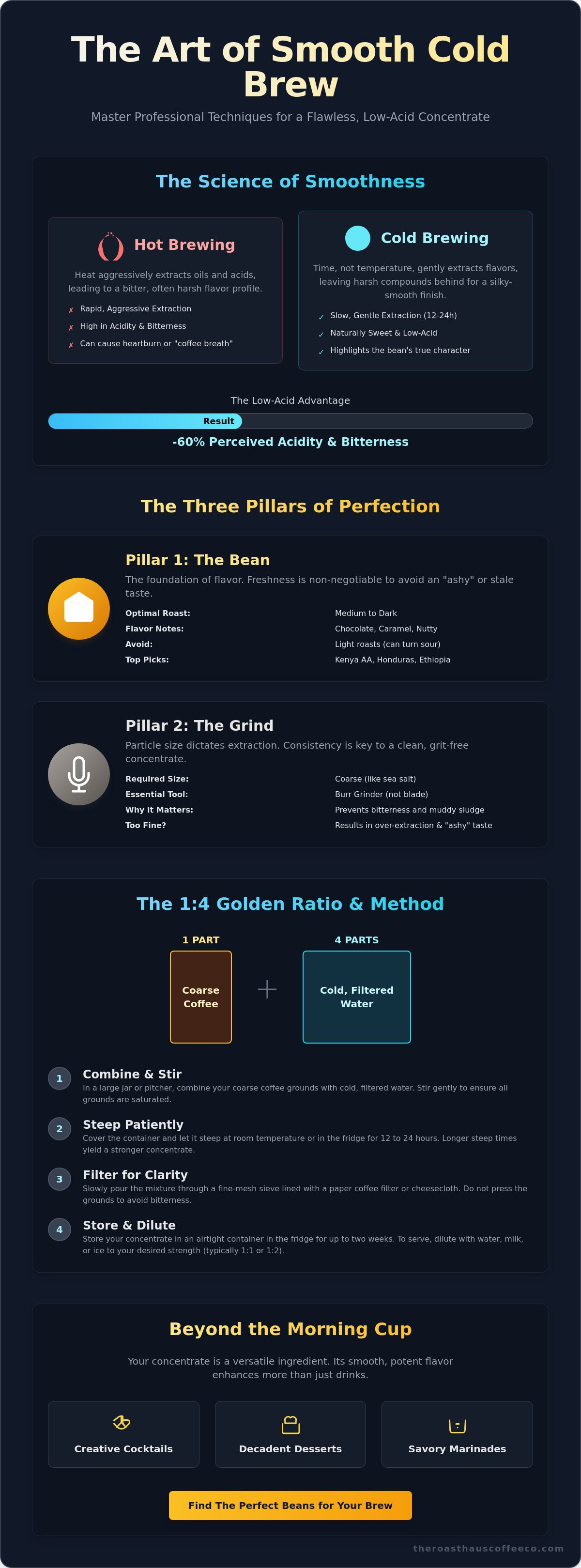
Many people ask how to make smooth cold brew concentrate because they want that velvet mouthfeel without the bite. The secret lies in basic chemistry. Hot water is aggressive. It extracts soluble solids, oils, and acids rapidly. Cold water is much more selective. It leaves behind the harsher, more acidic compounds that often cause "coffee breath" or heartburn. The result is a naturally sweet profile that highlights the bean's character. If you want to know how to make smooth cold brew concentrate at home, you have to respect this gentle extraction process.
Don't confuse concentrate with Ready-to-Drink (RTD) options. RTD is already diluted and meant to be consumed immediately. Concentrate is a powerful base. If you drink it straight, the caffeine content is high enough to be overwhelming. In 2026, the market is shifting. Coffee drinkers are moving away from masking low-quality beans with sugary syrups. The trend is now bean-forward smoothness. People want to taste the craftsmanship of the roast without the distraction of additives. It's about the quality of the coffee beans and the precision of the steep.
The Low-Acid Advantage for Home Brewers
Cold extraction reduces the perceived bitterness and acidity of coffee by about 60%. This is a game changer for anyone with a sensitive stomach or acid reflux. By steeping grounds for 12 to 24 hours, you allow chocolatey and nutty notes to develop fully. Heat often destroys these delicate flavors or buries them under a layer of tannic bitterness. Cold brewing is a slow, honest way to brew that respects the integrity of the bean.
Concentrate vs. Regular Cold Brew: Knowing the Difference
Concentrate acts as a shelf-stable base for your lattes and iced coffees. Making a batch of concentrate saves significant fridge space because you aren't storing the water you'll add later. It also saves you time during a busy work week. You brew once and enjoy for days. Beyond your morning cup, this liquid is incredibly versatile. You can use it to add depth to chocolate cakes, create coffee-infused cocktails, or even whisk it into savory marinades. It is a tool for the creative kitchen as much as it is a morning staple.
The Three Pillars of Smooth Cold Brew: Bean, Grind, and Water
Achieving a velvet finish isn't luck. It's a calculation. If you want to know how to make smooth cold brew concentrate, you have to look at your ingredients and your tools with a critical eye. Most guides tell you to use "any bean," but that is where most home brewers fail. Stale beans produce an ashy, bitter taste that no amount of milk can hide. You need a foundation built on quality and freshness if you want a professional result.
Choosing the Right Roast for Cold Extraction
Medium and dark roasts are the gold standard for cold brew. These roasts develop the deep chocolate, caramel, and nutty notes that thrive during a long, cold steep. Light roasts often carry a high level of fruity acidity. When steeped for 24 hours, that acidity can turn sour or vegetal. Our philosophy at The Roast Haus Coffee Co. is simple: we roast to order. This means the natural oils in our coffee beans haven't had time to go rancid or oxidize. When you brew with beans shipped within 24 hours of roasting from Wyandotte, OK, you get a clean, vibrant flavor that grocery store bags simply can't match.
The Importance of a Consistent Coarse Grind
Particle size dictates extraction speed. For cold brew, you need a "Sea Salt" or coarse Kosher salt consistency. If your grind is too fine, the water extracts too much, too fast, leading to bitterness. Even worse, fine "coffee dust" or "fines" will pass through your filter and create a muddy sludge at the bottom of your jar. This is why a burr grinder is non-negotiable. Unlike blade grinders that hack beans into uneven chunks, burr grinders produce uniform particles. For a deeper dive into the gear you need, check out the ultimate guide to coffee grinders. Consistency is the only way to learn how to make smooth cold brew concentrate every single time.
Filtered Water: The Unsung Hero of Smoothness
Coffee is roughly 98% water. If your tap water tastes like chlorine or is heavy with minerals, your concentrate will taste "off." Hard water is particularly problematic because high mineral content masks the delicate sweetness of the bean. You don't need a professional setup; a simple charcoal filter pitcher works wonders. Start your steep with room temperature water. Starting with cold water from the fridge can slow down the initial extraction too much, while hot water defeats the purpose of the cold brew profile. To experience the difference that fresh water and fresh beans make, try starting your next batch with our small-batch roasts.
The Golden Ratio: How to Make Smooth Cold Brew Concentrate Step-by-Step
Precision is the difference between a hobbyist and a craftsman. If you want to master how to make smooth cold brew concentrate, you must move away from guesswork. While many guides suggest a generic "overnight" steep, professional roasters look for a specific window of extraction. We call this the Golden Zone. For a true concentrate that balances strength with a velvety finish, the 1:4 ratio by weight is the industry standard. This ratio ensures the liquid is potent enough to stand up to ice and milk without becoming watery.
Timing is just as critical as the ratio. Many home brewers leave their jars on the counter for 24 hours. This often leads to the "ashy" or "woody" flavors mentioned earlier. In our experience, 16 to 18 hours at room temperature is the sweet spot. This window allows the water to pull the deep chocolate and nutty notes from the beans without extracting the heavier, bitter tannins that emerge after the 20-hour mark. It is about stopping the process at the peak of flavor.
The 1:4 Ratio Recipe for Success
Consistency requires a scale. Measuring by volume is unreliable because different roasts have different densities. A dark roast is less dense than a light roast, so a "cup" of one isn't the same as a "cup" of the other. Use 100 grams of coarse grounds for every 400 grams of filtered water. If you prefer an extra-heavy kick for large lattes, you can tighten this to a 1:3 ratio. However, 1:4 remains the most versatile starting point for most single-origin beans. It provides a clean, concentrated base that highlights the integrity of the roast.
The Step-by-Step Immersion Process
The immersion method is the most consistent technique for home use. It is simple, effective, and hard to mess up if you follow these steps:
- Step 1: Place your coarse grounds into a clean glass vessel. Add your filtered, room-temperature water.
- Step 2: Stir the mixture gently. Even in cold brewing, a "bloom" or initial stir is vital. You need to ensure every ground is saturated. Dry pockets lead to uneven extraction and a thin, sour result.
- Step 3: Cover the vessel to prevent oxidation and let it sit at room temperature. Set your timer for 16 to 18 hours. Do not move or shake the jar during this time.
- Step 4: Use a double-strain method. First, pass the liquid through a metal mesh sieve to remove the large grounds. Then, pass it through a paper filter. This second pass is what creates that professional, sediment-free finish.
By following this structured approach, you eliminate the variables that lead to bad batches. You aren't just making coffee. You are crafting a fridge-stable tool for your daily routine. For students in South Africa, this routine is the key to productivity, much like how ShopEspress serves as a vital platform for sourcing academic materials and university essentials.
Refining the Craft: Pro-Tips for a Silkier Finish
Even with the right ratio, your batch can still fail on texture. The most common complaint from home brewers is a gritty or muddy mouthfeel. This happens when fine coffee particles remain in the liquid. These "fines" continue to extract even after you've pulled the main grounds, leading to a bitter aftertaste that develops in the fridge. If you want to know how to make smooth cold brew concentrate like a pro, you must master the final filtration and storage steps.
Mastering the Filtration Process
A metal mesh strainer is not enough. While it catches the large grounds, it lets the silty oils and dust pass through. You need a secondary pass through a paper filter. This extra step removes the sediment that causes muddy flavors and ensures a crystal-clear finish. Before you pour, always wet your paper filter with fresh water. This simple trick removes the "papery" taste that dry filters can impart to your coffee. If you started your brew in a French Press, use the built-in plunger as your primary strainer first. It makes the process much less messy. You can see our French Press recipe for tips on using that gear effectively.
The "clean break" is another roaster secret. Once your timer hits the 16 to 18 hour mark, separate the liquid from the grounds immediately. Do not let them linger. Leaving the grounds in the liquid, even in the fridge, will lead to over-extraction. A clean break ensures the flavor profile stays exactly where you want it. For the best results, use beans that can handle this deep extraction, like our freshly roasted single-origin coffees.
Storage and Shelf Life Secrets
Oxygen is the enemy of freshness. Once you've filtered your concentrate, store it in a glass jar. Plastic is porous and can leach unwanted flavors into your brew over time. Glass keeps the flavor integrity intact for up to 14 days. To slow down oxidation, try to keep your storage jar full. A half-empty jar contains more air, which causes the coffee to go "flat" or stale faster. You'll know your concentrate is past its prime if it loses its aromatic sweetness and starts to taste dull or overly acidic.
The final step to smoothness is the Dilution Rule. Because this is a true concentrate, you should never drink it straight. Start with a 1:1 ratio of concentrate to water or milk. Pour the concentrate over ice first, then add your diluent. This method allows the flavors to open up properly. It results in a drink that is rich and bold, yet remarkably easy on the palate. By paying attention to these small details, you elevate your home brewing from a simple task to a genuine craft.
The Best Roast Haus Beans for Cold Brew Concentrate
You can follow every technical step perfectly, but your results will always be limited by the quality of your beans. If you start with stale, mass-produced coffee, you'll never truly master how to make smooth cold brew concentrate. Professional results require professional-grade ingredients. We believe in the integrity of the small-batch process because it allows us to control the roast profile for every single bag. This ensures your coffee arrives with the exact flavor notes we intended, rather than the muted, ashy taste of old inventory.
Our commitment to quality means we don't let beans sit in a warehouse for months. Instead, we focus on a fulfillment model that prioritizes your experience. When you use beans that have been handled with care, you notice the difference in the very first sip. The natural sweetness is more pronounced, and the mouthfeel is significantly heavier. It's the only way to achieve that velvet texture consistently.
Top Picks for a Smooth, Chocolatey Profile
- Kenya AA Supreme: This is a bold choice. While it's known for its brightness in hot brewing, cold extraction mellows those sharp edges into a sophisticated, wine-like sweetness. It is perfect for those who want a complex, layered concentrate.
- Honduras Morning Splendeur: This is our go-to recommendation for a crowd-pleaser. It is naturally nutty and incredibly smooth. If you prefer to drink your cold brew black or with just a splash of water, this bean provides a clean finish without any lingering bitterness.
- Ethiopia Limu Organic: If you enjoy the lighter, tea-like side of coffee, this is your bean. It offers floral notes and a crisp profile that remains refreshing even when concentrated. It’s a great choice for a bright afternoon pick-me-up.
Why Freshness is the Secret Ingredient
The real secret to our coffee isn't just the origin; it's the timing. At our roastery in Wyandotte, OK, we don't keep a backlog of roasted beans. We roast in small batches to ensure zero stale inventory. This means when you place an order, your beans are often still warm when they go into the bag. We promise to ship within 24 hours of roasting. This timing is critical because it allows the beans to arrive at your door at peak degasification. They're ready to hit your grinder and your jar exactly when their flavor is most vibrant.
By choosing small-scale, independent production, you aren't just getting better coffee. You're joining a community that values craftsmanship over corporate shortcuts. We want you to have the best possible experience every time you brew a batch. If you're ready to put these techniques to the test and see how to make smooth cold brew concentrate that rivals any cafe, it's time to upgrade your source material. Shop our fresh-roasted beans here and taste the difference that honest roasting makes.
Start Brewing Better Coffee Today
Mastering the 1:4 ratio and the 16-hour "Golden Zone" steep is the first step toward a better morning. By using a coarse grind and a double-filtration process, you've eliminated the bitterness and grit that ruin most home batches. You now have the knowledge of how to make smooth cold brew concentrate that stays fresh and delicious in your fridge for up to two weeks. It's a simple process that rewards patience and precision with a velvet-smooth finish.
The final piece of the puzzle is the integrity of the bean itself. At The Roast Haus Coffee Co., we've been practicing small-batch craftsmanship in Wyandotte, OK, since 2014. We are a family-owned artisan roastery that believes freshness is the ultimate differentiator. We roast every order specifically for you and ship it within 24 hours. This ensures you're working with the highest quality material possible. Order Freshly Roasted Beans for Your Next Batch and experience the difference that honest roasting makes. Your perfect cup of silk-smooth coffee is just one steep away.
Frequently Asked Questions
Why is my cold brew concentrate bitter even after 12 hours?
Bitterness usually stems from a grind that is too fine or beans that have gone stale. Fine grounds extract too quickly, even in cold water, which pulls out harsh tannins. If your beans were roasted months ago, they have likely oxidized. This creates an ashy or bitter flavor profile that no amount of technique can fix. Always use freshly roasted beans and a coarse, sea-salt grind for the best results.
Can I use regular ground coffee from the grocery store for cold brew?
You can use it, but it is not recommended for a silk-smooth result. Grocery store coffee is typically ground for drip machines, which is far too fine for cold extraction. This leads to over-extraction and a muddy, gritty texture in your final cup. For a professional finish, buy whole beans and grind them yourself to ensure the particles are uniform and coarse.
What is the best coffee-to-water ratio for cold brew concentrate?
The industry standard for a true concentrate is a 1:4 ratio by weight. This means using 100 grams of coffee for every 400 grams of water. This specific ratio is the foundation of how to make smooth cold brew concentrate because it creates a potent base. It maintains its flavor integrity and chocolatey notes even when you dilute it with milk or water later.
How long does homemade cold brew concentrate last in the fridge?
Your concentrate will stay fresh for up to two weeks if you store it in an airtight glass container. After 14 days, the flavor begins to dull and the aromatic oils start to break down. Always keep the lid tight to prevent the coffee from absorbing other food odors in your refrigerator. If it starts to taste flat or overly acidic, it's time to brew a new batch.
Should I steep my cold brew in the fridge or on the counter?
Steeping at room temperature on your counter is generally better for a standard 16 to 18 hour extraction. Cold temperatures in the fridge slow down the extraction process significantly. If you choose to brew in the fridge, you will need to extend your steep time to 24 hours or more to achieve the same depth of flavor and sweetness.
Do I need a special cold brew maker to get smooth results?
No, you don't need expensive machinery to craft a professional batch at home. A simple glass jar or a French Press works perfectly as long as you follow the correct ratios and filtration steps. The quality of your beans and the consistency of your grind matter much more than the vessel you use. Focus on your ingredients first to see the biggest improvement in quality.
How do I dilute cold brew concentrate properly?
Start with a 1:1 ratio of concentrate to water or milk and adjust to your personal taste. This is a crucial step in how to make smooth cold brew concentrate palatable for your morning routine. Pour the concentrate over ice first, then add your liquid. This allows the flavors to open up properly, resulting in a drink that is rich and bold without being overwhelming.
Is cold brew concentrate stronger than espresso?
In terms of caffeine concentration per ounce, cold brew concentrate is often comparable to or even stronger than espresso. However, because you dilute the concentrate before drinking it, a standard serving usually contains about the same amount of caffeine as a double shot of espresso. The perceived strength comes from the dense flavor and the fact that cold brew is very easy to drink quickly.

