


Most coffee drinkers spend their lives settling for a muted, bitter cup without ever realizing that Kenya AA coffee beans can actually taste like a fine Cabernet or a burst of fresh citrus. You've likely felt the disappointment of buying a bag labeled premium only to find stale beans from a big-box retailer that have been over-roasted until the origin flavors are gone. It's frustrating when confusing terminology makes it hard to know if you're getting a quality product. You deserve a brew that lives up to its reputation every single morning.
This guide will show you why this specific grade is considered the gold standard of East African coffee. We'll explain how our small-batch roasting process at The Roast Haus preserves the legendary wine-like brilliance of our Kenya AA Supreme. You'll learn exactly what the AA grade means for your cup and how to find a reliable roaster who prioritizes integrity and freshness over high-volume sales. We're also sharing our best tips for brewing to achieve maximum clarity, ensuring you experience the full sensory masterpiece of these world-class beans.
Key Takeaways
- Decode the grading system to understand how bean size ensures a more consistent and even roast in every batch.
- Learn to identify the signature wine-like acidity and citrus notes that make Kenya AA coffee beans a global favorite.
- Discover why small-batch production is the only way to prevent over-roasting and preserve the bean's natural brightness.
- Master specific brewing techniques and water quality tips designed to bring out the maximum clarity of your morning cup.
- Find out how our family-owned roastery in Oklahoma uses a 24-hour shipping model to guarantee your coffee arrives at its absolute peak.
Understanding the Kenya AA Grade: What the Label Really Means
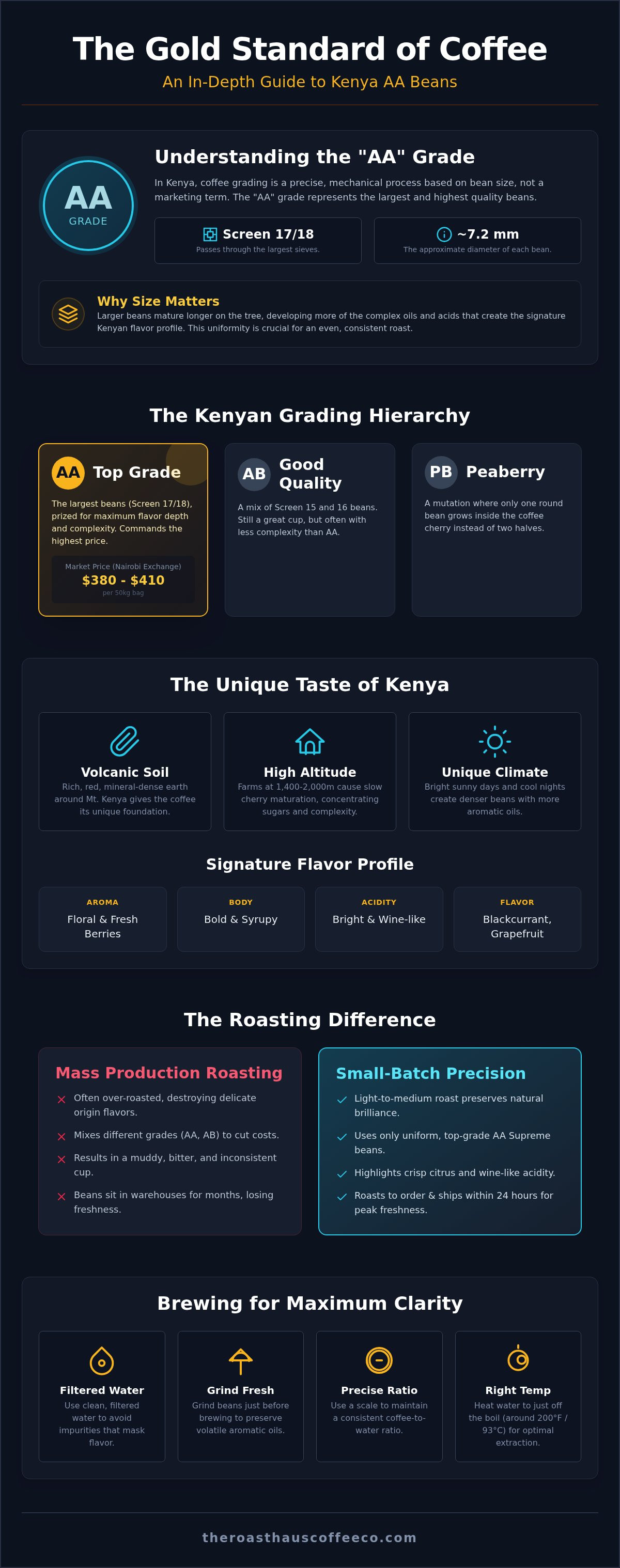
Grading in Kenya is a technical process, not a marketing gimmick. When you buy Kenya AA coffee beans, you're buying a product that has been mechanically sorted for size and density. The "AA" designation specifically refers to beans that pass through a screen size of 17 or 18. This is roughly 7.2 millimeters in diameter. Larger beans are generally prized because they've had more time to mature on the coffee tree. This extra time allows for the development of the complex acids and oils that define the region's profile. Understanding the history and standards of Coffee production in Kenya helps explain why these beans command a premium price on the global market.
The Kenyan Grading Hierarchy
The hierarchy is straightforward but strict. After harvesting and processing, beans go through a series of sieves. AA is the top size grade, followed by AB, which is a mix of screen sizes 15 and 16. While AB can still produce a great cup, it often lacks the flavor depth and complexity of the AA. Then there's the Peaberry (PB), where a single round bean grows inside the cherry. The grading system is overseen by the Coffee Board of Kenya, which was re-established under the Coffee Act of 2026 to ensure transparency and quality control. This oversight is reflected in the Nairobi Coffee Exchange, where clean AA lots from regions like Kirinyaga and Nyeri recently traded between $380 and $410 per 50 kg. Density plays a massive role here too. High-altitude Kenyan farms produce hard, dense beans. These can handle the high heat required to unlock the bright, phosphoric acidity that enthusiasts crave.
Why We Call Ours Kenya AA Supreme
At The Roast Haus, we don't just settle for any bag with an AA stamp. Our Kenya AA Supreme is a selection of the finest lots available from each harvest. We look for perfect uniformity. When beans are the same size and density, they react to heat in the exact same way. This means we can push the roast just far enough to develop the sugars without masking the delicate citrus notes. When you have a uniform screen size, you eliminate the risk of under-developed beans that can ruin a batch. This precision is vital for a light-to-medium roast where the goal is to highlight the bean's natural brilliance rather than the flavor of the roaster itself. Many large retailers mix grades to save money, but that leads to a muddy, inconsistent cup. We choose the Supreme path because it's the only way to honor the hard work of the Kenyan farmers and provide you with a truly legendary brew. Our small-batch approach ensures that these high standards are maintained from the farm to your front door.
The Unique Terroir and Flavor Profile of Kenyan Coffee
The flavor of Kenya AA coffee beans starts deep in the earth. Most of the best crops grow in the high-altitude regions surrounding Mt. Kenya. The soil here is rich, red, and volcanic. This specific geology provides the trees with essential minerals that you won't find in other coffee-growing regions. Because these farms sit at elevations between 1,400 and 2,000 meters, the cherries grow slowly. This slow maturation process is vital. It allows the plant to concentrate sugars and develops the intense complexity that defines the Kenyan cup. You aren't just drinking coffee; you're tasting the specific mineral composition of the East African Rift.
Volcanic Soil and High Altitude
The slopes of Mt. Kenya offer a unique microclimate. The combination of bright sunlight and cool nights forces the coffee trees to work harder. This environmental stress results in a denser bean with a higher concentration of aromatic oils. You can taste this terroir in every sip. It manifests as a bold, syrupy body that carries signature blackcurrant and grapefruit notes. Experts often point to Harvard Business School's analysis of the Kenya coffee cluster to explain how these geographic advantages are maximized by the country's organized farming cooperatives. This structure ensures that the unique qualities of the soil aren't lost during the early stages of production.
Kenyan coffee stands apart from any other origin. When you brew these beans, the first thing you'll notice is the aroma. It often carries a distinct floral scent mixed with the punchy smell of fresh berries. On the palate, the blackcurrant note is the most famous identifier. It provides a deep, dark fruit sweetness that balances the brighter citrus flavors like lemon and grapefruit. This balance is what makes the coffee feel wine-like and sophisticated. If you want to taste this clarity for yourself, you can explore our Kenya AA Supreme to see how this terroir translates to the final cup.
The Wet-Processing Method
The processing method is just as important as the soil. Kenya is famous for its "Double Washed" or wet-processing technique. This method is labor-intensive but results in a remarkably clean finish. After the cherries are picked, they are pulped and fermented in tanks for up to 36 hours. They are then washed, soaked again for another 12 to 24 hours, and finally dried on raised beds. This double fermentation process strips away all mucilage and highlights the bean's natural brightness. It's during this stage that the berry-like notes become more pronounced. Phosphoric acidity is the "sparkling" sensation on the tongue. This unique acidity gives the coffee its refreshing quality and ensures there is no lingering bitterness or muddy aftertaste. You get a crisp, refreshing exit that leaves your palate ready for the next sip.
Why Small-Batch Roasting is Essential for Kenya AA Beans
Roasting is where the potential of the bean becomes the reality of the cup. For Kenya AA coffee beans, this stage is precarious. These beans are prized for their high acidity and complex fruit notes, but those characteristics are heat-sensitive. If you roast them like a standard commodity bean, you'll burn off the very flavors you paid a premium for. Large-scale industrial roasters often use high heat and massive batches. This creates a "baked" or "burnt" flavor profile that masks the bright citrus and blackcurrant notes with a generic, charcoal bitterness. You lose the soul of the coffee in the name of volume.
Artisan vs. Industrial Roasting
Small-batch roasting is the only way to maintain flavor clarity. In a small drum, the roaster can monitor every degree of temperature change. We use precise thermal probes to ensure the beans reach their peak sugar development without tipping into a dark, oily state. This level of control is why we recommend checking out our guide on coffee beans to understand how different processing and roasting levels impact your morning brew. By keeping batches small, we ensure that every bean in the drum receives the same amount of heat. This consistency is vital for the dense seeds produced by the varieties studied at the Coffee Research Institute in Kenya. Precision isn't just a goal; it's a requirement for quality.
The 24-Hour Freshness Promise
Freshness is the final piece of the quality puzzle. Coffee is a perishable product. The volatile aromatics that give Kenya AA its "sparkle" begin to dissipate the moment the beans leave the roaster. Most coffee on grocery store shelves was roasted months ago. By the time you buy it, the vibrant acidity has turned flat and stale. You're left with a dull shadow of what the coffee should be.
Our philosophy at The Roast Haus is simple: we roast to order. We operate out of our family-owned roastery in Wyandotte, Oklahoma, and we ship your beans within 24 hours of roasting. This timing is critical. Kenya AA beans typically reach their flavor peak between day 3 and day 14 after the roast. By shipping immediately, we ensure the coffee arrives at your door just as it enters this prime window. You aren't getting a product that has been sitting in a warehouse; you're getting a fresh, artisan craft product designed for maximum sensory impact. This direct fulfillment model is what separates a truly bright brew from a mediocre experience. We take pride in being the bridge between the farm and your kitchen, ensuring the integrity of the bean remains intact.
How to Brew Kenya AA Supreme for Maximum Flavor
To get the most from Kenya AA coffee beans, you must account for their high density. These beans are physically harder than many other origins because of the high altitudes where they grow. This means they require a slightly more aggressive extraction to pull out the complex sugars. If your water is too cool or your grind is too coarse, the cup will taste sour and thin. You should start by mastering the basics in our guide on how to make coffee to ensure your foundation is solid. Use filtered water whenever possible. Tap water minerals often clash with the delicate phosphoric acidity, which can make the bright notes taste metallic or dull.
Grind size is the most important variable you can control at home. For Kenyan beans, you want a precise, uniform grind. If you have too many "fines" (tiny dust-like particles), they will over-extract and create a bitter aftertaste that ruins the clean finish. Aim for a medium-fine consistency for drip methods and a coarse, sea-salt texture for immersion brewing. Consistency in your grind ensures that the water travels through the coffee bed evenly, touching every surface area at the same rate.
The Pour Over Method
Pour over is the gold standard for this specific origin. Using a V60 or Chemex allows the bright, berry-like notes to shine without being weighed down by heavy sediment. We recommend a 1:16 ratio for the best results. Use 20 grams of coffee for every 320 grams of water. Heat your water to exactly 94°C. This temperature is hot enough to extract the deep blackcurrant flavors but cool enough to avoid bitter over-extraction. Pour in slow, circular motions to agitate the grounds. This technique releases the floral aromatics and ensures a balanced cup. The paper filter traps the heavier oils, leaving you with a brew that is crisp, clean, and incredibly vibrant.
French Press for Body and Wine-like Depth
If you prefer a heavier, more syrupy mouthfeel, the French Press is your best option. This method preserves the natural oils that a paper filter would otherwise remove. Because Kenya AA coffee beans are so dense, you might need to extend your steep time by 30 seconds compared to softer beans from other regions. A four and a half minute steep is usually the sweet spot for a full extraction. The metal filter allows the coffee's body to feel silky and substantial. This texture complements the wine-like acidity perfectly. Be sure to decant the coffee into a separate carafe immediately after pressing. Leaving it in the press will lead to over-extraction and a dry, astringent finish that masks the fruit notes.
Ready to put these techniques to the test? Order a bag of our fresh-roasted Kenya AA Supreme today and experience the difference that small-batch quality brings to your kitchen.
Experience the Peak of Kenyan Coffee with The Roast Haus
Choosing the right coffee is a personal journey. You've learned about the grading, the volcanic soil, and the precise brewing methods required for Kenya AA coffee beans. Now, it's about the source. At The Roast Haus Coffee Co., we take our role as an independent roaster seriously. We don't just buy beans; we select the top tier of the harvest to ensure our Kenya AA Supreme lives up to its name. Our commitment to quality means we never cut corners on the roasting process or the fulfillment timeline. We've spent years refining our craft to ensure that every bag delivers the sensory excellence you expect from a premium East African brew.
From Wyandotte to Your Kitchen
Our story began in 2014 in Wyandotte, Oklahoma. As a family-owned artisan roastery, we've spent over a decade perfecting the balance between heat and time. We believe that supporting independent businesses is about more than just a transaction. It's about participating in a community that values craftsmanship over corporate efficiency. Every bag of Kenya AA Supreme is handled with care by people who actually drink the coffee they roast. We don't use impersonal, large-scale industrial machines. Instead, we rely on small-batch production to maintain absolute control over the flavor profile.
The biggest differentiator in our model is the timing. Most coffee sits in a distribution center for weeks before it reaches a shelf. We've eliminated that delay. We roast your beans to order and ship them within 24 hours. This ensures that the "sparkle" and wine-like brilliance we've discussed actually make it to your cup. If you want to ensure your pantry is never without fresh-roasted brilliance, consider joining our coffee subscription. It's the most reliable way to experience our small-batch quality on a recurring basis. You get the peak of freshness delivered straight to your door without any of the guesswork.
The All Day Sampler Option
We know that palates vary. While Kenya AA Supreme is famous for its bright, blackcurrant acidity, some drinkers prefer the floral and tea-like notes of our Ethiopia Limu Organic. If you're still exploring your preferred acidity level, The All Day Sampler is an excellent starting point. It allows you to compare different East African and Central American origins side-by-side. This direct comparison is the best way to educate your palate and discover why the AA grade is so highly regarded by enthusiasts worldwide.
You shouldn't have to settle for stale, over-roasted beans that mask the true character of the farm. You deserve a cup that reflects the integrity of the soil and the dedication of the roaster. We invite you to join our community of craft coffee lovers who refuse to compromise on freshness. Order your bag of Kenya AA Supreme today. Experience the peak of Kenyan coffee, roasted with honesty in Oklahoma and delivered with speed.
Elevate Your Morning Ritual with Small-Batch Brilliance
You now understand that the secret behind Kenya AA coffee beans isn't just their size; it's the combination of high-altitude volcanic soil and meticulous sorting. We've explored how the "Double Washed" process creates that signature sparkling acidity and why brewing with a pour over method highlights those legendary blackcurrant notes. However, even the best beans fail if they aren't handled with care after they leave the farm.
At The Roast Haus Coffee Co., we bridge the gap between the Kenyan highlands and your kitchen. Our family-owned Oklahoma roastery focuses on artisan quality that industrial producers simply can't match. We roast every bag in small batches to preserve those delicate, volatile aromatics that define the AA grade. Because we ship your order within 24 hours of roasting, you can be sure the coffee arrives at its absolute peak of freshness. Don't settle for stale, over-roasted alternatives that mask the bean's true character.
Order Your Freshly Roasted Kenya AA Supreme Today and experience the world's brightest brew for yourself. Your palate will thank you for the upgrade.
Frequently Asked Questions
What does the "AA" in Kenya AA coffee beans mean?
The "AA" refers to a specific screen size used during the mechanical sorting process, specifically size 17 or 18. This is the largest standard grade in the Kenyan system. These larger beans are generally denser and contain more complex oils, which leads to the intense flavor profile found in Kenya AA coffee beans. Sorting by size ensures that the beans roast uniformly in our small-batch drum.
Is Kenya AA coffee high in caffeine?
No, Kenya AA coffee contains a standard amount of caffeine for 100% Arabica beans. While the beans are very dense and grown at high altitudes, the caffeine content is determined by the plant species rather than the bean size or grade. You'll get a clean energy boost without the jittery edge often associated with lower-quality Robusta blends found in big-box retailers.
What is the best roast level for Kenya AA beans?
A light to medium roast is the best level for these beans to preserve their natural, wine-like brightness. If you roast them too dark, you'll burn away the delicate blackcurrant and citrus notes that make this origin famous. Our Kenya AA Supreme is roasted specifically to highlight the "sparkling" phosphoric acidity rather than the smoky flavor of a dark roast.
Why is Kenyan coffee more expensive than other origins?
Kenyan coffee is more expensive because of the competitive Nairobi Coffee Exchange auction system and the labor-intensive "double washed" processing method. Farmers in high-altitude volcanic regions produce limited quantities of these top-tier beans. The high global demand for the AA grade, combined with strict quality controls from the Coffee Board of Kenya, naturally drives up the market price.
How should I store my Kenya AA beans to keep them fresh?
Store your beans in an airtight container in a cool, dark place like a kitchen pantry. Avoid the refrigerator or freezer, as moisture and food odors can easily ruin the volatile aromatics. Since we ship your order within 24 hours of roasting, your beans arrive at their peak. Try to use them within 14 days to experience the full brilliance of the flavor profile.
Does Kenya AA coffee taste bitter?
No, authentic Kenya AA coffee beans should taste bright and wine-like rather than bitter. Bitterness is usually a sign of over-roasting or using water that is too hot during the brewing process. When roasted and brewed correctly, you'll experience a crisp acidity and a clean finish that is refreshing. This is why we focus on small-batch precision to avoid any harsh or burnt flavors.
Can I use Kenya AA beans for espresso?
You can certainly use these beans for espresso, though they produce a very "bright" and fruit-forward shot. This style of espresso is popular in modern craft coffee shops but is very different from traditional, chocolatey blends. The high acidity cuts through milk remarkably well, making it a unique and vibrant choice for lattes or cappuccinos if you enjoy fruitier notes.
How long does it take to receive my coffee after ordering?
We ship your order within 24 hours of roasting at our facility in Wyandotte, Oklahoma. Depending on your location, most customers receive their coffee within 2 to 4 business days. This speed ensures you receive the beans just as they are entering their peak flavor window. You won't find this level of freshness from large retailers who store roasted coffee in warehouses for weeks.

