


You might reach for the darkest, smokiest beans in the cabinet when you need a serious morning boost, but that bold flavor is often lying to you. Many coffee drinkers assume a heavy taste profile equals more energy, only to end up feeling sluggish or unexpectedly jittery. The truth about light roast vs dark roast caffeine isn't about the color of the bean; it's about the science of the roast. We understand the frustration of buying a dark roast specifically for a "kick" and not feeling it. It's easy to confuse a charred, intense taste with high caffeine content, but these two things are actually unrelated.
Caffeine is remarkably stable during the roasting process. It doesn't just burn away when the heat goes up. In this guide, we'll show you how roast levels change the physical density of the bean and why your measurement method is the real secret to a consistent experience. You'll learn the practical difference between measuring by volume versus weight. By the end, you'll have the confidence to choose the right bean for your specific needs. Whether you prefer the bright notes of our Kenya AA Supreme or the balance of an Ethiopia Limu Organic, you deserve to know exactly what's in your cup. Let's look at the facts so you can master your morning ritual.
Key Takeaways
- Bold flavor does not mean more caffeine. Learn why intense, smoky notes are often mistaken for a higher energy kick.
- Roasting changes bean density. Discover how beans expand and lose weight as they get darker, which changes how much coffee you are actually brewing.
- Avoid the "scoop trap." We explain why the light roast vs dark roast caffeine content depends entirely on whether you measure your coffee by weight or by volume.
- Balance your palate and your energy. Use our guide to choose between bright acidity and smooth body based on your personal needs.
- Prioritize freshness over roast level. Understand why small-batch roasting and quick fulfillment are the real secrets to a superior cup.
Debunking the Coffee Strength Myth: Flavor vs. Caffeine
Many people reach for a dark roast when they need a wake-up call because the flavor is intense. We often associate bitterness and smokiness with power. This creates a common misunderstanding about light roast vs dark roast caffeine levels. In reality, the "strength" you taste is often just the result of longer roasting times, not a higher chemical dose of energy. It's a sensory trick our brains play on us. We assume that a bolder profile must mean a harder kick, but that isn't how the chemistry of a coffee bean works.
When we talk about coffee strength, we need to separate perceived strength from chemical strength. Perceived strength is how the coffee feels on your tongue. It involves the body, the bitterness, and the aroma. Chemical strength refers strictly to the milligrams of caffeine in your mug. These two things don't always move in the same direction. Caffeine is a very stable molecule. It survives the heat of the roaster almost entirely intact. Roast level is a tool for developing flavor profiles; it's not a way to destroy or create caffeine. To explore these profiles for yourself, you can buy specialty coffee online from Bambi Nonno Coffee, which focuses on premium beans and traditional roasting methods.
What Does 'Strong' Coffee Actually Mean?
In the coffee world, professional brewers use a metric called Total Dissolved Solids (TDS). This measures how much actual coffee material ended up in your water. If you use a lot of grounds and very little water, you get a high TDS. That cup will feel heavy and "strong" regardless of the roast color. Our perception of a "kick" is also influenced by sensory cues. The sharp acidity in a light roast can feel like a jolt to some, while the deep bitterness of a dark roast feels more substantial to others. Coffee strength is a measure of the concentration of dissolved coffee solids in your cup rather than the color of the bean itself.
The Role of the Maillard Reaction
The transformation of a green coffee bean into a brown one relies on the Maillard reaction. This is the same chemical process that browns a steak or toasts a piece of bread. As heat is applied during the coffee roasting process, sugars and amino acids inside the bean react to create hundreds of new flavor compounds. This is where the magic happens for our Ethiopia Limu Organic and our darker blends alike.
If the beans stay in the roaster longer, they move past the Maillard reaction into caramelization and eventually carbonization. This is where the "char" and smoky notes of a dark roast come from. While the sugars are burning away and the bean's structure is breaking down, the caffeine molecule remains resilient. It takes much higher temperatures than those used in standard roasting to significantly degrade caffeine. This is why the debate over light roast vs dark roast caffeine is rarely about the chemistry of the roast itself and more about the physical changes to the bean.
How the Roasting Process Affects Caffeine and Bean Structure
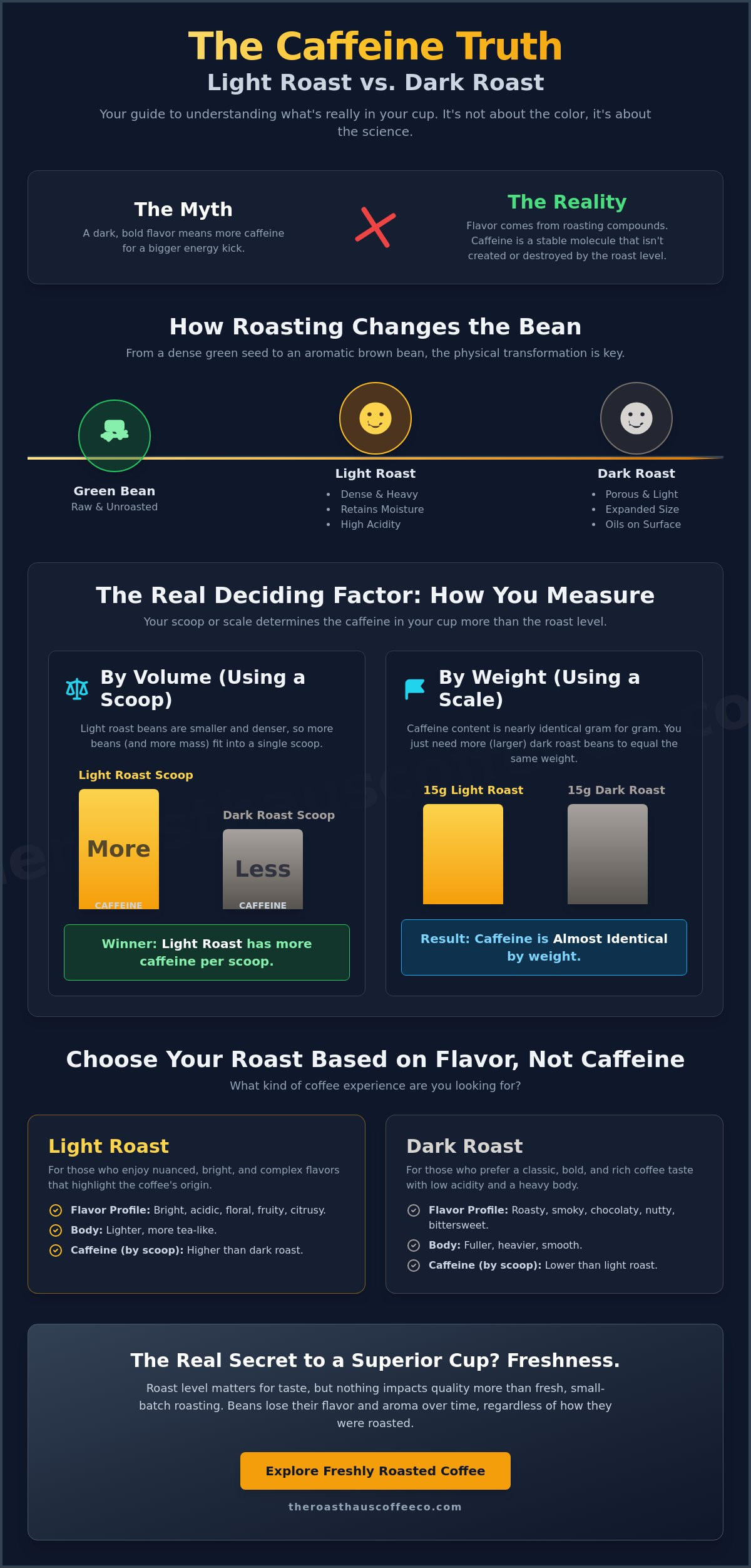
Roasting is a physical transformation that changes the very structure of the bean. When we apply heat, the bean begins to lose moisture and expand. This is a critical part of the light roast vs dark roast caffeine discussion because it changes the bean's density. A light roast bean is dense and heavy. It hasn't spent much time in the heat, so it retains most of its original moisture. A dark roast bean is the opposite. It has expanded significantly, becoming porous and light. This physical change is why a bag of dark roast often looks much fuller than a bag of light roast, even if they weigh exactly the same.
We monitor these changes through two specific milestones: the first and second cracks. The first crack happens when steam pressure builds up enough to break the bean's cell walls. This is typically where light roasts are finished. If we continue roasting, we reach the second crack. This is a sharper sound that indicates the physical structure is becoming brittle and oils are migrating to the surface. At The Roast Haus Coffee Co., our small-batch roasting process gives us the precision to hit these marks exactly. We don't rely on automated mass production. We use our senses to ensure every bean reaches its full potential.
Moisture Loss and Bean Expansion
During the roast, coffee beans can lose up to 20% of their total weight. This loss is almost entirely water. As the water leaves, the bean puffs up like popcorn. This means a dark roasted bean is physically larger than a light roasted bean, despite being lighter in weight. This porosity matters during brewing. Because dark roasts are more porous, water can penetrate them and extract caffeine more quickly. However, the total amount of caffeine available remains mostly unchanged from the start of the roast to the end.
Does Origin Matter More Than Roast?
The baseline caffeine level is determined long before the beans reach our roaster, and it plays a bigger role in the light roast vs dark roast caffeine comparison than most people realize. We exclusively use Arabica beans, which naturally contain about half the caffeine of the cheaper Robusta variety. Geography also plays a massive role. High-altitude beans, like our Kenya AA Supreme, grow more slowly in thinner air. This creates a much denser bean with a complex flavor profile.
According to the National Coffee Association's guide to roasts, the bean's origin and variety are the primary drivers of its chemical makeup. The starting caffeine in the green bean is the most significant factor in your final cup. If you want a specific energy level, choosing the right variety is just as important as the roast level. You can explore our full range of single-origin options at theroasthauscoffeeco.com to find your perfect match.
Weight vs. Volume: Why Your Measuring Scoop Matters Most
Most of us start the day with a simple plastic scoop. It seems reliable, but measuring by volume is actually the biggest source of inconsistency in your morning cup. This is what we call the "Scoop Trap." Because light roasted beans are denser and smaller, they settle differently in a tablespoon than large, puffed-up dark roasted beans. When you use a scoop, you are measuring space, not actual coffee mass. This creates a hidden variable in the light roast vs dark roast caffeine debate that most people overlook. If you want a consistent energy boost, you have to look past the scoop and focus on the actual weight of the coffee.
The scale is the great equalizer in your kitchen. When you weigh out 20 grams of light roast and 20 grams of dark roast, you are using the same amount of organic material. At this point, the physical density of the bean doesn't matter anymore because you aren't measuring by the space it occupies. This is how professional baristas ensure that every cup tastes the same and provides the same energy. It takes the guesswork out of your routine. It also ensures you aren't accidentally over-caffeinating just because you switched to a different bag of beans.
The Math of the Morning Scoop
Consider a simple comparison. If you take one level scoop of light roast beans and one level scoop of dark roast beans, the light roast scoop will almost always contain more individual beans. Because those beans are heavier and take up less room, you are essentially brewing more coffee by weight in that single scoop. This can result in the light roast cup having about 10% to 15% more caffeine than the dark roast cup. You should use a kitchen scale for the most consistent experience every single morning. This simple change in your process will do more for your coffee quality than almost any other upgrade.
Brewing Methods and Caffeine Extraction
How you extract that caffeine also changes the final outcome when making coffee at home. Different tools pull caffeine from the grounds at different rates. A French Press uses a long immersion time, which can pull more caffeine out of the grounds compared to a quick pour-over. The water has more time to saturate the coffee and dissolve the caffeine molecules. If you are looking for the strongest possible punch, your brewing method is just as important as your bean choice.
Your grind size is another critical factor in this equation. Finer grinds increase the total surface area that the water touches, which speeds up the extraction process. This is particularly important for light roasts, which are harder for water to penetrate because of their high density. You can check out our guide on coffee grinders to understand why a consistent grind is the foundation of a great cup. When you weigh your beans and grind them properly for your specific brewer, the light roast vs dark roast caffeine difference becomes almost negligible. You gain total control over your morning ritual.
Choosing Your Roast: Balancing Caffeine Kick with Flavor Profile
Choosing between roasts isn't just about the numbers. Since we've debunked the idea that one roast is inherently "stronger" than another chemically, your decision should focus on the experience you want. Some people want a bright, floral cup that wakes up their palate. Others prefer a rich, chocolatey brew that feels like a warm hug. Your choice in the light roast vs dark roast caffeine debate depends on your morning goals and your body's needs. This choice matters because the caffeine balance is often secondary to how the coffee makes you feel throughout the day.
Stomach sensitivity is a real factor that many coffee drinkers ignore. If you struggle with acid reflux or a sensitive gut, you might find that darker roasts are much kinder to your system. The longer roasting process reduces the level of chlorogenic acid, which is often the culprit behind stomach discomfort. This means you can enjoy your coffee without the unwanted side effects. It's a practical way to keep your energy up without the jitters associated with high-acid beans. We believe you shouldn't have to choose between energy and comfort.
We suggest a "Time of Day" strategy for the best results. Use light roasts in the early morning for clarity and focus. Switch to a dark roast in the afternoon when you want something decadent but easier on the stomach. Many coffee lovers find that these richer, smoky profiles pair exceptionally well with a quality cigar; you can explore Acid Kuba Kuba to find a flavorful companion for your afternoon ritual. If you aren't sure where to start, our The All Day Sampler is the perfect way to test different roast levels. It lets you see how your body reacts to various profiles without committing to a single bag. This approach helps you find the specific light roast vs dark roast caffeine ratio that works for your unique metabolism.
Light Roast: The Bright and Complex Choice
Light roasts are for the coffee purists. These beans are pulled from the roaster shortly after the first crack, preserving the unique characteristics of the soil and climate where they grew. You'll find high acidity, crisp floral notes, and a tea-like body in these selections. Our Ethiopia Limu Organic is a prime example of this complexity. To get the best results, use brewing methods that highlight these delicate notes. Pour over and Aeropress are excellent choices because they allow for precise control over extraction.
Dark Roast: The Bold and Low-Acid Choice
Dark roasts are all about the transformation of the bean. The heat has caramelized the sugars, resulting in deep notes of dark chocolate, toasted nuts, and molasses. This profile is the global standard for traditional espresso because it holds up well against milk and sugar. There is a common myth that dark coffee is more acidic because it's bitter. In reality, dark roasts contain fewer organic acids than their lighter counterparts. They offer a smooth, heavy mouthfeel that many find comforting.
You can find the right balance for your morning ritual by browsing our full collection of artisanal beans at theroasthauscoffeeco.com.
Freshly Roasted to Order: The Roast Haus Coffee Co. Approach to Quality Beans
While we spent time discussing the science of light roast vs dark roast caffeine, there is a factor that matters even more for your daily ritual: freshness. A coffee bean is a delicate organic product. Once it leaves the roaster, a clock starts ticking. The volatile oils that carry the flavor and the chemical punch you are looking for begin to dissipate. If you buy coffee from a grocery store, those beans have likely been sitting in a warehouse or on a shelf for months. By the time they reach your kitchen, the chemical integrity and sensory excellence have faded. No matter the roast level, stale coffee will always underperform.
We built our business on the belief that craft should always come before convenience. At The Roast Haus Coffee Co., we follow a relentless small-batch roasting model in Wyandotte, Oklahoma. We don't roast in massive quantities and wait for sales. We roast to order and ship within 24 hours. This ensures that every bag of beans arrives at your doorstep in its most potent state. This fulfillment model is our ultimate differentiator. It allows us to preserve the nuance of the bean and the stability of the caffeine content that we have discussed throughout this guide. Supporting a family-owned artisan roastery means you get a product that mass production simply cannot replicate.
From Wyandotte to Your Doorstep
Our small-batch process allows for a level of intention and care that large corporations can't match. We monitor every stage of the roast to ensure the bean expands correctly and retains its essential oils. These oils are where the flavor lives. When coffee sits for too long, oxidation takes over. This process breaks down the bean's structure and dulls the experience. We take pride in our identity as an independent venture. If you are in the Oklahoma area, we invite you to visit The Roast Haus Coffee Co. for local pickup. Getting your beans directly from the source is the best way to experience the quality we stand behind.
Finding Your Perfect Match
The debate over light roast vs dark roast caffeine usually ends when a customer finds the specific bean that fits their lifestyle. We encourage you to experiment with different origins and roast levels to see how they affect your energy. If you need more help narrowing down your options, use our beginner's guide to choosing beans. It provides a roadmap for understanding how different regions influence the final taste. Whether you want the clarity of a light roast or the richness of a dark roast, we are here to help you get the best possible experience. Join our community of coffee lovers who value quality and integrity in every cup.
Master Your Daily Ritual
Understanding the science of light roast vs dark roast caffeine puts you in control of your morning. You now know that flavor intensity is not a measure of chemical energy. By weighing your beans and choosing roasts based on your stomach sensitivity and flavor preference, you can eliminate the guesswork from your routine. The true secret to a superior cup isn't just the roast level; it's the integrity of the bean and the timing of the roast. Stale, mass-produced coffee can't offer the nuance or the consistent lift that a fresh, artisanal product provides.
At our family-owned artisan roastery in Wyandotte, OK, we prioritize craftsmanship over convenience. We focus on small-batch quality that you can taste in every single cup. We roast every order specifically for you and ship it within 24 hours. This ensures you receive the volatile oils and full caffeine potential that grocery store brands lose on the shelf. Shop our freshly roasted-to-order coffee beans and find your perfect roast today! We are proud to share our passion with you and help you discover a better way to drink coffee. Your perfect morning cup is waiting.
Frequently Asked Questions
Does dark roast coffee have more caffeine than light roast?
Dark roast coffee does not inherently have more caffeine than light roast. The caffeine molecule is very stable and survives the roasting process almost entirely intact. The perceived difference usually comes down to how you measure your beans. Because light roasted beans are denser, a single scoop of them contains more coffee material than a scoop of porous dark roast. If you weigh your beans on a scale, the caffeine levels are nearly identical.
Is light roast coffee more acidic than dark roast?
Light roast coffee is more acidic than dark roast because it spends less time in the roaster. High heat breaks down the organic acids found naturally in green coffee beans over time. Darker roasts have lower acidity levels, which often makes them easier on the stomach for people with digestive sensitivity. If you enjoy bright, citrusy notes, stick with a light roast. If you want a smooth, low-acid cup, a darker roast is the better choice.
Which roast level is best for an energy boost in the morning?
The best roast for a morning energy boost depends on your measurement routine. If you measure by the scoop, a light roast will provide more caffeine because the beans are smaller and heavier. However, if you use a kitchen scale, both roasts offer a similar kick. We recommend choosing based on your flavor preference. A bright Kenya AA Supreme might provide more mental clarity, while a dark roast offers a rich, comforting start to your day.
Does the brewing method change the caffeine content more than the roast?
Brewing methods often have a larger impact on caffeine extraction than the roast level itself. Variables like water temperature, grind size, and total contact time determine how much caffeine ends up in your mug. A long immersion in a French Press extracts more than a quick pour-over. This is why the light roast vs dark roast caffeine debate is only part of the story. Your technique is what ultimately unlocks the energy inside the bean.
Can I get the same caffeine kick from decaf coffee?
You cannot get a traditional caffeine kick from decaf coffee. Our Decaf Swiss Water Process removes at least 99.9% of the caffeine while preserving the bean's original flavor profile. It is the perfect choice for coffee lovers who want the taste of a premium roast without the jitters. While you won't get the stimulant effect, you still get the antioxidants and rich experience of a small-batch, artisanal coffee. It's about flavor, not the jolt.
Why does dark roast taste 'stronger' if it has less caffeine?
Dark roast tastes 'stronger' because of the chemical changes that occur during long roasting times. The beans develop bitter, smoky, and chocolatey notes as the sugars caramelize and the structure begins to char. These intense flavors are often associated with strength in our minds. Caffeine itself is actually quite bitter, but its presence doesn't always correlate with the bold, heavy mouthfeel of a dark roast. Bitterness is a flavor profile, not a measure of potency.
How should I measure my coffee to get a consistent caffeine dose?
You should always measure your coffee by weight using a digital scale to ensure a consistent dose. Measuring by volume with a scoop is unreliable because beans vary in size and density. A light roast is much heavier than a dark roast of the same size. Using a scale allows you to use the exact same amount of coffee material every morning. This practice leads to a predictable energy level and a better-tasting cup regardless of the light roast vs dark roast caffeine content.
Does the age of the roasted beans affect the caffeine level?
The age of the beans does not significantly change the caffeine level, but it does destroy the quality of the experience. Caffeine is a resilient molecule that stays intact long after the coffee has gone stale. However, the volatile oils that carry the flavor and aroma begin to oxidize immediately after roasting. This is why we roast to order and ship within 24 hours. Freshness ensures you get the best flavor and sensory experience alongside your caffeine.

