


With the average retail price of ground coffee hitting $9.72 per pound in April 2026, every failed batch of cold brew feels like a waste of hard-earned money. You've probably experienced the frustration of waiting 18 hours for a steep, only to pour a glass that tastes bitter or like stale cardboard. Finding the best coffee for cold brew shouldn't be a guessing game that ends in a drain-pour. You deserve a smooth, low-acid cup that rivals your favorite local roastery without the premium shop price tag.
I understand the confusion around whether to grab a light roast or a dark roast from the shelf. Cold brew is a slow extraction process that amplifies every trait of the bean, both good and bad. This guide will teach you exactly how to choose beans for a foolproof brew every time. We'll explore how different origins affect your final flavor and why roast-to-order freshness is the only way to avoid those dull, oxidized notes. By the end, you'll have a clear, step-by-step strategy for selecting beans that deliver consistent, cafe-quality results in every batch.
Key Takeaways
- Learn how cold extraction naturally removes the acidic compounds that make your coffee taste bitter.
- Compare dark and light roasts to find the best coffee for cold brew that matches your preferred flavor profile.
- Discover why beans from specific regions like Kenya and Ethiopia produce a cleaner, sweeter profile than generic store-bought blends.
- See why a specific grind size and roast date are the two most important factors in avoiding a stale, oxidized flavor.
- Get our roaster's top three recommendations for achieving consistent, shop-quality results at home.
Why Bean Selection Changes Everything for Cold Brew
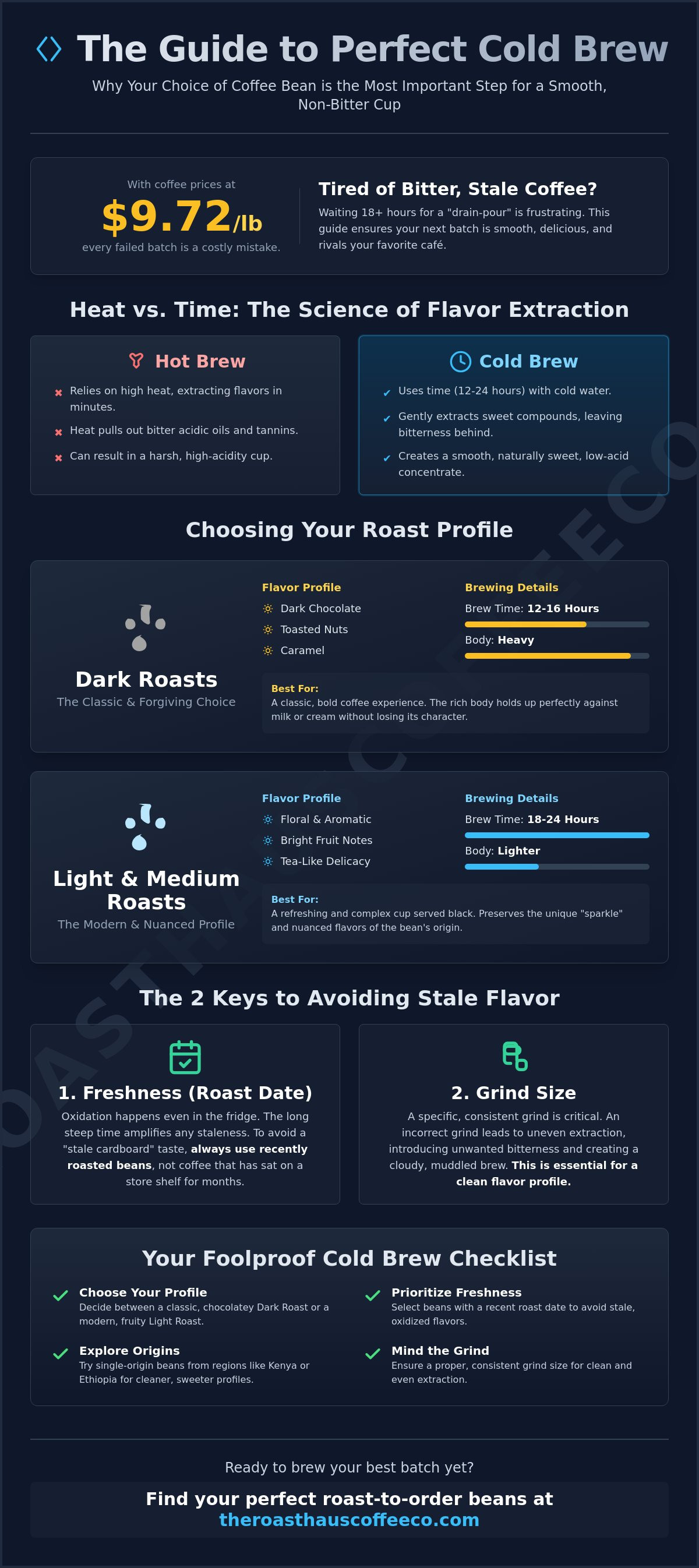
Hot coffee relies on high temperatures to melt oils and extract flavor in minutes. Cold brewing takes a completely different path. Cold brew coffee relies on time rather than heat to pull flavor compounds from the grounds. Because the water is cold, it never reaches the energy level required to extract the acidic oils and tannins that often cause bitterness in a hot cup. Cold brew extraction is a 12-to-24-hour immersion process that prioritizes sweetness over acidity.
This long immersion means your choice of beans is the most important decision you'll make. In a hot brew, you can sometimes hide mediocre beans behind the intensity of the heat. In cold brew, there's nowhere to hide. High-quality, small-batch beans are essential because they contain the complex sugars and stable oils that survive a long soak without turning sour. Choosing the best coffee for cold brew starts with understanding that you aren't just making a drink; you're conducting a slow, chemical extraction.
The Chemistry of Cold Extraction
Cold water interacts with coffee solubles much differently than boiling water. Heat acts as a catalyst that speeds up the breakdown of cellular structures in the bean. Without that heat, the water must act as a gentle solvent over many hours. Density plays a major role here. Denser beans, often grown at higher altitudes, have more concentrated sugars that release slowly. If you use "bad" beans with defects or uneven roasts, those negative traits will taste even worse after a 20-hour steep. The long contact time amplifies every flavor, so any hint of mold, ferment, or poor processing becomes impossible to ignore.
Freshness: The Hidden Ingredient
Many people believe that because cold brew is served chilled, the age of the bean doesn't matter. This is a mistake. Oxidation happens even in the fridge. In fact, the long brewing process gives oxygen more time to degrade the delicate flavors of the coffee. This is why roasted-to-order beans are superior to anything you'll find sitting on a grocery store shelf for months. Mass-produced coffee often has a distinct "stale cardboard" taste. This happens when the natural oils in the bean begin to go rancid. To get the best results, you need a solid foundation in choosing the best coffee beans that are fresh and vibrant. Using the best coffee for cold brew ensures that your 24-hour wait results in a glass of smooth, chocolatey perfection rather than a bitter disappointment.
Dark Roast vs. Light Roast: Choosing Your Cold Brew Profile
Roast level is the primary driver of your flavor profile. Most people assume dark roast is the only way to go. While dark beans offer that classic punch, they aren't your only option. Choosing the best coffee for cold brew depends on whether you want a rich, dessert-like cup or something crisp and refreshing. Your roast choice also changes your brewing mechanics. Darker beans are more porous. They give up their solubles quickly. Light beans are denser. They require more time and a slightly higher coffee-to-water ratio to reach the same strength. Understanding these physical differences helps you avoid under-extracted, sour batches.
The Case for Dark Roasts
Dark roasts are the traditional choice for a reason. They provide the heavy body and low acidity that most cold brew fans crave. During the roasting process, the Maillard reaction creates complex sugars. These sugars turn into notes of dark chocolate, toasted nuts, and caramel during a long immersion. Because dark roasts are more soluble, they extract faster. You'll get a bold result in about 12 to 16 hours. This profile is perfect if you like to add milk or cream. The intensity of a dark roast holds up against dairy without getting lost. It's the "classic" coffee experience that many home brewers find most reliable. It's also more forgiving. If you over-steep a dark roast slightly, you'll just get more body rather than harsh bitterness.
Experimenting with Light and Medium Roasts
Many competitors ignore light roasts, but they offer a modern, sophisticated profile. A light-brewed cold coffee is often tea-like and floral. It preserves the "sparkle" and fruit notes that heat usually destroys. These beans are less porous, so you should extend your steep time to 18 or 24 hours. The National Coffee Association suggests that bean selection is vital for achieving these specific sensory outcomes. Medium roasts act as a balanced middle ground. They offer enough body for a smooth drink while keeping some of the origin's unique character. If you're looking for an all-day drinker that doesn't feel too heavy, a medium roast is often the best coffee for cold brew. These roasts highlight the craftsmanship of the farmer and the roaster by letting the bean's natural sweetness shine through without being masked by smoke or char.
If you're ready to start experimenting with different profiles, check out our collection of fresh-roasted beans to find your perfect match.
The Best Single-Origin Regions for Cold Brew Extraction
Origin is the soul of your cup. While blends are designed for a standard, repeatable taste, single-origin beans are about distinct character. In cold brew, where the extraction is slow and gentle, these regional traits aren't just present; they are the stars of the show. Using single-origin beans is often the secret to finding the best coffee for cold brew. It allows you to target specific flavor notes like jasmine, blueberry, or toasted pecan without them being muddied by other components. As a roaster, I see how the long immersion process acts as a magnifying glass for terroir. You aren't just drinking coffee; you're tasting the soil and climate where it grew.
African Origins: Bright and Complex
African coffees are prized for their complexity and high-altitude density. Kenya AA Supreme is a standout in this category. It's famous for a vibrant acidity that can be sharp in a hot brew. However, when you steep it cold, that acidity transforms into a deep, wine-like sweetness with heavy berry notes. Ethiopia Limu Organic offers a completely different experience. It's lighter and more floral, often tasting more like a sophisticated iced tea than a traditional coffee. This makes it a perfect choice for a refreshing summer brew. Because these high-elevation beans are physically denser, they require more patience. I recommend a steep time of 20 to 24 hours to fully unlock their complex profile. The result is a clean, bright cup that doesn't need any cream to shine.
Central and South American Origins: Rich and Smooth
Central and South American regions provide the rich, smooth profile most people associate with a cafe-quality cold brew. Honduras Morning Splendeur is a reliable choice for this style. It features balanced notes of caramel and cocoa that naturally pair with cold water. These regions produce beans that are typically lower in acid and higher in chocolatey sweetness. This makes them the best coffee for cold brew for beginners. They are incredibly forgiving beans. Whether you steep them for 12 hours or 18, you'll likely get a consistent, velvety cup that doesn't require extra milk or sugar to be enjoyable. These "crowd-pleasers" are the backbone of many professional cold brew programs because they deliver a heavy body and a satisfying, nutty finish every time.
Preparation Essentials: Grind Size and the Freshness Factor
Choosing the best coffee for cold brew is only half the battle. Your preparation method either honors the bean or destroys it. Cold brew is an unforgiving teacher. If your technique is sloppy, the long immersion time will highlight every mistake. Two factors dictate your success more than any others: the physical size of your grounds and the time elapsed since the roast. When you get these right, you achieve that clean, heavy-bodied cup that makes home brewing worth the effort.
Why Grind Consistency Matters
A coarse grind is non-negotiable for cold brew. You want your coffee to look like coarse sea salt or cracked peppercorns. If the grind is too fine, the water extracts the bitter compounds too quickly. This results in a muddy, harsh concentrate that is difficult to filter. Consistency is actually more important than the size itself. Cheap grinders often produce "fines," which are tiny dust-like particles. These fines over-extract almost instantly, adding a sharp bitterness to an otherwise smooth batch. For a deeper look at tool selection, check out the ultimate guide to coffee grinders. A quality burr grinder ensures every particle is the same size, leading to a balanced and predictable extraction.
The Roast Haus Small-Batch Philosophy
Most commercial coffee sits in a warehouse for months before it reaches a shelf. This creates a "Freshness Gap" that is deadly for cold brew. Stale beans oxidize rapidly during a 20-hour steep, resulting in a dull, flat flavor. At our family-owned facility in Wyandotte, Oklahoma, we take a different approach. We follow a strict Roast-to-Ship 24-hour promise. We roast in small batches and get the beans to your door immediately. This ensures the natural oils are still vibrant when they hit the water. This level of integrity is why our customers trust us for the best coffee for cold brew. We want you to learn how to make coffee at home with total confidence in your ingredients.
Don't overlook your water. Since your final drink is mostly water, using a filtered source is vital. Tap water often contains chlorine or minerals that mask the subtle notes of a high-quality bean. Once your bag arrives, keep it in a cool, dark place. Avoid the fridge or freezer, as moisture can damage the beans. Treat your coffee with respect, and it will reward you with a perfect brew. You'll notice the difference in clarity and sweetness immediately.
Experience the difference that true freshness makes by ordering a bag of our fresh-roasted specialty coffee today.
Roast Haus Favorites: Our Top 3 Cold Brew Picks
You have the technique down and the chemistry understood. Now you need the right ingredients. Selecting a specific origin is the final step in mastering your home setup. Because we roast in small batches at our Wyandotte facility, we can preserve the delicate sugars that make these beans the best coffee for cold brew. Whether you want something that cuts through milk or a cup that tastes like a fine tea, these three picks represent the peak of our craft.
The Bold Pick: Kenya AA Supreme
Kenya AA Supreme is for the brewer who wants a complex and sweet result. This bean is famous for its black currant and citrus undertones. While these notes can be sharp in a hot brew, the cold immersion process rounds them out into a wine-like sweetness. It is a dense bean that stands up to a 24-hour extraction without losing its vibrant identity. If you want to experience the best coffee for cold brew in its purest form, drink this one black. For a modern twist, try it with a splash of tonic water and a wedge of lime. The carbonation highlights the berry notes perfectly.
The Smooth Pick: Honduras Morning Splendeur
Honduras Morning Splendeur is our most popular choice for those who love a traditional profile. It features a very mild acidity with a heavy focus on caramel and toasted nuts. This is a reliable, "anytime" coffee that feels velvety on the tongue. Because it has such a deep chocolatey base, it pairs beautifully with cream or oat milk. It is the ideal foundation for iced lattes or specialty coffee drinks. If you are new to home brewing, this is the most forgiving bean we offer. It delivers a consistent, rich flavor that never drifts into bitterness.
The Fruity Pick: Ethiopia Limu Organic
Elevate Your Morning Routine
Mastering cold brew is a rewarding process that starts with a solid foundation. You've learned that roast level and origin define your flavor profile, while grind consistency and water quality ensure a clean finish. Finding the best coffee for cold brew is ultimately about avoiding the stale, oxidized beans found in mass-market stores. Freshness is the single most important variable in your 24-hour immersion; it's the difference between a dull cup and a vibrant one.
Our family-owned artisan roastery in Wyandotte, Oklahoma, is built on the belief that timing is everything. We roast our specialty beans in small batches and ship them within 24 hours to ensure you receive the highest possible quality for your next steep. You can taste our commitment to craftsmanship in every velvety glass. Shop our freshly roasted-to-order beans for your next batch of cold brew and stop settling for bitter coffee shop leftovers. You have the knowledge and the tools to create a perfect batch. It's time to start brewing with confidence.
Frequently Asked Questions
How long should I steep my cold brew for the best flavor?
You should steep your cold brew for 12 to 24 hours depending on the roast level and your brewing environment. Darker roasts are more soluble and often reach their peak flavor around 12 to 16 hours at room temperature. Lighter, denser beans like those from Ethiopia may require a full 24-hour steep to unlock their complex floral notes. If you brew in the refrigerator, add 4 to 6 hours to your timer to account for the slower extraction.
What is the ideal coffee-to-water ratio for cold brew concentrate?
The ideal coffee-to-water ratio for a cold brew concentrate is 1:4 or 1:5 by weight. Using 1 pound of coffee to 2 quarts of water is a standard starting point for many home brewers. This creates a strong concentrate that you can dilute with water or milk later. If you prefer a ready-to-drink brew that doesn't require dilution, use a 1:12 or 1:15 ratio instead.
Can I use pre-ground coffee for cold brew?
You can use pre-ground coffee, but it is rarely the best coffee for cold brew because it oxidizes quickly. Most pre-ground bags are also too fine for long immersion, which leads to a muddy, bitter cup. For the best results, grind your beans fresh to a coarse, sea salt consistency right before you start the steeping process. This ensures the natural oils are vibrant and the filtration is clean.
Is cold brew coffee stronger than regular iced coffee?
Cold brew is typically stronger than regular iced coffee because it uses a higher coffee-to-water ratio and a much longer extraction time. While iced coffee is just hot coffee poured over ice, cold brew is a concentrated extract. You'll likely find that a 4-ounce serving of cold brew concentrate contains more caffeine than a standard 8-ounce cup of drip coffee. Always remember to dilute your concentrate to find your perfect strength.
Do I need a special cold brew maker or can I use a mason jar?
You don't need a special maker; a simple mason jar and a fine mesh strainer or cheesecloth work perfectly. The quality of your beans and the consistency of your grind matter far more than the vessel you use. As long as you can keep the grounds fully submerged and filter them out cleanly after 18 hours, your equipment is sufficient for professional results. Many experts actually prefer the simplicity of a glass jar for flavor purity.
Can I use decaf coffee for cold brew?
You can definitely use decaf coffee for cold brew, and it's a great way to enjoy the smooth flavor without the caffeine kick. We recommend our Decaf Swiss Water Process for this method. It retains the natural oils and sweetness of the bean without the chemical aftertaste often found in other decaffeination methods. This makes it a reliable choice for a late-afternoon treat that won't disrupt your sleep.
Why does my cold brew taste bitter even though I used cold water?
Bitterness in cold brew usually comes from using a grind that is too fine or steeping for too long. If your grounds are the size of table salt instead of coarse sea salt, the water will over-extract the tannins even at cold temperatures. To fix this, try coarsening your grind or reducing your steep time by 2 hours. Using the best coffee for cold brew that is freshly roasted will also help you avoid the bitter notes associated with stale beans.
Should I store cold brew beans in the freezer?
You should not store your cold brew beans in the freezer because moisture and temperature fluctuations can damage the delicate oils. Condensation can form on the beans every time you open the bag, leading to faster oxidation and a flat flavor. Keep your beans in an airtight container in a cool, dark pantry to maintain their integrity. This simple storage habit ensures your next batch is as fresh and flavorful as possible.

