


Your favorite coffee starts dying the second it leaves the roaster. It sounds harsh, but freshness is a chemical race against the clock, and the format you choose determines how quickly you lose that race. The debate over whole bean vs ground coffee usually comes down to a simple trade-off between peak sensory flavor and the practical need for a quick morning caffeine fix. It's frustrating to open a fresh bag of Kenya AA Supreme only to find the vibrant notes tasting flat or stale just a few days later.
We understand the struggle of wanting a better brew without needing a degree in chemistry or a massive budget for high-end gear. This guide will show you exactly how grinding your own beans impacts shelf-life and taste so you can decide if the extra effort is truly worth it. We'll explore the science of oxidation, explain when pre-ground coffee is actually the smarter choice for your lifestyle, and provide practical tips to improve the flavor of your existing setup. Whether you're a dedicated home barista or just want a reliable cup of Ethiopia Limu Organic before work, you'll find the clarity you need to brew better every single day.
Key Takeaways
- Learn how grinding increases surface area by 100x, causing flavor-stealing oxidation to happen much faster in pre-ground coffee.
- Compare the time-saving benefits of pre-ground coffee against the superior taste and aroma found in whole bean vs ground coffee comparisons.
- Identify which brewing setups, such as a French Press, demand a specific coarse grind that you can only achieve by grinding whole beans at home.
- Understand how our commitment to shipping within 24 hours of roasting ensures you receive the freshest product possible in either format.
- Get practical advice on whether a home grinder is a necessary investment or if custom-ground small batches are enough for your needs.
Whole Bean vs. Ground Coffee: The Fundamental Differences
The choice between whole bean vs ground coffee is a decision about how much control you want over your morning cup. Whole bean coffee is the roasted seed in its original, intact form. It holds all the volatile compounds and oils safely inside a natural protective shell. Ground coffee is that same bean processed into specific particle sizes, ready for immediate contact with water. At The Roast Haus Coffee Co., we offer both formats for all our origins, from Kenya AA Supreme to our Decaf Swiss Water Process. We do this because we believe quality shouldn't be a barrier to convenience, though the two formats behave very differently once they leave our roastery in Wyandotte.
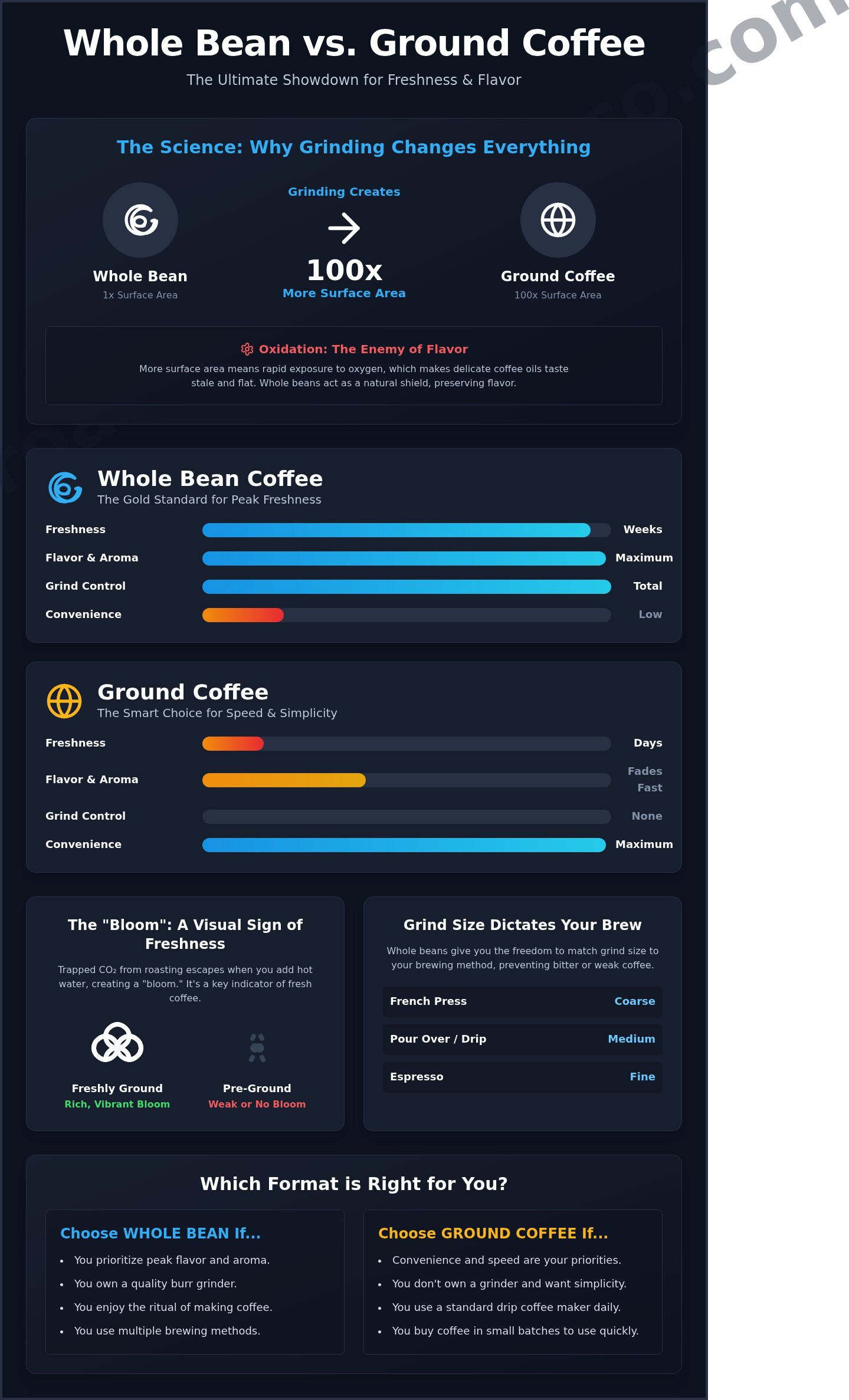
The "freshness window" is the most critical concept to understand. The moment a coffee bean is cracked or ground, its surface area increases exponentially. This exposes the delicate oils to oxygen, starting a chemical process called oxidation. Think of it like an apple. It stays fresh for a long time until you slice it. Once sliced, it begins to brown almost immediately. We ship our coffee within 24 hours of roasting to ensure that whether you choose whole or ground, you're starting with the freshest possible window.
What Is Whole Bean Coffee?
Whole beans are the gold standard for longevity. The outer structure of the bean acts as a natural seal, trapping the aromatics and CO2 that give coffee its vibrant character. When you keep the bean intact, you effectively pause the clock on flavor loss. This allows your coffee to stay peak-fresh for several weeks rather than just a few days. Beyond freshness, whole beans offer total customization. You can dial in the perfect grind size for a French press one day and a pour-over the next, ensuring your brew is never under-extracted or bitter.
What Is Pre-Ground Coffee?
Convenience is the primary reason most people choose pre-ground coffee. It removes a step from a busy morning routine and eliminates the need for expensive grinding equipment. However, consistency is the hidden benefit here. We use professional-grade industrial grinders at our roastery to ensure perfectly uniform particles. This level of precision is hard to replicate with a budget home blade grinder. For those just starting their how to make coffee journey, pre-ground options provide a reliable baseline for flavor. We grind our Ethiopia Limu Organic to order, so you still get the benefit of our small-batch quality even in a convenient format.
The Science of Freshness: Why Surface Area Matters
A single coffee bean is a vault. It protects the delicate chemical compounds and volatile oils that create the flavor you love. When you grind that bean, you break the vault into thousands of tiny particles. This increases the total surface area by approximately 100 times compared to the whole bean. Every one of those new surfaces is an "attack point" for oxygen. This physical change is the core reason the whole bean vs ground coffee choice matters so much for your morning brew. If you want to keep the flavor in, you have to keep the bean whole for as long as possible.
The Role of Oxidation in Flavor Loss
While we focus on the quality of the roast, having the right gear is just as important; for those looking to source professional equipment online, learn more about Happy Home Shopping Guyana for an expert guide to essential kitchen gadgets.
Oxygen is the primary enemy of coffee's complex flavor profile. It reacts with the lipids and oils inside the bean. These oils are fragile. When exposed to air, they begin to turn rancid, much like cooking oil left in a warm kitchen. You'll notice this first when the "bright" or fruity notes disappear. A coffee that was once vibrant and acidic becomes flat and dull. This happens much faster in ground coffee because the oxygen doesn't have to work its way through the bean's shell; it's already touching every part of the coffee. Keeping your coffee in whole bean form effectively seals those oils away from the air until the moment you're ready to brew.
Degassing and the Magic of the Bloom
When we roast our beans in Wyandotte, they fill with carbon dioxide. This gas acts as a natural preservative, pushing oxygen away from the bean's surface. It stays trapped inside whole beans for weeks. When you pour hot water over fresh grounds, the CO2 escapes rapidly, causing the coffee to bubble and rise. This is the "bloom." It's a visual indicator of freshness and quality. Pre-ground coffee rarely produces a satisfying bloom because most of that protective gas escapes within hours of grinding. Understanding the connection between artisan coffee and gas retention helps you see why we prioritize shipping within 24 hours of roasting. Without that gas, your coffee loses its sweetness and aromatic intensity.
Ground coffee also faces a moisture problem. Because it's so porous, it acts like a sponge for humidity and kitchen odors. If you store your grounds in a cabinet near pungent spices or in a damp environment, the coffee will absorb those external scents. This compromises the integrity of the roast profile. Whole beans have a much denser structure that resists these environmental factors. For many drinkers, the whole bean vs ground coffee trade-off comes down to how well they can protect their coffee from the air in their kitchen. If you aren't ready to invest in a home grinder, we offer custom grinding at our roastery to ensure you still get the most out of your Kenya AA Supreme or Ethiopia Limu Organic before the oxidation clock runs out.
Flavor, Convenience, and Cost: A Side-by-Side Comparison
Deciding between whole bean vs ground coffee often feels like a choice between quality and time. Many assume that whole beans are always more expensive, but for artisan roasts, the price per bag is usually identical. The real cost difference lies in the equipment. To get the most out of whole beans, you need a quality burr grinder. Brands like Rohnson offer a variety of household appliances that can help you achieve that professional grind at home. Blade grinders often produce uneven chunks that lead to a bitter cup, while a burr grinder ensures uniform extraction. If you aren't ready for that investment, buying small batches of professionally ground coffee is a smarter move than using a poor-quality grinder at home.
Storage is another factor where the formats diverge. Here in Wyandotte, Oklahoma, humidity can be a major hurdle for coffee integrity. Ground coffee has more surface area to absorb moisture from the air, which can lead to a musty flavor profile. Whole beans are more resilient, but both require an airtight container kept in a cool, dark place. Never store your coffee in the freezer; the condensation that forms when you take it out will damage the oils and ruin the roast.
The difference in flavor intensity is striking. Whole beans preserve the origin-specific nuances that define a high-quality roast. When you brew our Kenya AA Supreme as a whole bean, you'll taste the distinct, bright acidity and berry notes. In contrast, pre-ground coffee tends to have a more "mellow" or generic profile. As coffee ages, it crosses a "stale threshold" where it begins to lose its sweetness and develops a flat, cardboard-like taste. This usually happens within days for ground coffee, while whole beans can stay vibrant for weeks. If you want to test this yourself, our All Day Sampler is a great way to compare different origins and formats side-by-side.
Practicality and the Morning Rush
Convenience is a valid consideration. Grinding your own beans adds about 60 to 90 seconds to your morning routine. This includes measuring, grinding, and the occasional cleaning of the equipment. For busy households or early risers who don't want to wake the family with a loud grinder, pre-ground coffee is a logical choice. It allows for a simple scoop-and-brew workflow that is hard to beat when you're short on time. However, many find that the ritual of grinding becomes a favorite part of their day. It provides a sensory preview of the coffee through the intense aroma released during the grind. If you choose the ground format, we recommend buying only what you can finish in a week to stay ahead of the flavor loss.
Choosing the Right Format for Your Home Brewing Setup
Your brewing method is the ultimate filter for the whole bean vs ground coffee debate. Most standard drip machines are designed for the medium-fine grind found in generic grocery aisles. However, specialty brewers require specific textures to achieve proper extraction. Extraction is the process of water dissolving coffee solids into your cup. If the grind is too fine, the water takes too long to pass through, resulting in a bitter, over-extracted brew. Conversely, a grind that is too coarse for your machine will taste sour and weak.
For methods like the French Press or Cold Brew, a coarse grind is mandatory to prevent sediment from ruining the cup. Espresso is on the opposite end of the spectrum. It requires an ultra-fine, consistent powder that can withstand high pressure. Because espresso is so sensitive, using whole beans paired with a high-quality grinder is a non-negotiable requirement for a balanced shot. Manual pour-over methods also benefit from this precision, especially when brewing high-altitude beans like our Ethiopia Limu Organic, where subtle floral notes are easily lost if the grind isn't perfectly dialed in.
Matching Format to Brewing Method
Most pre-ground coffee sold in big-box stores is too fine for a French Press. This leads to "sludge" at the bottom of your beaker and a muddy flavor profile. Particle uniformity is the goal. When every bit of coffee is the same size, they all finish brewing at the same time. This is why we offer custom grinding at our roastery. We use industrial equipment to provide the exact texture your specific brewer needs, whether it's a coarse French Press or a medium-drip setting for your Morning Splendeur.
The Beginner's Equipment Roadmap
You don't need a $500 setup to enjoy artisan coffee. If you are just starting, it's better to stick with roaster-ground coffee than to use a cheap blade grinder. Blade grinders act like blenders, smashing beans into uneven shards that extract at different rates. A burr grinder is always the better investment because it crushes beans into uniform pieces. If you aren't ready to buy a burr grinder yet, our coffee subscription ensures you receive small, fresh batches ground specifically for your setup. This model allows you to enjoy the benefits of small-batch roasting without the immediate need for extra gear.
Ready to experience the difference that fresh roasting makes? Browse our full collection of small-batch artisan coffees and choose the format that fits your morning routine.
Why Roasted-to-Order Integrity Starts with the Right Choice
The entire whole bean vs ground coffee discussion changes when you remove the middleman. Most coffee drinkers are used to buying bags from a grocery shelf where the "Best By" date is the only guide. These beans often sit in distribution centers for months before they reach your kitchen. By the time you buy them, the oils have already begun to degrade. At The Roast Haus Coffee Co., we believe the fulfillment model is the ultimate differentiator. We roast every bag in small batches in Wyandotte, OK, and ship it within 24 hours. This speed ensures that the integrity of the bean is preserved, whether it's left whole or ground specifically for your brewer.
Our small-batch method allows for strict quality control that large corporations can't match. When you support an independent roastery, you're choosing a product handled by people who value the craft. We understand that not everyone is ready to manage a home grinder setup. That's why we offer custom grinding at the roastery. We use industrial-grade equipment to provide a level of particle precision that most home blade grinders simply can't achieve. This service bridges the gap for our customers, allowing them to enjoy the benefits of artisanal roasting with the convenience of a ready-to-brew format.
The 24-Hour Freshness Advantage
Our ground coffee beats grocery store "whole bean" options every time because of the timing. A bean that was roasted yesterday and ground today is objectively fresher than a whole bean that's been sitting in a plastic bag for six months. You should always prioritize the "Roasted On" date over a "Best By" date. The former tells you the actual age of the product, while the latter is often just a marketing estimate. By focusing on rapid fulfillment, we maintain high quality coffee beans throughout their journey from our roaster to your doorstep.
Find Your Perfect Balance
There's no wrong choice in the whole bean vs ground coffee debate if the beans are roasted to order. If you value the ritual and the peak aromatics of a fresh grind, choose our whole beans. If you need a reliable, high-quality cup during a busy morning rush, our ground options will serve you well. We're proud to be a personal venture that prioritizes your experience over mass-market efficiency. Your coffee journey is unique, and we're here to provide the expertise and the fresh roast to make it successful every morning. Shop our freshly roasted-to-order collections today and taste the difference that 24-hour fulfillment makes.
Take Control of Your Morning Cup
Choosing between whole bean vs ground coffee doesn't have to be a compromise between quality and convenience. You now understand that while whole beans offer the ultimate protection against flavor-stealing oxidation, a small-batch roast ground specifically for your brewer can still deliver a superior experience. The real secret to a better morning isn't just the format; it's the timing of the roast. By moving away from mass-produced grocery options and choosing artisan quality, you ensure that every cup is as vibrant as the day it was roasted.
At The Roast Haus Coffee Co., we take pride in our family-owned roastery in Wyandotte, OK. We use small-batch craftsmanship to maintain total quality control over every origin we sell. Our promise is simple: we roast your coffee to order and ship it within 24 hours. This relentless focus on freshness means you receive your Kenya AA Supreme or Ethiopia Limu Organic at its absolute peak. Experience the difference of roasted-to-order coffee today and discover how a dedicated craftsman can transform your daily ritual. You've done the research; now it's time to taste the results.
Frequently Asked Questions
Does whole bean coffee have more caffeine than ground coffee?
No, whole bean coffee does not contain more caffeine than ground coffee. Caffeine is a stable chemical compound that remains consistent throughout the roasting and grinding processes. The amount of caffeine in your cup is determined by the weight of the coffee used and the duration of the water contact during brewing. If you measure your coffee by weight rather than volume, the caffeine levels will be nearly identical for both formats.
How long does ground coffee stay fresh compared to whole bean?
Ground coffee reaches its peak flavor for only about 3 to 5 days after the bag is opened. In contrast, whole beans can maintain their vibrant aromatics and complex notes for 2 to 4 weeks if stored in an airtight container. This difference exists because grinding increases the surface area exposed to oxygen. We roast our Kenya AA Supreme to order to ensure you receive the freshest product possible for your morning routine.
Can I grind coffee beans without a grinder at home?
You can grind beans without a dedicated machine by using a blender, a mortar and pestle, or even a rolling pin and a heavy bag. However, these manual methods often produce inconsistent particle sizes that lead to poor extraction. This lack of uniformity results in a cup that tastes both bitter and sour at the same time. If you don't have a burr grinder, we recommend choosing our custom roastery grind to protect the flavor integrity.
Is it cheaper to buy whole bean or ground coffee?
For artisan selections like our Ethiopia Limu Organic, the price per bag is typically the same for both formats. The primary cost difference is the initial investment required for a high-quality burr grinder. While pre-ground coffee saves you money on equipment, buying whole beans can reduce waste over time. You won't have to throw away stale coffee because whole beans stay fresh much longer than pre-ground options do in your pantry.
Why does my home-ground coffee taste different than the roaster's ground version?
The difference in taste usually comes down to particle uniformity. We use professional industrial grinders at our roastery to produce perfectly even grounds for consistent extraction. Most budget home blade grinders act like blenders, creating a mix of fine dust and large chunks. This inconsistency causes the water to flow through the coffee unevenly. If your home-ground brew tastes muddy, it is likely a result of these mismatched particle sizes during the brewing process.
What is the best way to store whole bean coffee to keep it fresh?
The best storage method is an opaque, airtight container kept in a cool and dry location. Avoid clear jars because light can degrade the oils that give our Honduras Morning Splendeur its unique profile. Never store your beans in the refrigerator or freezer. The moisture and fluctuating temperatures inside those appliances cause condensation to form on the beans. This moisture destroys the delicate aromatics and ruins the roast integrity before you even begin brewing.
Should I buy whole bean coffee if I only have a standard drip machine?
Yes, you can use whole beans for a standard drip machine if you own a grinder that can reach a medium setting. Freshly grinding your beans right before you brew will always yield a more aromatic and flavorful cup. If you don't own a grinder yet, it is better to buy our professionally ground coffee. We ensure the grind size is perfectly calibrated for the drip extraction process so you get the best results every time.
Does the roast level affect how fast ground coffee goes stale?
Dark roasts generally go stale faster than light roasts once they are ground. The roasting process makes dark beans more porous and brings more natural oils to the surface. These oils are highly susceptible to oxidation as soon as they are exposed to the air. When comparing whole bean vs ground coffee in a dark roast, the flavor loss is more noticeable because those surface oils turn flat quickly without the protection of the bean's shell.

