


The darkest roast on the shelf isn't always the secret to a great drink. In fact, over-roasted beans are usually why your morning cup tastes like burnt charcoal instead of a balanced masterpiece. It's frustrating when your home-brewed cappuccino ends up tasting like a bowl of hot milk with no coffee character at all. You deserve a rich, velvety experience that holds its own against the froth.
Finding the best coffee beans for cappuccino requires more than just picking a bag labeled "espresso." You need beans with high soluble solids and peak CO2 levels to create that thick, stable crema that defines a cafe-quality drink. We believe in the integrity of the roast. Our small-batch craftsmanship highlights the natural oils and sugars of the bean without the bitter aftertaste often found in mass-produced coffee.
This guide explains how to choose beans that cut through milk with bold flavor. We'll explore why roast-to-order freshness is the ultimate differentiator for your crema. From the punchy acidity of our Kenya AA Supreme to the smooth, chocolatey finish of our Honduras Morning Splendeur, you'll gain the confidence to pick the perfect profile for your home barista setup.
Key Takeaways
- Identify the specific "milk-cutting" flavor profiles that prevent your espresso from tasting like hot milk when mixed with foam.
- Learn why the best coffee beans for cappuccino must be roasted-to-order to provide the CO2 levels necessary for a thick, lasting crema.
- Compare single-origin beans and blends to find the right balance of bold acidity or chocolatey sweetness for your morning cup.
- Discover the ideal 3-to-14-day freshness window and the 1:2 brewing ratio used by professionals to achieve a balanced flavor.
- Pick the right roast for your palate, whether you prefer the vibrant pop of Kenya AA Supreme or the caramel notes of Honduras Morning Splendeur.
What Makes a Coffee Bean "Best" for Cappuccino?
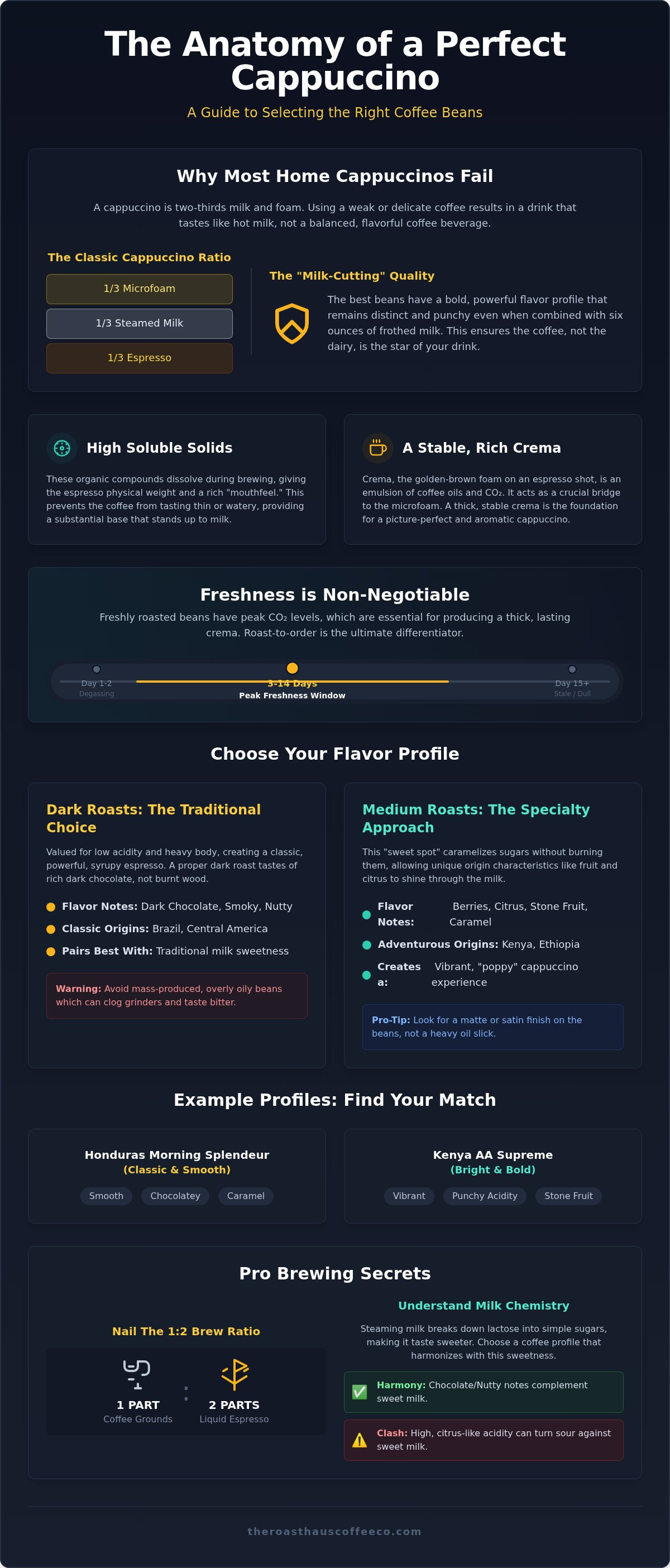
A classic cappuccino is a precise balance of one-third espresso, one-third steamed milk, and one-third foam. Because milk and foam make up the majority of the beverage, the espresso base must be exceptionally powerful. If you use a delicate or light-bodied bean, the coffee flavor will simply vanish under the weight of the dairy. The best coffee beans for cappuccino are those that possess a "milk-cutting" quality. This refers to a bean's ability to maintain its distinct character and punchy flavor even after being diluted by six ounces of frothed milk.
Achieving this balance requires beans with high soluble solids. These are the organic compounds that dissolve into the water during the brewing process. They provide the physical weight and "mouthfeel" that prevents the coffee from feeling thin or watery. We find that specific origins and roast profiles produce more of these solids, ensuring the coffee notes remain the star of the show. It is also a common mistake to assume "Espresso" is a specific type of bean. In reality, an espresso roast is just a roasting profile designed for easy extraction and bold flavor. You can use any bean for a cappuccino, but you must choose a profile that prioritizes body over subtle, floral notes.
The Synergy Between Milk and Coffee
Milk is a chemical partner to your coffee, not just a filler. Milk fats coat your tongue, which can dull your perception of flavor. To counter this, the coffee needs enough intensity to "clean" the palate with every sip. When you steam milk to the ideal temperature, the heat breaks down long-chain carbohydrates into simple sugars like lactose. This process makes the milk taste naturally sweeter. Light roasts often have high, citrus-like acidity that turns unpleasantly sour when it hits these sweet milk sugars. Medium-dark or dark roasts provide the chocolatey or nutty notes that harmonize with lactose rather than fighting it.
Crema: The Foundation of the Foam
The crema is the golden-brown layer on top of a fresh espresso shot. It acts as a vital bridge between the liquid coffee and the microfoam. The relationship between bean oils and foam stability is delicate. If a bean is too oily or too old, the crema will be thin and the foam will collapse into the liquid. Crema is the emulsified oils and CO2 that provide the cappuccino’s initial aromatic punch. Without a stable crema foundation, the layers of the drink will bleed together. Our roast-to-order model ensures these gases are at their peak, providing the structural integrity needed for a professional-grade pour at home.
Roast Levels and Origin Profiles for Milk Drinks
The heat of the roaster defines the final character of your cup. When you search for the best coffee beans for cappuccino, you'll likely see a debate between traditional dark roasts and modern medium profiles. Darker roasts are the historical standard. They provide the carbonized, smoky notes that many people associate with a classic Italian cafe. However, we prefer a medium-dark "sweet spot." This roast level allows the sugars within the bean to caramelize fully without crossing over into a burnt or ashy territory. It creates a bold foundation that doesn't just sit in the milk, but actively complements it.
Origin profiles act as the flavor foundation for your drink. Brazilian and Central American beans are industry classics for a reason. They naturally lean toward profiles of toasted nuts, cocoa, and brown sugar. These flavors harmonize beautifully with the lactose in steamed milk. If you want a more adventurous experience, African beans like our Kenya AA Supreme offer a "Bright and Bold" alternative. The high acidity and stone fruit notes of Kenyan coffee provide a modern twist. Instead of a heavy, chocolatey drink, you get a vibrant cappuccino where the coffee "pops" through the dairy fats. The Freshness Factor in these beans is vital, as the delicate acids in African origins degrade quickly if the beans aren't roasted to order.
Dark Roasts: The Traditional Choice
Traditional dark roasts are prized for their low acidity and heavy body. They produce a thick, syrupy espresso that feels substantial on the tongue. You must be careful with mass-produced "French" or "Italian" roasts, though. These often feature oily beans that can clog home grinders and leave a bitter, charred aftertaste. A well-executed dark roast should have a matte or slightly satin finish. It should taste like rich dark chocolate rather than burnt wood. This heavy body ensures the coffee remains the dominant flavor even in a larger eight-ounce pour.
Medium Roasts: The Specialty Approach
Using high quality coffee beans at a medium roast allows the unique origin characteristics to shine. You might taste hints of red berries or citrus that are usually lost in darker roasts. To prevent these beans from getting lost in the milk, you should pull a slightly tighter espresso shot. This concentrates the flavors and ensures the acidity doesn't turn sour when mixed with foam. Our Honduras Morning Splendeur is an excellent example of this balance. It offers a smooth, caramel-forward profile that feels like a decadent treat. You can explore our artisan roasts to see how small-batch consistency changes your morning ritual.
The Freshness Factor: Why Roasted-to-Order Wins
Freshness is the most overlooked variable in home brewing. Many people buy beans from big-box retailers or massive online marketplaces where the product has sat in a warehouse for months. By the time those beans reach your hopper, they are chemically "dead." To get the best coffee beans for cappuccino, you must look at the roast date, not the expiration date. Industrial-scale production prioritizes shelf life over flavor, but a cappuccino requires the volatile aromatics that only exist in recently roasted coffee.
Coffee beans go through a "degassing" window immediately after roasting. During the first 48 hours, the beans release too much carbon dioxide, which can make the espresso taste metallic or overly bubbly. The sweet spot for flavor and performance is between day 3 and day 14. After two weeks, the essential oils begin to oxidize and the CO2 levels drop. When you use stale beans, you get a thin, watery espresso that lacks the structural integrity to stand up to steamed milk. A molecular view of milk and coffee shows that while milk proteins are resilient, they will easily overwhelm the muted flavors of old coffee.
CO2 and Crema Stability
Crema isn't just for looks. It is a foam of emulsified oils and trapped CO2 that carries the coffee's intense aroma. This gas is what provides the resistance needed during the extraction process to create a thick, syrupy shot. Choosing roasted to order coffee is the only way to guarantee these gas levels are high enough to support your cappuccino's microfoam. You can spot stale beans by their appearance; they often look dull or greyish. Fresh beans have a vibrant, healthy sheen and produce a vigorous bloom when they first hit hot water.
The Artisan Roastery Advantage
We take a different approach in our family-owned roastery in Wyandotte, Oklahoma. Instead of roasting thousands of pounds at once, we focus on small-batch consistency. This allows us to maintain precise temperature control, ensuring each bean is developed perfectly to its specific profile. We ship every order within 24 hours of roasting. This ensures that when the package arrives at your door, the beans are entering their peak flavor window. Supporting an independent business means you get a product handled with craftsmanship, not just a commodity that's been sitting on a pallet. This dedication to timing is what makes the best coffee beans for cappuccino truly stand out in your morning ritual.
Top Roast Haus Picks for the Perfect Cappuccino
Selecting the best coffee beans for cappuccino is a personal journey. Some drinkers want a bold, aggressive cup that demands attention, while others prefer a dessert-like experience where the coffee and milk melt together. We roast our beans in small batches in Wyandotte, Oklahoma, to ensure these specific flavor profiles are preserved. Because we ship within 24 hours of roasting, you receive the beans at the absolute peak of their flavor potential, ensuring the best coffee beans for cappuccino perform exactly as they should in your machine.
Kenya AA Supreme: The Milk-Cutter
This is our most popular choice for those who want their coffee to "pop" through the dairy. Kenya AA Supreme possesses a deep, winey acidity that provides a sharp contrast to the heavy, creamy texture of microfoam. It has a rich body that ensures the espresso remains the star of the show. You'll notice distinct tasting notes of blackcurrant and grapefruit. When you add steamed milk, these sharp fruit notes transform into a delightful "berries and cream" flavor profile. It's a sophisticated choice for a morning ritual that refuses to be muted.
Honduras Morning Splendeur: The Balanced Classic
Baristas looking for something more adventurous should try our Ethiopia Limu Organic. It offers floral and wine-like notes that are rare in milk-based drinks. It's a complex profile that requires a skilled hand, but the reward is a highly aromatic cappuccino. For late-night cravings, our Decaf Swiss Water Process is a chemical-free way to enjoy a rich cup without the jitters. It retains the full body and integrity of a standard roast, ensuring your evening drink doesn't feel like a compromise. You can shop our full collection of small-batch roasts to find your perfect match today.
Brewing Tips: From Bean to Frothy Perfection
Even the best coffee beans for cappuccino can't save a poorly extracted shot. You've selected your roast-to-order beans from Wyandotte, but now you must respect the chemistry of the brew. Precision is the difference between a muddy cup and a masterpiece. Every variable, from the temperature of your water to the pressure of your tamp, dictates whether those artisan flavors actually make it into your cup. Don't let high-quality beans go to waste by rushing the process.
Your choice of coffee grinders is the most important decision in your kitchen. A consistent grind ensures that water flows evenly through the puck. Because we focus on small-batch consistency in our roasting, our beans provide a predictable density. This makes it easier for you to find the perfect setting without wasting half a bag on trial and error. If the grind is too coarse, the water rushes through, leaving you with a sour, thin liquid that disappears in the milk. If it's too fine, the shot will be bitter and over-extracted.
We recommend a 1:2 brewing ratio for the espresso base. If you start with 15 grams of ground coffee, aim for 30 grams (roughly 30ml) of liquid espresso. This concentration provides the "milk-cutting" strength necessary for a balanced drink. It ensures the bold notes of our Kenya AA Supreme remain distinct even after you add four ounces of frothed milk. Using a scale is the only way to guarantee this level of accuracy every morning.
Dialing in Your Espresso
Adjust your grind based on the specific roast level you're using. Lighter roasts, like our Ethiopia Limu Organic, usually require a slightly finer grind to extract their complex sugars properly. A level tamp is essential to prevent "channeling," where water finds a path of least resistance and leaves half the coffee unbrewed. Use a firm, even pressure to create a flat surface. Time your shot to fall between 25-30 seconds for optimal balance.
The Milk Component
Whole milk is the gold standard for cappuccino foam because its fat content creates the most stable microfoam. If you prefer plant-based options, Oat and Soy milks pair best with our artisan beans due to their creamy textures and ability to hold a structure. Avoid "big bubbles" by keeping the steam wand just below the surface during the initial "stretching" phase, then submerging it to create a vortex. Aim for a final temperature of 150°F (65°C) to preserve the natural sweetness of the lactose. Pour with a steady hand to integrate the microfoam into the espresso for a silky, professional texture.
Master the Art of the Home Cappuccino
Creating a cafe-quality cappuccino at home isn't about luck; it's about the integrity of your ingredients and the precision of your technique. You now understand that the best coffee beans for cappuccino must have the strength to cut through milk and the freshness to produce a thick, stable crema. Whether you prefer the bold, winey notes of a Kenyan origin or the smooth, chocolatey finish of a Honduran roast, your choice defines the character of your morning cup.
We are a family-owned operation in Wyandotte, Oklahoma, dedicated to the craft of small-batch roasting. Our roasted-to-order model ensures that your beans ship within 24 hours of leaving the roaster, preserving the peak CO2 levels required for a perfect extraction. Don't settle for stale, warehouse coffee that disappears in the froth. You have the tools and the knowledge to brew something exceptional every single day.
Take the next step in your barista journey. Shop Our Freshly Roasted Coffee Beans and experience the difference that artisan quality makes.
Frequently Asked Questions
What is the best roast level for a cappuccino?
A medium-dark roast is the ideal choice for this drink. It provides enough body and caramelization to stand up to the milk without the burnt aftertaste of an oily dark roast. When searching for the best coffee beans for cappuccino, look for profiles that preserve the bean's character while providing chocolatey notes. This roast level ensures your espresso base is strong enough to remain the star of the beverage.
Can I use regular coffee beans for cappuccino?
You can use any bean, but the results depend on the roast profile. Drip coffee beans are often roasted lighter, which can taste sour when mixed with milk. For a balanced cup, choose beans specifically roasted for espresso extraction. These have the necessary soluble solids to provide a heavy mouthfeel. This ensures your coffee doesn't disappear once you add the foam and steamed dairy to the cup.
Why does my cappuccino taste too milky?
A milky taste usually indicates a weak extraction or a bean that lacks acidity. If your espresso is too thin, the dairy fats will overwhelm the coffee notes. Using the best coffee beans for cappuccino, such as our Kenya AA Supreme, provides a bold profile that stays prominent. Also, ensure you are pulling a 1:2 ratio shot to keep the flavor concentrated and avoid over-dilution.
Is Arabica or Robusta better for cappuccino?
100% Arabica is the superior choice for a specialty experience. While some commercial blends add Robusta for cheap crema and extra caffeine, it often brings a harsh, rubbery flavor. High-altitude Arabica beans, like our Ethiopia Limu Organic, offer the sweetness and complex acidity needed to create a sophisticated, well-rounded drink. It results in a cappuccino that doesn't just taste like caffeine and hot milk.
Does freshness really matter if I am adding milk?
Freshness is critical because it dictates the quality of your crema. Crema is made of emulsified oils and CO2, which only exist in abundance in recently roasted coffee. If your beans are stale, the crema will be thin and the foam will collapse. We roast in small batches in Oklahoma and ship within 24 hours to ensure your beans are at their peak for brewing.
How many espresso shots go into a standard cappuccino?
A traditional 5 to 6 ounce cappuccino uses a standard double shot of espresso, which is about 2 ounces of liquid. This follows the classic Italian ratio of equal parts coffee, milk, and foam. If you are using a larger mug, you may need to pull a second double shot. This prevents the drink from tasting like a latte and maintains the proper flavor balance.
What is the best way to store beans for freshness?
Store your beans in a cool, dry, and dark place using an airtight container. Exposure to oxygen, light, and moisture is the fastest way to turn your artisan coffee stale. Don't use the refrigerator, as coffee beans are porous and will absorb food odors easily. Our bags feature one-way degassing valves, which are designed to let gas out while preventing air from entering the bag.
Can I make a good cappuccino with decaf beans?
You can definitely enjoy a high-quality decaf cappuccino. Our Decaf Swiss Water Process beans are processed without chemicals, preserving the organic flavor compounds and heavy body of the original bean. You'll still get a thick crema and a rich, satisfying taste that pairs perfectly with microfoam. It is the ideal option for a late-night treat without the caffeine jitters or a bitter aftertaste.

